
August 18, 2023 - PBS NewsHour full episode
8/18/2023 | 56m 45sVideo has Closed Captions
August 18, 2023 - PBS NewsHour full episode
August 18, 2023 - PBS NewsHour full episode
Problems playing video? | Closed Captioning Feedback
Problems playing video? | Closed Captioning Feedback
Major corporate funding for the PBS News Hour is provided by BDO, BNSF, Consumer Cellular, American Cruise Lines, and Raymond James. Funding for the PBS NewsHour Weekend is provided by...
August 18, 2023 - PBS NewsHour full episode
8/18/2023 | 56m 45sVideo has Closed Captions
August 18, 2023 - PBS NewsHour full episode
Problems playing video? | Closed Captioning Feedback
Where to Watch PBS News Hour
PBS News Hour is available to stream on pbs.org and the PBS app.
Providing Support for PBS.org
Learn Moreabout PBS online sponsorshipGEOFF BENNETT: Good evening.
I'm Geoff Bennett.
Amna Nawaz is away.
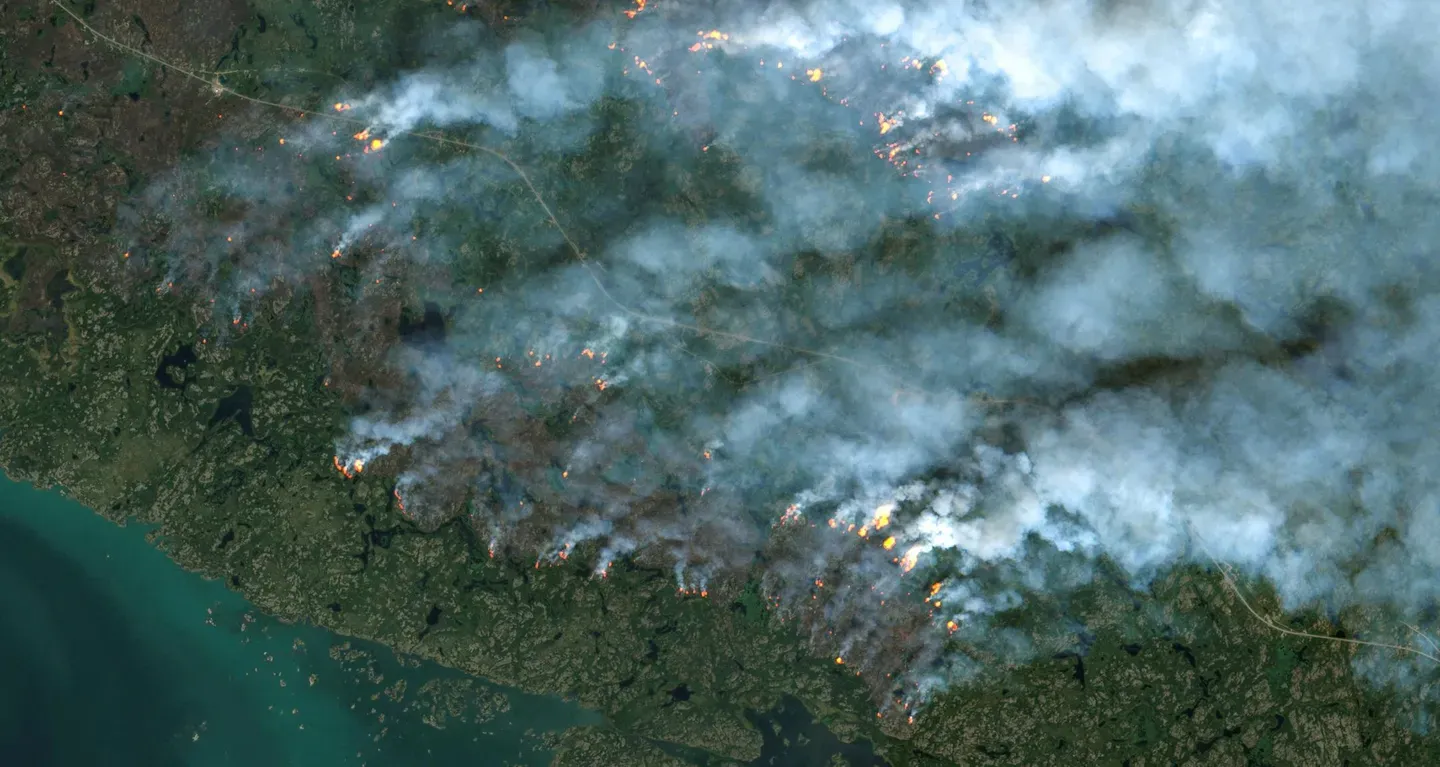
On the "NewsHour" tonight: Vast areas of Canada burn, while Maui continues its recovery from wildfires, as the official responsible for not activating alert sirens resigns.
President Biden meets with leaders of Japan and South Korea to shore up alliances amid increasing instability in the Pacific.
And Israel's minister for strategic affairs discusses the tumultuous politics at home and his country's potential diplomatic deal with Saudi Arabia.
RON DERMER, Israeli Minister for Strategic Affairs: Let's not underestimate the impact an Israeli-Saudi can have on the region and the world.
It would effectively be at least the beginning of the Arab-Israeli conflict.
(BREAK) GEOFF BENNETT: Good evening, and welcome to the "NewsHour."
The impact of wildfires is being felt on two fronts tonight.
On Maui, residents are trying to rebuild their lives days after fire scorched parts of the island as they are mourn the many lives lost.
But for one city in Canada's Northwest Territories, the fire danger is only just beginning.
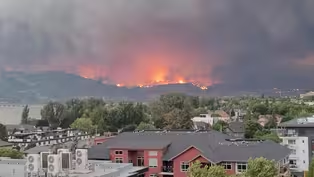
Traffic lined the only highway out of Yellowknife today, while other residents packed airports amid urgent orders to evacuate.
TEBBIA TEONCEY, Yellowknife Resident: I have never seen anything like it.
And I have never heard anyone speculate that, in my lifetime, something like this would happen.
GEOFF BENNETT: It's a race against time.
A wildfire rages just a few miles north of Yellowknife, the capital of Canada's Northwest Territories, and home to some 20,000 people.
Forecasters say strong winds could push the flames into the city by the weekend.
This year has been the worst wildfire season in Canada's history.
More than 51,000 square miles have burned so far.
That's far more than the country's average wildfire season, which typically scorches 9,000 square miles.
The wildfire danger also extends to British Columbia as a heat wave is bringing sweltering temperatures.
CLIFF CHAPMAN, Director of Wildfire Operations, British Columbia: This weather event has the potential to be the most challenging 24 to 48 hours of the summer from a fire perspective.
We are expecting significant growth and we are expecting our resources to be challenged.
GEOFF BENNETT: Meantime, on Maui, local authorities are facing scrutiny after last week's wildfire wiped away the entire town of Lahaina, seemingly without warning.
QUESTION: Do you regret not sounding the sirens?
HERMAN ANDAYA, Former Administrator, Maui Emergency Management Agency: I do not.
The sirens, as I mentioned earlier, is used primarily for tsunamis.
And that's the reason why.
GEOFF BENNETT: Maui's emergency services chief, who defended his decision to not sound outdoor alert sirens as the fire raged, resigned overnight, citing health reasons.
That is as relief efforts continue.
Those whose homes were spared are banding together to help in any way they can.
CORRINE NOBRIGA, Lahaina Resident: It's a touchy situation right now, because for us, as a community, of course, we're happy that we have our homes, but our heart aches, because that's our other neighbors and our families.
GEOFF BENNETT: The search for victims continues, with more than 1,000 people still missing as of this morning.
President Biden is scheduled to visit the island on Monday.
In today's other headlines: A Category 4 hurricane brewing over the Pacific Ocean could weaken and become the first tropical storm to reach Southern California in 84 years.
It's currently located off Mexico's western coast, packing sustained winds of 130 miles per hour.
Forecasters expect it to weaken by the time it hits Southern California on Sunday.
It could bring heavy rain and flash floods to the state and other parts of the Southwest.
Parts of the Spanish island of Tenerife are engulfed in flames and thick smoke tonight.
It's the worst wildfire the area has seen in decades, burning through the wooded hillsides that make it a major tourist destination in the Canary Islands.
As firefighters raced to contain the blaze, nearly 8,000 people in the affected regions were left fearing for their homes.
VANESA HERNANDEZ, Tenerife Resident (through translator): Our lives are left their.
Human lives are more important, obviously, but it could have been avoided.
And we believe that not enough has been done to prevent it from getting here.
That is the sorrow we have.
It's not the material.
No, it's our life.
It's our roots, the work of our relatives, of our parents.
GEOFF BENNETT: The Canary Islands, like much of mainland Spain, had been suffering through droughts for the past few years.
The hot and arid conditions have caused the fire to spread rapidly.
Russian air defenses said they shot down another Ukrainian drone over Moscow.
Some of the fragments crashed into an exhibition center a few miles from the Kremlin.
There were no casualties.
Meantime, the U.S. gave its approval for the Netherlands and Denmark to deliver F-16 fighter jets to Ukraine.
It's unclear when they will enter the conflict, but it could take as long as a year to train the pilots.
And stocks were mixed today on Wall Street.
The Dow Jones industrial average gained 26 points to close at 34500.
The Nasdaq fell 26 points.
The S&P 500 lost a fraction of a point.
And former first lady Rosalynn Carter celebrated her 96th birthday today at home in Plains, Georgia.
The Carter Center said the festivities included cupcakes, peanut butter ice cream and releasing butterflies in her garden.
Mrs. Carter is the second oldest presidential spouse in U.S. history.
She has been diagnosed with dementia, while former President Jimmy Carter continues to receive hospice care.
They're the longest-married first couple to date.
Happy birthday to her.
And still to come on the "NewsHour": we look at the rising threats against judges, juries and election workers; David Brooks and Ruth Marcus weigh in on the week's political headlines; and comedian Atsuko Okatsuka talks about her journey to the stage and her first special.
President Biden met today with the leaders of Japan and South Korea at Camp David, the presidential retreat.
Japan and South Korea have long had antagonistic relations but, today's meeting is a new starting point for the two countries.
They released the Camp David Principles, in which they promised to consult with one another if either felt their security was threatened.
They also committed to improving military coordination by sharing real-time information about North Korean ballistic missile launches.
Along with the U.S., they will expand trilateral military exercises and establish a three-way hot line for crisis communication.
President Biden said today's agreements would have long-lasting effects.
JOE BIDEN, President of the United States: This is a historic meeting.
But we're about to -- we have laid in place a long-term structure for a relationship that will last and have a phenomenal impact, not just in Asia, but around the world.
This is a big deal.
This is a big deal.
GEOFF BENNETT: A big deal, he says.
Well, just how significant are the new agreements?
Mike Mochizuki is a professor at the Elliott School of International Affairs at the George Washington University.
He focuses on Japan and security in Asia.
Welcome back to the "NewsHour."
It's good to have you here.
MIKE MOCHIZUKI, George Washington University: Thank you for having me on the program.
GEOFF BENNETT: So, these agreements on joint military and technology initiatives come against the backdrop of Beijing's growing power.
In your view, what impact will this have?
MIKE MOCHIZUKI: Well, first of all, I think what it does is, it enhances deterrence and coordination among the United States, Japan and South Korea to counter the aggressive behavior by China.
But there could also be a negative consequence of the Camp David summit, and that is that it could intensify the confrontation or divide between the United States, Japan and South Korea on the one hand and China, North Korea and Russia on the other hand.
And as a result of the Camp David meeting, the other trilateral could respond in ways that could actually undermine the security of Japan and South Korea.
GEOFF BENNETT: Well, one imagines that the annual joint military exercises between Japan and South Korea would most anger the Chinese government.
Of course, China just finished its own exercises with Russia.
How might China respond to that?
MIKE MOCHIZUKI: OK, well, what China will do is most likely engage in gray zone behavior, engage in more military exercises in Japan - - Japan's neighborhood with Russia, and will be less of a constraining force on North Korea in terms of the development of its nuclear weapons program.
And the real concern, I think, for Japan and South Korea is that this could lead to a real divide in Asia between those countries that seem to be much more dependent upon China and the countries in Asia that are aligned with the United States.
GEOFF BENNETT: What might this mean for Taiwan?
Because the three countries have an interest in the Taiwan Strait and the East China Sea.
MIKE MOCHIZUKI: Yes.
Well, certainly, the Camp David statement talked about the importance of peace and stability in the Taiwan Strait.
And this is something that the leaders of Japan and the United States and South Korea and the United States have already said in other joint statements.
But I think the real concern is that there might not be any kind of restraining factor in terms of the intensification of tensions across the Taiwan Strait.
And I sense that, in both Japan and South Korea, there's a feeling that the United States may be overreacting to some of the provocations by China, and, in so doing, might be exacerbating the tensions and ultimately increasing the danger of military conflict over the Taiwan Strait.
So, both Seoul and Tokyo would be very much interested in having the United States engage in a serious dialogue with China in order to stabilize relations with China and try to defuse tensions across the Taiwan Strait.
GEOFF BENNETT: This summit has been a real shot in the arm for American diplomacy in Asia, because the troubled relationship between South Korea and Japan has long been this sort of like weak link in Washington's efforts in the Indo-Pacific.
Why was the moment right now to bring this together?
And how was the Biden administration able to do it?
MIKE MOCHIZUKI: Well, I think, the major credit has to go to President Yoon.
Japan and South Korea had been locked in tensions regarding the wartime forced labor issue.
Japan insisted that the forced labor issue had been resolved in the 1965 normalization process.
In the end, President Yoon made the bold decision to basically make a dramatic concession to Japan, and have the South Koreans pay for the compensation for victims of forced labor.
Now, unfortunately, this has not been a popular decision in South Korea.
Sixty percent of the South Korean public oppose the decision by President Yoon.
So I think what President Yoon has been trying to do is to move very rapidly to improve security relations with Japan, as well as the United States, to lock in these gains, so that they will survive even after his presidential term ends in 2027.
And President Biden has seized this opportunity, this historic opportunity, to move the ball forward by inviting both Prime Minister Kishida and President Yoon to Camp David.
GEOFF BENNETT: Mike Mochizuki, thank you for your insights this evening.
We appreciate it.
MIKE MOCHIZUKI: Thank you.
GEOFF BENNETT: A top-level Israeli delegation is here in Washington this week to discuss the broad outlines of a once-unthinkable agreement between Israel and the kingdom of Saudi Arabia to normalize diplomatic relations.
Nick Schifrin explains.
NICK SCHIFRIN: (AUDIO GAP) several agreements shepherded by the Trump administration between Israel and its former adversaries comes now the prospect of the biggest prize, but at what price Israel, the United States and Saudi Arabia?
At the same time, unprecedented civil upheaval grips Israel, as Benjamin Netanyahu's government looks to restrain the country's Supreme Court in what his critics say could destroy the nature of Israeli democracy.
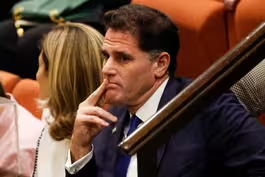
With me now to discuss this and more is the Israeli minister of strategic affairs, Ron Dermer.
Ambassador Dermer, thanks very much.
Welcome to the "NewsHour."
As I said, among the topics that you are here in Washington to discuss is the possible normalization between Israel and Saudi Arabia, which U.S. officials tell me they are prioritizing, hoping... RON DERMER, Israeli Minister for Strategic Affairs: Correct.
NICK SCHIFRIN: ... in the next year.
And part of that would be allowing Saudi Arabia to have civil nuclear capacity, including enrichment.
Does the Israeli government support that?
RON DERMER: Like so many things, the devil is in the details, and we're going to have to look at what ultimately is agreed upon.
And you're right.
The Saudis have put that, a civilian nuclear program, which you probably are aware of, they -- as the signatories of the NPT, they could go to China or they can go to France tomorrow, and they could set up -- ask them to set up a civil nuclear program and to allow for domestic enrichment.
They could do that tomorrow if they wanted to.
So the question that I asked myself is, if the U.S. is involved in this, what will that mean 10 years down the road, 20 years down the road, 30 years down the road, and what's the alternative?
There are other issues the Saudis have put forward.
(CROSSTALK) NICK SCHIFRIN: Sure.
Sure.
And -- but it sounds like you're not against it, certainly.
And that is not necessarily the policy of the Israeli government over the last few decades.
There's been a long tradition opposing nuclear expansion in the region.
It used to be known as the Begin Doctrine, after Menachem Begin, of course, former prime minister, founder of Likud Party, who, of course, Prime Minister Benjamin Netanyahu is a member of.
Begin bombed an Iraqi nuclear reactor to prove his doctrine.
RON DERMER: Right.
NICK SCHIFRIN: Does this Israeli government believe the Begin Doctrine no longer applies?
RON DERMER: No, the Begin Doctrine definitely applies.
You have countries in the region that can have civilian nuclear power.
That's a different story than a nuclear weapons program.
NICK SCHIFRIN: You're also, of course, asking for something.
The prime minister's former national security adviser Meir Ben-Shabbat said this: "Saudi Arabia joining the nuclear club would produce a widening of nuclear proliferation in the region.
Other countries would work to acquire uranium enrichment capabilities in their own territory."
So what does Israel want in exchange for that?
RON DERMER: We're not going to agree to any nuclear weapons program with any of our neighbors.
And the question will be, when it comes to the details of an agreement, what are the safeguards?
And what happens if they take another path, if they take a path with the Chinese or something else?
We have to think through that whole thing.
But let's not underestimate the impact that an Israeli-Saudi peace agreement could have on the region and the world.
I think, if Saudi -- if you get a Saudi-Israeli peace, you're going to have several other Arab countries, and Muslim countries are going to follow.
And I think it's the ultimate game-changer.
(CROSSTALK) NICK SCHIFRIN: But we also have to deal with the Palestinians.
Of course, Saudi Arabia will demand significant concessions from Israel when it comes to the Palestinians.
Let me give you some options, ending illegal settlement activity, curbing especially large settlements, strengthening the Palestinian Authority, and expanding the territory under its jurisdiction.
Are you willing to give any or all of that to the Saudis... (CROSSTALK) RON DERMER: Well, this may surprise you, but I'm actually not going to negotiate on PBS.
What we will do -- I will say the way, we look at this issue, it's not just this is that -- this or that price for Israel.
We would like to ultimately achieve a peace agreement with our Palestinian neighbors.
NICK SCHIFRIN: Saudis are making clear there's no peace with Saudi Arabia until there are these concessions for the Palestinians.
Are you willing to... (CROSSTALK) RON DERMER: Well, I don't think -- I don't think they have been specific about what concessions.
I think... NICK SCHIFRIN: They haven't, which is why I gave you some options.
RON DERMER: And I think -- and I think what Saudi Arabia looks at this move with the United States as something that will anchor their alliances with America for a half-century.
And I think we both have an interest in seeing if we can get the Palestinians on a path which can ultimately lead to a political settlement of the conflict.
NICK SCHIFRIN: Let's talk about judicial reform.
These are efforts the prime minister describes as reforms to Israel's -- quote -- "all-powerful judiciary."
RON DERMER: Right.
NICK SCHIFRIN: You represent the government coalition that's negotiating with the opposition in the president's house in Israel.
In the United States, as you know well, if the House of Representatives by a small majority wants to abuse the rights of the minority, it would pass a law that goes through the House, through the Senate, signed by the president of the United States, goes through the federal court system, the Supreme Court, as guaranteed by the Constitution.
In Israel, if the Knesset, if the Parliament wants to impose its majority on the minority, there's only one check, the Israeli Supreme Court.
Why are you trying to remove that check?
RON DERMER: Well, we're not trying to move the check.
I think there's been a lot of misreporting on that.
There are many checks that the Supreme Court has on the authority of the executive branch and even on the Knesset.
When a law is passed, they can decide whether the laws is -- there's a conflict of interest, whether there was due process, whether it's proportionate, all these other checks.
But there was an extra check that you don't have in your system here, which is, the judges could decide, we don't believe this is reasonable.
In Israel, you cannot replace the will of the public, elected through their elected representatives, with 50 non-elected judges to decide that this is reasonable or unreasonable.
NICK SCHIFRIN: Since you have been pushing this through, there's obviously been massive, unprecedented protests across the country.
The shekel has lost value.
Private capital inflows are down.
Israel start-ups are registering abroad.
Moody's, S&P have warned about investing in Israel.
And, of course, the military in Israel have repeatedly warned there is a crisis of readiness because of the fissures that your reforms have created in society and because reservists are now threatening not to show up.
So is that not a failure of leadership by Prime Minister Netanyahu?
RON DERMER: No, I don't think so.
I think, unfortunately, some of these protesters have crossed lines that should never be crossed.
We're a citizens army in Israel.
The army should have never been brought into it.
And I... NICK SCHIFRIN: Wait a minute.
Wait.
Are you criticizing individual members for protesting at all?
Is that what... (CROSSTALK) RON DERMER: I don't -- no, of course not.
The protest is a fundamental right in every democracy.
What I don't think you should do, military reservists should not come to an elected government and say, if you don't adopt this or that policy, we're not going to serve democracy.
NICK SCHIFRIN: But you have Israeli military leaders warning the prime minister that this is a readiness issue.
That's more than just the question of individual reservists.
(CROSSTALK) RON DERMER: Because the military reservists have decided that they're going to dictate the policy.
(CROSSTALK) NICK SCHIFRIN: And the leader -- and the military leaders have said there's a significant risk to this.
RON DERMER: But the people who make decisions in a democracy are not military reservists or military officials.
It's the elected branch of government.
And it's the -- that's Israel's democratic leaders that have to make that decision.
NICK SCHIFRIN: And for the first time in its history, next month, the entire 15-judge Israeli Supreme Court will hear an appeal against the law that curbs its own powers.
Will you respect their decision?
RON DERMER: Israel is a country of the rule of law.
So we will always abide by law.
But it's important to understand... NICK SCHIFRIN: Is that a yes?
RON DERMER: It's important to understand that the judges cannot be above the law.
What's the authority?
What's the authority that gives the power of the Supreme Court to decide to nullify a basic law?
It's never happened in Israel's history.
NICK SCHIFRIN: That's correct.
It's never happened.
It's also never happened that the Supreme Court has to hear a case about curbing its own power.
So, again, will you abide by the court?
RON DERMER: Right.
I don't -- and... (CROSSTALK) NICK SCHIFRIN: Will you abide by the court ruling?
RON DERMER: The prime minister put out two principles.
He said the government should always respect decisions of the Supreme Court, and the Supreme Court should never be above the law.
NICK SCHIFRIN: Ambassador Ron Dermer, thank you very much.
RON DERMER: Thank you.
GEOFF BENNETT: After Georgia officials announced the fourth indictment of former President Donald Trump, threats of violence escalated.
White House correspondent Laura Barron-Lopez has more on the alarming trend and its impact on civil servants.
LAURA BARRON-LOPEZ: First, it was Ruby Freeman, a Fulton County election worker targeted and smeared by Trump and his allies in the aftermath of the 2020 election.
The Georgia indictment details how members of the enterprise traveled from out of state to harass Freeman, intimidate her and solicit her to falsely confess to election crimes that she did not commit.
And, last week, a racist death threat against the judge presiding over the federal January 6 case led to an arrest.
It's a familiar pattern.
Trump posts vitriolic attacks and conspiracies.
Then his most ardent followers stock or threatened the targets of those attacks.
Tammy Patrick knows the stakes well.
She's a former election worker in Maricopa County and now the CEO of programs at the National Association for Election Officials.
Tammy, thanks so much for joining "NewsHour."
Ruby Freeman and her daughter, who was also an election worker in 2020, have spoken about the impact of that intimidation on their lives.
RUBY FREEMAN, Former Georgia Election Worker: There is nowhere I feel safe, nowhere.
Do you know how it feels to have the president of the United States to target you?
The president of the United States is supposed to represent every American, not to target one.
WANDREA "SHAYE" MOSS, Former Georgia Election Worker: This turned my life upside-down.
I no longer give out my business card.
I don't transfer calls.
I don't want anyone knowing my name.
LAURA BARRON-LOPEZ: Tammy, what did you think after you saw the Georgia indictment criminalize the harassment that Ruby and her daughter faced?
TAMMY PATRICK, National Association for Election Officials: I think it's a much-welcomed response to the situation that we're in, because, unfortunately, for many election administrators, poll workers and individuals in our community that step forward on Election Day to help their fellow citizens cast their ballot, they're faced with some of the same threats.
And although it's extreme to have a president or the former president of the United States attacking you personally, there is still much of this going on to this day.
And so we need to hold people accountable, because it's really creating a problem for the conduct of elections in this country.
LAURA BARRON-LOPEZ: Tammy, you work with election officials.
What are they telling you about the steps they're taking to protect themselves?
TAMMY PATRICK: Yes, listening to those comments from the election workers in Georgia, I'm reminded of stories I'm hearing from election officials all across the country, stories of individuals taking their names off the mailbox at the end of the driveway on the family farm where their family has farmed for generations, because people are coming from out of state and attacking them.
Individuals who no longer go to the local grocery store.
They have to pick up their groceries curbside, because they used to tell me that they would walk down the streets of their of their hometowns, and they felt like they were the pillars of the community.
And now they feel like the pariahs, because of the attacks, because of the assaults.
But I want to be really clear here.
It's not just the election workers.
It's not just election officials.
It's their friends, their families.
Many of them get calls.
And they say things like: "We know your daughter's bedroom is the second one on the back of the house that is by the oak tree," or, "We know that your son walks to school in the morning and goes down Third Street and then turns on Elm."
These are the sorts of tactics that people are using to intimidate our election officials and to try and scare them away from a job and a profession that they love.
LAURA BARRON-LOPEZ: Tammy, those are certainly terrifying stories.
Do you see a through line between the experiences of Ruby, Ruby Freeman, and other election workers, as you just mentioned, and the treatment of the jurors and the judges this week?
TAMMY PATRICK: We find ourselves in an environment where it has become acceptable for some to leverage what they believe are their First Amendment rights to attack others and to foment violence and to intimidate and to threaten others in their official capacity or in the capacity that they have been tasked with, whether they're a juror or stepping in to serve as a temporary poll worker.
This is definitely something that is pervasive.
We're seeing it at school board meetings.
We're seeing it with poll workers.
We're seeing it with jurors, with judges.
And we have to understand that this is not the way that a free and fair society functions.
And we need to hold people accountable when they step beyond that line of the First Amendment protections and step into the line where they're yelling fire in a crowded theater.
LAURA BARRON-LOPEZ: And Ruby Freeman and her daughter, Shaye Moss, are both no longer election officials, election workers, due to their experience.
How are those threats, the intimidations that you just laid out, impacting your ability to recruit future election workers?
TAMMY PATRICK: In this moment, it is difficult finding individuals who will run for office that have the right motivations to serve in that office, who want to be appointed as a county registrar or as an auditor of elections or a supervisor of elections, to serve as a county clerk.
It's also just as critical that we have the hundreds of thousands of individuals that we need to serve at the polling places and to work in the warehouse, to work prior to Election Day preparing materials.
LAURA BARRON-LOPEZ: Are you losing institutional knowledge in the administration of elections because of threats like this?
TAMMY PATRICK: We absolutely are in a situation where, when individuals leave the profession, they take with them, oftentimes, a lifetime of institutional knowledge, which is hard to get back.
One of the challenges in this moment is that, with that loss of institutional knowledge, we could see the increase of errors.
And with those errors occurring, unfortunately, I think it's going to be the case, because we saw this in the midterm elections, that any error can be turned and manipulated and leveraged and weaponized, as though it is somehow demonstrating that our elections are illegitimate, or that they lack integrity, when, in fact, elections are conducted by people, for people, and errors can happen.
And that's why it's important that we have infrastructures in place so, when a mistake is done or happens or occurs, that we have a situation where we can step in with policies and protocols to remedy those errors.
LAURA BARRON-LOPEZ: Tammy Patrick of the National Association for Election Officials, thank you.
TAMMY PATRICK: Thank you so much for having me.
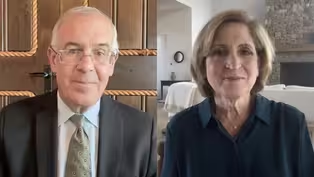
GEOFF BENNETT: For a breakdown of the week's political headlines, we turn now to the analysis of Brooks and Marcus.
That's New York Times columnist David Brooks, and Ruth Marcus, associate editor for The Washington Post.
Jonathan Capehart is away tonight.
With a welcome to you both.
And so looking at the week that was, Donald Trump and 18 of his associates were indicted in Georgia this week in a charging document that accused him of being the head of a criminal enterprise to overturn the 2020 election.
And, David, it strikes me that Donald Trump has legal problems in Georgia.
He also has political problems in Georgia, because, as The Wall Street Journal pointed out this past week in a well-reported article that really sort of captures the ways in which Trump fatigue is pervasive in Georgia, especially among some suburban independents and disenchanted Republicans.
And then you have got the popular governor there, Brian Kemp, who has called out Donald Trump's election lies and has tried to push the party beyond obsessing over the last election.
Does Georgia provide a road map for Republicans to move beyond Donald Trump, of course, those Republicans who choose to do that, who want to do that?
DAVID BROOKS: Well, the Georgia Republicans saw Trumpism face to face.
It wasn't just lies that happened to somebody else.
It was lies directed directly at them.
So they have seen the brute reality, and they are unable to escape the obligation to respond to that.
I thought Brian Kemp would have been the strongest Republican to run against Donald Trump.
He's a very successful governor.
He's demonstrated his courage in standing up to Trump.
And the fact that he's decided not to run for president was, in my mind, to my -- a tragedy to the party.
So, I think -- I'm glad the Republicans in Georgia are one of the few brave holdouts, but we need somebody to lead the charge, and Kemp was perfectly positioned.
GEOFF BENNETT: Ruth, how do you view it?
RUTH MARCUS, Columnist, The Washington Post: Well, you asked if it's the road not taken, the -- the road map.
And I think it's kind of the road not taken.
We have seen this road being not taken by Republican candidates and Republican elected officials for years now.
And that is because, in their perception, which is probably correct, it is not in their political self-interest to do that.
I do think one of the interesting political questions about Georgia involves Georgia itself.
There are very few battleground states in the 2024 election.
Georgia was close.
As Donald Trump kept pointing out, he only needed 11,900 and -- 780 votes to get across the finish line there.
I do wonder, since Governor Kemp won the state by a large margin, Donald Trump lost it to Joe Biden by a very small margin, if the impact of Georgia of might be in Georgia, rather than elsewhere.
GEOFF BENNETT: Meantime, Donald Trump is also planning to skip the first presidential debate that's scheduled for Wednesday, and is instead expected to sit for an online interview with Tucker Carlson, according to The New York Times and CNN.
David, what do you make of that decision?
And how might it affect the debate?
DAVID BROOKS: Well, he's saying, I'm bigger than the Republican Party.
The Republican Party wants its candidates to debate.
It's the normal thing to do.
But Donald Trump is no stranger to violating norms.
I do think, politically, if I were just a Machiavellian adviser to Trump, I'd say he's doing the right thing.
Why put himself out in Chris Christie's path if he doesn't need to?
I do think it will transform the debate.
Now it looks more like a debate of contenders vying with each other to see who gets to face off against the champ.
And so I would imagine that this will be a bad and tough night for Ron DeSantis.
The Trump -- the path to get to Trump leads through DeSantis.
So it seems to me that every other candidate on that stage is going to try to take down DeSantis and tell the donor class, tell the disaffected Republicans: I'm the guy, I took down DeSantis.
His day is over.
It's up to me.
And so I'm looking at it as sort of like the primaries to get to Trump, and, there, hopefully, somebody will emerge.
GEOFF BENNETT: In fact, Ron DeSantis said today, Ruth, without mentioning Donald Trump's name, he said, all Republican contenders owe it to the people to show up on that stage.
Donald Trump has made the point that Republicans know him, they know his record, and why should he share the stage with people who are polling in the single digits?
RUTH MARCUS: Well... GEOFF BENNETT: What are your expectations for Wednesday's debate?
RUTH MARCUS: Well, my hopes for Wednesday's debate are that Trump's absence allows for two things.
It allows for a little bit more talk about substance.
I know this sounds incredibly naive, but a little more talk about substance than we would have if Trump were there.
I also hope it allows one or two candidates to emerge from the pack and get their chance to shine.
I do want to potentially take issue with Machiavelli Brooks over there and say... (LAUGHTER) RUTH MARCUS: ... we have seen this -- we have this stunt from Donald Trump before.
He pulled it in January 2016, when there was a GOP debate in Iowa and he didn't turn up.
And guess what happened in the Iowa caucuses a few weeks later?
He lost to Ted Cruz, or at least the numbers said he lost to Ted Cruz.
I think he thought it was rigged.
And I wonder.
It is the smart thing to do when you're sitting on a lead not to befoul yourself by being - - exposing yourself to your competitors.
But it does make him look like a coward, as Chris Christie said.
And it does create that space that wouldn't have been there if Donald Trump were in the room for others, Vivek Ramaswamy, Tim Scott, to potentially emerge and become some serious challengers to him.
GEOFF BENNETT: Meantime, on the Democratic side, you have got Congressman Dean Phillips, who is on a media tour of late.
He was on this program last night begging for a prominent fellow Democrat to mount a primary challenge to Joe Biden.
He says that Democrats are saying they want not a coronation, but a competition.
Is that a widely held view, Ruth, or is Phillips here on a solo mission?
RUTH MARCUS: I don't know if it's a solo mission, but it's a -- it's not -- I'm not going to say kamikaze mission, but it's not a mission that's going to end with what he wants.
There are problems with Joe Biden's candidacy.
There are many Democrats behind the scenes and a few publicly who talk about his age, who talk about other problems with his candidacy.
But let's be serious.
I'm old enough to remember -- I'm sorry to say, I'm old enough to remember 1980 and what happened in the Democratic Party when it was riven by division.
And if somebody were to emerge and challenge Joe Biden at this stage in the campaign, him having decided to run, his vice president, who, if he didn't -- if he somehow chose not to run, if she were not the nominee, that would create some divisions within the demographics of the party.
I think the Democrats are going to war with what their -- what they view as their strongest candidate, and with good reason.
That's Joe Biden.
And I think, no matter what Dean Phillips says, that's the way it's going to be.
GEOFF BENNETT: David, what's your view?
And how might the Biden campaign turn his age into an asset?
DAVID BROOKS: Well, have him run a marathon.
(LAUGHTER) DAVID BROOKS: Have him do it.
I agree with Ruth that Phillips' idea that there's some mystery moderate governor the Democrats can turn to -- there's a lot of problems with Joe Biden running for reelection, his age primarily.
His approval ratings are low.
But any time you look at some alternative, whether it's the mystery moderate from the Midwest or Gavin Newsom or anybody else, things start unraveling really fast.
And so the Democrats are lucky, frankly, to have a candidate in Biden who has presided over an incredibly strong economic recovery, who has presided over pretty good international peacemaking efforts, both in Asia this week and also in Europe, and who I believe whose numbers will go up as inflation recedes, as it is.
And the strong job numbers are there.
And they're extremely lucky to have a candidate, frankly, who's not a member of what you would call the coastal elite.
And Joe Biden has -- sends off all the right cultural messages for moderate independent voters who don't have college degrees.
And Democrats are not grateful enough for what they have, in my view.
GEOFF BENNETT: David Brooks and Ruth Marcus, big thanks to you both.
Have a great weekend.
RUTH MARCUS: You too.
DAVID BROOKS: Thank you.
GEOFF BENNETT: Turning her interesting, sometimes tumultuous life story into comedy comes naturally for Atsuko Okatsuka.
Amna sat down with her recently to see how that humor lands with an ever-growing audience and helps her sort out that life story.
The conversation is part of our arts and culture series, Canvas.
AMNA NAWAZ: Her comedy is physical.
ATSUKO OKATSUKA, Comedian: Did you eat?
No?
Eat.
Please, eat, eat, eat, eat, eat, eat, eat, eat, eat.
(LAUGHTER) AMNA NAWAZ: Her style eccentric.
ATSUKO OKATSUKA: Wow.
(INAUDIBLE) It's the weird one.
Uh-oh.
She's going to get weird and crazy.
AMNA NAWAZ: And she knows how to hook her audience.
Atsuko Okatsuka is an Internet sensation with followers who watch as she marries her husband for the second time.
WOMAN: The straights got married again.
AMNA NAWAZ: And dances with her grandmother, who now has a separate fan base of her own.
Okatsuka rocketed to viral fame with the creation of her own drop challenge to a Beyonce song.
A million people watched her, creating their own videos, including tennis star Serena Williams and actor Mandy Moore.
ATSUKO OKATSUKA: My husband and I had an intruder come to our house.
AMNA NAWAZ: And she shines in her first HBO comedy special, "The Intruder."
ATSUKO OKATSUKA: The guy kind of watches this, creeps out, and starts to run away.
(LAUGHTER) AMNA NAWAZ: Her quirky observational humor has struck a chord.
ATSUKO OKATSUKA: Truly, there is a corner in my house that I sometimes take the time to stand at, just because I pay rent.
(LAUGHTER) ATSUKO OKATSUKA: Yes, I'm always like, this is like $30 right here.
(LAUGHTER) ATSUKO OKATSUKA: Why don't I ever stand here?
(LAUGHTER) ATSUKO OKATSUKA: You pay for it.
At least feel it.
(LAUGHTER) AMNA NAWAZ: She sat down with me recently and talked about discovering comedy in an unlikely place.
What did you see or hear that said, this is something I want to do?
ATSUKO OKATSUKA: When I first watched stand-up comedy was -- it was through Margaret Cho.
So it was this DVD that was handed to me during a really, really boring sermon at church.
One of my friends was like -- like, passed it to me and was like: "Shh.
Hey, this is stand-up comedy."
And it was someone who looked like me.
And then it wouldn't be until years later that a boyfriend told me that I was funny and that I should try doing stand-up.
Yes, my fellow basic person.
AMNA NAWAZ: It also took years to get her own special.
Okatsuka is just the second Asian American woman ever to get her own HBO comedy special.
The first was Margaret Cho over two decades ago.
MARGARET CHO, Comedian: I never saw Asian people on television or in movies, so my dreams were somewhat limited.
I would dream, maybe someday I could be an extra on "MASH."
(LAUGHTER) ATSUKO OKATSUKA: It's not about them going, oh, you can't say that out loud.
You can't go, no, no, there's only enough slots for so many Asians at a time.
It's just they show it to you.
Yes, so you have to push past a lot of barriers.
AMNA NAWAZ: Why do you think it did take so long?
ATSUKO OKATSUKA: I think people are afraid of things not working.
People are afraid of things they're not used to seeing, but they have to trust the audience.
The audience has been asking for -- and that's what I mean by, like, social media and, like, stand-up comedians can post their own clips online, and then they gain their own followers an, go on tour, and the audience is there.
And they prove like, look, people do want to see this.
Then the industry usually listens.
AMNA NAWAZ: You have a story a lot of people can relate to, though, about coming here, learning how to fit in, making a new life in a new country.
And your comedy special is called "The Intruder."
Is there another meaning behind that title too?
ATSUKO OKATSUKA: Yes.
Yes.
And I'm glad that, like, you saw it, because it's not so over the head, right?
But, yes, the double entendre is that, as a formerly undocumented immigrant, right, I oftentimes felt like I was intruding on everyone else.
AMNA NAWAZ: What do you mean by that?
ATSUKO OKATSUKA: I'm coming to someone else's country.
I'm coming to someone else's culture.
And being without papers means, like, you're not really supposed to be here.
Anybody who's ever felt like an outsider just because you talk differently, or look differently, or dress differently than other people, than the norm, I think you might have felt like an intruder as well.
AMNA NAWAZ: Her road to success was an unlikely one.
Born in Taiwan, she spent her early childhood in Japan before moving to the United States at the age of 10 with her mother and grandmother.
For years, she lived undocumented, hiding parts of her identity.
Today, she owns it.
ATSUKO OKATSUKA: I am a product of divorced parents.
(LAUGHTER) ATSUKO OKATSUKA: Guilty.
Was undocumented for seven years due to a lie my grandma and my mom told me about how long we were going to be here.
(LAUGHTER) AMNA NAWAZ: Tell me about your family and how you came to live in the U.S. ATSUKO OKATSUKA: My mom and grandma and I moved to the U.S. when I was 8.
But, at the time, I didn't know I was moving here.
My grandma, she's so sweet, unassuming-looking, this, like, old Asian woman.
But she was a liar.
(LAUGHTER) ATSUKO OKATSUKA: She told me we were coming to the States for a two-month vacation, and then she had us overstay our tourist visas.
We became undocumented.
We were living in my uncle's garage.
And so that was -- that's how she at least got me to move to L.A. AMNA NAWAZ: Yes.
ATSUKO OKATSUKA: Yes.
AMNA NAWAZ: The challenges, some very personal, feed her work today.
And Okatsuka doesn't shy away from the tough stuff.
ATSUKO OKATSUKA: My dad's on his third divorce.
My mom's schizophrenic.
At a certain point, I want to look at my family and be like, guys, if you wanted me to do comedy, you could have just told me.
You know what I mean?
(LAUGHTER) AMNA NAWAZ: You have talked about your mother's own mental illness.
ATSUKO OKATSUKA: Mm-hmm.
AMNA NAWAZ: Why do you think it's important to weave those details into your work?
ATSUKO OKATSUKA: As a kid, I was always able to make sad things funny, not just for me, but for my family.
It's just a part of how I communicate with people.
I go, OK, this very-difficult-to-talk-about subject mental illness, no worries.
Let's talk about it.
But I'm going to make you laugh while I'm doing it.
(LAUGHTER) ATSUKO OKATSUKA: You know?
And, that way, like, we both feel better, yes.
AMNA NAWAZ: Okatsuka continues to tour across the country, bringing her comedy and building connections wherever she goes.
What do you love about this work?
What is it like when you're up on stage and you can make an entire room laugh?
ATSUKO OKATSUKA: Oh, gosh.
It's just -- it's finding community, yes.
And my fans are fellow weirdos.
You're a fellow weirdo for even connecting with me.
AMNA NAWAZ: Thank you for that.
ATSUKO OKATSUKA: Watching my comedy, even laughing at it.
Sorry.
You're not normal.
(LAUGHTER) ATSUKO OKATSUKA: And that's what I love, though, that we can all find each other and be like, yes, like, we're not alone and all the times we might have felt that way.
That's why -- that's why I love it.
GEOFF BENNETT: And we will be back shortly with a look at what's coming up in "Washington Week" and "PBS News Weekend."
But, first, take a moment to hear from your local PBS station.
It's a chance to offer your support, which helps keeps programs like this one on the air.
For those of you staying with us, we take a second look now at a unique public art program.
As with many cities in the Rust Belt, Fort Wayne, Indiana, went through tough times, as manufacturing plants closed, jobs dried up, and people left.
But, recently, the city has seen a turnaround and made a big investment in public art.
Special correspondent Cat Wise spent time with an artist who is a driving force behind that effort.
It's part of our arts and culture series, Canvas.
CAT WISE: Above a busy street in downtown Fort Wayne in a quiet studio apartment, artist Alexandra Hall brings colorful, playful creatures to life with paint and brush.
Hall, who is 37, grew up in Fort Wayne and has been a full-time artist since 2015.
Over the years, she's drawn and painted a variety of subjects, including portraits, still-life, and delightful tipsy frogs.
More recently, she's become known for her large-scale paintings of animals in bright, pattern-filled costumes.
ALEXANDRA HALL, Artist: I am inspired by a lot of different things, travel.
Sometimes, it is a person I see on the sidewalk.
I have for a very long time recreated the things I see into whimsical animals that often have human traits or an anthropomorphized animal.
CAT WISE: Tell me about the dripping of the paint.
Why is that important?
(LAUGHTER) ALEXANDRA HALL: I think that there is a little bit of chaos in every piece.
There needs to be that release of control, that idea that nothing in our life is unchanging and nothing in our life is fully in our control.
I tuck that into because that's been part of my life story and I think its part of most people's life story.
CAT WISE: Her life took an unexpected turn in high school, when she was diagnosed with bone cancer.
ALEXANDRA HALL: Back when I was ill, I was spending a lot of time in bed.
It was really up to me to create the worlds around me and make it interesting.
And so art became that outlet for me, and it's still an outlet for me today.
CAT WISE: After recovering and going to college, Hall began traveling and discovered a love of public art.
ALEXANDRA HALL: When I traveled, I noticed that there were communities that organically have a really strong public art presence.
And I found myself more drawn to those places and those spaces because they have some sort of story to tell.
At the time, I would say, I thought, wow, I can't wait to live in a place like this.
This is -- I want to leave Indiana.
CAT WISE: Hall eventually decided not to leave.
Instead, she's brought public art to her hometown.
ALEXANDRA HALL: So, in the summer, this can be a really cool place to hang out, read a book, and it is a little quieter than the street side.
CAT WISE: In 2016, Hall started a donation-funded organization called Art This Way.
Now a nonprofit that's part of Fort Wayne's Downtown Improvement District, the organization facilitates public art projects on private property and the development of pedestrian-friendly spaces.
ALEXANDRA HALL: We work really hard to make spaces walkable, in the sense that there is art every so often and often enough that you are intrigued and inspired.
CAT WISE: You want to keep going.
ALEXANDRA HALL: And want to keep going, yes.
CAT WISE: She took me on a tour to see some of the 30 large-scale pieces her organization has helped install by local, national, and international artists.
Tell me about this mural.
ALEXANDRA HALL: Right.
So this is Walt Whitman by Tim Parsley.
This is meant to depict the creative brain and the hope that comes from the creative brain.
What we wanted to do with the Art This Way program was create a place where public art could be about anything, and it didn't need to necessarily be about Fort Wayne.
So, give it room to breathe and allow art for art's sake to happen.
CAT WISE: That art, she says, has helped breathe new life into the city, which, during the downturn years, had seen an increase in vacant parking lots and abandoned buildings.
Today, once-stark alleyways are now a destination.
Oh, my goodness.
Tell me about this piece.
ALEXANDRA HALL: So, this is called 77 Steps.
We have seen engagement photos.
People get engaged in this space.
It can be programmed to do a lot of different things.
We will program it for special events and holidays, you name it.
CAT WISE: The community loves it.
(LAUGHTER) ALEXANDRA HALL: Yes, the community loves it.
CAT WISE: Art This Way's projects, including two of Hall's own works, are part of a growing collection of public art throughout the city, nearly 150 pieces, including a new sculpture in honor of Ukraine.
ALEXANDRA HALL: You are supposed to engage with this, like a lot of the works that we install.
You're supposed to be able to touch them.
And, here, you're supposed to stand and be pictured with your crown and your set of wings.
CAT WISE: Events like the annual Art Crawl in September draw locals and visitors and perhaps convince some of those visitors to stay.
BILL BROWN, Former President, Fort Wayne Downtown Improvement District: There's more people moving in than are moving out.
It's there.
It's a big deal.
And that something to be proud of.
CAT WISE: Bill Brown is a retired Fort Wayne business owner and former head of the Downtown Improvement District.
BILL BROWN: Well, we have some outstanding local artists.
CAT WISE: I met him at The Bradley, a new boutique hotel in downtown.
BILL BROWN: What is cool is that The Bradley's been able to embrace them and hang their art.
CAT WISE: He says public art has played a significant role in Fort Wayne's revitalization efforts, which have also included riverfront development and a baseball stadium.
Nationally, a 2018 survey by the nonprofit Americans For the Arts found that 70 percent of Americans believe that the arts improve the image and identity of their community.
In Indiana, arts and culture is a $7.6 billion industry which supports more than 78,000 jobs.
Brown says, in Fort Wayne, nearly everyone is on board now with public art, but it took some time to get there.
BILL BROWN: I think the change was the realization that the arts can drive economic development.
I think that -- kind of that show me kind of thing, a conservative community, once they trust, they are all in.
And that's where I think, with people like Alex, it is about performance, trust, and talent.
CAT WISE: Hall and other Fort Wayne artists have been building on that trust and expanding their impact, like Theoplis Smith, who goes by the artistic name Phresh Laundry.
I met him at his new mural in the entrance tunnel to Electric Works, the recently renovated former campus of General Electric that was vacant for years.
Smith, an internationally recognized artist whose work can be seen throughout Fort Wayne, including at The Bradley Hotel, has high hopes for his city.
THEOPLIS SMITH, Artist: I want this to be like a mecca in the North region to see the arts flourished.
Being the second largest city in Indiana, the economy is growing.
You have people in all walks of life coming into Fort Wayne to see what we have to offer.
We want to make sure we are screaming and echoing arts.
CAT WISE: But, as his city grows, he wants to make sure everyone is included and able to access the arts.
THEOPLIS SMITH: You have your fine line between gentrification vs. revitalization.
It makes sure that you have the right people at the table to make it cohesive.
You want people to feel invited, feel welcome, feel, I belong here.
CAT WISE: Hall also wants to make public art more accessible.
ALEXANDRA HALL: What we have created is the huge melting pot of street art.
We are seeing lots of diversity in the cultures and ethnicities and where someone is from, Brazil, Germany, you name it.
CAT WISE: She's now consulting with communities outside of Fort Wayne.
And, over the past three years, she's led more than three dozen projects in rural towns in Indiana, New York, and Pennsylvania.
And while she still loves to travel, she has no plans to leave her hometown.
For the "PBS NewsHour," I'm Cat Wise in Fort Wayne, Indiana.
GEOFF BENNETT: Later this evening on PBS, tune in to "Washington Week With The Atlantic."
Jeffrey Goldberg is here with a preview.
JEFFREY GOLDBERG: Hey.
Hey, Geoff.
So it's a busy week, as you know, and we're going to be talking about indictments, all of the indictments, but with a special focus on the Georgia indictment.
And we're going to be talking about Rudy Giuliani a bit, the seeming downfall of a person we once referred to as America's mayor.
There's a lot to talk to -- talk about.
And we have got a great panel.
So I hope everybody joins in.
GEOFF BENNETT: All right, we will be sure to watch.
And on "PBS News Weekend": how families are preparing for a new Montana law banning certain medical treatments for minors with gender dysphoria.
NARRATOR: At 14, Sid (ph) started taking puberty blockers and at 17 began hormone therapy.
The Beardsleys (ph) firmly feel that this was the right choice for Sid.
TEENAGER: It's basically just grown my confidence.
It's made me a lot happier.
And I actually feel like I have a future.
I can grow up, be an adult.
Like, I'm ready to exist on this planet.
NARRATOR: Said is among the last group of transgender youth in Montana who can legally receive gender-affirming care.
GEOFF BENNETT: That's tomorrow on "PBS NewsHour Weekend."
And that is the "NewsHour" for tonight.
Remember, there's much more online, including a look at an effort to address surprise billing for ambulance rides, which are not regulated under the so-called No Surprises health care act.
I'm Geoff Bennett.
Thanks for joining us.
Have a great weekend.
Brooks and Marcus on Trump's Georgia indictment, GOP debate
Video has Closed Captions
Brooks and Marcus on Trump's Georgia indictment and upcoming GOP debate (8m 16s)

Comedian Atsuko Okatsuka on her journey to the stage
Video has Closed Captions
Comedian Atsuko Okatsuka on her journey to the stage and connecting with audiences (7m 33s)
Israeli minister on possible Saudi Arabia diplomatic deal
Video has Closed Captions
Israeli minister Ron Dermer discusses potential diplomatic deal with Saudi Arabia (7m 35s)

Japan, South Korea agree to strengthen military coordination
Video has Closed Captions
Biden reaches deal with Japan and South Korea to strengthen military coordination (6m 59s)
Residents flee Yellowknife as wildfire moves closer to city
Video has Closed Captions
Residents flee Yellowknife, Canada as wildfire moves closer to city (2m 35s)
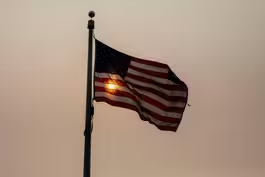
Trump conspiracies inspire threats against civil servants
Video has Closed Captions
Trump conspiracies inspire threats against judges, jurors and election workers (7m 19s)
Providing Support for PBS.org
Learn Moreabout PBS online sponsorship New Episode
- News and Public Affairs

Today's top journalists discuss Washington's current political events and public affairs.

- News and Public Affairs

FRONTLINE is investigative journalism that questions, explains and changes our world.
 New Episode
 New Episode
 New Episode
 New Episode
 New Episode
 New Episode


 New Episode
 New Episode
Support for PBS provided by:
Major corporate funding for the PBS News Hour is provided by BDO, BNSF, Consumer Cellular, American Cruise Lines, and Raymond James. Funding for the PBS NewsHour Weekend is provided by...