
August 18, 2024 - PBS News Weekend full episode
8/18/2024 | 26m 44sVideo has Closed Captions
August 18, 2024 - PBS News Weekend full episode
Sunday on PBS News Weekend, polls show Vice President Harris gaining ground in key swing states ahead of this week’s Democratic National Convention. We get the latest from the NewsHour team on the ground in Chicago. Then a look back at the chaotic 1968 Democratic convention in Chicago. Plus, why a device used to treat a deadly heart condition is under scrutiny.
Problems playing video? | Closed Captioning Feedback
Problems playing video? | Closed Captioning Feedback
Major corporate funding for the PBS News Hour is provided by BDO, BNSF, Consumer Cellular, American Cruise Lines, and Raymond James. Funding for the PBS NewsHour Weekend is provided by...
Support provided by:

August 18, 2024 - PBS News Weekend full episode
8/18/2024 | 26m 44sVideo has Closed Captions
Sunday on PBS News Weekend, polls show Vice President Harris gaining ground in key swing states ahead of this week’s Democratic National Convention. We get the latest from the NewsHour team on the ground in Chicago. Then a look back at the chaotic 1968 Democratic convention in Chicago. Plus, why a device used to treat a deadly heart condition is under scrutiny.
Problems playing video? | Closed Captioning Feedback
How to Watch PBS News Hour
PBS News Hour is available to stream on pbs.org and the free PBS App, available on iPhone, Apple TV, Android TV, Android smartphones, Amazon Fire TV, Amazon Fire Tablet, Roku, Samsung Smart TV, and Vizio.
Providing Support for PBS.org
Learn Moreabout PBS online sponsorshipJOHN YANG: Tonight on PBS News Weekend, on the eve of the Democratic National Convention in Chicago, polls show vice president Harris gaining ground in key swing states, then America at a crossroads.
A look back at the chaos that consumed the 1968 Democratic Convention in Chicago, and why itús unlikely to happen again this time.
MAN: America before August 28, 1968 and after August 28, 1968 was a different America.
The idea that this convention will be a watershed is pretty much inconceivable.
Now this election might be a watershed.
JOHN YANG: And why a device used to treat a deadly heart condition is under scrutiny.
(BREAK) JOHN YANG: Thank you.
Good evening.
Iúm John Yang.
Secretary of State Antony Blinken is in Israel tonight trying to nail down a ceasefire deal, despite some objections from Hamas, even as Israel mounted fresh assaults on Gaza.
Israeli air strikes killed at least 29 people, including six children.
Israel says it was targeting Hamas rocket launchers.
In a cabinet meeting today, Prime Minister Benjamin Netanyahu said he could be flexible on some parts of the U.S. backed cease fire proposal, but would stand firm on others.
Netanyahu and Blinken are to meet tomorrow, and Blinken is to fly to Egypt on Tuesday.
Ukraine is ramping up military operations in its nearly two-week old incursion into Russia.
Ukrainian armed forces video shows a vital bridge in Russiaús Kursk Region being hit by an air strike.
Itús the second key span thatús been destroyed, severely hampering Russian supply lines.
President Volodymyr Zelenskyy is asking Western allies to lift remaining restrictions on using long range Western weapons to strike targets deeper in Russia, while Russia is weakened.
On the eve of the Democratic Convention, Vice President Kamala Harris was in the key swing state of Pennsylvania.
Harris and running mate Minnesota Governor Tim Walz made calls to supporters, speaking to volunteers.
Harris compared her leadership style with Donald Trumpús.
KAMALA HARRIS, U.S. Vice President: This campaign is about a recognition that, frankly, over the last several years, thereús been this kind of perversion that has taken place, I think, which is to suggest -- which is to suggest that the measure of the strength of a leader is based on who you beat down, when what we know is the real and true measure of the strength of a leader is based on who you lift up.
JOHN YANG: Former President Trump and his running mate, J, D, Vance will be in Pennsylvania tomorrow.
And French actor Alain Delon has died.
His smoldering good looks lent an air of wounded mystery to dark roles in a string of classic films.
He played a hitman in the Samurai, an unscrupulous art dealer in Mr. Klein and the murderous social climbing Tom Ripley in Purple Noon.
Off screen he was notorious for his entanglements with women organized crime and right wing politics.
Today, French President Emmanuel Macron hailed him as a French monument.
Alana Alain Delon was 88 years old.
Still to come on PBS News Weekend, a look back at the chaotic 1968 Democratic Convention and why a potentially life-saving heart device is under scrutiny.
(BREAK) JOHN YANG: It has been an unprecedented run up to this weekús Democratic Convention.
The incumbent president dropping out under pressure from his own party, and the Vice President taking his place.
NewsHour anchors Geoff Bennett and Amna Nawaz are in Chicago for the next chapter.
Geoff, whatús this week going to look like?
GEOFF BENNETT: Well, John, Democratic officials say the convention will open tomorrow night with the theme "For the People."
Weúll hear from Secretary Hillary Clinton, the First Lady, Dr. Jill Biden, and President Joe Biden, whose prime time keynote address will make the case for electing Kamala Harris.
Tuesday will be organized along the theme of what Democrats call their "Bold Vision for Americaús Future," with evening keynotes from Michelle and Barack Obama.
Wednesday night, we can expect the campaign to draw a contrast with the Trump ticket, and thatús when weúll hear from former President Bill Clinton and Kamala Harrisús running mate, Minnesota Governor Tim Walz.
And on the last night, as is customary, weúll hear from the nominee herself, Kamala Harris, as she formally accepts the Conventionús nomination for president, outlines her agenda and reintroduces herself to the American public.
So, over the next four days, Democrats will look to capitalize on their baseús newfound enthusiasm for this campaign, which has really returned the presidential race to a neck and neck contest.
AMNA NAWAZ: Thatús right, Geoff, you know, I asked multiple Democratic officials and lawmakers, all of whom are attending the convention this week, to describe that sense of enthusiasm, they use words like joy and excitement and this word I heard a lot momentum going into this convention, and we have seen that momentum show up among voters in a race that has shifted dramatically since vice president Harris moved to the top of the ticket.
In fact, the latest battleground state polling shows Harris and former President Trump mostly tied.
The latest national polling shows Harris with a narrow lead over Trump on both fronts.
Of course, that is an improvement for Democrats from just a month ago when President Biden was still running for reelection.
Our White House correspondent Laura Barron-Lopez has been covering the Harris-Walz campaign.
Sheús here with us in Chicago.
So Laura, as weúve been saying, this is a very different convention to the one Democrats were planning just a few weeks ago.
Whatús the vibe been like here in Chicago?
LAURA BARRON-LOPEZ: Itús totally different.
You can feel it here on the ground in Chicago, Democrats are motivated in a way that we didnút hear them be motivated prior to Kamala Harris jumping in and when it was a rematch between Donald Trump and Joe Biden.
And to seize on that momentum, Kamala Harris, the Vice President, is in Pennsylvania campaigning alongside her vice presidential pick, Tim Walz.
They have a bus tour thatús going through Western Pennsylvania as well as Pittsburgh, and the campaign is holding 2,800 battleground state events where they are signing up more than 10,000 volunteers for shifts this week to knock on doors, including some high profile surrogates are out there, Pete Buttigieg, along with his husband in the state of Wisconsin, going through that key battleground state as they try to really just capitalize, as you said, Geoff, on the momentum that theyúre feeling with their base.
GEOFF BENNETT: And Laura, I know youúve been speaking with Democratic voters about this race.
What have they been telling you?
LAURA BARRON-LOPEZ: Iúve been speaking to a number of Democratic voters, not just here in Chicago, but also in Wisconsin, and they tell a similar story.
Essentially, a lot of them used words like nervous, worried.
They used words like grim.
When I asked them how they felt about this rematch, when it was a rematch between Donald Trump and Joe Biden, and then how they feel now that Kamala Harris is about to, you know, go through this convention and sheús the Democratic nominee, how they feel about that the race has totally changed.
And they say that now theyúre more hopeful, that they feel like all of the dynamics have shifted, that they sense it in their communities, and they are clearly much more excited to just go out and vote, and they feel as though that Democrats potentially have a chance to win this election, when they didnút necessarily feel that just a few weeks ago.
AMNA NAWAZ: Laura, I know youúve also been speaking with black voters in particular, of course, who are a key part of that Democratic coalition, voting bloc.
What are you hearing from them?
LAURA BARRON-LOPEZ: So as you both know, Donald Trump has been trying to siphon away, specifically black voters because, of course, the vast majority of black voters vote for Democrats, more than 80 percent almost every election cycle.
But he is thinking -- Donald Trump is thinking that at the margins, maybe he can siphon away a few black voters.
Iúve been talking to some who voted for Trump in the past, saying that they arenút as necessarily interested in voting for him this time, but theyúre not exactly sold on Kamala Harris yet, and they want to hear more from her speaking directly to them, specifically on the economy.
They want to hear a lot more from her on those issues, on housing, which weúve seen that she started to roll out more of her plans to differentiate herself from President Joe Biden.
But the black women that I spoke to are credibly excited, and they feel as though that the country is ready to elect its first black woman and South Asian president.
So theyúre hoping that that what theyúre feeling is something that a lot of other women are feeling across the country.
And a lot of them name issues like reproductive rights and health care and abortion for why theyúre excited about Harris.
AMNA NAWAZ: We expect to hear a lot more, hopefully more details too, on this stage behind us for the rest of the week.
Laura Brown-Lopez be here with us in Chicago all week.
Thanks so much, Laura.
LAURA BARRON-LOPEZ: Thank you.
AMNA NAWAZ: John, we will send it back to you.
JOHN YANG: Thanks, Amna, Geoff and Laura and the entire team in Chicago, and they will all be there for live special coverage every night of the Democratic National Convention, beginning Monday at 8:00 p.m. eastern here on PBS.
Chicago has hosted more presidential conventions than any other U.S. city, stretching back to 1860 when Republicans nominated Abraham Lincoln, but perhaps none was as notorious or as consequential as the 1968 Democratic Convention, when deep divisions over the Vietnam War played out on both the convention floor and on the streets of Chicago, that history and its relevance to today is the subject of tonightús installment of Judy Woodruffús ongoing series, America at a crossroads.
MICHAEL JAMES, 1968 Democratic Convention Demonstrator: You know, we thought of ourselves as revolutionaries in those days, and we were really irked by the Democratic Party and the war in Vietnam.
JUDY WOODRUFF (voice-over): Michael James was in Chicago in 1968 when the protests at the Democratic Convention began.
MICHAEL JAMES: Itús not just the war in Vietnam.
It was early womenús movement, certainly civil rights movement.
People were really aware of what was going on in the world, and were taken out of the Democratic Party.
We were demonstrating because all of the delegates were staying here.
JUDY WOODRUFF (voice-over): I met him across the street from the Hilton in downtown Chicago, where he took part in some of the most intense clashes, including when he and others began rocking a police van.
MICHAEL JAMES: And thereús a lot of myths about tipping it over, but we never did.
We rocked it.
This guy in this passenger seat.
JUDY WOODRUFF: Right here.
MICHAEL JAMES: Right here, he comes out.
He grabs one of these guys.
I grabbed him.
I took him down, and I disappeared.
JUDY WOODRUFF (voice-over): It was another violent moment in an already bloody year.
MARTIN LUTHER KING, Civil Rights Leader: Weúve got some difficult days ahead.
JUDY WOODRUFF (voice-over): Civil rights leader Martin Luther King had been assassinated, leading to days of riots in major cities, including Chicago, mired in the Vietnam War, which would kill tens of thousands of Americans.
President Lyndon Johnson decided not to seek a second term.
LYNDON JOHNSON, Former U.S. President: I shall not seek and I will not accept the nomination of my party for another term as your president.
JUDY WOODRUFF (voice-over): He threw his support behind his vice president, Hubert Humphrey, but it was up to the delegates to choose a new nominee at the convention.
Then in June, less than three months before the convention was set to begin, one of Humphreyús challengers, Robert F. Kennedy was gunned down.
RICK PERLSTEIN, Author: The menace of violence was everywhere.
It was inside the convention hall.
It was outside the convention hall.
JUDY WOODRUFF (voice-over): Chicago based author and journalist Rick Perlstein has written extensively about that summer, including in his book "Nixonland: The Rise of a President and the Fracturing of America."
We met at the Chicago History Museum last week.
RICK PERLSTEIN: It all came to a head on Thursday, August 28, when the protesters tried to march to the convention hall from this hotel downtown, were kind of waylaid by the police, so they decided to sit down right in the middle of the street, do a sit down strike right in front of the cameras, and the Chicago Police waded into the crowd with billy clubs and just randomly started beating people as hard as they could, throwing them into police wagons.
When the police wagon was full, theyúd throw a tear gas canister inside, then they would close the doors, and the protesters were chanting, the whole world is watching.
JUDY WOODRUFF (voice-over): The cityús mayor, Richard J. Daley, was incensed by protesters threatening to disrupt the convention.
Police were also angry, feeling they had been held back from responding in full force earlier that year during the riots following Kingús assassination, and many of the protesters thought the country would be on their side.
RICK PERLSTEIN: But it turned out that most of the country seemed to side with the police.
Believe that they must have been provoked.
MAN: With George McGovern as President of the United States, we wouldnút have to have to stop those statics in the streets of Chicago.
JUDY WOODRUFF (voice-over): At the same time, there was chaos inside the convention hall as the party battled over whether to call for the end of the Vietnam War.
RICK PERLSTEIN: That was equally conflict written and all of these forces came together in an extraordinary confluence of violence, anger, and all of it was seen on TV.
JUDY WOODRUFF (voice-over): In the end, Perlstein explained, most Americans sided with the police.
Richard Nixon ran on a promise to restore law and order.
RICHARD NIXON, Former U.S. President: A growing concern is also the issue of peace at home.
JUDY WOODRUFF (voice-over): That November, he narrowly beat the eventual Democratic nominee Vice President Hubert Humphrey.
RICK PERLSTEIN: It was definitely an inflection point, and many, many things, is an inflection point for the Republican politics of law and order and basically presenting themselves as the forces of hierarchy decency.
You know, if youúre behind a white picket fence and work hard and play by the rules, the people Richard Nixon termed the silent majority were for you and the Democrats are in cahoots with these anarchists, right?
It was, you know, profoundly inaccurate.
It was a smear, but that was the beginning of that smear.
JOE BIDEN, U.S. President: I revere this office, but I love my country more.
JUDY WOODRUFF (voice-over): Fast forward to today, when a sitting Democratic president has stepped aside, a conflict rages overseas that has reignited tensions on the left.
There are renewed pushes for womenús rights and racial equality, and the Republican presidential candidate himself, a recently convicted felon facing more charges, is running on a promise of law and order.
RICK PERLSTEIN: I think the parallels donút really rise above the level of the superficial.
Conventions are very different now than they were in 1968 in part because of 1968.
In 1968 the guy who became the Presidential Nominee the Democratic Party didnút enter a single primary.
Basically, the delegates decided who to vote because political bosses told them to.
And these were deals made in back rooms, often at the convention.
JUDY WOODRUFF (voice-over): Following 1968 the Democratic Party reformed its nominating contest to favor primaries giving voters more of a say, while Perlstein says this year is unusual, Harris did appear on primary ballots with President Biden, and since his stepping aside, delegates have overwhelmingly lined up behind her.
But the question remains if younger progressive voters who are pro-Palestinian will also back Harris.
JUDY WOODRUFF: How would you compare the passions that were flowing in 1968 around Vietnam with whatús going on now in the United States, around the Israel, Gaza war?
RICK PERLSTEIN: Well, thereús, you know, considerable group of people who are extremely passionate about whatús going on in Israel and in Gaza.
I would say the biggest difference is that the people who are extremely passionate about what was going on in Vietnam were young people who could have ended up in Vietnam that same month.
And this is a time in which as many as 100 American soldiers were dying a day.
You know, I donút want to take away from a moral passion, but you know, this was kind of life and death.
JUDY WOODRUFF (voice-over): In addition, Perlstein says the federal government now runs security, which has become much tighter, especially after the terrorist attacks of 9/11.
RICK PERLSTEIN: There was this brief shining moment in which, you know, this crazy thing American political convention that is not predictable, seemed possible, but the Democrats are in array.
You know, theyúve lined up behind a candidate.
I think 83 percent of Democrats said that they agree with the decision of the party to put forward Kamala Harris over Joe Biden.
The delegates will vote for her.
Will hear inspiring speeches, will see celebrities sing songs, and life goes on.
JUDY WOODRUFF: But very different from ú68 inside the hall.
RICK PERLSTEIN: Very different from 1968.
America before August 28, 1968 and after August 28, 1968 was a different America.
The idea that this convention will be a watershed is pretty much inconceivable.
Now, this election might be a watershed.
But, you know, the energy lies elsewhere.
MICHAEL JAMES: I think itús important to keep it kind of cool.
JUDY WOODRUFF (voice-over): Thatús a point that Democrat and former 1968 protester Michael James agrees with.
MICHAEL JAMES: I definitely donút want to have what happened in ú68 happen because I think that the danger of having the orange haired guy resume office of presidency will really be a disaster, not only for America, but the world.
JUDY WOODRUFF: For PBS News Weekend, Iúm Judy Woodruff in Chicago.
JOHN YANG: Americans rely on the Food and Drug Administration to make sure that medical devices are safe.
Now, reporting by KFF Health News raises questions about how the agency has dealt with some products, including one that treats a heart condition.
Ali Rogin has more.
ALI ROGIN: The device is called MitraClip, and its goal is to fix leaky heart valves, often in patients too sick for surgery, itús implanted by snaking a small clip into the heart through a major vein.
Now, a new investigation by KFF Health News looks into questions surrounding the deviceús development, promotion and use since it was approved by the FDA back in 2013.
David Hilzenrath is the senior and Washington correspondent for KFF, and was the lead author of this story.
David, thank you so much for being here.
What type of patient was this device developed for and why was it such a game changer?
DAVID HILZENRATH, Senior Correspondent, KFF News: MitraClip is used to treat patients with a condition called mitral regurgitation, or MR, in which blood flows backwards through the heartús mitral valve.
MR can lead to heart failure and death.
Iúve seen estimates Ali that millions of people in the United States experience MR including 10 percent of people over 75.
MitraClip system includes a tiny clip that is implanted in the mitral valve to fasten the two flaps of the mitral valve together and enable them to achieve a tighter seal.
ALI ROGIN: And what was then the reality of what you found about how what this product says it does matches up with the reality?
DAVID HILZENRATH: For many patients, it may be a game changer.
We found that the story of MitraClip is in many ways, a cautionary tale, however, about the science, the business and the regulation of medical devices.
We found that since the FDA approved MitraClip in 2013, MitraClip has been named in thousands of reports to the FDA about malfunctions or cases in which it might have caused or contributed to a patientús injury or death.
We found 17,000 reports, of which more than 1,100 involved deaths.
There has long been debate about research surrounding MitraClip.
Before the FDA approved the device in 2013, it issued a paper criticizing data marshaled in support of MitraClip, and one outside advisor to the agency compared that data to poop, more specifically, horse poop and dog poop.
ALI ROGIN: Now in terms of the deaths that you mentioned, certainly the people associated with MitraClip would point out that this was not a physically well population to begin with, so some deaths are to be expected.
But is the issue here that the claims are that these devices actually cause the deaths.
DAVID HILZENRATH: The reports that I described do not prove causality.
Itús one of the flaws in the FDA post market surveillance system that these reports are not definitive.
The FDA relies largely on reports submitted by the manufacturers themselves, such as, in this case, Abbott.
ALI ROGIN: And as you mentioned, Abbott denies wrongdoing.
They say in part that, quote, it is a safe and effective treatment option with a strong foundation of clinical evidence for more than 20 clinical trials.
I do want to ask you, though about the clinical trial aspect of this.
It does seem like a Catch 22 that the very companies that are charged with proving to the FDA that their products are safe and effective, largely bankroll a lot of these clinical trials because theyúre extremely expensive and theyúre the only ones that can do so.
Is that an inherent conflict of interest in just how the system is run in the United States?
DAVID HILZENRATH: Itús built into the system.
What you describe Ali is absolutely true.
The FDA relies primarily on clinical trials conducted by the very companies that manufacture these products.
Much of the research that Abbott alluded to in that statement was funded by Abbott.
Many of the doctors involved themselves had financial relationships with Abbott, and the research is not always clear cut.
It can be debated.
ALI ROGIN: This investigation also, though, reveals the amount of uncertainty that is allowed for in the FDA approval process.
Is that also something that is pretty standard when FDA approval is sought?
DAVID HILZENRATH: Well at times, and weúve seen this with other products.
The FDA has approved medical products over the objections of its own staff professionals.
In the case of MitraClip, the FDA initially argued that the clinical research and other data the manufacturer had produced to argue for approval was fundamentally flawed.
To cite just one example, the allegation was that the MitraClip patients in that testing were treated by surgeons who were highly experienced, while those in the control group were treated by doctors who performed surgery much less frequently.
In that testing, MitraClip was compared to surgery, and the FDA convened this committee of outside advisers.
The committee was quite split on what to recommend to the FDA.
The committee voted against the proposition that the device was proven effective.
However, it voted that the benefits outweighed the risks.
Ultimately, the FDA approved it for a somewhat narrower universe of patients than originally proposed.
ALI ROGIN: I should note that the FDA has a statement that says that the agency believes that the overall benefits of this device continue to outweigh the risks in these patients, and that Abbottús recall strategy was appropriate and adequate.
Much left to discuss, but we have to leave it there.
David Hilzenrath with KFF, thank you so much for coming in.
DAVID HILZENRATH: Thank you, Ali.
Great to be here.
JOHN YANG: And that is PBS News Weekend for this Sunday.
Iúm John Yang.
For all of my colleagues, thanks for joining us.
Have a good week.
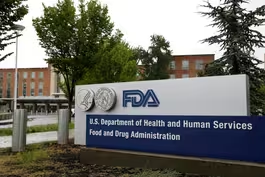
FDA-approved medical device raising safety concerns
Video has Closed Captions
One medical device is raising questions about FDA’s approval process (6m 23s)
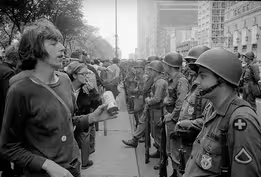
A look back at the 1968 Democratic convention
Video has Closed Captions
A look back at the 1968 Democratic convention and its relevance today (8m 58s)
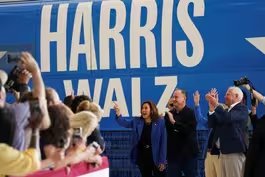
What to expect at the Democratic National Convention
Video has Closed Captions
A look ahead to this week’s Democratic National Convention in Chicago (5m 36s)
Providing Support for PBS.org
Learn Moreabout PBS online sponsorship
- News and Public Affairs

FRONTLINE is investigative journalism that questions, explains and changes our world.

- News and Public Affairs

Amanpour and Company features conversations with leaders and decision makers.












Support for PBS provided by:
Major corporate funding for the PBS News Hour is provided by BDO, BNSF, Consumer Cellular, American Cruise Lines, and Raymond James. Funding for the PBS NewsHour Weekend is provided by...