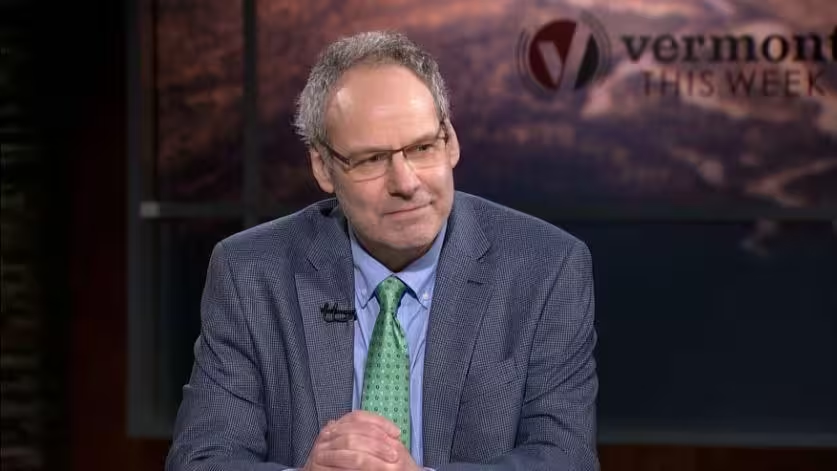
Vermont This Week
August 2, 2024
8/2/2024 | 26m 45sVideo has Closed Captions
Flash flooding tears through rural communities in NEK | Lt. Gov Debates | Local News Publishers
Flash flooding tears through rural communities in NEK | Lt. Gov Debates | Local News Publishers | Panel: Mitch Wertlieb - Moderator, Vermont Public; Mikaela Lefrak - Vermont Public; Colin Flanders - Seven Days; Peter Hirschfeld - Vermont Public.
Problems playing video? | Closed Captioning Feedback
Problems playing video? | Closed Captioning Feedback
Vermont This Week is a local public television program presented by Vermont Public
Sponsored in part by Lintilhac Foundation and Milne Travel.
Support provided by:


Vermont This Week
August 2, 2024
8/2/2024 | 26m 45sVideo has Closed Captions
Flash flooding tears through rural communities in NEK | Lt. Gov Debates | Local News Publishers | Panel: Mitch Wertlieb - Moderator, Vermont Public; Mikaela Lefrak - Vermont Public; Colin Flanders - Seven Days; Peter Hirschfeld - Vermont Public.
Problems playing video? | Closed Captioning Feedback
How to Watch Vermont This Week
Vermont This Week is available to stream on pbs.org and the free PBS App, available on iPhone, Apple TV, Android TV, Android smartphones, Amazon Fire TV, Amazon Fire Tablet, Roku, Samsung Smart TV, LG TV, and Vizio.
Support the crew
Help Mitch keep the conversations going as a member of Vermont Public. Join us today and support independent journalism.Providing Support for PBS.org
Learn Moreabout PBS online sponsorshipWith residents and state leaders alike still reeling from the impact of devastating storms.
Less than a month ago, flash flooding, tears the rural communities in Vermont's northeast kingdom.
I'm numb.
I'm numb.
I want to cry.
I at times I do.
I just pause and tear up and I don't know what I'm going to do.
I know this may seem never ending, but we'll get through it, continue to build back, increase our resiliency, and put ourselves in a better position to withstand future storms.
Plus, the Republican and Democratic candidates for lieutenant governor make the case for why they're the best person for the job.
And a recent Seven Days article explores the challenges facing Vermont's local news publishers and asks the question, can they be saved?
That and more ahead on Vermont this week.
From the Vermont Public Studio in Winooski, this is Vermont this week, made possible in part by the Lintilhac Foundation and Milne Travel.
Here's moderator Mitch Wertlieb.
Thanks so much for being with us.
I'm Mitch Wertlieb.
It's Friday, August 2nd.
And joining us on the panel today, we have Mikaela Lefrak from Vermont Public.
Colin Flanders from seven days.
And joining us remotely today, Pete Hirschfeld from Vermont Public.
Thank you, everyone, so much for being here.
Now, I wish we were starting with a different story.
I know that we are all weary of this, but we have to talk about yet more flooding.
This time, the northeast kingdom hit especially hard.
Pete Hirschfeld, you've been doing some outstanding reporting.
I know you were up in the hardest hit areas.
Tell us where you were and what you were seeing there.
I was all over the place, Mitch, because you really kind of have to go all over the place in order to take in what happened in the kingdom, very diffuse developmen patterns in Orleans, Caledonia and Essex counties, which means that the damage from this flash flooding o Tuesday was also very diffuse.
I was hiking through Woods and North Kirby with volunteers on Thursday morning to try to reach homes that had been stranded since Tuesday morning.
I was on Mt.
Hunger Road in Linden, where a tiny little placid rivulet, as some neighbors there described it, turned into just a torrent that carved a canyon, swallowed a couple of houses, severely damaged two others.
Then you had across town to a place like Red Village Road on Lyndonville, which took some of the worst damage.
And there are scores of residents who are stranded right now.
At least eight massive road washouts on Red Village Road.
I talked to the the town manager there.
He said it's going to be a week before they can get through that first initial washout.
So he can't even give folks a timeline for when they're going to be able to finally leave their homes by car.
They still don't have power there, which means a lot of them still don't have running water.
So I can't really overstate the devastation that these communities are experiencing right now.
And Pete, there are a lot of elderly residents, too, in these areas.
Right.
And some people that have been in these homes for decades and some, as I understand it, talking with Vermon emergency management officials have been completely washed away.
Is that right?
I talked with a woman just a couple of hours a day ago, Mitch.
Her home.
We're actually looking at it right now on the screen Peyton, Dave Webster and yeah, they woke up at 123 because the Brock was so loud, decided to make some coffee and wait it out.
Next thing they knew, they heard their foundation cracking.
They lived in that home for almost 50 years.
A lot of the neighbors around there have lived there just that long.
Had told me that that what is so devastating about this, one of the things that's so devastating about this is the los of those kinds of communities, tight knit communities, where people have been sharing space for more than half a century.
And she says that's that's gone now.
The rainfall amounts were unbelievable.
There were records set in some places.
I know Saint Johnsbury saw about eight inches of rain.
We're looking at a map right now that is showing some of these historic rain totals.
And we heard from the Lyndonville police chief and state recovery officer talking about some of this devastation.
Here' what they had to say about it.
This was never a troubled area.
This area up through here is never really overly flooded.
So we're doing the best we can to track it and figure out how to best support our people.
Incredibly important as we go into the legislative session that it's a serious part of the discussion, how we adapt in the long run.
So a couple of things there Pete, I want to ask you about.
First of all, did you also find from the people you spoke with that they were kind of surprised because this is not an area that is known, such as, you know, Mayberry in Montpelier, places like that.
That is seen this kind of flooding before.
And then what is the discussion about moving forward, about plans to deal with the next storm, which we know is not going to be another 100 years?
So I think one of the things that is so unnervin about what happened on Tuesday is that people who have never seen flooding and I think think of this the scale of floods we have seen in Vermont over the past 13 months especially.
But, you know, throw Irene in there, too.
Right.
And they said this is the first time this place is ever flooded.
And it didn't just flood, Mitch.
I mean, properties were torn away, swallowed by the river.
Homes were destroyed.
It was as severe as it could be.
So that creates a lot of anxiety about wh and where is going to be next.
As for where the kingdom goes from here in terms of long term mitigation, planning, frankly they don't have a lot of hours in the day to be thinking about that right now.
Right.
They're just moving past life saving activities to make sure that people didn't drown.
To be clear, it it's a miracle that nobody died.
There were people that were swept away in their cars by this that were that were rescued or people whose homes were dislodged before they were able to get out who were rescued.
So that is the question, though, not just how do you mitigate against the flood, but how do you address the long term needs of the increasing number of Vermonters who are displaced by events like this?
And I think one of the things that's become clear to a lot of people is that the disaster response apparatus is now in place, and state and federal governments are wholly inadequat to address the needs of people who come out of something like this.
It's quite amazing because the efforts for swiftwater rescues, you were talking about the fact that nobody died, which is remarkable.
These are all volunteer efforts, the people that were doing those swiftwater rescues.
So, again, it's it's being put on the local community to deal with this, but moving forward.
Here's what Senators Bernie Sanders and Peter Welch had to say, because they are quite aware that the state of Vermont only has the capacity, only so much capacity to deal with the surge.
They had to say, I wish from the bottom of my heart that I could tell you that this type of extreme weather is not going to happen again.
But I can't do that.
It could happen tomorrow, could happen next month.
It could happen five years from now.
That is a somber reality that we have got to address.
We can't recover without that federal help.
I just can't stress this enough.
It's my hope that getting disaster funding will be a top priority when we come back in September.
Pete, I know that you spoke with Peter Welch about this very thing.
He was shocked to find out that FEMA was not getting the kind of assistance to people that it needed.
What was he telling you?
What Peter Welch told me is that he is of the belief that we need a wholesale reformation of FEMA as we know it.
He says having a DC based government bureaucracy, making decisions about who gets money, when has shown itself to not be the way to go.
What he envisions is a different kind of structure in which the federal government is still disbursing money, but that that money goes directly to state and local entities who would then be responsible for distributing it t residents in municipal cities.
He says this will get rid of the some of the administrative costs that, as it turns out, end up eating quite a quite a bit of money that taxpayers are allocating for FEMA in the first place.
And he says it will also give residents and municipalities a much quicker turnaround time.
Just for example, I was talking with with Justin Smith, town manager in Linden, as we were sort of surveying the task ahead of them.
And he said one of the huge concerns I have right now is how are we going to pay for this?
Lyndonville has still not gotten a public assistanc check from FEMA for the damage that occurred to their road networks in July of 2023.
So that gives you a sense of how long towns and residents are waiting for help that they need right now.
All right.
Well, thank you for the update on that.
And as we are talking today at this taping, there is still no federal disaster declaration for the floodin that happened three weeks ago.
Governor Phil Scott is apparently also trying to get some federal disaster relief for this latest storm to hit the northeast kingdom.
Climate change has a lot to do with this.
Kill the frack.
I know this came up as a topic when you were hosting the debates for lieutenant governor candidates on the Republican side.
Let's start there.
What were some of the differences with the two candidates in talking about climate?
Sure.
Those two candidates, John Rogers, who was a long time Democrat in both the House and the Senate in Vermont, and as a switch over to the Republican Party and excuse me, he has some some more traditional views, traditionally Democratic views, when it comes to climate change.
He's very concerned about the impact that it's having on Vermont.
He also cited the numerous sustainable farming practices that he's put in place on his own land.
He runs a hemp and cannabis farm.
Gregory Thayer, meanwhile, is a more dyed in the wool Republican.
He says that he doesn't think that humans are having an impact on climate change.
He said, quote, I don't believe it's a big problem.
He does think that the state could be doing more to mitigate future flooding, such as dredging rivers.
But seas, storms as something that are going to happen when they happen.
We have some remarks from both those candidates.
Let's hear what they have to say a little bit more about that.
They want to hel build the party of Phil Scott.
I want to help build a party of moderates who recognize that climate change is real and that we have to work on it with real solutions, not the faux solutions that the majority is working on right now, which are enriching very wealthy energy developers.
We have to work on real solutions that make a difference here and aren't doing destruction to people and the environment on the other side of the planet.
I'm not a big climate guy.
I don't think there is an extension of the threat.
I think that if people do the right things that we you know, our environment, we have the cleanest water clean up there.
People.
You know, I don't see people throwing stuff out on the out of their cars into the roadsides.
And, you know, you do have some of it, of course, because there just are some people that don't care.
But I'm not a big you know, the CO2 is needed in our environment and they want to do away with CO2 emissions.
I don't think we can ever get away from the combustion engine and fossil fuels.
And it's you know, fossil fuels are made from the earth in the earth.
And I think it's the way we extract them.
Okay.
So some some very distinct different views on something like climate change there from from those two candidates.
Anything else stuck out to you about their differences in style or just the way they would approach the job?
Sure.
I mean, they were one thing that really stuck out to me was how different they were but how civil this debate was.
When people ask me how it went.
The thing that keeps popping in my head is, you know, this is how you kind of hope local democracy looks to people with very opposing views, able to sit down at a table and really discuss them.
I'm glad to hear that in a civil way.
So that so, you know, that part was really nice.
But I've got to say they have such different views on so many things, everything from how to approach the drug crisis.
That was a big difference.
John Rogers is open to the idea of safe injection sites, which, you know, art.
There is going to be one that opens in Vermont after this legislative session.
A place where people can use illegal drugs under medical supervision with the goal of hopefully reducing fatal overdoses.
Gregory Thayer Definite definitely against those.
He also is very worried about things like cannabis or the potential of legalizing other drugs that are currently illegal.
That's that's a big worry on his mind right now.
But, you know, they both agree that there is a drug proble in Vermont, very worried about the effects of fentanyl, especially in our schools and on young people as well.
Let's move to the Democrats now.
The lieutenant governors debate there.
One name pretty well known, David Zuckerman and the education spending seemed to be a pretty big topic that came up there.
What were some of the differences with the candidates here?
Yes.
So David Zuckerman, of course, our current lieutenant governor, he's in his third term, also has many, many years of legislative experience in both the House and the Senate.
And he like his opponent in this debate, Thomas Renner, is very concerned about education spending.
They both are.
They had slightly different ideas on how to address it.
Thomas Renner suggested the possibility of increasing the sales tax as a way to to funnel more money into our public education system.
Zuckerman called that a regressive tax, and that's not a good idea.
He would much rather see a different type of tax funneled towards education, such as a wealth tax raising, raising taxes on people who are making the most money, who are living in Vermont.
He is also interested in figuring out a way to tax people who have second homes and they both are trying to figure out a way to suss out the folks who are who are using Airbnb or other similar sites to rent out properties and suss out who is doing that as a, you know, as a local trying to get know a form of income versus maybe a big corporation or somebody who is using that really as an investment and try to figure out how to tax those in different ways.
And in case you missed the debate, here's what the candidates had to say.
I think talking about education spending, we've seen under this governor about a $60 million tax shift on to the property tax side of the equation by pushing human services costs onto the end fund.
And that's something that people don't realize.
And when we compare ourselves to other states, we're not comparing apples to apples because other states pay for that with human services.
So that's simply a management side of things as well as an efficiency side of things.
But also we're seeing the wealthiest 1% of Vermonters pay only 3% of their income towards the end fund, whereas working class middle 60% of Vermonters pay between three and a half and four and a half percent.
So if we made the income sensitive, sensitive, sensitive portion of property taxes applied to everybody, it would be about a $30 million savings for working class people in a $30 million increase on the wealthiest.
We need to look into new revenue forms of funding, education, tax, whether that be sales taxes, something like that to contribute towards education.
And we also need to look at how we fund education creatively.
We need to look at how our schools are operating creatively.
You know, we know that we have a dwindling population of students.
There's an impact that there's a cost to that.
So we really need to be looking at the entire educational system very holistically and proposing new changes, if that's what we need in order to make it affordable for Vermonters.
Vermonters want students to have the best education that they can.
I haven't talked to a single Vermonter who doesn't want that.
But what's concerning is when you're paying more money for education, but the students are getting less.
Now, I know tha the job of lieutenant governor doesn't get a lot of attention.
Sometimes it's considered very ceremonial.
But I'm going to throw this open to the panel here.
Just is there anything else that you're watching with these two candidates that you find might be a little bit interesting here?
Peter, I know you've covered David Zuckerman extensively at the statehouse before.
What intrigues me about Prospect heading into the general is it's been a while since we've seen a Republican other than Phil Scott mount a serious candidacy or have a serious chance of winning broad support from the Vermont electorate in a general election.
If John Rogers can make it past the primary, Gregory Thayer is going to be impaired in the general by his very MAGA stances on things.
I don't think that's going to play super well in general in Vermont, but John Rogers is really sort of dipping into the Phil Scott playbook for how to win over Democratic voters in Vermont.
I don't mean to say that he's trying to manufacture something in the image of Phil Scott.
I think this is who John Rogers is, right?
He's a lifelong Democrat.
He comes from a family of Democrats who were Democratic before.
That was the thing in Vermont.
So that's what that's what I think could be what sort of appeal to John Rogers having that in a general?
Does he have the name recognition?
And and what sort of impression can he make on voters, many of whom I think are very receptive to the sort of message that John Rogers is presenting to them?
Cullen, would you agree with that?
He's got a chance here to establish himself in that sort of Phil Scott mode?
Yeah, I think it's going to be a real challenge, though.
I mean, he was just four years ago we had Scott Milne running for lieutenant governor in the same way.
It was very close to Phil Scott and trying to position himself as the Phil Scott candidate of the lieutenant governor's position.
And he did not do that well.
So it is a challenge and there is something about Phil Scott that I think Republicans are trying to tap into at times.
And it's it's easier said than done.
And Michela, briefly, was this also a civil debate with the two candidates on the Democratic side?
Well, certainly we concluded with the conversation about the Olympics.
And we're going to we're going to get to that.
We hope so as well.
Colin, I want to stick with you, though.
You had a really amazing piece in the latest seven days and kind of a depressing one, I have to say, given the topic and the job that we're all involved in here and it was about local news publishers and the struggles that they're having.
You laid out a pretty stark picture here.
I want to ask in general, what is the state of local news in a general sense, but also comparatively in the state of Vermont?
How is Vermont doing on that front?
Yeah.
So generally across the country, local news is in trouble and it has been for many years.
I think if you look bac to 2000 compared to now, we're almost had 3000 less local newspapers than we had back then and two more are failing on average, every year, every week, rather.
Here in Vermont, we've been a little we've been a little lucky that a lot of newspapers haven't been closing left and right.
But if you look a little deeper, you start to see that distress is being felt.
If you look at the numbers of how many people are actually working in journalism, they have declined dramatically over the last 20 years, from about 1500 to 350, and that's including people who are working on the business side of things.
So that's not just reporters out there and that is being felt across the state.
When you look at the amount of coverage that can be dedicated to all of the things that are going on.
And when people ask, you know, okay, why is this important?
One of the things you pointed out in this article and this kind of shocked me a little bit, was that studies show that communities that have less local news coverage tend to be more more polarized.
Yeah, that's right.
I mean, I tried not to get too starry eyed about the local news.
I mean, there are some papers that are struggling are a little more like glorified press releases these days.
But if you take a look at it, I mean, it makes sense if you think your local newspaper folds or you're going to be consuming less news, probably not.
You're just going to be consuming news from different sources.
And I'm encouraging people to try to think about everybody is seen on Facebook a loud boom in the middle of the night.
And there are 100 comments about people trying to guess what it was.
Was that a transformer or was it gunshots?
Was it.
And what we're losing when we lose a local newspaper is a trusted news source where, you know that information is being verified.
That's not really something that Facebook, that Twitter, that Tik-Tok can replace.
And that's a challenge.
So people when they start to consume more hyperpartisan news, especially on the national level, that leads to more polarization.
Whereas local newspapers are a way for people to connect with members of their community who they might not agree with.
And that's that's increasingly rare these days.
You quoted a well-known local journalist, David Goodman, and he said, I mean, I get this quote exactly right.
He said, Most of our state is not a news desert talking about Vermont, but all the reporters feel like they're in one and about to die of dehydration.
That's a very strong statement.
That is your local reporter.
Do you feel that way?
Yeah, I mean, it depends on what we could tashian I think this has been a busy one, but no, I mean, it's a great point and it's something that could probably be said about a lot of different sectors of our state that we are trying in many ways to do more with less.
So newspapers nowadays are expected to cover the news as it's happening.
They need to get something up online within the hour of a flood or within the hour of a fire.
And they also need to put that message out, not just through the normal channels, but all of these different channels.
They need to get up online.
They need to get it on Facebook.
They need to get it on Instagram.
And so it's newspapers are doing more than ever before to try to reach readers, and yet they are struggling more than ever before to do that and to monetize that.
I mean, that's really what we're talking about here is money.
It is hard to make money doing this business.
And without the money, it's hard to have someone like Pete trouncing around out in the woods, which we would never have otherwise learned about that.
Right.
And I want to briefly ask you before we shift on to something else what is being done about this?
Were there any strategies that you heard about?
Yeah, there's a lot of strategies, unfortunately.
I don't know if any of them are really silver bullets here.
I mean, newspapers are looking for ways to diversify their income.
So go beyond just subscriptions or advertisements, which is traditionally how you make money as a newspaper.
More are looking to readers to say maybe you can pitch in $5 a cappuccino a week and and help us out here or papers are increasingl looking at the nonprofit model in sort of the same way that Vtdigger does of trying to get some philanthropic support.
The challenge, as our story notes, is that that can ebb and flow just like just like advertising based on the economy.
And so there is no answer here.
I think, unfortunately, what was kind of a most bleak point to me is that a lot of these newspapers right now are getting by solely on the sheer will of their publishers and reporters, even when they probably shouldn't be.
I mean, there's some I wouldn't be surprised in the next five year if we do start to see closures and that's going to have an impact because once they're gone, newspapers aren't going to be popping up in their place.
I do appreciate your reporting on that.
So I want to shift to something that's a little lighter, something that we can all maybe have some fun with.
And we're talkin about the Olympics, of course.
And, Michaela, the fac you have been really fantastic about highlighting Vermonters, especially who are involved in these Summer Olympics, what can you tell us about some people that have been fun to watch the news?
We need it is so much speed on the Olympics with my little hands.
Yeah.
There are three Vermonters competing in Paris right now.
It's been so fun to follow them.
Billie Bender is a rower from Norwich, Vermont, who grew up rowing for Hanover High School.
He went to Dartmouth.
He made it through the semifinals with his rowing partner.
They did not.
They made it into the finals.
They did not medal.
So still did a great job.
Very fun to watch them.
A lot of smart with the women's sevens, the rugby sevens.
We never got a rugby sevens team.
Oh my gosh.
It has been so much fun to watch.
She's 27 years old.
She's from the New North End to Graham to a huge start.
Yeah.
She has 2.1 million followers on TikTok, 2.6 million on Instagram.
She really spreads this message of like body positivity and really trying to grow the sport of rugby.
And they won a bronze medal this week.
And then, of course, Allie Saint Pierre, our own homegrown runner, she grew up on a dairy farm in Montgomery and she's going to be competing in the women's 1500 meter this week.
I can't wait to see that.
What an astonishing runner.
It's gonna be great.
All right.
Before we go, some sad news to share.
Bill Maher is a journalist, state legislator, high school teacher, marine beekeeper, author, brewer.
So much more has passed away.
Now, many of you may remember memories of Bill Moyers from his work as a VP commentator for over a decade.
Bill was an active contributor to several non-profits throughout his life, including as a longtime board member of the Vermont Journalism Trust.
In an interview with Vtdigger is David Goodman.
Shortly before his passing, Moyers said, quote, I've enjoyed life and I'm ready to go, and I'm just happy to go without any pain facing terminal lymphoma, Meyers chose to make use of Vermont's medical aid in dying.
Bill Moyers is survived by his wife of 53 years, their two sons and three grandchildren, and he will be missed.
That is where we have to leave it for today.
I want to thank our panelists so very much.
Michael Lefrak from Vermont public Cohen Flanders from seven days.
And joining us remotely today, Pete Herzfeld from Vermont Public Pete, I hope you can get some sleep with all the reportin you've been doing outstanding.
Thank you, everyone, so much for being here.
Thank you for watching at home and listening as well.
And we'll see you next week.
I'm Mitch Lieb and this is Vermont.
This week.
And.
 New Episode
- News and Public Affairs

Top journalists deliver compelling original analysis of the hour's headlines.
 New Episode
- News and Public Affairs

Today's top journalists discuss Washington's current political events and public affairs.
 New Episode


 New Episode
 New Episode
 New Episode
 New Episode
 New Season
 New Episode
Support for PBS provided by:
Vermont This Week is a local public television program presented by Vermont Public
Sponsored in part by Lintilhac Foundation and Milne Travel.