
August 2021: Composting in Tampa Bay
Season 2021 Episode 8 | 26m 47sVideo has Closed Captions
Reduce, reuse, recycle and...compost?
As we look for ways to improve the land and curtail waste, composting is one area that can greatly impact our environment in a positive way. Learn from different stakeholders who are showing ways that composting can make a difference, from improving soil health to reducing landfill waste, and even how composting can help reverse climate change. Learn more about this eco-friendly activity.
Problems playing video? | Closed Captioning Feedback
Problems playing video? | Closed Captioning Feedback
Up Close With Cathy Unruh is a local public television program presented by WEDU
August 2021: Composting in Tampa Bay
Season 2021 Episode 8 | 26m 47sVideo has Closed Captions
As we look for ways to improve the land and curtail waste, composting is one area that can greatly impact our environment in a positive way. Learn from different stakeholders who are showing ways that composting can make a difference, from improving soil health to reducing landfill waste, and even how composting can help reverse climate change. Learn more about this eco-friendly activity.
Problems playing video? | Closed Captioning Feedback
How to Watch Up Close With Cathy Unruh
Up Close With Cathy Unruh is available to stream on pbs.org and the free PBS App, available on iPhone, Apple TV, Android TV, Android smartphones, Amazon Fire TV, Amazon Fire Tablet, Roku, Samsung Smart TV, and Vizio.
Providing Support for PBS.org
Learn Moreabout PBS online sponsorship- [Announcer] This is a production of WEDU PBS, Tampa St. Petersburg, Sarasota.
- Reduced, reuse or recycle and compost, perhaps it's not always associated with environmental activism, but composting is an important part of reducing waste and promoting a healthy environment.
We'll meet several stakeholders across Tampa Bay, who are committed to raising awareness about composting.
Plus find out where to get training on the basis of this sustainable practice coming up next.
(upbeat music) Composting it's a natural process whereby organic matter is broken down by micro organisms and the presence of oxygen.
The material undergoes a chemical and a biological transformation and creates a rich soil filled with beneficial microbes.
This resulting soil is known as compost and has many environmental benefits that we'll learn more about today.
Over the last several years, composting programs have taken root in areas across the Gulf Coast from Dunedin to Clearwater, Tampa and beyond.
There are now many resources for residents to learn how to compost as well as other ways, individuals and businesses can contribute to the cost.
Welcome to up-close.
I'm Cathy Unruh.
Today we are joined by Natalie Gass sustainability program coordinator for the City of Dunedin.
And also with us is Sheridan Boyle, sustainability coordinator for Clearwater.
Caitlyn Peacock is executive director of the Tampa Bay network to end hunger and works on the Waste No Food Tampa Bay Initiative.
Thank you all for joining us virtually today.
Let's start just a little bit on your backgrounds.
Natalie you've been with the City of Dunedin since 2018, what is your job as sustainability program coordinator?
- I work a lot on environmental projects, programming and policies, and that really connects all of our different departments as well as our community members.
- And Sheridan is your role similar with Clearwater?
- Yeah, it is very similar to Natalie's role in Dunedin.
And we also not only work with our internal departments, but also with our external partners around the region.
- And Caitlyn, as we get into the topic of composting, we're going to learn what it has to do with food waste and food provision, but tell us what your job is in that department.
- So we help lead the initiative referred to as creating a regenerative community food system, and that includes local policy analysis, as well as the Waste No Food Tampa Bay, which connects restaurants and other donors with recipients.
- Now let's start with composting.
Who wants to tell us first the science behind composting, how it works biologically Natalie?
- Sure, I'll start.
So basically you are combining carbon and nitrogen and you are incorporating that and letting them basically all of these microorganisms and insects do this work of breaking it down and making it into something new into something soil.
And that would really help with your soil health.
- Sheridan, why is compost a good soil?
Compare it to traditional soil.
- I always say composting is magic because of the nutrient rich soil that it does produce rather than buying that soil from probably a far off place.
You really get to make it on-site it's nutrient rich and you control what goes into the soil rather than not really knowing when you buy from an outsource outside company.
- And we're gonna provide resources later where people can learn, really get into the nitty gritty of how to compost, but let's cover a couple of the basics.
There's brown material and there's green material, and then there's water and all three are needed to create compost.
Who wants to tell us about that?
- You got it absolutely right.
The additional component is also water.
So composting, absolutely needs to happen in the presence of oxygen, but a lot of people forget that adding water to your compost is really needed as well.
And for people, sometimes it's intimidating to get into composting because they think it's an exact science and while it is a science, it really, you can play with that combination of brown material, green material, air, and water.
And Natalie, can you tell us some examples of brown material and green material?
- Yeah, absolutely.
So brown materials would be a dead leaf, soil, mulch I've know that you need more browns than greens and greens are your food waste.
So that could be an apple core or eggshells or even coffee grounds.
And again, the brown is carbon rich and the green is nitrogen rich and just a few examples of materials that can be composted and materials that cannot.
- Examples of materials that can be composted.
So shredded paper is a really great example, paper towels that you use not to clean up chemicals, but just to wipe your hands with are really great source of carbon, egg shells are really great.
Some things that you would not want to compost include any kind of paper that's very waxy, pets waste a lot of people think you can compost.
And it's definitely something that you would not as well as meat and dairy.
They're really not appropriate for a backyard compost setup.
- And we can compost indoors as well, correct?
- Yes, you can with special bins, - Does it take a lot of space?
- No, it does not.
Depending on the type of bin that you purchase and thankfully with a quick Google search, you'll see a wide variety of different of bins and sizes.
- And not only generally speaking are neighborhoods and municipalities friendly to composting or are there deep restrictions or local ordinances controlling it?
How does that go?
- Yeah, I think it will be, it depends when you have more education around composting and the benefits and when it's done correctly, it actually is really amazing.
It doesn't smell and it actually smells good, which is people don't always know that.
And another component is that when you go through some of these video courses and education, you learn how to be a good neighbor while composting.
- And how do you tell when your compost is ready to go and it's going to be beneficial soil.
- So it should not have a smell just as Natalie said, a lot of people think composting is smelly, but composts only has a smell when something's gone wrong or you've done it incorrectly.
And at the end, all of the materials should be broken down and it should have like a rich brown color to it.
You really shouldn't see any fragments of food left in the compost.
- And Sheridan let's talk about exactly what you did in Clearwater to get the composting thing going.
You worked with Amanda Streets, tell us how you got started.
So, first and foremost, we double-checked with our community code to make sure composting was allowed and that we were abiding by our community code and what we were engaging residents with.
So that is always the first thing.
And then Amanda and I really worked together to create the curriculum.
She recorded some of the videos at her house that explained how to exactly compost and I explain, or I recorded videos in our offices here that explained more about our sustainability programs and why composting is important.
Once those were recorded, we put them together as a full course and then made it available online to residents.
And then any resident that completed it could pick up a compost bin from one of our compost bin pickup days.
- And about how many people have participated so far.
- Almost 500 have picked up a compost bin in terms of who have participated in the course that is over a thousand because that is open to the public in general.
- And when we mentioned Amanda Street, she's a local expert.
We're gonna hear from her in a little bit.
She knows a lot about composting.
Caitlyn, thank you for your patience.
We're going to come to you now.
We want to tie this together.
How does composting work with programs that aim to end hunger?
- Absolutely, so compost is essential in creating a local food system and of course helps us grow food, to get to folks that are in need.
So we began utilizing and administering the Waste No Food smartphone app, which helps connect donors that have edible food leftovers to nonprofit charities.
But just recently, within the last two years, we created a tier within that app that allowed for donors to post food scraps that were no longer consumable, but that could be used for the purposes of compost so that those donations can be posted using this tool that would then blast all of our registered users for the app that can then pick up, these food scraps from their local restaurant or what have you so that then they can use that to provide, you know and create their own compost.
So we administer that program here in Tampa Bay.
- And give us a feel for how popular it's become.
- It has become very popular.
And I would say, especially in the last two years, Well, we suspended and experienced a little low because of COVID.
We weren't encouraging transactions of donated food scraps, but right before COVID head and then now we're revamping and relaunching and we have had significant community interest.
So as a part of our co composting initiative, we do provide a bucket to those that are interested.
And we just recently partnered and Pasco County for the Plant for Pasco Initiatives.
But it's just been tremendous to see all of the attention and over the Tampa Bay area, we have several hundred users of the app.
So it's the sharing economy, which is what this app essentially is a representation of has really just become more comfortable for people.
Especially with things like Uber and Lyft, people are more comfortable exchanging or completing a transaction with a total stranger.
So six years ago when we launched the app, it was a little bit more difficult, but I think people are really ready to be a part of creating that sustainable local regenerative food system.
And I think this is just a way that people, can be a part of that process of creating their own soil.
- And Natalie, your program is called Dunedin Does Compost.
- Yeah and we modeled it very similar to Clearwater their program and how they, we also engaged with Amanda Streets.
And so she did our video course as well.
And we just changed it a little bit to make it more towards Dunedin.
So we also talked about backyard chickens, and we talked about a few different things.
And then the same thing, we were able to give out compost bins for Dunedin's residents.
We launched the program a few months ago, we had about 130 to 150 people who have taken the online courses.
And about 75 people have picked up compost bins so far.
- And we've heard about Amanda Streets a few times.
Now let's hear from Amanda here she is.
- I was able to teach a lot of people, composting classes over the last couple of years In fact, that I taught well over a hundred composting classes.
But one of the last programs that I worked on was Tampa Bay networks to end hunger is creating alternative food system project.
And that actually allowed me to go into all sorts of different organizations and teach composting classes to the community for free.
And that was amazing because I was able to offer composting classes for people who would maybe not ordinarily be able to come and take them.
I was able to go to them and teach them how to compost.
And that was really exciting to be able to do.
So, composting is really important.
It goes beyond growing food or just reducing waste at the US Composting Council's annual convention that I went to, one of the keynote speakers talked about Project Drawdown, and there's about 100 solutions to reverse climate change.
And they said that about 35 of them involve composting.
It is waste reduction, it's food growing it's soil health.
It's reducing contaminants because compost can actually help to remediate contaminated soils.
So there's a number of different things that make composting super important.
And for that to be something that's accessible to everybody, or most people just at their fingertips to be able to be, "Oh, instead of putting my food scraps here, "I'll put them here instead."
So it's really win-win for everybody.
- How important is it to have people who are really engaged in this endeavor help you get your programs off the ground?
- So I would say it's very important, especially since in this region, composting is kind of a newer concept.
And so some people are hesitant about it.
So to have really enthusiastic residents that have been waiting for this and are vocal about it, it really lends support.
- Natalie, why is this so important environmentally?
- This really brings in quite a few different components into sustainability.
So one, you are reducing food waste going to landfill or waste to energy plant you're reducing greenhouse gases.
And the fact that that methane won't be released into the atmosphere, and you're also really engaging and making healthy soils, which is also critical for our ecosystems.
- For everyone who might not know how powerful methane is as a greenhouse gas and why we want to reduce it, fill them in.
- So that's about a 25 times more potent as a greenhouse gas and that I can trap heat that much easier.
And so it is something that also needs to be heavily addressed as well as carbon.
- And Sheridan this is typically created in landfills where waste gets disposed of.
And so how does composting combat the method and release which we find in landfills?
- Correct, so by diverting that food waste from going into a landfill, or we in Pinellas county have waste to energy facility, but we'll talk about landfills here.
You are not causing that methane to occur methane is generated by the breakdown of organic matter and a lack of oxygen, which is a landfill.
And then when it breaks down into your accurate compost, then in the presence of oxygen, it does not generate that methane.
And so that's the main benefit we see from a greenhouse gas emissions perspective.
- And Caitlyn you're appreciative of the environmental effects also.
- Yes, absolutely.
We were trying to help divert, consumable food from the waste stream before it hits the waste stream using the app, as well as helping to divert kitchen scraps for the purpose of compost before it hits the waste stream.
So that's definitely so important just going back to the other comments that have been made in creating that sustainable, local food system and as well as the environmental benefit of reduction of greenhouse gas.
- And we also looked at some composting programs in area universities to learn more about these grassroots efforts that we're talking about.
(upbeat music) - The farm itself previously, the compost and the garden were kind of separated entities, and we're hoping to bring them together now under one roof, as the Eckerd College Community Farm, it really plays an integral role because it takes in the waste from the garden and the farm.
And then it creates through that nutrient dense black gold that we can provide right back out to the farm.
- I've been a work study student working with the compost program since my sophomore year.
So for the past three years, I've been helping to run the program, train the volunteers, lead the shifts and help maintain our facilities back here in the garden.
When I started my sophomore year, I've been doing this for two years now, Amanda Streets, the Pinellas community compost director, she came in and was teaching me and some other work study students how to compost.
And a lot of those myths started going away.
She really helped me feel empowered in the work I was doing as a woman as well.
There's a lot of things that, people can say bad about composting, yes, it is a dirty, sweaty, hardworking job, but it also is very rewarding because I'm getting out here every day.
It's good cardio, it's good strength training.
And it's also reconnecting to mother earth and turning food scraps into your own nutritious fertilizer that you can then grow more food from, which really is really rewarding.
So all those misconceptions went out the door.
As soon as I just got out here and got my hands into the soil that we were making.
- Well, I had a compost bin at my house growing up.
My dad showed me how to compost was just always there.
So in the back of my mind, I thought, why not put your food to good use, put it back in the garden.
We always had a garden growing up as well.
So having that joy of picking a fruit that you grew yourself completed that circle for me in my mind.
And I had no idea that you could do it on an industrial scale until I got to Eckerd and I saw our facilities.
And then from there I learned about towns who have programs.
And so for me, composting just seems like a natural part of what we should be doing with our waste and with our consumerism, it seems like something that everyone should do, it's super accessible.
If you can just get a bucket and a bin, get some wood chips and put your food in.
- Especially in a college setting where we're producing so much food waste, students go into the cafeteria, they're able to get as much food as they want.
And oftentimes they're getting made way more food than they can eat.
And they're not taking it with them.
They're throwing it either in the trash can, if they don't know what composting is or they are composting their food scraps, and then we pick them up.
And so that way we are able to mitigate the amount of food that would normally just be going to a landfill, but actually using it to grow more food on our own campus farm.
- We're hoping to make the farm here at Eckerd College as much as we can a piece for the city to see that we can do agriculture in a very sustainable way, that we don't have to rely on food that gets shipped from all around the world.
And to empower people that this is something you can do right here in your backyard.
- What I hope that people learn from the compost program we have here at Eckerd is that they can take this compost and grow their own food from it and take that to their communities and show that to their friends and family, because it really is an amazing rewarding experience to have throwing your food scraps into the compost bin, covering it with a thick layer of carbon rich material, being mulch, and turning the pile and watering it and nurturing it every day and growing your own food from it.
I hope people can learn how beautiful of a process that is because not only does that connect us back to our own roots, but it helps us become more community oriented.
And I really hope that's what people can gain from this experience of composting.
- So with all that, we are learning so far about composting, where do you see this movement going?
- Ideally, we would have more and more people engaged, including additional residents, as well as businesses.
It would be great to see a industrial composting facility occur and the Tampa Bay region currently we do not have one.
And that would allow either even greater service and pick up of compost to be processed industrially rather than depending on residents' backyard.
- So what would industrial composting looks like?
Would it be like a garbage truck coming to your house and picking up your waste or what.
- It looked like that?
So it would be one localized facility that processes waste.
It looks different across many different cities in the United States, but some of those include a specialized truck that comes and picks up a special bucket, much like your recycling are or your trash service.
- And not only what are your dreams or aspirations for this.
- I think same as Sheridan's, we really wanna see this grow as a region.
And I think that's why so many cities and communities are really getting excited and getting behind composting.
We just had a church launch, a compost program in our area, and that's so exciting to see.
So there's a lot of movement.
There's a lot of excitement, and I'm really excited to see where this goes.
- Caitlyn, one of the benefits of these kinds of programs is community building citizens and neighbors getting to know each other, working together.
I imagine you experienced that in what you're doing.
- Oh yes, absolutely.
Community members really taking control of producing their own supplementary, healthy food and utilizing, their homemade kitchen scraps to make their soil that then they put back in to the food system in their backyard to help create the food for themselves in their family.
And it really is going to take a community to really make this a reality.
Community engagement is number one and people really enjoy in my experience composting and understanding that they can make their own soil and it saves them money after they get the hang of it.
And so I think that the community engagement is just absolutely pivotal.
And I think the time is perfect, especially with COVID and the increase of food insecurity.
I think it just became a lot more attractive to the general public to start composting and taking more control of their own, household food production.
- Let's say you're not a gardener.
What are the benefits to you of composting?
What are you going to do with the compost once it's created, Sheridan?
- That's my favorite question, because a lot of people don't realize the many uses for compost.
So if you grow vegetables in your backyard, great, you know that you can use compost for that, but generally property owners have some sort of landscape.
So compost can be really great for your just regular landscape plants.
You can also dilute your compost, which is called a compost tea, and you can apply it to like a regular turf grass lawn as a form of fertilizer.
That's better environmentally than synthetic fertilizer.
And then you could also add some compost to your household, indoor plants as well.
- And is it ever possible to just have too much compost?
You don't know what to do with it.
- Everyone has neighbors.
And my answer for that is no.
- Everybody can use some good soil, Natalie speak to those are hearing us and might be on the fence about, should I get this to try or not?
- Yeah, absolutely.
So I think the really amazing thing behind these video courses that the City of Clearwater, City of Dunedin and many other cities have provided is that they give you a really clear understanding of what's involved, how to maintain it.
I have had people come to me and say, those video courses made it seem so simple.
I now understand it's not a crazy science test.
it is something that is feasible and that they can do in their backyard.
And they can always come back to these resources if they have questions or if they needed to troubleshoot something in the future.
- And Caitlyn connect the dots for us here.
How does this all come together?
Thinking in our own homes about composting and about gardening and about our food waste and about sharing food, how does that all work together?
- Working for an anti-hunger organization, we always love to see compost going back into growth food, to help serve neighbors that might otherwise be in need or struggling to provide those healthy food options, but certainly understand the other uses of compost just to help create healthy soil.
Most importantly, divert the food waste from the waste stream.
And so, it all is connected to living a healthy life.
And there's just so many things we could go into about that, but it all is connected.
It's all about, closing the loop and creating this really community owned solution to this problem that we're all experiencing and our communities.
So it's exciting that it's becoming a trendy and catching on in our area, because I do see that there is a lot of excitement behind this movement, and it's only going to continue to grow.
- And Sheridan and Natalie, I would assume you agree.
- Yeah, absolutely.
- Thank you all for being with us today.
We appreciate it.
- Thank you.
- You can find many resources online for the programs and efforts we spoke about today.
For general information about composting.
You can visit my clearwater.com/compost, for the Waste No Food Tampa Bay app, visit networktoendhunger.org/wmf and for more about Dunedin Does Compost visit dunedingov.com/greenscene.
This episode of up-close may be viewed in its entirety on wedu.org.
I'm Cathy Unruh, and I'll see you next time up close.
(upbeat music)
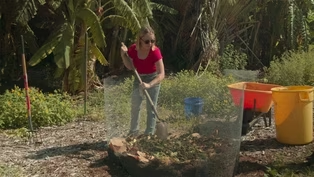
Preview: S2021 Ep8 | 29s | Learn more about this eco-friendly activity and community efforts to increase composting. (29s)
Providing Support for PBS.org
Learn Moreabout PBS online sponsorship













Support for PBS provided by:
Up Close With Cathy Unruh is a local public television program presented by WEDU