State of the Arts
State of the Arts: August 2021
Season 39 Episode 8 | 26m 47sVideo has Closed Captions
Kids make films in Trenton, Alea explores Latin American music and The Curse of Quon Gwon.
TV and film actor Joseph Halsey returns home to Trenton to teach local kids the craft of filmmaking. At Two River Theater’s outdoor stage, Alea explores the musical heritage of Latin America, from cumbia, vallenato, ranchera, and jazz to pop. And, in 1916, 20-year-old Marion Wong wrote and directed The Curse of Quon Gwon. Now her descendants are seeking to secure its place in film history.
Problems playing video? | Closed Captioning Feedback
Problems playing video? | Closed Captioning Feedback
State of the Arts is a local public television program presented by NJ PBS
State of the Arts
State of the Arts: August 2021
Season 39 Episode 8 | 26m 47sVideo has Closed Captions
TV and film actor Joseph Halsey returns home to Trenton to teach local kids the craft of filmmaking. At Two River Theater’s outdoor stage, Alea explores the musical heritage of Latin America, from cumbia, vallenato, ranchera, and jazz to pop. And, in 1916, 20-year-old Marion Wong wrote and directed The Curse of Quon Gwon. Now her descendants are seeking to secure its place in film history.
Problems playing video? | Closed Captioning Feedback
How to Watch State of the Arts
State of the Arts is available to stream on pbs.org and the free PBS App, available on iPhone, Apple TV, Android TV, Android smartphones, Amazon Fire TV, Amazon Fire Tablet, Roku, Samsung Smart TV, and Vizio.
Providing Support for PBS.org
Learn Moreabout PBS online sponsorshipHalsey: Have your body say what you -- Narrator: Actor Joseph Halsey is back in his old neighborhood to teach Trenton-area kids the art of filmmaking.
Halsey: I want them to become whatever they find their passion for.
I actually think a lot of our kids are gonna wind up in politics, and they're gonna use these acting techniques to get elected -- at least, I hope so.
Female Narrator: The lost story behind America's first all-Asian silent movie is reconstructed by a fairly Dickinson University professor.
Siporin: "The Curse of Quon Gwon" is one of the greatest unsung master stories of silent cinema, and that it was made by a woman who was barely 20 years old... Alexa: Violet Wong was an immigrant, she was the star of the first Asian American film, and she was my great-grandmother.
Jiménez: [ Singing in Spanish ] Narrator: And the Latin duo of ALEA.
brings their singular blend of styles to Two River Theater in Red Bank.
Jiménez: These songs, some of them were called piquerias, which is kind of a way of, like, narrating in a poetic way.
My own take in lyrics about my family, about my land.
[ Singing in Spanish ] [ Music plays ] Female Narrator: "State of the Arts" going on location with New Jersey's most creative people.
[ Music plays ] Announcer: The New Jersey State Council on the Arts, encouraging excellence and engagement in the arts since 1966, is proud to co-produce "State of the Arts" with Stockton University.
Additional support is provided by The Geraldine R. Dodge Foundation and these friends of "State of the Arts."
[ Music plays ] [ Music plays ] Woman: Act 6, Scene 1, take 1.
Halsey: As soon as she gets set, then you state your line, okay?
Woman: For the Preston Area Community Foundation... Halsey: But I do feel struggle breeds and adds to your creativity.
And I love working with young people who have been through some stuff already.
And this is where we came from.
Growing up in the city of Trenton -- which is where our main headquarters is here -- you know, I found my way into different mischief.
And when I was involved into the arts, it seemed like my focus was able to be redirected in a more positive way.
Before the damage to our design is irreversible.
Man: You mean your design don't you?
Male Narrator: Joseph Halsey started out in film and television in the 1980s.
He now plays a recurring role as a police officer on "Law & Order: SVU" -- the longest-running prime time live action series on TV.
Stabler: Other ways to get down there?
Cop: Just one.
You have to come down the front stoop and -- Narrator: He's back in his hometown of Trenton, New Jersey, to produce independent documentaries like this one that brings kids who've had run-ins with the law into conversation with police officers.
Boy 1: How do you feel when you see your partner getting aggressive with a person that did nothing to him?
Cop: In your mind, you didn't do nothing, but because we know what we know, we know we have all the right to arrest you.
Boy 2: Y'all say we judge y'all...
Male Narrator: He's also teaching local kids the art of filmmaking.
Joe has established a foundation in his father's name to do just that.
Halsey: My father, who is the namesake of the foundation -- the James R. Halsey Foundation of the Arts -- taught me as a young kid.
You know, he was our coach.
And he took every kid that seemed not to be wanted because they lacked some sort of athletic ability, and he exploited their strength to make them a part of a whole team.
The biggest challenge is that we have to remember where we're at.
On more than one occasion, you know, the class was taken up.
But just listening, because some of our kids have lost somebody to gun violence, Boy: They feel like it's -- Halsey: A good amount of our kids deal with challenges that a lot of people aren't aware of.
Male Narrator: One of his student filmmakers -- a recent grad from Trenton Central High -- is going to Harvard University.
Vasquez: When I started off, I was very shy, very, like, to myself.
And when they wanted me to be part of the acting crew, which meant that I had to act in front of the camera, I wasn't really willing to do so.
But Mr. Joseph, he obviously wanted everyone to do a little bit of everything.
So he encouraged me to, you know, act in front of the camera at least once.
Try it out, see how I feel.
And he made sure that I felt comfortable.
Halsey: Our Harvard-bound Eric.
What we supplied him with was just a place to express himself.
And then all of a sudden, this young, quiet Latino kid was on every billboard and on every video that the city puts out, and he's thriving.
Yeah?
What was some of your better or favorite times here?
Vasquez: I enjoyed the time that you brought me into the documentary that you worked on.
That was very professional, and I thought -- you know, I really enjoyed it.
Halsey: Our current kids -- our young students -- just finished up.
They were all in the "Zombies; An American Horror Story."
Woman: Act 4, Scene 1, Take 2.
Girl 1: [ Gasps ] Girl 2: How?
Girl 3: What's the matter, girls?
Looks like death came for you.
Girl 1: You did, as well.
Girl 2: How do we stop it?
Halsey: Have your body do the language.
Your body language was great.
You're like, "Oh, my God."
Jules: I think my next step from here -- I think I'm going to go to New York to do more theater.
Welcome James R. Halsey Foundation of the Arts, and this will be our new crib.
Halsey: Another reason why I got into it was, I was that kid who could have gone to the wrong place on the road, but art put me in the right direction.
Once I found that focus, I became lasered in on it.
Went to Florida School of the Arts and moved to New York.
Yes, I was waiting tables, and that's how I was able to get my first TV job.
I waited on the casting director for "Bill Cosby."
And he looked at me and he said, "Are you an actor, by any chance?"
And I said, "Well, I'm young; I'm cute.
I'm waiting tables in New York.
What do you think?"
[ Laughs ] And he called me in.
Man: One pizza and one pint of coffee ice cream.
Mrs. Huxtable must be out of town.
Male Narrator: Given all that's happened with Bill Cosby, we asked Joe how he now feels about his first big role on national television.
Man: Thank you.
Enjoy your slice.
Halsey: I can't speculate on anything that happened when I wasn't there or if I wasn't in the room.
So, for me, at that time in my life, it was incredible.
I mean, my mother was -- You know, her son's on national TV.
At that time, it was the number-one rated TV show in America.
And, you know, that was my moment.
That was my moment, and it was great.
But also...
It's up to me as an educator now to guide children in the right way of treating each other.
And what I can tell you is this -- this new generation, they are more accepting of other cultures and other ideas and other sexualities.
They're like, "Whatever."
They really are.
They are so much more open-minded than we have ever even thought of being, and I think that's gonna help with situations that we've seen in the past.
So, that gives me hope.
That gives me hope that some of these things that do come out in our industry are gonna stop, and it's gonna change.
There's so many benefits to what we do, and what's better than sharing a meal with a couple of young people who have great ideas?
And we do share a meal every Wednesday, because I want them to become whatever they find their passion for.
I actually think a lot of our kids are gonna wind up in politics, and they're gonna use these acting techniques to get elected -- at least, I hope so.
I wish I had more time in the day.
Put it this way -- what I would want 10 years from now is a full-time free art school for kids that would not have that opportunity otherwise.
That was good.
That was good!
Girl 1: We didn't say it!
Halsey: Oh, you didn't say it?
All right.
Happy anniversary.
Girl 2: Happy anniversary.
Halsey: Cut!
All right.
[ Music plays ] Female Narrator: Later on the show, the Colombian-Mexican duo ALEA performs their unique blend of Latin music.
But first, new discoveries about one of the first Asian American films.
[ Music plays ] Alexa: There's this thing that we see in Hawaii called "talk story," and it's when friends and family gather around and you just talk for hours and hours and hours about things that happened in the past.
[ Music plays ] I was one of the few Asian Americans whose great-great- great-grandparents were the ones who immigrated.
I feel like I am constantly trying to find those connections.
Growing up, so many people would stop me and tell me how much I looked like Violet.
She had these Cupid-bow lips, and her eyes were gorgeous.
Her eyebrows were so expressive.
Violet Wong was an immigrant, she was the star of the first Asian American film, and she was my great-grandmother.
[ Music plays ] "The Curse of Quon Gwon" is a film that was written and produced by my great-great-Aunt Marion.
Siporin: "The Curse of Quon Gwon" is one of the greatest unsung master stories of silent cinema, and that it was made by a woman who was barely 20 years old with no formal training, no film school, no prior experience, but with just such an innate, excellent sense of story blows my mind.
Gregory: She played the villainess.
She raised the money.
She had family and community support.
Siporin: Everyone in the entire Wong family was involved in some respects, whether it was making costumes and sets or securing finance.
Alexa: There were three generations of Asian American woman from my family just acting alone, not even including all the people working backstage.
Marion was bold.
Marion didn't stay in the confines of what the youngest daughter of a Chinese American household was expected to be.
She was a trailblazer.
Gregory: Marion grew up in Oakland, California.
The emerging movie industry was around her.
The Orpheum Theater, Paramount, Fox -- all developed in that neighborhood.
They would have, you know, the nickelodeon machines.
They were, pop a nickle in and see short movies.
Siporin: Women were making films about themselves for other women all throughout the early silent era -- tons of these heroic shorts about female action heroes.
And it was films like this that Marion Wong would have been seeing in the early 1910s, up until the year 1920, when there was what I call a "soft purging" of female influence from Hollywood.
[ Music plays ] "The Curse of Quon Gwon" gets made in 1916.
In 1917, Marion and her mother, Chin See, took the film -- its original full five reels -- to New York on the train to meet with distributors.
Alexa: But it was rejected.
And then, after that, World War I hit, and, as we all know too well today, a pandemic hit.
Siporin: And in the process of editing down a more streamlined version to meet their demands, she gave up.
Alexa: The family kept quiet about the film afterwards.
Siporin: Over time, people throw things away, unfortunately.
Things get damaged.
Alexa: We were missing several reels.
We didn't have the original dialogue of the film.
Gregory: Our family was embarrassed and ashamed that it was a failure.
Siporin: The film went largely ignored and unappreciated because the surviving footage lacked preserved intertitles.
And for decades, the plot was believed to be permanently lost.
[ Music plays ] Alexa: In June, 1968, my great-grandmother, Violet, took my dad to her basement, and she pointed to a corner.
And there was this brown container just placed next to a water heater.
And she told my dad, "You do something with this."
And he took these reels, and he converted them to 16 millimeter.
Gregory: And these two versions were merged in 2004 by the Motion Picture Academy and digitized to what we have today.
[ Projector whirring ] [ Music plays ] Siporin: I remember the first time that my husband John and I watched "The Curse of Quon Gwon" that immediately as the credits began to roll, the first thing he said was... John: Well, that was baffling.
Siporin: I had no idea what it all meant.
But I was thinking one day, "Isn't it strange?
Isn't it a lucky coincidence that the title card is preserved that says the name of the film?
That every major plot point in the surviving footage is there?"
The golden key to cracking this code was through a thing called the lexicon of gestures.
In silent film, actors use their entire bodies to express emotions or even plot points.
When I would watch the film, I would pay very careful attention to the gestures, knowing and understanding that they were a preservation of the lost plot.
I've watched each segment -- each scene of it -- probably hundreds of times -- practically frame by frame, breaking down the film into the most essential building blocks of human motivations.
Alexa: The hair scene is a great example where, you know, she's fighting with the servant girl about how she's supposed to do her hair for a very important and traditional tea ceremony.
But Violet prevails, and she gets to keep her bangs.
That character is so American that she pushes back against what the family wants her to do.
Siporin: The plot descriptions that we inherit from the 1910s newspaper clippings are intentionally misleading.
This isn't about a Chinese God punishing a family for becoming too Westernized.
Alexa: What the film is really about is trying to understand Chinese culture... but also being so American that you don't know where to start.
Siporin: Our goal here is to return what has been stolen -- to give back the truth; to set the narrative straight.
Alexa: How lucky are we to connect with our relatives who are long gone through cinema?
I never met them, but I got to experience their youthful energy as if they had never left.
[ Music plays ] Marion Wong was going through many of the same identity crises that I am, as an Asian American woman.
I do feel a responsibility to carry on this story... and continue protecting it.
I think that's been passed to me.
[ Music plays ] [ Music plays ] [ Music plays ] Male Narrator: Next up, ALEA travels through Latin America with music.
[ Music plays ] [ Both singing lively tune in Spanish ] [ Music plays ] Jiménez: I come from a very small town in the North Coast Peninsula that goes into the Caribbean Sea in Colombia.
[ Music plays ] ALEA's my artist name.
I just wanted something to, like, signify everything that I wanted to do in music, and "ALEA" just came to be that name.
[ Music plays ] Dias: When we've done the work that we've done here around Latin theater and reaching out to the Latinx community, I've realized that there's a huge and rich, diverse population of Latins here in this part of New Jersey and a wonderful mix of the cultures.
So our plaza series is trying to represent as much of that as we can.
Jiménez: [ Singing in Spanish ] [ Music plays ] I graduated in communications in Columbia, and then, somehow, I got to get here to Berklee College of Music, which is where I finished jazz composition and performance.
And then, made it to New York.
[ Singing in Spanish ] The moment I decided to leave for the United States, I had already decided, "I'm going to make a career out of music."
Every step of the way -- the classes, the piano, the dance, branding, creating a video -- all of that was part of the same decision.
Isunza: I have family in different parts of Mexico where the Native American and West African music get mixed -- where the Andalusian music and gypsy music get mixed.
So, I start traveling around Mexico.
After that, I start traveling more in the world, looking for these roots that comprise our Latin American folkloric music.
[ Both singing in Spanish ] Jiménez: All these important mixtures -- we call it mestizaje -- really influences who I am.
I wanted to bring more of my roots into my music, and that's how I met Sinuhé.
[ Laughs ] Because this guy is, like, super dedicated not only to music, but with this love for culture and for, like, understanding how music and culture develop together.
So, we started kind of, like, brainstorming.
And then we got to this song called "Hecha La Sal," which means "Add Salt."
And "Hecha La Sal" is the first song that we really, like, co-wrote.
[ Playing mellow tune ] [ Music plays ] [ Both singing in Spanish ] [ Music plays ] Jiménez: It was so different from what I had in my head and from what he had in his head.
[ Singing continues ] [ Music plays ] We basically went for a currulao-huapango -- currulao from Colombia, Pacific Coast, huapango from Mexico -- and added to that a little bit of funk, a little bit of, like, sass -- some R&B to it.
[ Singing in Spanish ] [ Music plays ] "Hecha La Sal" has really connected with people because it talks about immigration.
[ Singing in Spanish ] [ Music plays ] "If, by centuries, people have been passing and crossing and traveling, trying to look for a different way of living, like, why is this wrong?
[ Singing in Spanish ] It's our nature to migrate.
It's our nature to look for better opportunities and to add your own sauce and to add that beautiful part of you to the land where you get to and just, you know, make it better.
[ Music plays ] [ Both singing in Spanish ] Isunza: A city with many different cultures has a lot of spices.
So, "sal" is the salt.
"Bring the salt" is like, offer what you have.
Enriched the communal culture and learn from the other cultures.
It's not like, "I put the flavor!"
No, it's bringing the flavor together and cooking.
[ Music plays ] Dias: I love that about Sinuhé and ALEA -- that they come from very specific places and they sort of unearth their cultures in a particular way, but they mix it together and kind of make this new American thing happen.
-[ Singing in Spanish ] [ Music plays ] Isunza: It's really important to have the two schools in every traditional music.
One school is conservative.
Needs, like, "This has to be like this, and it has to have these elements."
Because if you change that elements, music change.
That's true, and we need that people.
[ Singing continues ] And also, we need the people that -- "Yeah, but this is still alive."
And if he's not growing -- if it's not taking new influences; talking about what we are now -- it's gonna die.
[ Music plays ] So you can't just live in one of the sides.
Jiménez: [ Holding note ] Isunza: You need the balance between both.
-[ Singing in Spanish ] [ Music plays ] Isunza: ALEA came from La Guajira in North Colombia.
One of the traditional genres played over there is the vallenato.
-[ Singing in Spanish ] [ Music plays ] Jiménez: There are not very many women that represent vallenato because our culture is very chauvinist.
I have understood this since I was little.
So, for me, that was kind of hard, because I didn't want to write something in something that made me mad.
[ Music plays ] These songs, some of them were called piquerias, which is kind of a way of, like, narrating in a poetic way.
My own take in lyrics about my family, about my land.
[ Singing in Spanish ] [ Music plays ] I wanted to kind of reconnect to it and see it in a way that wasn't this negative version of what I had grown up with, but see the beauty of it.
My grandfather -- who's, like, such a gentleman -- my dad, so many that are just so amazingly passionate about vallenato, and that's what we did with "Aire Guajira."
-This is a vallenato with New York sound.
[ Both singing in Spanish ] [ Both singing jaunty tune in Spanish ] We live in New York.
We have that influences to bring to the genre with all respect.
We just want to represent what we are.
[ Music plays ] [ Music plays ] Jiménez: Many of our genres have transformed and changed over time because that's what music does.
That's the only way to move forward.
[ Singing passionate tune in Spanish ] [ Music plays ] [ Music plays ] [ Music plays ] It's important to celebrate where you come from, but then, it's also really important to bring it to where you are and to connect with the people where they are -- especially in a crowd that has never heard of any of this and something connects.
Because music has this powerful thing where you don't need to understand the words.
All you gotta do is feel it.
[ Music plays ] You know, I want to be that bridge.
I don't want to just hold on to it forever and not let it move forward.
[ Music plays ] And I just hope that people will see the positive that I'm trying to do.
[ Music plays ] [ Cheers and applause ] Thank you.
[ Distant train horn honks ] [ Speaking Spanish ] [ Laughs ] I've asked him if I passed the test.
[ Laughter ] Female Narrator: To leave a comment or sign up for our weekly e-newsletters, visit our website.
We love hearing from you.
Thanks for watching.
Woman: [ Singing in Spanish ] [ Music plays ] [ Music plays ] [ Music plays ] [ Music plays ] Announcer: The New Jersey State Council on the Arts -- encouraging excellence and engagement in the arts since 1966 -- is proud to co-produce "State of the Arts" with Stockton University.
Additional support is provided by The Geraldine R. Dodge Foundation and these friends of "State of the Arts."
[ Music plays ]
Video has Closed Captions
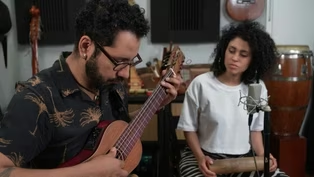
Clip: S39 Ep8 | 8m 8s | ALEA explores the musical heritage of Latin America, from cumbia and ranchera to pop. (8m 8s)

Video has Closed Captions
Clip: S39 Ep8 | 8m 1s | The first Asian American film is restored. (8m 1s)
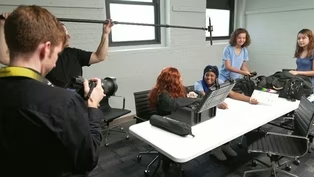
Homecoming: Actor Joseph Halsey
Video has Closed Captions
Clip: S39 Ep8 | 6m 50s | Actor Joseph Halsey returns home to Trenton to teach local kids the craft of film making. (6m 50s)
Providing Support for PBS.org
Learn Moreabout PBS online sponsorship

- Arts and Music
The Best of the Joy of Painting with Bob Ross
A pop icon, Bob Ross offers soothing words of wisdom as he paints captivating landscapes.












Support for PBS provided by:
State of the Arts is a local public television program presented by NJ PBS