Compass
August 2023 Edition
Season 6 Episode 9 | 27m 45sVideo has Closed Captions
Apollo High School Majorettes dance team & the latest from Minnesota’s Alt-Meat Revolution
Learn about the St. Cloud High School Apollo Majorettes dance team and see the latest installment of “Minnesota’s Alt-Meat Revolution."
Problems playing video? | Closed Captioning Feedback
Problems playing video? | Closed Captioning Feedback
Compass is a local public television program presented by Pioneer PBS
Compass
August 2023 Edition
Season 6 Episode 9 | 27m 45sVideo has Closed Captions
Learn about the St. Cloud High School Apollo Majorettes dance team and see the latest installment of “Minnesota’s Alt-Meat Revolution."
Problems playing video? | Closed Captioning Feedback
How to Watch Compass
Compass is available to stream on pbs.org and the free PBS App, available on iPhone, Apple TV, Android TV, Android smartphones, Amazon Fire TV, Amazon Fire Tablet, Roku, Samsung Smart TV, and Vizio.
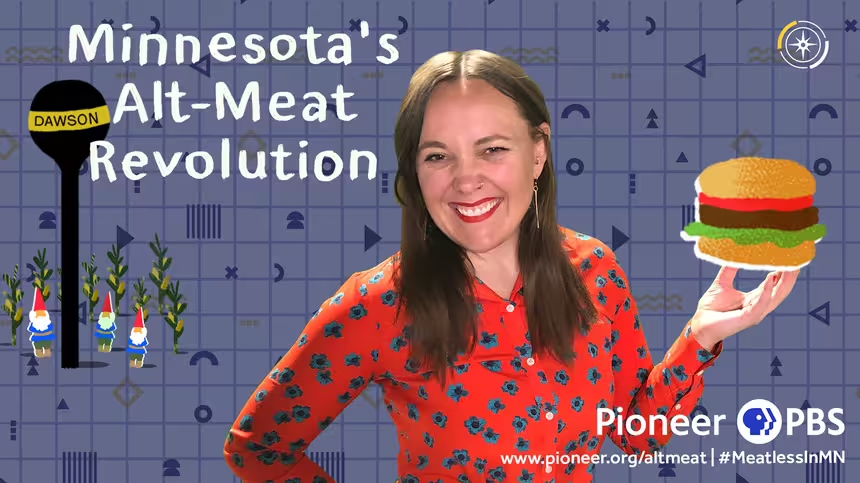
Minnesota’s Alt-Meat Revolution
“Minnesota’s Alt-Meat Revolution" is a year-long video and print journalism collaboration project, looking into the roots and impact of the plant-protein phenomenon that’s exploding across the globe.Providing Support for PBS.org
Learn Moreabout PBS online sponsorship(bright uplifting music) (gentle piano music) (upbeat music) - [Amanda] Funding for Compass is provided in part by Shalom Hill Farm, the Corporation for Public Broadcasting, and Members of Pioneers PBS.
Thank you.
(bell chimes) - So, yo, my name is Ms. Black!
I'm just kidding.
Okay, I'm just kidding.
- [Amanda] Ms. Shana Black, coach of the St.
Cloud High School, Apollo Majorettes dance team, is a vibe, checked and verified by her students.
- I don't wanna see and one, two, three, four, five, six, seven, eight.
One, two, three, four, five.
I wanna see, one, two, three, four, five.
- [Grace] I am kind of...
I'd say a second manager.
Right beneath Ms. Black, then I'd like to say I'm here that's just me.
But no, I do have a lot of running behind the scenes.
Ms. Black needs something, I get it and it's there in, (student snaps), yeah.
But why I've stayed is Ms. Black herself, she has brought so many people together.
(marching band music) - [Shana] Majorettes is a combination of jazz, tap, cultural, stomp, hip hop, all in one, and you dance with marching bands normally.
It's part of my culture and this is how we just celebrate and have fun.
- [Amanda] And her recruitment methods were intentionally all inclusive.
- [Bri] Ms. Black approached me in the hallway with a flyer.
She was like, "Oh my gosh, I have this dance team.
We're starting."
And I looked at it, I'm like, "Dance, I can't dance."
I think I just want to prove everyone wrong that I can do it and I'm not just invisible quiet girl that sits in the back of the class.
I really wanted to break outta that shell and venture out and show some personality.
Everyone's very welcoming.
[Shana] There's no strict, there's no formal.
We all have crazy personalities but they clash and they blend together very real.
And then it helps that Ms. Black, I consider her like a second mom 'cause she reminds me a lot of my mom.
So that was just like another big family community.
- [Shana] No requirements, I do want to know if... What you can bring to the table because I don't wanna force you to be dancing.
So if you like to do hair, then you could do hair.
If you like to do makeup, then you could do makeup.
If you wanna help choreograph the dancing, you can help choreograph the dancing.
- [Amanda] While it's a dance team, Ms. Black makes room for those who want to participate and the team has a variety of needs, like a show announcer.
- All right, so next up we got a dance battle.
It's gonna be Superstar and On Point.
(crowd cheering) Majorette names are super important because they represent you as a person and how you are significant to the team.
Alright, so next up we got another performance for you.
It's Top Model and Unexpected with Space Between.
(lively hip-hop music) (time-warped music) - [Amanda] According to the Minnesota Department of Education's report card, as of February, 2023, 70% of students in the St.
Cloud school district received a free or reduced lunch compared to 43% statewide.
According to the state's data, this district is considered high poverty.
- So I noticed there was a lot of kids that was not in any sports or activity.
And I thought about those kids that couldn't afford to do it because I was that kid that couldn't afford to do it.
- It's a prime representation of equity.
It's unconditional, right?
The Majorettes, Shana has developed... Has created an opportunity for students that removes barriers.
Barriers of experience, right?
You don't have to have started dance when you were 5 years old but rather you are welcome into this space as long as you're, you're wanting to move.
- [Amanda] Ayan Omar has been the Director of Equity Services since December of 2022 and is the first Somali American person in the position.
- And when I think of equity in the work that I do, in my role it's always about, what are some additional barriers, burdens, that we need to remove in this decision?
And Shana's really taken that approach with the Majorettes.
- Oh, just think about this space.
I mean, who did I use as an example?
- Ms. Black.
- Ms. Black, right?
Ms. Black is doing equity work, why or how?
- She giving opportunity to everyone.
(inspirational music) - [Shana] There's so many restrictions to be a part of so many different clubs and so many different things and we don't have any restrictions.
We just want you to feel comfortable if not...
I want everyone to know this is a positive social environment.
- I like Majorette because it's the style of dance that I do.
They kind of have this African style that I really like.
And because that dance is easy to do and also because in the Majorette group, you can found friends, people can support you, if you have any problem, help you.
- I just did it to improve my confidence and it's a hobby that I didn't really know that I would get into, so I guess that's kind of why I did it.
- [Amanda] Yeah and do you feel like your confidence has improved?
- Definitely.
- [Amanda] Why is that?
- I think it's because it allows me to be myself more and that I have people that I can relate to that didn't really have a lot of dance experience.
- So tonight's our final showcase of Majorettes Last Ride.
So we're gonna perform all of the dances we did at the games the whole year.
- [Amanda] During the school year, you can find a Majorettes performance during the halftime of Apollo sporting events.
And their final event was an accumulation of a year of performances.
(upbeat techno music) - [Ayan] Every teacher that goes into education, goes into it with the intent of inspiring young hearts using their natural needs and curiosity, and just fostering that by being inviting, and creating the space and showing up, right?
Kids just need more adults to keep showing up for them.
- So it kind of give them the confidence to... "You know what, I will go out for the speech team.
You know what, I will go out for theater."
(upbeat music) - Shaya Black is leaving the St.
Cloud School District and the Majorettes dance team and the Majorettes are looking for a coach for the 2023-2024 school year.
(upbeat music) (inspirational tones) - [Narrator] The Harrington-Merrill House is a central part of the storied history of Hutchinson, Minnesota and preserving it speaks to the spirit of today's community.
- Hutchinson was settled in 1855, when the three Hutchinson brothers, John, Judson, and Asa came west looking to start their own settlement and so they came to Hutchinson.
They all laid out their 160 acre plots.
Most of the buildings at that time were a little log shanties, very small.
However, in 1858, Louis Harrington built the first wood structure in Hutchinson, which was a feat at the time because it was very hard to get lumber into town when you had nothing but oxcart trails and foot trails to traverse.
The House stood...
It was actually a popular place for Little Crow.
Little Crow was the Dakota leader from the Dakota Band of Sioux that were in Minnesota.
And Little Crow actually came to this area in Hutchinson quite often, and he would visit the Harrington's.
And he was actually good friends with Louis Harrington.
- [Narrator] Because of broken treaties and delayed annuity payments among other things, some Dakota people waged war on the U.S. government to try to reclaim land.
This war included an attack on Hutchinson in September of 1862.
- When the attack came, every building in Hutchinson was raided except for the stockade and the house.
The the house is stands..
It has standed the test of time.
It's been here since the beginning, it's still here today.
It has survived a war, it has survived grasshopper plagues.
It's survived everything and it's still here.
So as far as the City of Hutchinson and McLeod County go, it's one of the most important structures in the area.
- [Narrator] Lewis Harrington was also a land surveyor and designed the layout of Hutchinson in 1855, which included parks, a town square, a school site, and a church.
- If you look around Hutchinson today, Louis's 1855 design for the town is still here.
Louis Harrington's home is a symbol of the vision that the early founders had for this town.
The home needs to be preserved.
- [Narrator] When the Harrington-Merrill House was damaged by fire and threatened with being torn down.
Historic Hutchinson saw this as an opportunity to work with the city to save the property.
So Historic Hutchinson partnered with the city of Hutchinson to take the property and put it into the Park Systems.
- Historic Hutchinson started as a community with the Visitors Bureau with the intention to tell Hutchinson's story and to bring visitors to the area through tourism.
A time later, our 501-C3 was adopted and we developed our mission statement, which is to restore, preserve, and protect the living and structural history and the spirit of the Hutchinson area and to showcase these assets now and for the future.
So here we are, 23 years later, we've raised over a half a million dollars and we have ongoing projects like the Harrington-Merrill House.
- [Narrator] Since over the years, many changes were made to the structure, a decision was made to restore the house to its 1900 grandeur and historical architect, Robert Claybaugh, was hired to assure that the renovation was historically correct.
It was also decided to rebuild the west wing of the house that had been destroyed during the fire.
Money was needed to restore the house and the project received great support from individuals, foundations, business leaders as well as galas and other fundraising events put on by Historic Hutchinson.
That began about a 10-year journey of restoration, where the house was raised and put on a new foundation.
The color was determined and the west wing was rebuilt with peg and beam construction, no nails to the frame.
The windows were restored by a historically accurate window company.
By 2012, the Harrington-Merrill House project was completed on the exterior and it was nominated to the National Register of Historic Places and it was accepted to the National Register in December of 2012.
Before Historic Hutchinson was formed, the city of Hutchinson lost important historic structures.
These include the Old City Hall and Fire Hall, the Armory, the Masonic Temple, Angsguard College, the Bathhouse, which was WPA project at the dam on Main Street, the North Star Station on Main Street where the Fireman's Park is now, and the other two rail depots.
In addition to the Harrington-Merrill House, Historic Hutchinson was also instrumental in saving the Quast Mural, the St. John's Episcopal Church, The Depot, and the Hager Jewelry Clock.
While eight old structures are gone, Historic Hutchinson has saved five historic structures with more preservation projects to come in the future.
- Historic Hutchinson started out as being an arm of the Convention and Visitors Bureau to help tell Hutchinson's story.
But it became evident very quickly that we were also the conscience of Hutchinson when it came to the historic assets and preserving them.
It was a big leap for the city and for our group to take on such a large project but it is truly our flagship project that helps tell the story of Hutchinson and will keep on giving that gift of history to future generations.
(inspirational music) (cars passing) (bird chirping) - [John] If I had to survive off of plant-based burgers, if it was my only choice, I could survive off eating them but me as a carnivore my whole life, pretty much, I still would prefer the beef over the plant-based.
(rock 'n' roll music) But now, if I needed to change my diet, eat somethin' healthier, I would definitely go to a plant-based burger.
- [Amanda] John's sentiments on plant-based proteins are pretty common amongst locals in southwest Minnesota.
The rural town of Dawson is very much a meat and potatoes community so it seemed a little ironic when I learned that southwest Minnesota has facilities owned by a couple of influential plant-based protein companies.
Like, Eat Just has a plant in Appleton that has the capacity to put out 29 million plant-based eggs per month, the most in the world.
And in Dawson, Minneapolis based PURIS opened the largest operating yellow field pea processing plant in North America.
PURIS caught the eye of ag giant Cargill, and by 2019, Cargill had invested $100 million in the company.
So what is PURIS and how did pea protein make its way to Dawson?
(soft rock music) The Rusty Duck has been a popular bar and restaurant here in Dawson for 14 years.
Situated just a few miles from PURIS, Co-owner Tom Beals remembered what it was like when PURIS first moved to town.
- Tons of contractors, it would be nuts in here.
Our placement was full of steelworkers, electricians, you name it, they were... Yeah, it was great for business for a long time.
- [Amanda] I wasn't there but the way that Tom described it, it was fun, it was exciting, something new was coming to town and to The Rusty Duck menu, came something Tom never could have imagined.
- Oh, we got a veggie burger.
- [Amanda] Veggie burgers.
- We put it on the menu after PURIS had started here, I pretty much just decided it was a good business decision to support them and what they were doing and put it on the menu, and if people wanted it, were asking for it anyway, then let's roll with it.
- Why do you think more and more people are asking for veggie burgers?
- I don't...
It just seems like it's more of the way now that people are looking for plant-based food, even out here in this economy.
(southern rock music) - [Amanda] So can you tell me what brings you here today?
- It's only place in town, I can get a plant-based burger.
I swapped to a plant-based lifestyle about five, six years ago.
- [Amanda] Why?
- Health.
- Kenyon is the Environment Health and Safety Manager for PURIS and just happened to be grabbing lunch in The Rusty Duck.
His was the only veggie burger ordered for lunch that day.
Tell me about your veggie burger.
What do you get on it?
What's your favorite?
How do you like it prepared?
- [Kenyon] Typically just, just take 'em off of the grill.
Pretty basic, lettuce, onions, ketchup.
- The challenge PURIS sees for the future of food, is creating a product that's plant-based, nutritional, and maybe most importantly tastes good.
- When we founded the business, and I say we super generally because I was two, when my parents founded the business back in 1985, we had nothing.
It was started in our basement and my dad said that we were gonna create a plant-based food company.
(relaxing music) - [Amanda] And that was a revolutionary idea in the 1980s.
Nicole's parents, Jerry and Renee Lorenzen, thought that a food system that feeds animals to feed humans was inefficient and unsustainable.
So they thought to take out the middle cow and directly feed people, nutrient rich plants.
- [Nicole] So his belief was that if people are gonna eat plants, then the plants need to taste good.
And so at a very young age, my brother and I, we really had to pull our weight.
We grew up working in the fields.
We had test plots kind of all around the Midwest, maybe 10 acres, 20 acres but they'll have thousands of varieties in 'em.
And so we grew up cross pollinating plants to make new varieties.
We did that all the way through college.
My dad, we were from southern Iowa, he planted one of his test plots in Ames in the town I went to school in so that I could still do the crossing that summer.
- [Amanda] Definitely a dad power move.
But like many kids, Nicole wasn't a hundred percent sold on taking on the family business.
She did know she wanted to help people.
- [Nicole] And in my professional career, we were working on training devices that treated cardiovascular diseases.
And the thing that always kind of stopped me was that diet and exercise would prevent a lot of these things for a lot of people.
And there's so much...
There's so much power in the food that we eat and how it impacts our health and our longevity.
And that was really for me when I came back to the family business, I saw an opportunity to take what I had learned in this other field and start applying it earlier in people's lives.
- [Amanda] PURIS has 225 employees and is trying to compete with giant multinational food companies.
Their special sauce has been the yellow field pea.
- [Nicole] And so when we created our pea protein, which was commercialized in 2015, it was very novel onto the market in North America.
And that set us on really what happened over the next almost 10 years, which has been this incredible journey of pea protein taking the market by storm.
It's had just, it is had a complete revolution over the past three years.
When that happened, we had already invested into our second facility and that's the facility in Dawson, Minnesota, which is one of the largest and most state-of-the-art pea protein processing plants in the world.
- [Amanda] This is around the time that Cargill was like, "Here's a hundred million dollars PURIS, keep it up."
And Dawson was also like, "Yeah, keep it up."
Because that building had been vacant from 2014 until PURIS bought it in 2019.
- It was good to see that something was going to use that plant, I just didn't... Was surprised at how big a transition they did out there from a milk plant to what it is now.
- [Amanda] One of the reasons PURIS set up in Dawson was this building built by Dawson Mills in the late 1970s.
It's been the home for several food producing companies, some that even did plant protein processing before it was as popular as it is today.
- I'm Randy Tenson, I'm the mayor of Dawson.
I'm also have ownership of the barbershop in Dawson and it's been here for 37 years.
- Randy is a busy guy, as you can see.
We caught up with him in the middle of a cut.
- So my name's John Parsons, I work out at PURIS here in Dawson.
- [Host] How often do you get your hair cut?
- Once or twice a month.
- Do you come here usually?
- Ever since I moved to town, I come here.
- [Host] How does his hair behave for you?
- He got really thick hair so it's really easy.
- [Amanda] John is an instrumentation and electrical technician.
He moved to Dawson to work at the new building, which processes peas grown all over North America.
The split yellow field peas come here after their cleaned, de-hulled, and split in Puris' facility in Harold, South Dakota.
- So this is our splits, receiving, and storage.
- [Amanda] You've heard of split pea soup, yeah?
- You take that outer shell off and it falls into two pieces, right?
So we call those splits and what we receive here in Dawson is cleaned, yellow split peas.
Once here, we grind them up into a flour, put it into a solution and then we do a bunch of separations after that.
- [Amanda] But why peas?
- A pea consists about 20 to 25% protein.
- And that's higher than a lot of other legumes or... - Well, soy actually has a higher protein content but you get the allergens that come along with that.
And another thing about pea protein that makes it a little more attractive is our taste and texture.
So our customers have found that pea protein has a different mouthfeel.
- [Amanda] While people have been able to consume PURIS pea protein in partner companies products, most notably as the pea protein ingredient in Beyond Meat products.
PURIS only recently came full circle with their business with the 2022 launch of their own food line, AcreMade.
- [Nicole] I personally have an an egg allergy and so it's for me, something that I always wanted.
And so we put our team on how can we create awesome plant-based eggs from peas?
- What we're gonna do here is we're gonna showcase the powdered AcreMade egg substitute in a scrambled egg format and we're gonna put it on some avocado toast.
So our product itself is shelf stable.
So for somebody who isn't necessarily looking to like get rid of their eggs within like a couple of weeks or so, this is something that can last a year to two years.
So... - So zombie apocalypse.
- If zombie apocalypse happen, these will be in all the bunkers, for sure.
So, we have the powder here and then from here we're gonna add some cold water.
(upbeat jazz music) - Wanna cheers?
- Cheers.
(lively jazz music) - It's good.
- [Nicole] Our dad really challenged our team to say, if we can make pea protein taste just as good as any other proteins on the market then we might have something.
- [Amanda] Taste is so important.
So what do people in Dawson think of the plant-based burger now?
Who better to ask than one mayor and one bar owner who have never tried a veggie burger before?
(zany music) Whoa, you're just diving in?
- Well, yeah.
- Put both burgers on the char boiler, cooked them both exactly the same and I put different colored picks in them to be able to tell the difference between the two.
- Which are you gonna try first?
So you tried the right one?
- I tried this one.
- So you try your right one first.
- Okay.
(inquisitive music) - I'm pretty sure which one is which.
- Interesting... That's just a facial expression we have.
- That's a very good tasting of burger.
This is beef, this is all plant, and this one is really good.
- What do you think, Tom?
- They're they're both very good.
I think, I would guess what one is the beef and what one is the veggie burger, yep.
- That is the real meat and that's the plant based.
- So you had it right?
- Yep, yep and that's the plant based and that's the real meat.
- So you both had it- - Yep, both had it right, yep.
I was expecting it to have a taste that was pretty bland.
You think about ground up peas and that's...
I was just...
In my opinion, I would've thought it would be more of a bland... - And I even think the texture - [Ted] Amazingly- - Quite amazingly similar.
- Oh, it is.
It's very, I mean it.
- So is this the first veggie burger either of you have ever eaten?
- Yep, it's the first one I ever had.
- In your whole entire life?
- That was excellent.
- This is it?
- Yep, yes.
- I'm so glad I could be here for this moment.
- [Amanda] Today's plant protein companies seem to have figured out the main problem that plagued the companies trying to popularize plant-based protein in the seventies and eighties, taste.
And so much of how plants taste, come from how seeds are developed and grown.
In order for any protein operation, plant-based or not to be successful, it comes back to the growers because without farmers there's no plant-based egg for your avocado toast and that would be devastating.
In our next episode, we'll meet some growers who explain why they do or do not grow the PURIS Yellow Field Pea.
(cheerful music) (inspirational tones) (peaceful music) - [Amanda] Funding for Compass is provided in part by Shalom Hill Farm, the Corporation for Public Broadcasting, and Members of Pioneer PBS.
Thank you.
(inspirational music)

Clip: S6 Ep9 | 6m 49s | Majorette dance team at Apollo High School (St. Cloud MN) is open to all — dancers or not! (6m 49s)
Providing Support for PBS.org
Learn Moreabout PBS online sponsorship
- News and Public Affairs

Top journalists deliver compelling original analysis of the hour's headlines.

- News and Public Affairs

FRONTLINE is investigative journalism that questions, explains and changes our world.












Support for PBS provided by:
Compass is a local public television program presented by Pioneer PBS