
August 2023
Season 7 Episode 10 | 26m 50sVideo has Closed Captions
Visit with saxophonist Patrick Munford, Point of No Return Improv and Goodwill Industries.
Host Blue Green visits with 83-year-old saxophonist Patrick Munford, who has had a most interesting life. Then it’s off to Jilly’s Music Room to hang out with the comedy group Point of No Return Improv. Finally, he takes a behind-the-scenes tour of Goodwill Industries of Akron to learn more about the organization’s mission, online shopping service and retail stores.
Problems playing video? | Closed Captioning Feedback
Problems playing video? | Closed Captioning Feedback
Around Akron with Blue Green is a local public television program presented by WNEO
August 2023
Season 7 Episode 10 | 26m 50sVideo has Closed Captions
Host Blue Green visits with 83-year-old saxophonist Patrick Munford, who has had a most interesting life. Then it’s off to Jilly’s Music Room to hang out with the comedy group Point of No Return Improv. Finally, he takes a behind-the-scenes tour of Goodwill Industries of Akron to learn more about the organization’s mission, online shopping service and retail stores.
Problems playing video? | Closed Captioning Feedback
How to Watch Around Akron with Blue Green
Around Akron with Blue Green is available to stream on pbs.org and the free PBS App, available on iPhone, Apple TV, Android TV, Android smartphones, Amazon Fire TV, Amazon Fire Tablet, Roku, Samsung Smart TV, and Vizio.
Providing Support for PBS.org
Learn Moreabout PBS online sponsorship(uptempo electronic music) - Hey out there, Akronites.
Welcome once again to "Around Akron with Blue Green".
And as always, we have an amazing show ahead of us today.
I'm gonna head down to Goodwill and see what they're all about.
Then it's gonna be over to Jilly's in downtown Akron to check out PNR Improv.
Now to kick this show off today, I'm gonna meet up with a person that I met at Goodwill.
Let's go see what Patrick Munford is all about.
(slow jazz music) - My mother was a avid music person.
Every day she'd come home and play Count Basie and Duke Ellington's, all of those kinda things like that had fascinated me.
Plus she had a job that every day when she got off of work, she had to take the bus and go up Howard Street where all the clubs were.
And the bus, and transfer to the bus that would take us home, the Euclid bus.
And while we would be waiting there, I would hear all of these jazz guys in the clubs, playing saxophones, and able to peep in.
So it was an exciting time.
People dressed in the suits and always ties and white shirts and the big hats.
That kinda situation.
(slow jazz music continues) I become Chief Bailiff.
I was the Chief of Police.
(slow jazz music continues) Camp Lejeune Marine Corps base.
I've been a state parole officer, deputy sheriff, 25 years.
Summit County Juvenile Court, youth counselor, Marine Corps, six years.
From E-1 to E-5 sergeant.
I've had two broken necks.
I was paralyzed for a year and a half.
I've overcome cancer.
I've barely got outta kindergarten and I was the person that created the ankle house arrest system here.
That's probably now all over the world as you can see.
Some modeling agency spots me.
You know, 'cause I'm salesman for... Just 'cause I'm dressed all the time.
I become a male model up there for different ads and so forth.
I've done a lot of things from a negative attitude to a positive attitude.
Trans mutation, if you might wanna call it.
From where I come from to where I'm at now, it's been as you say, a traveling journey.
(jazzy saxophone music) The jobs meant just practice whenever I could.
But when I retired I was able to, of course, not have nothing to do except instead of retire, rewire myself and having that as a hobby and so forth.
I decided to go out on the street corner and knock on a couple doors, but I didn't get far.
I ran into the daughter of the people that work, that own the Szalay's fruit stand there.
I started off with them playing every weekend, Saturday and Sunday from (chuckles) 8:00 in the morning to like 5:00 in the evening.
'Cause it helped me get so many places that it was a kind of a magical thing.
You know, the people that would call and take my card and have me do different backyard events for 'em.
You know, the graduations.
And then I was doing fundraisers for the food bank and Cleveland Clinic.
The highlight, I think, was to be able to play to those that were departing at the Hospice Center for Cleveland Clinic.
(slow jazzy music continues) Somebody apparently had sent a video to Kenny G or his manager or somebody.
Anyway, they called the...
It used to be CIC up on Portage Trail, the music store.
"We wanna send that guy a Kenny G horn and we want him to come to Youngstown at the Stambaugh theater to have Kenny sign it."
Here I am, walking down the aisle with this horn that I'm supposed to have signed and people, "Well, who is this guy walking down to the front row, with a horn?"
And that was one of the best concerts I had.
"Now go on there", they would go backstage and he signed that.
That's a highlight.
You know, meeting him, hugging him.
Still at this point, I have a cause to get up for music.
That's what kinda keeps me alive.
(jazzy saxophone music) - Next up, it's the PNR Improv.
Let's go see what they're all about.
(uptempo jazzy music) - Once upon a time, a theater company called Antic in Cuyahoga Falls, they were putting on a production of the play "1984".
- [Actor] And you can get away with that.
- And then a few weeks into rehearsal, 911 happened.
And they decided to do the play anyways, but since 911 had just happened, people weren't really ready to go see the play version of 1984.
So the play lost some money.
And so a couple people, Bob Coppedge and Kathleen Walden decided to start an improv group, which initially was to raise money for the theater group who had lost money.
But then after that they decided to keep doing it.
The group started in February, around April.
I joined the group at the same time as Phil actually.
And we've been going ever since.
And that was in 2002 is when the group actually started.
- Then you said, "Watch the tent."
- Whoa.
(audience laughs) - It's a lizard.
- Is it real?
Is it real?
- No, the lizard is real.
- Oh, yeah.
- Oh my God.
- Oh my God.
- Oh my God, I think the lizard's coming in the tent.
The lizard's in the tent!
- And scene.
(audience cheers) - Jazz musicians still have to practice is how I would put it.
We do various exercises to essentially teach us how to communicate with each other 'cause ultimately, a lot of improv is just sort of an idealized form of communication where that's really what it's all about, is people on stage reacting to each other is how I would describe it.
- Hello, Tooth Fairy.
Welcome back.
As you can see, I've lost three more teeth.
- You're supposed to be stemming through this parts, that way more the magical.
- Tooth Fairy, you and I both know the magic stopped in this transaction a long time ago.
(audience laughs) By the way, I've upped my price.
- I would say it's pretty great.
I would say that it is probably the closest that I feel to God.
(laughs) I don't know.
It's what I do at this point.
It is my way of being.
It is honestly...
It is an incredible, it's quite a ride.
I'm at a point, I've been doing this since 2002.
So to me it's almost automatic, really.
I just get on stage and stuff starts happening.
- I mean, to be honest, your quite a disappointment.
I mean, I don't...
I just wanna be honest with you so that you can improve.
And I still love you, but yeah, you kinda suck.
- Yeah?
(audience laughs) - I'm not fan off...
I'm not a big fan.
- I suck?
- A little bit.
- Your firstborn child and I suck?
- Yeah- - I know, it's all about that 36 hours of labor you had to go through!
That's why you hate me!
- That's a big part of it.
- Yeah, yeah.
Well, you just really hate me.
You don't even want me around.
- Freeze.
- Freeze.
- You just really hate me.
You don't even want me around.
- Yeah, so what?
(cast laughs) - I think that improv is a beautiful art form.
And I really hope that...
There's a lot of improv going on here in Ohio right now.
And I think that's great.
There's a strong community in the Cleveland area.
PNR has been doing great here in the Akron, Cuyahoga Falls area for like 20 years.
21 years, actually.
- Yeah, how scary that mask is though.
I thought there was a monster in the basement, okay?
And it was right at the bottom of the stairs.
And Mom, I can't go down there.
- Well, you gotta do this on the feet, you know, it's therapy, okay?
Here, let me put on this one.
(Phil growls) (Roxanne screams) - What's that for (mumbles indistinctly).
- Let me get this clown- - Please stop.
I'll go down if you stop doing that, okay?
- Here, go down and face the clowns down there.
- Freeze.
(claps hand) The clown is down there.
- Okay, all right, okay, you go.
- No.
(audience laughs) Oh, man!
- Honk honk!
(audience laughs) - You have to go.
- He's got one of those squeaky balls.
- I think that you're fine, please?
- Honk honk.
- Oh my God.
- You're the older brother, okay?
You need to do this for me, please.
- Excuse me, sir.
- Honk honk.
- Oh God.
- Freeze.
(claps hand) (cast talk indistinctly) Honk honk.
- Dude, that is such a hilarious bit.
Oh my God!
- (laughs) I know.
- No wonder they call you the best clown on earth in 1834.
(audience laughs) - Thank you.
- All right, so my advice would be to go see an improv show so you know what kinda thing it is, at least from the outset.
And then I would probably recommend a person take some classes or become involved in some type of organization that'd be willing to teach you the skill sets.
(slow jazz music) - Next up, it's off to Waterloo Road.
I'm gonna learn all about the amazing things Goodwill does for the community.
(inspirational music) - Goodwill began in Boston by Dr. Edgar J. Helms in 1902.
And his idea was to help individuals in the community learn a skill, whether they were disabled, misplaced in work, could not find a job.
He would collect textiles, linens, so that they could be repaired and then sold in the store.
And it would then support that individual's wages.
From their other communities, saw what was happening, they got wind of it, and started just kinda piecing out, kinda franchising out if you would say, into other areas that were in need of this type of a service.
(inspirational music continues) We have almost 500 team members here at Goodwill.
We might be a little closer to 450 and we cover five counties, Summit, Portage, Ashland, Richland, Medina counties.
The majority of the workforce is in retail.
We have about 320 team members in retail.
And our workforce makes up a vast majority of individuals, some coming in that have never had a position in a job before.
So they need to learn new job skills.
Some people might just want to be a donation attendant because they retired, but they don't want to not work.
So they get their socialization and earn some money that way.
We also offer all of our facilities as training centers.
So if we have people coming in from an agency or if we have kids coming in from the school, from the JOG program, then all of our stores are available to do some training and teaching so that they can get live hands-on skills.
(inspirational music) People come here to see friends and they come here to look for things, say hi to their friends.
Everybody that's in the resale community usually knows who's in the resale community.
So they talk and they, "Hey, what's been selling good for you lately?"
"This hasn't been doing so well for me."
And I think, theY help each other and, "Hey, did you see this item?"
"Did you see that item?"
But a Goodwill shopper is usually a pretty consistent shopper.
They're here multiple times a week, especially if it's something that they are using to make sure that their family has clothing.
You know in that instance, you have to come a few times a week and they get to know each other.
And it's the same with our cashiers and our retail workers within the stores.
They get to know the customers as well.
And I think that a lot of times they grow very, very big bonds and very great relationships and it's just something you can come, you see a familiar face, you can have a good, short conversation with somebody.
And so I think that it's kinda organically built itself that way.
(inspirational music) We do have a sewing center.
And some of the things that they do back in the sewing center would be first of all, for Goodwill.
This sewing center makes all of our vests for our donation attendance.
It makes all of the aprons and smocks for our other team members.
And then, we also offer those across all Goodwills to purchase.
So we send them out a flyer through our intra web and they get back with our sewing manager, Al Sardelle, to see if there's something that they can get an order placed or something specific that they might want.
Al's team also does things like vests for First Energy.
He also works with the Ohio Department of Transportation for sewing their vests and our jail systems to help with their laundry bags.
So there are quite a few things that they do back there.
And we basically do kitting for another company.
So if a company has something that they want to put together in a package, they can call us and say, "Hey, this is what I got."
And we call Richard MacGyver very often because he will come up with some sort of a jig or apparatus to help the team members meet the goal of getting that item kitted and how the original purchaser wants it.
(upbeat music) I hold the Round-up program very near and dear to my heart.
When I got here about seven years ago, I think the first year that I was here, we did $33,000 in Round-up.
And I challenged the team to do better.
So we doubled it the next year.
We doubled it the next year.
And then we've stayed at that pace for a few years now.
But Round-up basically stays within the community that it's taken in.
So if you give a Round-up here at our Waterloo location, that money is going to support Summit County.
And it's for anybody that is displaced.
Maybe they just took in a foster child or a family member's child.
Maybe they've had a fire in their home and they need to replace some items.
It is something where our stores are ready to help if someone comes in with a question and we can get the ball rolling for them with the application.
And it usually is a pretty quick process, especially if they've let us know, "I need this now."
We do our very best.
We can get it to 'em same day sometimes.
(upbeat music continues) - Now, let's go learn how to donate, shop, and see what the Goodwill retail experience is all about.
(upbeat music) - We can start at the donor door where donations come through.
So our donation attendants then help us get it into the building from the donor.
And once it's in the building, it goes through a process of quality checking.
And that would be through our processors.
They check it over, deem whether it needs to go into salvage.
Maybe it has rips and tears that are just too much for us to sell.
And that goes right into the salvage stream.
And if it is up to our standards, it can go out onto the sales floor or to one of our e-commerce departments that we sell through.
So there's a couple different paths it could take in the life cycle of it being in the store.
And then of course, the final resting home in a retail store is on the sales floor.
(slow upbeat music) We have quite a few different e-commerce sections that we use.
A myth is all the good stuff goes to e-commerce and it's just not true.
We take in about 18,000 tons of donations in our agency.
So that's through our 14 regular retail stores and our two attended donation centers.
Between all of those areas, we get 18,000 tons of donations.
That's a mind boggling amount of donations.
Each store is asked to send two cloth carts full a week into one of our e-commerce departments.
So it is such a small fraction that they're sending in of product.
I can't even put a number to it because the fraction is too small.
So not everything goes to one of our online shopping areas.
Many, many wonderful treasures stay in the store for our customers to be able to come in and buy.
Now, if it does get to one of our online sites, it's shopgoodwill.com.
That would be the main site where we have all the collectibles.
And the customer determines the price.
We also have an eBay store where we list textiles, purses, accessories, shoes, that type of thing.
We are also working with a new online called GoodwillFinds.com that's newer to us.
It's just in its infancy stages and it is really for everything, so that it can take on textiles, accessories, the odd knickknacks and that type of thing, and sell it all in one place.
We do have two other ways that you can purchase through brick and mortar stores.
One is the Blue Boutique.
It's in the Montrose Center.
And we would have items there that would be of a higher value so that someone that is shopping, is shopping for a purpose because they're looking for possibly a wedding dress or a cocktail dress, something along that line.
A business outfit.
We do have a lot of handbags, shoes, accessories as well.
And then the other brick and mortar would be here at our outlet store.
So once it's gone through all of the retail stores and through our e-commerce, it goes to the outlet store for one more chance to buy it per pound.
If it doesn't sell at the outlet then we get it into our salvage stream.
And at that point in time, we would bundle it together with like objects, so that it could go to, let's say textiles.
We bail those together and those textiles will go to a vendor that might shred it up and make it into stuffed animal fillings or something along that line.
(upbeat music) We do have a a vintage collection here in our Waterloo service center.
We use it for our annual Taste of Vintage event.
That is our biggest fundraiser in November.
And it is a collection of textiles, shoes, accessories from the 1800s until about the early 2000s, I believe.
We have a few things from that.
But it goes all the way back to the 1800s.
And this came about from some donations and it being recognized through a team member that used to work here in the office, "We should start saving these."
And so it really just came out of saving them.
Word caught on that we were looking for vintage items.
We still get them to this day and then we use them for that Taste of Vintage event.
(upbeat music continues) - Thank you once again for watching this episode of "Around Akron with Bluegreen".
If you have any questions or comments, you can catch me on social media.
Thank you and have an amazing day.
(upbeat music) Let's see if I can do this.
Yeah, okay, right?
A little trick, see?
(laughs) Okay, I'm done.
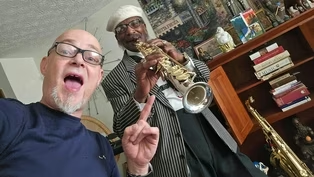
Preview: S7 Ep10 | 30s | Visit with saxophonist Patrick Munford, Point of No Return Improv and Goodwill Industries. (30s)
Providing Support for PBS.org
Learn Moreabout PBS online sponsorship













Support for PBS provided by:
Around Akron with Blue Green is a local public television program presented by WNEO