
August 22, 2024 - PBS News Hour full episode
8/22/2024 | 57m 46sVideo has Closed Captions
August 22, 2024 - PBS News Hour full episode
Thursday on the News Hour, vice presidential candidate Tim Walz gives Democrats a pep talk before all eyes turn to Kamala Harris’ speech in Chicago on the last night of the DNC. We hear from members of a crucial voting bloc about what Democrats need to do to win their votes. Plus, what Ukraine stands to gain or lose from capturing Russian land.
Problems playing video? | Closed Captioning Feedback
Problems playing video? | Closed Captioning Feedback
Major corporate funding for the PBS News Hour is provided by BDO, BNSF, Consumer Cellular, American Cruise Lines, and Raymond James. Funding for the PBS NewsHour Weekend is provided by...
August 22, 2024 - PBS News Hour full episode
8/22/2024 | 57m 46sVideo has Closed Captions
Thursday on the News Hour, vice presidential candidate Tim Walz gives Democrats a pep talk before all eyes turn to Kamala Harris’ speech in Chicago on the last night of the DNC. We hear from members of a crucial voting bloc about what Democrats need to do to win their votes. Plus, what Ukraine stands to gain or lose from capturing Russian land.
Problems playing video? | Closed Captioning Feedback
How to Watch PBS News Hour
PBS News Hour is available to stream on pbs.org and the free PBS App, available on iPhone, Apple TV, Android TV, Android smartphones, Amazon Fire TV, Amazon Fire Tablet, Roku, Samsung Smart TV, and Vizio.
Providing Support for PBS.org
Learn Moreabout PBS online sponsorshipAMNA NAWAZ: Good evening.
I'm Amna Nawaz.
GEOFF BENNETT: And I'm Geoff Bennett.
On the "News Hour" tonight: GOV.
TIM WALZ (D-MN), Vice Presidential Candidate: We're on offense and we have got the ball.
We're driving down the field.
GEOFF BENNETT: Vice presidential candidate Tim Walz gives Democrats a pep talk before all eyes turn to Kamala Harris' speech here on the last night of the Democratic National Convention.
AMNA NAWAZ: We hear from members of a crucial voting bloc about what Democrats need to do to win their votes.
LAURA BARRON-LOPEZ: Do you think that Democrats have taken Black voters for granted?
ANTOINE CARTER, Milwaukee Resident: What I see is, they assume that our vote is guaranteed.
LAURA BARRON-LOPEZ: And Ukraine's president visits the border area where his country's forces launched an incursion into Russia.
What Ukraine stands to gain or lose from capturing Russian land.
(BREAK) GEOFF BENNETT: Welcome to the "News Hour."
It is the final night of the Democratic National Convention here in Chicago, which has been unlike what anyone expected just a month ago.
In a few hours, Vice President Kamala Harris is set to accept her party's nomination for president and outline her vision for the country.
AMNA NAWAZ: Harris' running mate, Minnesota Governor Tim Walz, set the stage for her last night as he introduced himself to the American people and accepted his nomination all with some Midwestern flair.
Night three at the DNC featured rising party stars.
GOV.
WES MOORE (D-MD): That is the story of America.
AMNA NAWAZ: A parade of celebrities.
KENAN THOMPSON, Actor: What's up DNC?
AMNA NAWAZ: And a musical nod to Minnesota.
But the state's governor and evening's headliner, Tim Walz, was introduced by this group.
MAN: Come on out, Scarlets.
AMNA NAWAZ: Former members of the high school football team he once coached.
GOV.
TIM WALZ (D-MN), Vice Presidential Candidate: Thank you.
AMNA NAWAZ: In the biggest speech of his political career, Walz introduced himself to America as a small-town kid, former National Guardsman and high school teacher whose students inspired him to run for office.
GOV.
TIM WALZ: They saw in me what I had hoped to instill in them, a commitment to the common good, an understanding that we're all in this together.
AMNA NAWAZ: Peppering his speech with the familiar campaign message of freedom.
GOV.
TIM WALZ: In Minnesota, we respect our neighbors and the personal choices they make.
GOV.
TIM WALZ: And even if we wouldn't make those same choices for ourselves, we have got a golden rule.
Mind your own damn business.
AMNA NAWAZ: With his wife, Gwen, watching on, Walz recounted their fertility struggles before having their daughter, Hope, and son, Gus.
GOV.
TIM WALZ: Hope, Gus and Gwen, you are my entire world and I love you.
AMNA NAWAZ: Bringing 17-year-old Gus to his feet and tears as he pointed to the stage, saying: "That's my dad."
GOV.
TIM WALZ: I'm letting you in.
AMNA NAWAZ: The Harris/Walz campaign has embraced a direction best summed up in a single word.
REP. HAKEEM JEFFRIES (D-NY): Joy.
Joy comes in the morning.
BILL CLINTON, Former President of the United States: Kamala Harris, the president of joy.
PETE BUTTIGIEG, U.S. Secretary of Transportation: There is joy in it.
OPRAH WINFREY, Producer/Philanthropist: Joy.
AMNA NAWAZ: A message underscored in a surprise appearance by hometown hero Oprah Winfrey.
OPRAH WINFREY: We won't be set back, pushed back, bullied back, kicked back.
We're not going back.
AMNA NAWAZ: Several speakers, in fact, issued sharp rebukes of Vice President Kamala Harris' opponent, former President Donald Trump, including House Minority Leader Hakeem Jeffries.
REP. HAKEEM JEFFRIES: Donald Trump is like an old boyfriend who you broke up with, but he just won't go away.
REP. HAKEEM JEFFRIES: Bro, we broke up with you for a reason.
BILL CLINTON: So, the next time you hear him, don't count the lies.
Count the I's.
AMNA NAWAZ: Former President Bill Clinton warned of complacency post-convention as the shadow of his wife Hillary Clinton's 2016 loss still looms over the party.
BILL CLINTON: We have seen more than one election slip away from us, when we thought it couldn't happen, when people got distracted by phony issues or overconfident.
AMNA NAWAZ: And, once again, this Democratic Convention relied on Republicans to help make the case for their candidate, like former Mike Pence adviser Olivia Troye.
OLIVIA TROYE, Former U.S.
Homeland Security Official: You aren't voting for a Democrat.
You're voting for democracy.
AMNA NAWAZ: In stark contrast to the raucous cheers, a somber, steady chant broke out as the parents of Israeli-American Hamas hostage Hersh Goldberg-Polin took the stage...
AUDIENCE: Bring them home!
Bring them home!
AMNA NAWAZ: ... calling for a cease-fire and speaking directly to their son.
RACHEL GOLDBERG-POLIN, Mother of Hamas Hostage: Hersh, Hersh, if you can hear us, we love you.
Stay strong.
Survive.
AMNA NAWAZ: But outside the arena, a frustrated group of uncommitted delegates staged a sit-in after learning their request for a Palestinian-American speaking slot was denied by the DNC.
The top of the Republican ticket, meanwhile, worked to counterprogram in battleground Arizona.
DONALD TRUMP, Former President of the United States (R) and Current U.S. Presidential Candidate: Comrade Kamala Harris, she -- I call her comrade because she is a radical left Marxist.
She wants open borders.
AMNA NAWAZ: Trump's running mate, Senator J.D.
Vance, spoke at a sheriff's office in Georgia.
SEN. J.D.
VANCE (R-OH), Vice Presidential Candidate: What a dynamic duo they make, a dynamic duo for people who don't like law enforcement, a dynamic duo for people who want to make our streets less safe.
AMNA NAWAZ: Back in Chicago, Democrats are gearing up for the convention's grand finale and the historic moment their candidate will accept her party's nomination for president.
GEOFF BENNETT: All right, let's go this evening to the convention floor, where our White House correspondent, Laura Barron-Lopez, is standing by.
Laura, what can we expect to hear from Vice President Harris later this evening?
LAURA BARRON-LOPEZ: Geoff, a campaign official said that Vice President Harris is going to share her personal story, the story of being raised by a single mother in a middle-class neighborhood, and also share her story of her decision to become a prosecutor to protect others.
She's also going to emphasize what Democrats call the dangers of Project 2025 and fundamentally underscore her patriotism and where she wants to take the country, striking a contrast with Donald Trump.
AMNA NAWAZ: Laura, as we have heard again and again from speakers, it's just over two months to go until Election Day.
I know you have been speaking with Democrats and with voters.
What do they want to hear from Vice President Harris tonight?
LAURA BARRON-LOPEZ: Amna, many of the Democrats that I have spoken to, including lawmakers, don't want detailed white papers from Vice President Harris.
They don't think that she needs to be putting out 10-point policy plans.
But I spoke to Senator Brian Schatz of Hawaii, who said that he wants Harris to really emphasize her vision and direction for the country in an honest way for voters and do that over and over again, but not to box herself in, because you never know what the makeup of Congress is going to be if you're trying to negotiate on legislation.
And, also, a number of voters have told me and Democrats that they want to hear her really lean in on border security and immigration.
But some voters say that they also -- Harris is still a bit undefined for them, and so they want to hear more from her on the economy and on abortion.
GEOFF BENNETT: And, Laura, there's some lingering tension between the Harris campaign and DNC organizers and this so-called Uncommitted Movement.
Where does all of that stand?
LAURA BARRON-LOPEZ: So, last night, the Democratic National Committee denied the uncommitted delegates' request to have a Palestinian-American speaker on the main stage.
And delegates told us that they had been talking to the campaign for months about this.
The campaign had been speaking to them every day this week and had ultimately tried to get them to stop a sit-in that they started after this request was denied.
And we spoke to some of the uncommitted delegates, and they told us that they felt as though the bar that they asked for was the bare minimum of having a Palestinian-American speaker take the stage.
They weren't asking necessarily for any major change in policy at the convention.
Of course, they do want a change in policy, but not here, and that they said that they are Democrats.
They would like to be able to move towards Harris.
But at this point, they're very frustrated that their main request was denied.
AMNA NAWAZ: Laura, as we know, Kamala Harris will be the headliner tonight.
But who else should we expect to hear from on the stage tonight?
LAURA BARRON-LOPEZ: So we're going to be hearing from a number of Democrats, including Senator Elizabeth Warren of Massachusetts and Senator Mark Kelly of Arizona.
His wife, a gun control activist, Gabby Giffords, is also expected to speak, as well as Governor Gretchen Whitmer of Michigan.
She's going to be talking.
And then Maya Harris, Kamala Harris' sister, is going to be talking to the arena here ahead of the vice president's acceptance speech.
One thing I'd also like to add, Amna, is that when I was talking to lawmakers about the vibes here, they said that one big difference -- there's been a lot of comparisons between Kamala Harris and Barack Obama in 2008.
One big difference, some lawmakers told me, is that they feel as though this campaign is about all Democrats and people writ large.
They felt like Obama's campaign was much more about his persona and the celebrity of Obama.
AMNA NAWAZ: That's our Laura Barron-Lopez down on the convention floor.
Laura, thank you.
LAURA BARRON-LOPEZ: Thank you.
AMNA NAWAZ: Meanwhile, political parties traditionally don't compete too vigorously with each other's conventions.
Usually, the opposing presidential candidate holds few, if any, events.
This year, the Trump campaign is rejecting that model.
During the Democratic Convention, the former president had one of the busiest campaign schedules of the cycle.
To discuss the Trump campaign's plans and the view of the Democratic Convention, we're joined now by Lisa Desjardins, who covers the Trump campaign for us.
So, Lisa, just take us through what exactly the Trump campaign is doing here, what messages they're trying to send.
LISA DESJARDINS: Well, first try and imagine a blank map of the United States.
That is what it usually looks like for the opposing presidential candidate in this convention.
Now let's look at what's happening with the Trump campaign this week.
Here's where the former president has been this week and then also here is where his vice presidential nominee has been.
Look at those states.
Those are the key states that the teams are fighting for, both Republicans and Democrats, Arizona, Wisconsin, Michigan, Pennsylvania, and North Carolina, a state that we see Trump really wants to protect.
So you get from that map not only the important states, Amna, but also the fact that the Trump campaign and Trump campaign sources tell me they do feel like they need to step up their game.
They also point out that they did not get the chance to directly rebut their opponent, Kamala Harris, at their convention because she was not yet the nominee.
So they feel like they have to hit the ground running as much as possible starting right now.
AMNA NAWAZ: Lisa, as we have heard, the Harris campaign here is really centered on a message of freedom as central to their campaign.
Has the Trump team now settled on any kind of campaign message to run against Vice President Harris?
LISA DESJARDINS: Those who have been listening to the Trump events this week have seen he's tried out some different tactics, different messages, but sources around the Trump campaign and in Trump world tell me they think that that is kind of settling down into sort of a three point of attack.
The first was something that you reported on, Amna, this idea that Kamala Harris is liberal to the extreme.
That nickname now that he's settled on, it seems like comrade Kamala.
Obviously, she is someone who is a part of a democratic republic.
She is not a communist.
But that is something that they're going to try and tag her with.
The other two things are the biggest issues here, border and immigration.
That's where we saw the former president today, the other one, the economy.
I think that this is really the most important one for the Trump campaign, and they know it.
One source told me that there is a race right now to define Kamala Harris on the economy, and they said, if Harris is able to project herself as a change agent, versus someone who is to blame for the economy, then it's game over, that Republicans now and Trump himself need to define her as someone responsible for the problems, as she tries to define herself as someone who can solve them.
AMNA NAWAZ: Lisa, even as the Trump campaign works to now push their own messages, what do we know about how the former president and his campaign team are reacting to what's happening here at the Democratic Convention?
Are they watching these proceedings?
LISA DESJARDINS: They are absolutely watching.
In fact, vice presidential nominee J.D.
Vance today talked about that on the trail, that he's been watching.
Now, what are they saying about it?
They're paying attention and saying that the Democrats are void of substance.
This goes to what Laura was saying about policy documents.
They're trying to say that they're focused more on Trump.
And he is keeping count of how many references he has there.
They're also noticing those Republican speakers, including Stephanie Grisham, who spoke Tuesday, former press secretary to Donald Trump.
Here's what she said at the convention Tuesday.
STEPHANIE GRISHAM, Former White House Press Secretary: I saw him when the cameras were off.
Behind closed doors, Trump mocks his supporters.
He calls them basement dwellers.
On a hospital visit one time, when people were dying in the ICU, he was mad that the cameras were not watching him.
He has no empathy, no morals, and no fidelity to the truth.
LISA DESJARDINS: In response, Trump spokesman Steven Cheung wrote to me, wrote this statement: "Stephanie Grisham is a stone-cold loser who clearly suffers from Trump derangement syndrome and many other mental issues.
She's a liar and a fraud."
That obviously a very strong statement.
There isn't really a Trump derangement syndrome.
That's a phrase that they're using.
One last thing, Trump won't just be watching tonight.
He's going to be live posting on social media.
He put this out on TRUTH Social that he will do a live play-by-play.
Tonight, Amna, as you know, is Kamala Harris' night.
But Donald Trump does not like being out of the spotlight, and that's how he will attempt to get back in it.
AMNA NAWAZ: All right, that's our Lisa Desjardins, who covers the Trump campaign for us.
Lisa, thank you.
GEOFF BENNETT: Well, Georgia is one of a handful of states that could determine the winner of this year's presidential election.
For more on that, let's bring in Senator Raphael Warnock.
Welcome back to the "News Hour."
It's good to have you here.
SEN. RAPHAEL WARNOCK (D-GA): Good to be here with you.
GEOFF BENNETT: So, Kamala Harris continues to cut into Donald Trump's previous polling lead in key battleground states, to include Georgia.
Is Georgia in play in 2024?
Could Kamala Harris and Tim Walz win the state?
SEN. RAPHAEL WARNOCK: Oh, absolutely.
Georgia is very much in play.
I think I know a little something about how to win that state.
I have done it twice.
And as I move around the state, I was there at their first rally following the announcement that she would be the likely nominee.
And you could not contain the energy and the excitement, not only in that room, but on the ground as I move all across Georgia.
And I have to say that the former president may be offering us a little bit of help as he flies into Georgia.
And because he has no impulse control, he can't help himself, he attacks the sitting governor of Georgia, who happens to be a Republican.
While they're focused on that internal fight and their problems, we're going to remain focused on the problems of the people of Georgia, the problems of the American people.
GEOFF BENNETT: We spoke with South Carolina Congressman Jim Clyburn on this program last night, and he had something of a warning for the Harris campaign.
He said it's great that they have had this historic fund-raising haul, but you just can't spend that on TV ads and radio ads.
You have to be in the communities.
You just can't talk about, for instance, the administration's investments in HBCUs.
You actually have to go to HBCUs and engage those students.
Do you see a campaign that is as aggressive to match the level of energy, for instance, that we have been seeing in this arena all week?
SEN. RAPHAEL WARNOCK: Well, I think that Whip Clyburn is exactly right about that.
You have got to be in the ground -- in the ground.
You have got to be in these communities.
I experienced that in my own campaign, and I think it's an important playbook.
People want to feel that you're walking with them, even as you work for them.
Now, we only have about 75 days.
So those of us who are surrogates have to be in these places as well.
And I think that there's a path to get that done.
GEOFF BENNETT: As we have been talking about in the program so far this evening, there is this undercurrent of division about the campaign's approach to Israel policy, whether or not a Palestinian-American should be given a speaking slot on this stage.
In your speech Monday night, you spoke of wanting all of God's children to be OK. You said poor inner-city children in Atlanta, poor children of Appalachia, the poor children of Israel, the poor children of Gaza.
How do you see this issue being resolved among Democrats?
And do you think a Palestinian-American should have a speaking slot at this -- at this convening?
SEN. RAPHAEL WARNOCK: Well, listen, President Biden and Vice President Harris have been clear-throated that we need a cease-fire and we need an immediate cease-fire.
And so that work continues.
If it were a simple issue, it would be resolved already.
But, certainly, my heart goes out for the Palestinian people, who have endured so much pain during this war, and even prior to this war.
By the same token, you can't help but feel your heartstrings being tugged as you watched that couple last night talk about their young son, who is now a hostage of Hamas.
And so let's end the war, let's bring the hostages back home, and let's find a path toward a two-state solution.
That's what we need.
That's the only way that you can have a situation in which Israelis and Palestinians can live in peace side by side.
GEOFF BENNETT: In your DNC speech on Monday, you also issued a clear warning about GOP voter suppression efforts.
Georgia is in many ways ground zero for that effort.
You have a number of Trump loyalists, right-wing Republicans who now have a majority on the Georgia State Elections Board.
This is an unelected board.
And they have approved rules that could delay the certifying of the vote if Donald Trump loses.
What is being done in Georgia right now to protect the integrity of the vote?
SEN. RAPHAEL WARNOCK: Well, I want to underscore what you're saying.
They are literally changing the rules right now in the midst of an election.
By the way, that sounds like a desperate party.
That sounds like somebody who knows they're losing the argument.
And so already they're trying to position themselves not to certify a race whose results they do not like.
It cannot stand.
And part of what we have got to do is, we have got to have lawyers and we have got to have the infrastructure on the ground to challenge all of these machinations and -- that I fully expect.
But we don't agonize.
We organize.
And we have got to turn out our people so that our win is unassailable.
At the same time, we have got to have the infrastructure on the ground.
Look, when we entered my second run-off for this last race, I literally had to sue the state of Georgia so that the people of Georgia could vote during the first weekend of the run-off.
And then, when I won, they appealed and I had to win again.
And then they appealed, and I had to win again.
And so we will remain vigilant both in terms of the legal side of this, as well as the electoral work that we have to do.
GEOFF BENNETT: I'm saving my most pressing question for last.
We were talking earlier about how Georgia won the roll call on Monday night.
GEOFF BENNETT: Lil Jon fired up the Georgia delegation during the DNC's musical roll call.
Where did this idea come from?
Who had the idea to call up Lil Jon and do the roll call in that way?
SEN. RAPHAEL WARNOCK: Look, I wish I could take credit for that.
But this is Georgia.
This is how we roll, if you will.
SEN. RAPHAEL WARNOCK: We have moved from not, look, only did Georgia win the other night.
I think, in the whole history of roll calls from John Kennedy to Lil Jon, Georgia wins.
GEOFF BENNETT: I do not think we can argue with that.
GEOFF BENNETT: Senator Raphael Warnock, thanks so much for coming by.
I appreciate it.
SEN. RAPHAEL WARNOCK: Thank you so much.
AMNA NAWAZ: Well, Kamala Harris is just hours away from making history as the first Black woman of Indian descent to accept a party's nomination for president.
Earlier today, I spoke with Washington Congresswoman Pramila Jayapal, the first Indian American woman in the House and chair of the Progressive Caucus, about Harris' historic nomination.
Congresswoman Jayapal, welcome back to the "News Hour."
REP. PRAMILA JAYAPAL (D-WA): Thank you.
It's great to be with you.
AMNA NAWAZ: So you are chair of the House Progressive Caucus.
Tell us about what you make of this ticket's policies that you have seen so far.
Are they progressive enough for you and your colleagues?
REP. PRAMILA JAYAPAL: Yes, this is a terrific agenda that the Biden/Harris administration first laid out, that Vice President Harris has been part of getting done, but now that the Harris/Walz campaign is laying out.
And I think it's just really clear they are going to provide economic opportunity and freedom for everyone across this country.
So, her focus on housing, very critical, nobody can afford a place to live across the country.
Her focus on raising taxes on the wealthiest corporations, very, very progressive, very important, but also the care economy, the work she's done around childcare and long-term care, taking care of our families, paid leave.
These are critical issues.
And, of course, our freedoms, the freedom to vote, the freedom to make choices about our own body, those are all essential pieces that she has already talked about that are big parts of our agenda.
AMNA NAWAZ: You have disagreed with the Biden/Harris administration a few policies, immigration, for example, Israel's war on Gaza, for example.
Do you want to see a potential President Harris break more dramatically from the policies of the Biden/Harris administration on those two issues, for example?
REP. PRAMILA JAYAPAL: Well, on immigration, it was really that I believe we have to, of course, secure the border, get more resources into immigration judges, asylum officers.
But we have got to fix the underlying system.
And Democrats have the solution for that.
And, in fact, the Biden/Harris administration introduced an immigration bill, a comprehensive immigration reform bill that would have modernized our system.
We just need to be able to pass that.
That has border pieces in it.
But you can't fix the border unless you actually fix the underlying system and have more legal pathways for people to come in.
I feel confident that Vice President Harris, as president, will continue to pursue those critical reforms to modernize our immigration system.
On the war on Gaza, I think there's an opening here.
She has been extremely sympathetic and empathetic to the Palestinian people and the plight of what's happening in Gaza in particular.
And I think that the opportunity to make progress on changing U.S. policy and making sure that we are not providing weapons that are actually killing people in Gaza, we need to apply our own domestic laws.
So we're not quite there yet.
But, as I always say, perfection may not be on the ballot, but real progress is.
And there's no question that we can organize towards better policy under a Harris/Walz campaign, and we will not be able to do that under Donald Trump.
AMNA NAWAZ: As you have seen, members of the Uncommitted Movement, including the few dozen uncommitted delegates here, staged a sit-in yesterday after they learned they would not be allowed a speaking slot on the main stage here at the DNC.
Do you believe they should have been allowed that opportunity to speak?
REP. PRAMILA JAYAPAL: I do.
I do.
And I have made that clear to the campaign as well.
I think, if you are going to highlight the incredibly powerful stories and pain of the people that have been part -- have just essentially been caught in this horrible conflict -- and I was so moved by the heartbreaking stories of Rachel and Jon last night, the hostage family.
I have met with them directly, spoken with them.
I think every American hearing that story wants to bring Hersh home, wants to bring the hostages home.
And I think every American hearing the stories of Palestinian-Americans who have lost dozens of family members in Gaza would also feel that same empathy and determination to end this war and to end the killing in Gaza.
So I do wish -- and maybe there's still a chance, I don't know, but I wish that we could hear that from the main stage as well, because, at the end of the day, this is about everyone being seen and heard.
And I think the Harris/Walz campaign has been so good and the vice president herself and Governor Walz are so good at letting people know that they are part of our democratic fabric and that they matter, that their voices matter, their stories matter.
AMNA NAWAZ: There's going to be a historic moment here tonight, when your party puts forward a Black woman of South Asian descent to accept your party's nomination for the presidency.
You have made history in your own way, as the first Indian American woman elected to the House.
Is the significance of that moment, is that something you have reflected on?
REP. PRAMILA JAYAPAL: I reflect on it all the time.
And when I cast -- I was in -- when we were casting our votes for Washington state for the vice president, we actually said her full name, Kamala Devi Harris, because it was important to us.
We have the first South Asian party chair as well in Washington state.
And it's really meaningful.
And I think one of the magical things about this ticket is that, no matter who you are, there is an identity there that you can get connect with.
If you're middle class, if you're working class, both Kamala Harris and Tim Walz have that connection.
If you're South Asian American, Indian American, as I am, you see yourself in her as well.
If you are Black, you see the opportunity.
If you are a woman, you see the opportunity.
If you are a white rural voter, you see the opportunity.
Tim Walz came out of a red rural district.
And so I think that this is a moment where we really can unite the country under Kamala Harris and Tim Walz, and we can say no to the politics of division and fear and hatred, and we can say yes to the politics of freedom and opportunity, respect and dignity and humanity for all.
AMNA NAWAZ: Congresswoman Pramila Jayapal from Washington, thank you so much for joining us.
REP. PRAMILA JAYAPAL: Thank you, Amna.
AMNA NAWAZ: It's great to speak with you.
REP. PRAMILA JAYAPAL: Great to speak with you.
GEOFF BENNETT: In dozens of speeches, Democratic leaders have drawn a sharp contrast between how Kamala Harris and Donald Trump would govern.
We're going to add context to some of what we have heard in Chicago.
And for that, we're joined by political editor in chief Katie Sanders.
Thanks so much for being here.
KATIE SANDERS, Editor in Chief, PolitiFact: Happy to do it.
Thanks for having me.
GEOFF BENNETT: So let's start with what we heard from former President Bill Clinton.
Last night, he said that Democrats have created 50 times more jobs than Republicans.
BILL CLINTON, Former President of the United States: Since the end of the Cold War in 1989, America has created about 51 million new jobs.
BILL CLINTON: I swear I checked this three times.
Even I couldn't believe it.
What's the score?
Democrats 50, Republicans one.
GEOFF BENNETT: So he says he checked it three times.
Was he right?
KATIE SANDERS: He is right on the numbers, but there's extra context that's needed.
So we rated this mostly true.
So the numbers are accurate.
Democratic presidents have benefited from significantly more job gains going back to that precise 1989 starting point.
You have to listen to that.
That omits the -- any job gains that we're seeing during the Reagan years, right?
But I think the extra context is that we would want viewers to know presidents are not all-powerful.
It's not as if it's all the work.
President -- former President Clinton might want to share some of that credit with the Republican-led Congress that governed legislatively while he was in office.
So there's some squishiness there.
If you go back even further, the Democrats still have a jobs gain.
It's about 70 percent going back to the Eisenhower years until now.
Republicans have a smaller gain.
But I think the big thing to know is that Democratic presidents have overseen economic recoveries.
And that's really just a stroke of bad luck in some cases for the Republican presidents who lost jobs.
GEOFF BENNETT: All right, let's fact-check what we heard from Pete Buttigieg about crime numbers under the Trump administration.
PETE BUTTIGIEG, U.S. Secretary of Transportation: Donald Trump rants about law and order, as if he wasn't a convicted criminal running against a prosecutor.
PETE BUTTIGIEG: As if we were going to forget that crime was higher on his watch.
GEOFF BENNETT: All right, so was crime higher during the Trump era?
KATIE SANDERS: This is one of those quintessential lines that is very broad that we have been hearing from speakers this week.
We rated this claim half-true.
So violent crime did spike in 2020.
That coincided with the pandemic, with George Floyd protests, but it was a very notable spike for violent crime.
But Pete Buttigieg was being broad here.
He said crime.
And if you look at property crime, it actually went up in 2022 under President Biden.
So it's more complex than he's letting on.
But, generally, it did see an increase during the Trump years compared to now.
GEOFF BENNETT: Another key issue has been the conservative Heritage Foundation's policy road map known as Project 2025.
And among the claims, speakers have said that Project 2025 would increase taxes on the middle class, eliminate the Department of Education, require reporting of miscarriages to the government, and make it easier to fire civil service employees.
What did your fact-check find?
KATIE SANDERS: We have heard those again and again this week.
I think the ones that are more straightforward are about civil servants and about closing the Department of Education.
Project 2025 does say that.
We would say that's true.
And more or less, President -- former President Trump shares the perspective.
That's also what he wants to see, which isn't always the case when you have heard these speakers warn about Project 2025.
As far as like the broad tax increase, I thought that was interesting.
We heard Kamala Harris on the campaign trail talk about how this plan would increase taxes on middle-class families by $3,900.
People might hear that and be like, oh, no.
It's not a tax increase.
It correlates with Trump's 10 percent tariff idea that he's been proposing, which would have an effect and raise the cost of a lot of everyday items.
But $3,900 is very specific.
It's also higher than any other estimate we have seen from groups that study this kind of thing.
So I would say that seems exaggerated for now.
As far as counting miscarriages, the plan does call out current abortion data collection practices.
It's voluntary.
Some states like California don't participate.
And Project 2025 says they want to know more about the number of spontaneous miscarriages that are happening in state hospitals, in addition to abortions and other types of data.
So it does call for that data collection, but that is not exactly what we heard on stage.
GEOFF BENNETT: You were with us at the Republican National Convention as well.
When you compare the RNC to the DNC, which gathering has shown the greatest fidelity to the facts?
KATIE SANDERS: Certainly, there's been some exaggerations this week about -- or maybe really broad claims.
But I think it's hard to compare anyone with the amount of falsehoods that you hear at a campaign rally from former President Trump.
If you remember his speech, we were doing a lot of fact-checking in the moment of things we have heard again and again and again.
So I think that is challenging to stack up against any other gathering really for the facts.
With Kamala Harris' speech tonight, I'm curious if she's going to continue a trend to stay broad, stay a little vague, narrow -- focus more on her biography, versus going into specific claims.
We will just have to see.
Her campaign speeches have not had a similar style, to say the least, as former President Trump.
GEOFF BENNETT: OK, Katie Sanders of PolitiFact, thanks so much.
KATIE SANDERS: Thank you.
GEOFF BENNETT: And you can see more fact-checks from this week's Democratic National Convention and from the ongoing presidential race online at PBS.org/NewsHour.
AMNA NAWAZ: Well, Kamala Harris has reset the presidential race, but questions remain if one crucial Democratic voting bloc will turn out in similar numbers to previous years.
Laura Barron-Lopez spoke with several Black men about what Harris needs to do to win their votes.
ANTOINE CARTER, Milwaukee Resident: I would love to know what makes her Kamala, as opposed to Joe Biden's vice president.
LAURA BARRON-LOPEZ: On Milwaukee's East Side, 39-year-old Antoine Carter says he's still learning about Kamala Harris.
How did you vote in the 2020 election?
ANTOINE CARTER: I voted against Trump.
LAURA BARRON-LOPEZ: So for Joe Biden?
(LAUGHTER) ANTOINE CARTER: Yes, you can say that.
LAURA BARRON-LOPEZ: Carter says there's still no way he'd vote for former President Donald Trump, but he's uncertain if he will cast his ballot for Harris or stay home.
Do you think that Democrats have taken Black voters for granted?
ANTOINE CARTER: For sure.
For sure.
From my perspective, what I see is, they assume that our vote is guaranteed.
LAURA BARRON-LOPEZ: Black voters, especially women, are expected to once again overwhelmingly support Democrats this November, and enthusiasm has surged for Harris.
JOE BIDEN, President of the United States: Thank you, thank you, thank you.
LAURA BARRON-LOPEZ: Though President Biden won 91 percent of the Black vote in 2020, Republicans made marginal gains with Black men, with Trump winning about 12 percent of them.
And, this year, polls from before Harris entered the race showed Trump's support among Black men had climbed to about 20 percent.
ROD ADAMS, New Justice Project: There are a lot of folks who are open to it, people don't feel like they have a political home.
LAURA BARRON-LOPEZ: Rod Adams runs a social justice nonprofit in Minneapolis that he started following the murder of George Floyd.
Today, his group organizes conversations among young Black men.
Some of them, Adam says, are open to voting for Donald Trump.
ROD ADAMS: I think that the Black men who voted for Democrats for the past several elections, they want to do that, but they also want to be courted.
These are folks who are living paycheck to paycheck.
There has not been a plan that has been laid out for them.
And because of that, folks feel like, even if they vote for Harris, their communities won't change.
DONALD TRUMP, Former President of the United States (R) and Current U.S. Presidential Candidate: I seem to be doing very well with Black males.
LAURA BARRON-LOPEZ: The former president is trying to win over Black voters at the margins in key states.
QUESTION: Why should Black voters trust you?
LAURA BARRON-LOPEZ: Last month, while speaking to a gathering of Black journalists in Chicago, Trump said immigrants were taking -- quote -- "Black jobs."
DONALD TRUMP: A Black job is anybody that has a job.
That's what it is, anybody that has a job.
LAURA BARRON-LOPEZ: And questioned the vice president's racial identity.
DONALD TRUMP: So, I don't know.
Is she Indian or is she black?
QUESTION: She has always identified as a black woman.
DONALD TRUMP: But you know what?
I respect... ROD ADAMS: The more in which we see Trump, and the more in which we see Trump make racist attacks on Kamala Harris, we're going to see some of that Black coalition come back to Kamala.
LAURA BARRON-LOPEZ: But Adams also says Harris needs to focus on issues that Black voters care about most, including raising the minimum wage, lowering the cost of housing and criminal justice reform.
He's supporting Harris, but Adams says concerns remain about the fact that she was a former prosecutor.
NARRATOR: Kamala Harris has spent decades fighting violent crime.
ROD ADAMS: A lot of Black voters, they call her a cop and say that she was one of the drivers of mass incarceration in California.
Some of that is misinformation, but those are the things that folks are bringing up.
Folks have been traumatized.
Me, particularly, my mom went to prison, my dad went to prison.
All of my siblings are felons.
I have dealt with issues to criminal justice system too.
So that is one of our kitchen table issues.
LAURA BARRON-LOPEZ: But back in the crucial state of Wisconsin, many voters don't need any more convincing.
DAVID DUNN, Harris Supporter: Her background and upbringing and then her experience, it kind of defines what politics may look like going forward.
LAURA BARRON-LOPEZ: At a weekend festival in Milwaukee, we met 34-year-old David Dunn.
He and his wife are excited about Kamala Harris.
DAVID DUNN: Even if you don't feel that we're ready for a Black woman president, I guess the question would be, do we feel that we're ready for four more years of Donald Trump?
LAURA BARRON-LOPEZ: Across town, 34-year-old Devon Madison voted for Trump in both 2016 and 2020.
DEVON MADISON, Milwaukee Resident: I voted for Trump because I thought it would be better for jobs, yes, finding better jobs and helping, I guess, me and other people I know find a place to work.
LAURA BARRON-LOPEZ: Was it better for jobs?
DEVON MADISON: No, not at all.
LAURA BARRON-LOPEZ: Madison says he regrets voting for Trump.
He likes some of what he's heard about Harris' plans on trying to make housing more affordable, but he's skeptical it'll actually help him.
Are you going to vote in November at all?
DEVON MADISON: No, no, probably not.
She doesn't really appeal to, like, my current circumstances and the things I have going on, as well as a lot of people I know.
To sum it all up, it's like broken promises, fake promises, talking about doing certain things that they're not going to really do.
CLIFF ALBRIGHT, Black Voters Matter: You all know we got a big election coming up, right?
LAURA BARRON-LOPEZ: Black voters staying home this year is a fear for progressive organizer Cliff Albright.
CLIFF ALBRIGHT: The largest bloc voters is neither Democrat or Republican, but those registered voters that don't vote, which in any given year can be close to 50 percent.
And so that's always a concern.
LAURA BARRON-LOPEZ: Albright is the executive director of Black Voters Matter, an organization that works to boost voter turnout in communities of color.
CLIFF ALBRIGHT: Organizing everybody that comes in that gas station.
LAURA BARRON-LOPEZ: Earlier this week, we joined him on what he calls the Blackest Bus in America as it rolled through Chicago's South Side.
MAN: How you doing, brother?
CLIFF ALBRIGHT: I'm Cliff, Stan, Cliff.
LAURA BARRON-LOPEZ: While he admits many Black men distrust the political system, he says they remain one of the most reliable voting blocs for Democrats.
CLIFF ALBRIGHT: Black men routinely are going to vote at least 85 percent for a Democratic candidate.
Whatever critiques I may have of Democrats in general, of Biden, even of Kamala Harris, at the end of the day, Trump is not delivering on anything that really benefits our community.
The only thing that he's really concerned about is what benefits himself.
LAURA BARRON-LOPEZ: That's a message Antoine Carter agrees with.
And while he's more excited with Harris at the top of the ticket, he wants to hear more.
What does she need to do at the end of the day to win your vote?
ANTOINE CARTER: She needs to, one, kind of show me a plan, like put something on paper, let me see something, things like the economy, things like education.
I have a 12-year-old who's in the seventh grade.
We're just making sure that neighborhoods are safer and schools have more rigor.
And I know the president can't do it all, but I know the president puts people in place to make those decisions.
LAURA BARRON-LOPEZ: The Harris campaign says they're already seeing a shift among Black men toward the vice president.
For the "PBS News Hour," I'm Laura Barron-Lopez in Chicago.
AMNA NAWAZ: A Canadian rail official has told the Associated Press that one of the nation's two major freight operators will end its lockout immediately to get trains moving again.
GEOFF BENNETT: For that and all the day's other news, we turn now to our friend and colleague William Brangham, who's in our Washington studio -- William.
WILLIAM BRANGHAM: That's right, Geoff and Amna.
It has been a dramatic day for Canada's railroad industry, which plays a major role in trade with the United States.
The reported end of Canadian National Railroad's lockout came just an hour after the nation's labor minister ordered Canada's two major rail operators into arbitration to settle a labor dispute.
Earlier today, trains across Canada had come to a screeching halt when management and unions had failed to reach a deal by last night's deadline.
Workers had been seeking better protections, saying long hours can cause dangerous fatigue.
Canada's labor minister announced the arbitration order this afternoon, saying he hoped the action would reassure the country's trading partners.
STEVE MACKINNON, Canadian Labor Minister: Canada is a trading nation.
Our government will do everything in its power to preserve the stability and certainty that our railways and entire economy are renowned for the world over.
WILLIAM BRANGHAM: According to an estimate by the Railway Association of Canada, half of Canada's exports travel by rail.
U.S. regulators approve new COVID-19 vaccines today.
The shots are designed to target the most recent strains of the virus, plus any variants that might arise this winter.
Pfizer and Moderna are set to begin shipping millions of doses within days.
The CDC has already recommended the shot for every one six months and older.
This comes amid a summer wave of COVID cases across the country.
Turning to the Middle East, a U.S. official says talks have resumed in Cairo over a so-called bridge proposal that could lead to a cease-fire in Gaza.
Today, Palestinian officials said at least 16 people were killed by airstrikes in the Gaza Strip overnight and through the morning, including small children.
This comes as the USS Abraham Lincoln aircraft carrier has arrived in the Middle East amid concerns that Iran will launch a retaliatory strike against Israel.
Iran blames Israel for the death last month of a Hamas leader in Tehran.
The Italian Coast Guard says the body of British tech magnate Mike Lynch was recovered today from the wreckage of the yacht that sank off the coast of Italy on Monday.
The 59-year-old had been on holiday on the yacht, having just been acquitted of multiple fraud charges here in the U.S. Recovery crews have found six bodies so far.
Lynch's 18-year-old daughter Hannah, is still unaccounted for.
The Justice Department announced charges today against a Guatemalan man for his alleged role in the deaths of dozens of migrants inside a tractor trailer in Texas in 2022.
Rigoberto Roman Miranda Orozco is charged with six counts of migrant smuggling resulting in death or serious bodily injury.
He's the first person arrested outside the country to face charges in connection to the incident when 53 migrants died in sweltering temperatures.
Authorities say they're sending a message to other traffickers.
JAIME ESPARZA, U.S. Attorney for the Western District of Texas: If you seek to profit off the backs of these migrants over -- over their livelihood, we will pursue you.
And we are going to make sure that justice is had.
WILLIAM BRANGHAM: Miranda Orozco, who rejects the charges against him, faces up to life in prison if convicted.
On Wall Street today, stocks ended lower ahead of a highly anticipated speech by Federal Reserve Chair Jerome Powell on Friday.
The Dow Jones industrial average lost 177 points on the day.
The Nasdaq dropped nearly 300 points, weighed down by some of the biggest names in the tech sector.
The S&P 500 also ended lower, losing about 50 points.
And we have a unique passing of note.
Australia's Sphen the penguin has died.
The male gentoo penguin was one half of a so-called penguin power couple with his male partner, Magic.
Same-sex couples are not uncommon in the animal kingdom.
They were together for six years, shared a nest, and even raised two foster chicks.
They became international icons, immortalized on floats, at Pride celebrations, and appearing in documentaries.
Such penguin monogamy is also not limited to Sphen and magic.
The majority of all penguin couples stick together for life, perhaps a lesson for us all.
Sphen the penguin was 11 years old.
Ukraine's president today visited near the site where two weeks ago his troops launched a surprise incursion into Russia.
Volodymyr Zelenskyy said Ukraine captured more territory and Russian soldiers in Russia's Kursk region.
Moscow said it foiled a Ukrainian attempt to seize land in the neighboring region of Bryansk.
And, meanwhile, Ukraine is continuing its efforts to bring the war into Russia using long-range drones.
Nick Schifrin has more.
NICK SCHIFRIN: In Southwest Russia today, a ferry carrying fuel for occupied Crimea went up in smoke, as did a Russian airfield 170 miles east of Ukraine's border.
Never before has Ukraine had so much long-range capacity to bring the war into Russia, which is what it continues to do on the ground in Kursk.
Ukrainian soldiers post videos attacking and trying to encircle Russian reinforcements.
They launch cluster munitions on bridges and makeshift crossings that Russians would need to use to redeploy.
Ukrainians are also digging in to try and hold territory that Kyiv calls a buffer zone.
The Russians in Kursk also appear ready for a long fight.
State TV showed new bomb shelters in the regional capital.
Ukraine controls about 450 square miles of Russian territory.
Russia said today it blocked two new Ukrainian incursions to the West.
But Kyiv hopes holding this territory can reduce attacks inside Ukraine and give Ukraine leverage in future peace talks, Ukrainian President Volodymyr Zelenskyy said today after his first visit here since the incursion.
VOLODYMYR ZELENSKYY, Ukrainian President (through translator): To drive the occupier from our land, we must create as many problems for the Russian state as possible on its own territory.
NICK SCHIFRIN: Russian President Vladimir Putin delivered his own analysis today, claiming Ukraine attacked a Russian nuclear power station.
Ukraine labeled that the pot calling the kettle black, since Russia two years ago seized Ukraine's Zaporizhzhia nuclear power plant.
And in Eastern Ukraine today, soldiers are struggling to prevent Russia from seizing more territory.
Russians have moved within six miles of Pokrovsk, a key Ukrainian logistics hub, whose capture could help Russia expand its control of the Donetsk region.
The fighting has been fierce and personal.
When a small Ukrainian drone approached a Russian soldier, he headbutted it and survived.
Both sides have hard heads when it comes to their missions.
DID, Ukrainian Army (through translator): We will stand here, kill them to the end, so that they do not go further, so they do not enter Pokrovsk.
They will not enter.
We will not let them.
NICK SCHIFRIN: But the Russians are advancing so quickly, today, much of Pokrovsk evacuated, including the most vulnerable.
Victoria carries her newborn to an unknown future, no idea if their home will remain Ukrainian.
VICTORIA, Ukraine Resident (through translator): It's so sad, I want to cry.
This is what I feel.
I don't want to go anywhere.
I want to be at home.
NICK SCHIFRIN: Home is where love resides.
And, today, love feels lost, many of their fathers forced to stay behind, forced to watch their sons through the window, forced to say goodbye, hoping it's not farewell.
Indian Prime Minister Narendra Modi will visit Kyiv tomorrow for the first time since the full-scale invasion.
He said today in neighboring Poland there should be a negotiated end to the war.
For more on Ukraine's incursion into Russia, Russia's advance in the east and the overall state of the war, we turn to Can Kasapoglu, senior fellow at the Hudson Institute.
Can Kasapoglu, thanks very much.
Welcome to the "News Hour."
We have now seen Ukraine say for the last two weeks that its goals in Kursk is to create a buffer zone and create some kind of leverage in future negotiations.
Is that a good strategy?
CAN KASAPOGLU, Senior Fellow, Hudson Institute: Well, actually, this is what they have as their best shot, because we have a very attritional war, and Russia has better stamina compared to Ukraine.
It is almost impossible to Ukraine to recapture the lost territory, especially given the scope of the Western military assistance.
So they had to go unconventional.
And this is the best unconventional shot that they could take.
And I think it is unfolding pretty well for Ukraine.
NICK SCHIFRIN: Can 450 square miles of Russian territory really give Ukraine leverage in any future peace talks?
CAN KASAPOGLU: Well, actually, it is not about the amount of territory.
It is about Ukraine when the music stops.
So it should be a dialogue between the equals and exchanging Russian territory in return for Ukrainian territory.
NICK SCHIFRIN: We saw earlier in my story Ukrainian soldiers digging in, obviously expecting some kind of Russian attempt to evict them.
Can they hold this territory?
CAN KASAPOGLU: Well, that's the million-dollar question.
The Ukrainian units need to do three things to pull it off.
First, they should dig in a very complex defensive architecture like the Russian strong points in the south that botched the Ukrainian offensive last year.
Second, this area should be under air defense umbrella of the Ukrainian military.
And, third, Ukrainian units shouldn't outrun their artillery and their rocket support.
NICK SCHIFRIN: U.S. and Ukrainian officials confirmed to me that they have not seen Russian soldiers reinforcing the lines in Kursk from the main areas of fighting in Eastern Ukraine, including Pokrovsk.
But U.S. officials confirmed to me also that Ukrainian forces pulled some of the soldiers, their own soldiers in Pokrovsk in order to invade in Kursk.
So what is the impact of this Kursk operation, could it have, on Ukraine's ability to hold in the east?
CAN KASAPOGLU: This was a gamble that Ukraine had to take, because, even if they amassed their troops in the Pokrovsk front, the operation wasn't going well for Kyiv.
And there is -- for a long time, Kyiv has been losing territory in the east inch by inch, day by day to the Russian incursion.
Both offensive campaigns have the good chance to go well.
And I wouldn't be surprised to see Ukrainians capitalizing on their gains and settling and digging in, in Kursk.
And that's -- and I wouldn't be surprised by seeing the Ukrainian flag in Kursk in the forthcoming months.
Likewise, I wouldn't be surprised to see the Russian combat formations fully invading Pokrovsk, Eastern Ukraine, in the forthcoming weeks or months.
NICK SCHIFRIN: What would be the impact if Russian forces did seize Pokrovsk?
CAN KASAPOGLU: Pokrovsk is the hub of transportation in the east, and that would open many options for the Russian military to capitalize on.
I think one direction that they might go is to further advance into Eastern Ukraine and complete the conquest of Donetsk region, which is the epicenter of the Russian military strategy in the east.
Russian military strategy in the east is very territorial.
NICK SCHIFRIN: And, finally, we have seen more and more long-range strikes, one on the Black Sea today, another at an air base deep into Russia, yesterday on Moscow itself.
What's the impact of Ukrainians being able to launch all these strikes?
CAN KASAPOGLU: At the geopolitical level, it is exposing Russia's nuclear bluff to the West.
We have seen this is not the first time that the Ukrainians are hitting deep Russian territory, and none of these attacks triggered a Russian tactical nuclear response.
That should tell something to the West.
Militarily, these strikes are important, because the Ukrainians are hitting Russian bases hosting aircraft and glide bombs.
The third thing that it is doing is that, along with the Kursk offensive, striking deep inside Russia is Ukraine's one and only option to show some offensive footing.
And it is also a calling to the West to lift all the caveats and restrictions over the Western military assistance for not to hit inside Russia, the Russian territory.
NICK SCHIFRIN: Can Kasapoglu, thank you very much.
CAN KASAPOGLU: Thank you.
WILLIAM BRANGHAM: And let's hand it back over to Geoff and Amna in Chicago.
GEOFF BENNETT: William, thank you.
And there is more coverage of this Democratic National Convention online, including from our own Judy Woodruff.
She reflects on the women who paved the way for Kamala Harris to make history as the first woman of color to lead a major party's ticket.
That's on our Instagram account.
AMNA NAWAZ: And, of course, we will be here all night on this final day of the Democratic National Convention.
You can join us for live coverage of the evening's events that will be capped off by Vice President Harris' acceptance speech.
Our PBS News special begins at 8:00 p.m. Eastern.
And that is the "News Hour" for tonight.
I'm Amna Nawaz.
GEOFF BENNETT: And I'm Geoff Bennett.
We will see you back here very soon.
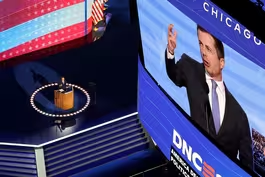
Fact-checking Democrats’ claims at the 2024 DNC
Video has Closed Captions
Fact-checking Democrats’ claims at the 2024 Democratic National Convention (5m 34s)
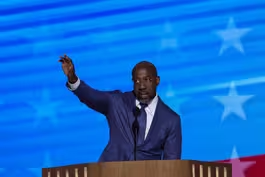
‘Georgia is very much in play’ for Harris, says Sen. Warnock
Video has Closed Captions
‘Georgia is very much in play’ for Harris, says Sen. Warnock. Here’s why (5m 50s)
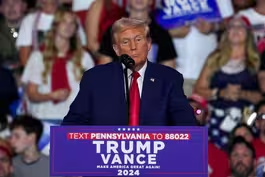
How the Trump campaign is attempting to counter the 2024 DNC
Video has Closed Captions
How the Trump campaign is attempting to counter the 2024 Democratic convention (4m 40s)

Walz steps into national spotlight on third night of the DNC
Video has Closed Captions
Vice presidential nominee Walz steps into national spotlight on third night of the DNC (5m 14s)
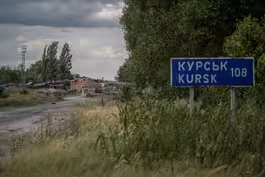
What Ukraine stands to gain or lose in Russia’s Kursk region
Video has Closed Captions
What Ukraine stands to gain or lose from capturing Russian land in Kursk (8m 55s)
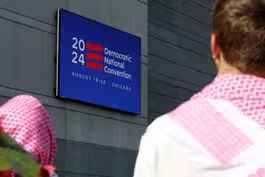
What voters, uncommitted delegates at DNC expect of Harris
Video has Closed Captions
What voters and uncommitted delegates expect from Harris as the DNC draws to a close (3m 37s)
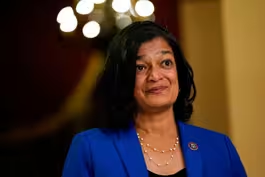
Why Rep. Jayapal says ‘real progress’ is on the ballot
Video has Closed Captions
‘Perfection may not be on the ballot, but real progress is,’ Rep. Jayapal says (6m 10s)
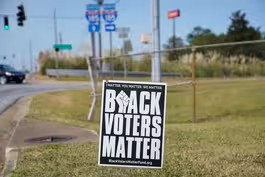
Why Trump is gaining ground with some Black men
Video has Closed Captions
Trump is gaining ground with some Black men. Here’s how Harris can change their minds (6m 49s)
Providing Support for PBS.org
Learn Moreabout PBS online sponsorship
- News and Public Affairs

FRONTLINE is investigative journalism that questions, explains and changes our world.

- News and Public Affairs

Today's top journalists discuss Washington's current political events and public affairs.












Support for PBS provided by:
Major corporate funding for the PBS News Hour is provided by BDO, BNSF, Consumer Cellular, American Cruise Lines, and Raymond James. Funding for the PBS NewsHour Weekend is provided by...