Vermont This Week
August 23, 2024
8/23/2024 | 26m 46sVideo has Closed Captions
Feds grant Vt. a disaster declaration for July storms | Historic Lyndon covered bridge dismantled
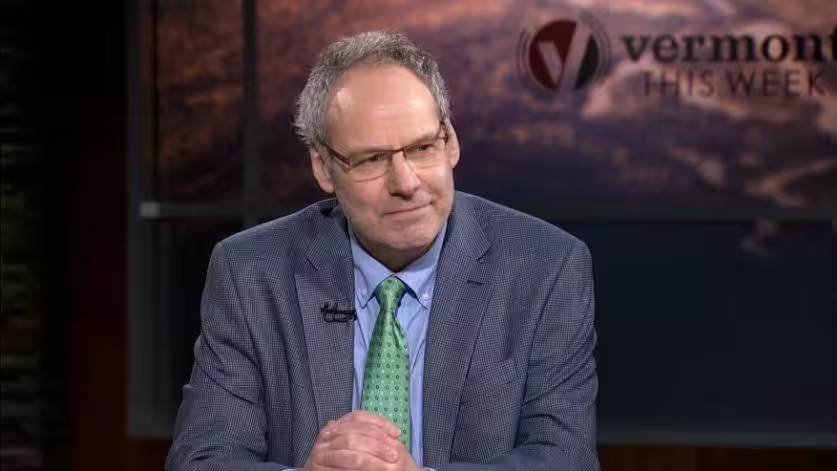
Feds grant Vt. a disaster declaration for July storms | Historic Lyndon covered bridge dismantled | New legislation broadens financial aid, in-state tuition eligibility in 2025 | Panel: Mitch Wertlieb - Moderator, Vermont Public; Lola Duffort - Vermont Public; Anne Wallace Allen - Seven Days; Dan D'Ambrosio - Burlington Free Press.
Problems playing video? | Closed Captioning Feedback
Problems playing video? | Closed Captioning Feedback
Vermont This Week is a local public television program presented by Vermont Public
Sponsored in part by Lintilhac Foundation and Milne Travel.
Support provided by:


Vermont This Week
August 23, 2024
8/23/2024 | 26m 46sVideo has Closed Captions
Feds grant Vt. a disaster declaration for July storms | Historic Lyndon covered bridge dismantled | New legislation broadens financial aid, in-state tuition eligibility in 2025 | Panel: Mitch Wertlieb - Moderator, Vermont Public; Lola Duffort - Vermont Public; Anne Wallace Allen - Seven Days; Dan D'Ambrosio - Burlington Free Press.
Problems playing video? | Closed Captioning Feedback
How to Watch Vermont This Week
Vermont This Week is available to stream on pbs.org and the free PBS App, available on iPhone, Apple TV, Android TV, Android smartphones, Amazon Fire TV, Amazon Fire Tablet, Roku, Samsung Smart TV, and Vizio.
Support the crew
Help Mitch keep the conversations going as a member of Vermont Public. Join us today and support independent journalism.Providing Support for PBS.org
Learn Moreabout PBS online sponsorshipPresident Biden approves Vermont's request for a major disaster.
Declaration for flooding occurred between July 9th and 11th.
But state officials emphasized that FEMA's aid won't be a cure all.
Obviously, with seven counties, that are that are, declared at this point for both individual assistance and public assistance.
I can't tell you how nervous everyone is, in terms of where's the money going to come from?
Plus an historic Linden Covered Bridge is dismantled and new legislation broadens financial aid and in-state tuition eligibility in 2025.
That and more ahead on Vermont this week.
From the Vermont public studio in Winooski, this is Vermont this week.
Made possible in part by the Lintilhac Foundation and Milne Travel.
Thanks for being with us.
I'm Mitch Wertlieb.
It's Friday, August 23rd and joining us on the panel today, we have Dan D'Ambrosio from the Burlington Free Press and joining us remotely today, Lola Duffort from Vermont Public, and Anne Wallace Allen from seven days.
Thank you all so much, everyone, for being here.
Well, we're going to start again with a story that we've been talking a lot about.
There's sort of some good news here because we're talking about flooding.
Yes, but we're also talking about financial aid that is coming to Vermont.
Little differ.
finally, Vermont has a disaster declaration for flooding that occurred in mid-July.
What can you tell us about the aid that is coming, but also aid that is still perhaps expected to come?
Yeah.
So, Vermont has received a major disaster declaration for seven counties, covering the period between July 9th and July 11th.
So our, viewers will probably notice that that does not account for the flooding that occurred later that month, particularly in the northeast Kingdom.
but that major disaster declaration will allow, both individuals to receive some aid from FEMA.
so, you know, some cash assistance for, repairs that they can't get money for insurance from.
But, you know, we should note that that cash assistance is capped.
and so there is a limit to how much you can receive from FEMA.
And often people are not at all made whole.
So it helps.
But, that doesn't mean that people will not be potentially permanently financially devastated from this flood.
this disaster declaration also makes available, reimbursements to state and local governments to make repairs on infrastructure.
that reimbursement will be it, 75%, which means that, you know, there is still going to be this question of how do we cover that 25%, particularly in, you know, smaller municipalities that are facing, devastation that will cost many times, their annual budget to fix?
and so I think we could probably expect a conversation about that at the, at the state House this winter when lawmakers reconvene.
And Lola, that was the nervousness, I guess the Governor Scott was talking about at the top of the show there.
He's saying that, you know, like you're saying some of this money is capped.
it may not make people completely whole when we're talking about the individual assistance.
You mentioned, also the municipal assistance that also has to come.
Here's what the Waterbury Municipal, town manager had to say about that.
Pretty substantial costs.
All that's paid up front by the town.
And we, with the disaster declaration, we hope to get that 75% of that money back.
But we know that's going to take at least a year.
There's always concern.
There's always an additional cost.
If the town has to borrow in the short term, there's an interest cost that and I don't believe the interest is reimbursable.
It may be, but I'm not certain of that.
but yeah, there's always a concern.
It's always it's one more thing to manage.
Well, I have to confess, I don't know if the interest is reimbursable either.
I don't I don't know if you do, but it does sound here like, yes, there is some assistance coming, but there's a time factor here that's a problem.
And how much of this money is actually going to be able to to make these towns whole.
Right.
And of course, there is the other question of building back, not just what we had before, but building back in more resilient ways.
and I remember after Irene, I remember talking to people about this.
It was always a huge fight with FEMA, to get money so that, you know, it wasn't just that you were rebuilding your old culvert, but you were also upsizing, and FEMA often stood in the way of that.
Did not want to pay for that.
and so, you know, this is welcome news, but it's, we shouldn't exactly cheer because this is sort of the minimum.
And what's going to happen as far as that late July flooding that you talked about with the Northeast Kingdom, what is the process there for seeing if some financial help from the feds can come there as well?
Yeah.
So it's kind of a three part process.
Vermont has already done the first part, which is they've asked FEMA for a preliminary damage assessment.
So they asked me to sort of tally up damage that they see in order to make a recommendation as to whether or not there should be a major disaster declaration.
Once FEMA makes that assessment, Vermont is able to actually ask for a disaster declaration from the white House and then the white House.
you know, says yay or nay.
Usually it's yes, once you get that recommendation from FEMA.
So, you know, we're still waiting for part two of that process.
so, you know, we will probably get a major disaster declaration for the Northeast Kingdom floods next month, I guess.
but, you know, we'll have to see.
We'll have to see which counties get included.
And we will also have to see whether or not we meet the thresholds for individual assistance, which are different than for public assistance.
So often what you'll find is, you know, we'll get a public assistance declaration, but not one for individual assistance, which is, as you can imagine, really, really difficult for, for those folks who are, who experience kind of catastrophic impacts.
But, you know, there weren't enough of them, so.
Well, we'll have to follow your reporting on that as we get closer to see if we do get that next federal, disaster declaration.
They're talking about the Northeast Kingdom, specifically what's happening in Linden.
there was an historic covered bridge there.
You know, Vermont is well known for its historic covered bridges.
It had to be dismantled.
Chris Thompson of the Linden Selectboard talked a little bit about that.
We just had the results of a flood study.
The data is showing that the concrete abutments that hold up the Sandborn bridge create kind of a pinch point in the river, which which is backing water up upstream.
And we have a we have a mobile home park right there.
And we have some businesses.
And that brings us to you and Wallace Allen.
I know you've been covering this story about this historic Linden Covered Bridge.
It had to be dismantled.
There are some problems now that I think, Chris was referring to in that clip about bringing it back as planned.
What are those problems?
Right.
So this is also related to the late July flood.
Linden was kind of spared.
And the big one that hit central Vermont.
But in late July, the bridge did hit flood stage and it did move those abutments, endangering the security of the bridge.
Now, Linden has been raising money for a few years now to refurbish that old covered bridge, which was built in 1860 and moved to its current site in 1960 over the Pacific River.
So they had they had already had an RFP out to refurbish the bridge.
But after the late July flood damage the bridge and put a little lateral bend in it because of all the debris that hit it, they were worried they were going to lose the bridge altogether into the river.
So they hired some timber framers to, use cables to attach it to the shores and also to take the siding off so that, the next flood wouldn't, it meet so much resistance and that would flow through.
And that was because right after the late July floods, we all started hearing about Hurricane Debbie's remnants coming and that.
So Linden Village Linden officials were spooked.
So after Hurricane Debbie didn't really do its damage, they decided to dismantle the bridge anyway.
And then they started on the riverbank up high above flood flood stage.
And now, they're going to decide what to do with it.
There's still a really strong push in town to save it because, as you said, Vermont is known for its covered bridges.
Linden, in particular, is known as the Northeast Kingdom capital of covered bridges, because Linden has five of them.
but the problem in Linden is that they are deep in flood recovery from the late July floods.
They've they still have roads closed.
They had they lost many homes.
So nobody, is taking the time out now to decide on the next steps for the bridge.
They're stacking it on the riverbank and turning their attention back to their roads.
Well, I appreciate the update on that story, as sad as it is, and, we hope for the best in that situation, of course, and mostly for the folks who lost their homes there.
It is still devastating to see some of those pictures.
I want to turn now to you, Dan D'Ambrosio, thank you for so much for being here.
And you wrote a story in the Free Press, recently that had to do with in-state tuition eligibility, for 2025, new legislation has broadened this financial aid.
What can you tell us about that?
Yeah.
That's right.
Mitch, the new law passed this year extends in-state tuition and financial aid on a as needed basis to all Vermonters for public universities and colleges, regardless of their immigration status, so that includes a lot of folks who are in Vermont who would not have had access.
And you met someone who this is affecting directly.
What can you tell us about that person?
Yeah, I interviewed a farmworker named Christiane Santos who came here a few years ago from Mexico.
From from, Tabasco.
The state.
And, the reason he came is the reason they all come here, which is to earn money.
And then his plan was to go back and go to university in Mexico.
He's a very ambitious, very smart young man.
How old is this man?
He's 21, 21.
Okay.
And, so with this law, when this law passed, it was just tremendous for him because now his plan is to attend university And he also happens to have a pathway to a green card, which will allow him to live and work permanently United States.
But it'll be a very long road for him to to get that.
But it just it's very uplifting for him.
And, you know, he sees a brighter future.
How did this legislation come about?
Well, there are just advocates in the legislature and we're not who, who and I have to mention migrant Justice justice, the nonprofit that advocates for migrant workers.
They've been behind the milk with dignity program, among other things.
Yes.
Yeah.
And, they have been the driving force.
And legislators will tell you that, to get this done.
But we're not the first to do it by any means.
There are 24 other states and the District of Columbia, Columbia that have similar laws, that do similar things.
So it's as, Representative Leonor Dodd, she was one of the main proponents, points out the you know, this has been done and we kind of know it works.
And so and, yeah, when does this legislation actually go into effect?
You say it's already helping this one gentleman.
You say, well, it won't actually go into effect until next July 2025.
VSC felt like they needed more time to kind of get their systems.
That's the Vermont Student Assistance Corporation.
Okay.
Yes.
And they're obviously going to be involved here.
one thing to note, though, is this did not go through appropriations because all the parties concerned said that they could they could implement this without additional costs.
So I think that's important to note.
Well, thank you for your reporting on that.
And we're going to turn now to another school story, not higher education, but sort of back to high schools and D4.
I know you've been covering this story in, North Country Union High School.
We talked about this a couple of weeks ago on the show.
There were concerns about some toxic chemicals that were found within the school, and I know that school officials were hopeful they would not have to move students out of the school for the upcoming school year.
What can you tell us about the latest with that situation at North Country High?
Yeah, well, the worst case scenario has come to pass.
so work has been ongoing basically all summer to try and remediate, PCBs at North Country Union High School, which, educates about 700 kids.
So a lot of kids, so work has been go ongoing all summer to try and remediate this toxic chemical.
it's worked in some areas of the school, and it has not worked in some areas of the school.
And they were very worried, that they might get to this part of the school year and not have fixed the problem.
and that that seems to be what's happening.
They received, results this week, for the B wing, B wing of the, of the campus, which is where most classrooms are housed.
And the results were not good.
basically all of them showed levels of, elevated levels above action levels.
and so administrators are erecting wedding tents on the fields of the high school.
And that is where, the students will go once they come back.
And they've also had to delay the start of school by a week.
so it's a huge mess.
Not ideal to have tents.
There's going to be weather issues, I'm sure, with all of that.
I also understand all of that.
officials with North Country Union High were not exactly happy with the mandate to do the testing, which confuses me a little, because you want to know if your school has PCBs in it.
But why were they upset about that?
Sure.
Yeah.
So there's a law that was passed in 2021, that said, all schools built before 1980, we're going to have to do this testing.
And that's because in 1979, Congress banned, PCBs.
So we know PCBs are pretty bad news.
should note Vermont is the only state in the nation with this kind of broad mandate to test all of its schools.
and that's because it's really expensive to remediate.
And the science of, PCB remediation is also evolving.
So basically, since this mandate started, school officials have been howling about it.
And it's because it has, in a lot of places, created pretty, intense disruptions to learning.
North Country is definitely the the worst example thus far.
You know, we haven't seen an entire high school be kind of taken offline for the start of the school, year.
But it's also a really good example of, the peril of this kind of legislation.
And, you know, I was reading a story in a national education publication very recently that was about a study on the science of PCB remediation.
and, you know, the the headline was like, now we understand how to do this a little bit better, and we understand how to do this a little bit better, because, of the study coming out of this remediation project in a Vermont school, so on the one hand, it's very cool that Vermont is contributing to this deeply important body of research about how we remediate these toxic chemicals.
the problem for administrators on the ground is they're saying we don't understand why Vermont is being this guinea pig for the nation.
and we're very worried about the disruptions that we are having to endure, to learning, which do not always result in PCBs actually being successfully remediated.
and so that's that is why you're seeing, educators complain about this.
you know, they're, they're well aware that PCBs are not good.
They're not saying we we want cancer causing chemicals in our buildings.
but they're saying we're a little bit worried that we, opened a can of worms, and and we don't really know what to do after the worms start wriggling all over the place.
Yeah, and it's not like a situation in Burlington where the kids could at least go to a mall inside and have school there.
They're talking about wedding tents here.
it does sound like they're really scrambling up in North Country there.
Yeah.
And I have to say, it's been really funny, talking to administrators across the state about this and hearing, people kind of, express, like, jealousy about the fact that, that, like, sending your kids to a Macy's is not an option, right?
Like, right now, sending your children to a Macy's is like, well, we don't have the luxury of doing that.
We don't we don't have them all here.
and so it's it's just been this, I mean, kind of dystopian thing to watch it.
It does sound pretty bizarre.
And, briefly on a wider view of what's happening is the new school year begins.
There's an effort to, again, get cell phones out of schools.
I know different schools take different approaches here.
What can you tell us about that?
Yeah.
So, you know, most schools in the state have some sort of restriction on cell phones.
You can't use them in class.
of course, as you might imagine, that's really hard to enforce.
And educators, continue to complain about the disruptions that cell phones bring to learning.
and then on top of that, there is, you know, a lot of concern about the youth mental health crisis in the country.
And there's been this nationwide kind of movement to try and get cell phones completely out of schools in an attempt to make kids less depressed.
and so that's really catching on here.
And we see, you know, there are a few schools that are that are trying to take this, you know, slightly more cold turkey approach.
you know, they're buying yonder pound pouches, which are these lockable pouches, and asking students to put them put their cell phones or, you know, in them at the beginning of the day so that they literally cannot access the phones for the entire day.
All right.
Thank you for that update.
and, Wallace Allen, I want to turn back to you.
there is a new interim president for the University of Vermont.
Who is this person?
Her name is Patrick Wheelock.
And actually, she's, she's the she's been the provost for, UVM for several years, and she's been with the university for 22 years.
So she's very well known.
but when Suresh Kamala, the president now, announced or the University of Arizona announced it had hired him, the university moved quickly to ask Patty Pre-Law to step in as interim.
Now, the the future president as of course, a matter of great interest at UVM.
It's a it's a big economic development and cultural engine for our largest city and also for the whole state.
So there's a lot of questions for the trustees right now about what's going to happen next.
And, the trustees themselves don't really know.
They were a little bit surprised at how quickly University of Arizona did their search for a new, president.
They just took about nine weeks between announcing the job opening and offering it to UVM presidents.
So the head of the board of trustees, Ron Lumber, isn't sure how long UVM next search is going to take.
As we know, the whole world is speeded up.
But I did ask him if Patty Pre-Law was interested in the president's job, and he said that she's thinking about it.
I mean, she's she's 70 and she's by many accounts been a very, very effective provost.
And now that she's interim president, she has to appoint somebody to serve as provost.
So, I think that she's going to give it some thought before deciding whether she applies.
The trustees have also pledged to, go out and get community input about what they would like to see in a new president.
Ron Lembra, the chairman of the board of trustees.
He told me that it's a pretty competitive landscape out there, but he thinks that UVM is getting to be in a better position.
It's getting to be better known.
It's positioning itself as a research university.
So, there's going to be a lot of dynamism that UVM over the next months.
And it's possible that the search won't take the typical 6 to 18 months that we see these university search is taking.
Initially, when Gary MLA announced that he was leaving, they were talking about 6 to 8 months, but that could that could actually take less time.
Now also of local concern, what can you tell us briefly about the sale of a well known ski resort in Vermont, Killington, which I understand is going to local investors.
Yeah.
It's not every day that a venerable Vermont business goes back from the hands of its corporate owner to, local owners again.
And that's what is happening with Killington.
It's our largest ski resort.
In fact, they bill themselves as the largest resort in the East, and they, a it's been owned for many years by powder, which is a company based in, in, Park City, Utah, that owns several ski resorts in, Canada and the US.
And they have decided to sell it back to an ownership group in Rutland that includes some longtime second home owners who've been passholders at Killington for many, many years.
One of them grew up skiing here as a kid and, has been on the board of the Killington Mountain School, which is a ski and high school since 2008.
So, residents who are pledging also to stay out of the day to day operations of the resort, they're their business guys.
But they said, we're not going to we're going to keep the same management team in place.
They've told people who ski there that they're aren't going to see any changes.
They're still going to accept the icon pass, which is that pass that covers, resorts all over the world.
So no immediate changes and no changes in personnel.
Okay.
Dan Dambrosio, you had a fascinating article recently about Vermont's Black bear population, which I have to assume is increasing and more incidents of humans coming into contact with bears.
One in particular sounded pretty wild.
What can you tell us about the state's black bear population?
Well, it's very healthy.
That's one first thing to say that, you know, one time in the 70s, the black bear population was down to about 1500, which is not many.
Now it's, it's at a healthy level.
It's like 67,000 and it goes in cycles.
so, wildlife officials aren't certain yet whether we're on a, continuing upward trajectory or if it'll sort of correct itself.
its bear population has been growing about 8% annually for a few years.
And, and so typically it will kind of correct itself, so to speak.
We do have the hunting, black bear season coming up, I think September 1st.
So I'm not mistaken.
Yeah.
That's right.
But you did have this story about a bear in Stowe.
Well, what can you tell us about that incident?
Yeah.
so a bear got into the attic of a condominium complex in Stowe trying to get to birdseed.
This is birdseed is so often the problem.
no matter how much wildlife officials tell people not to leave their birdseed out once the bears come out of hibernation, you know, it still happens.
So it got into the attic trying to access this this birdseed.
And, game warden named Jeremy Schmid was called to resolve the situation.
It was a new one on him.
As you might imagine.
So he, peeked up into the attic.
It was pitch black.
If there are no people, it's just, just insulation and rafters.
And he sees the bear over by the hole that it created when it went up into the attic.
He, he hit it with a, non-lethal round to assuming maybe it'll just go right back down the hole.
Well, it's like a rubber bullet type of thing.
Yeah, they don't like to call it.
They call it a wildlife defense round.
Okay.
Jeremy was very, adamant on that.
But instead of going back to the hole, the bear ran around the attic and went right back to where it was.
so he had to try something else.
He tried enlarging the hole.
Ultimately, he's banged on the ceiling with a flashlight and that got it done.
Yeah.
Amazing.
you know, wildlife has been all over the place.
There was a rare kind of a link spotted in Vermont for the first time in, I believe, since 2018, actually, which is pretty amazing.
Now, before we go, we do have some sad news to share.
And that's that.
Bill Doyle, who served in the Vermont Senate for 48 years, died last week.
He was 98 years old, and Doyle was first elected in 1968.
He was reelected 23 times, serving until 2017.
Doyle was a champion of local government.
He spent a good part of his legislative career as chair of the Senate Committee on Government Operations.
He also taught political science at Johnson State College for 60 years.
He retired in 2018.
He wrote The Vermont Political Tradition and Those Who Helped Make It, a well-regarded history of states politics, first published in 1984.
That's all we have time for.
He will be missed.
Thank you so much to our guest today, Deb Rossio and Wallace Allen and Lola De, for such a pleasure to be with you, and I hope you'll join us again for Vermont this week.
Next week.
And.

- News and Public Affairs

Top journalists deliver compelling original analysis of the hour's headlines.

- News and Public Affairs

FRONTLINE is investigative journalism that questions, explains and changes our world.












Support for PBS provided by:
Vermont This Week is a local public television program presented by Vermont Public
Sponsored in part by Lintilhac Foundation and Milne Travel.