
August 25, 2023
8/18/2023 | 55m 38sVideo has Closed Captions
Alondra Nelson; Oscar Isaac and Jeremy O. Harris; Dr. Daniel Grossman and Katrina Kimport
Former acting director in the White House Office of Science and Technology Policy Alondra Nelson on the dangers, the opportunities, and the global move to regulate AI. Actor Oscar Isaac and producer Jeremy O. Harris discuss the success of "The Sign in Sidney Brustein’s Window." A new study called "Care Post-Roe" reveals that laws blocking female reproductive rights are putting lives at risk.
Problems playing video? | Closed Captioning Feedback
Problems playing video? | Closed Captioning Feedback
August 25, 2023
8/18/2023 | 55m 38sVideo has Closed Captions
Former acting director in the White House Office of Science and Technology Policy Alondra Nelson on the dangers, the opportunities, and the global move to regulate AI. Actor Oscar Isaac and producer Jeremy O. Harris discuss the success of "The Sign in Sidney Brustein’s Window." A new study called "Care Post-Roe" reveals that laws blocking female reproductive rights are putting lives at risk.
Problems playing video? | Closed Captioning Feedback
How to Watch Amanpour and Company
Amanpour and Company is available to stream on pbs.org and the free PBS App, available on iPhone, Apple TV, Android TV, Android smartphones, Amazon Fire TV, Amazon Fire Tablet, Roku, Samsung Smart TV, LG TV, and Vizio.
Watch Amanpour and Company on PBS
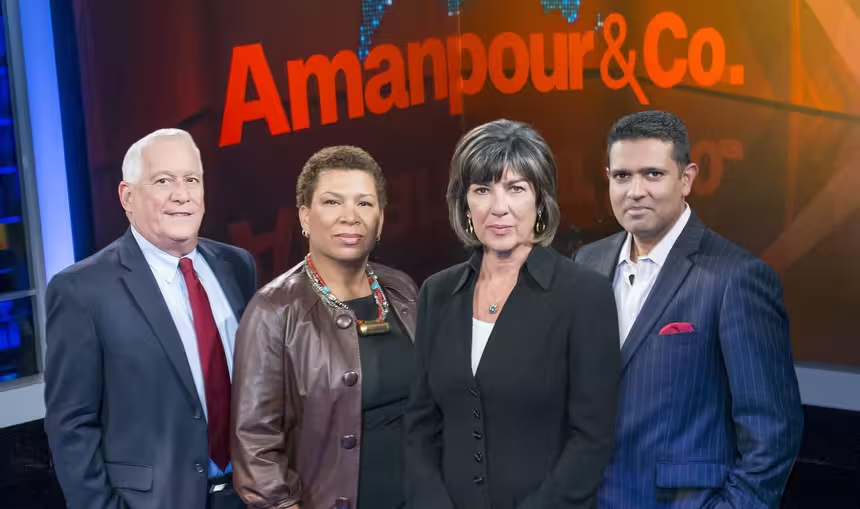
PBS and WNET, in collaboration with CNN, launched Amanpour and Company in September 2018. The series features wide-ranging, in-depth conversations with global thought leaders and cultural influencers on issues impacting the world each day, from politics, business, technology and arts, to science and sports.Providing Support for PBS.org
Learn Moreabout PBS online sponsorship[bright upbeat music] - Hello everyone and welcome to "Amanpour & Company", here's what's coming up.
- I think if this technology goes wrong, it can go quite wrong.
- [Christiane] The leaders of ChatGPT join the chorus calling for regulation of super intelligent AI.
- We've seen that self-regulation of companies doesn't work and that we need to have a different playbook for this moment.
- [Christiane] I ask Alondra Nelson, architect of the Artificial Intelligence Bill of Rights about the Biden administration's efforts to regulate it.
And.
- We have instances of people doing all of these things that they need as basic medical care under an umbrella of fear.
- [Christiane] As South Carolina passes a six week abortion ban, a new study warns that healthcare providers are unable to meet their duties.
Michel Martin talks to the authors of that study; medical sociologist Katrina Kimport and Dr. Daniel Grossman.
Also ahead.
♪ Night and day now A forgotten treasure back on Broadway.
I speak to actor Oscar Isaac and producer Jeremy O. Harris about taking on "The sign in Sydney Brustein's Window".
[bright upbeat music] - [Narrator] "Amanpour & Company" is made possible by the Anderson Family Fund, Sue and Edgar Wachenheim III, Candace King Weir, Jim Atwood and Leslie Williams.
The Family Foundation of Laila and Mickey Strauss, Mark J. Blechner, Seton J. Melvin, Bernard and Denise Schwartz, Koo and Patricia Yuen, committed to bridging cultural differences in our communities.
Barbara Hope Zuckerberg, we try to live in the moment to not miss what's right in front of us.
At Mutual of America, we believe taking care of tomorrow can help you make the most of today.
Mutual of America Financial Group, retirement services and investments.
Additional support provided by these funders and by contributions to your PBS station from viewers like you.
Thank you.
- Welcome to the program everyone.
I'm Christiane Amanpour in New York.
As we enter an uncharted era of artificial intelligence, we begin with the risk of a creation turning on its creator.
OpenAI, which is the company behind ChatGPT is calling for an international regulator, much like the UN nuclear watchdog, to prevent a catastrophe endangering our very existence.
In a statement on their website, OpenAI's three co-founders write, "We can have a dramatically more prosperous future "but we have to manage risk to get there.
"Given the possibility of existential risk, "we cannot just be reactive."
The real world impact of this technology which is still only in its infancy is already being felt.
Like the bogus AI image of an explosion at the Pentagon which caused a selloff on the stock market this week.
But it's also driving incredible scientific breakthroughs like the paralyzed man who just took his first steps in a decade, thanks in part to AI technology.
Alondra Nelson was acting director in the White House Office of Science and Technology, policy thereof, and the architect of the Biden administration's blueprint for an AI Bill of Rights.
I ask her about the threats and opportunities and the global moves to regulate AI.
Alondra Nelson, welcome to the program.
- Thank you for having me.
- So with all your experience as a researcher, in the executive office as deputy assistant on these matters to the president, you have said, and I will quote you, "We are living already in a time of profound uncertainty "with looming risk about AI."
Lay out for us what you mean.
- I mean that we are building a powerful technology, perhaps the most powerful technology that we will have built in our time on this planet and that we need to do it with guardrails and with a real clear sense of both the pitfalls and the possibilities of these new technologies.
And it's also a time in which I think that we can all agree that we're worried and that there are looming risks all around and that this powerful technology, automated systems, AI, has the potential to exacerbate many things that we already are quite concerned about, including misinformation and disinformation, issues around bias surveillance and the like.
- So Sam Altman, who is the CEO of OpenAI, one of the originals in this business, he testified in Congress last week and it was quite important because every time these CEOs go before Congress, it's an attempt presumably to investigate what's going on and to see how it can be protected as well.
This is what he said about the road ahead.
- I think if this technology goes wrong, it can go quite wrong and we want to be vocal about that.
We wanna work with the government to prevent that from happening.
- So he wants to work with the government.
We've seen this playbook before where Congress has hauled social media giants, Zuckerberg and the others, and Congress seems to be sort of a bit thrown for a loop by all the technical geekery around it.
Is Congress, is the administration prepared to deal with the looming threat of AI.
- I think this is an incredible window of opportunity because I think Congress and the executive branch has shown that they are getting prepared.
So I think to your point, we saw the social media playbook, we've seen that self-regulation of companies doesn't work and that we need to have a different playbook for this moment.
So what's encouraging here is that conversations are happening early on in the development of a new technological sort of paradigm.
And we saw that most recently last week, Senator Blumenthal chaired the hearing that you showed that included OpenAI CEO Sam Altman.
So we've seen the Biden-Harris administration over the last year show that it's committed to getting automated systems right and AI technologies right and making sure that the benefits of them are maximized and the harms are minimized and that work has been ongoing including with policies, laws, and regulations that are already on the books that can be expanded to sort of offer guardrails around AI and obviously, conversations about new ones that we need besides.
In addition, I've been encouraged to see congressional leaders, so members of Congress who not just the usual suspects, so not just the members of Congress who have had careers of working on tech policy but people who work in the national security space who think about domestic policy issues as their primary portfolio also thinking about the implications of AI.
And so, I think this moment is different in part because we've got a bigger tent, I think, of congressional leadership understanding that this is really an all hands on deck moment and that they all need to be engaged in learning enough about this technology to be able to offer guidance to the nation about how we can use it responsibly.
- So this week we saw an irresponsible use of AI in a sort of a visual mechanism whereby it's gone viral, this picture of an explosion at the Pentagon which clearly brought back memories of 9/11.
Of course, it was totally fake, it did have an impact on the stock market and it shook people for a while.
That is a very visual demonstration thereof, so I wanna know how dangerous you think that stuff is.
That goes to the heart of the misinformation piece of this, the deep fake piece of this where anything can be faked.
- That Pentagon fire deep fake was quite worrisome on two levels.
So that was a story that was about Twitter and about the effectively the collapse of the verification regime at Twitter that would've offered at least a few signals about whether or not this was true and whether or not it should or could be believed.
And so we no longer have that system of guardrails at Twitter.
So it's worrisome in that case.
And it was also worrisome of course, because it traveled so quickly and there are things that we could have done I think to have made a different outcome.
In addition to sort of Twitter, I think behaving more responsibly.
It's also the case that companies that make tools that allow the creation of video.
So we're not talking about deliberate bad actors who are gonna try to get around these but at a very basic baseline, you should be able to mark or have to be required to identify that you are using AI systems in the product that you are creating, whether or not that's a visual product or a voice product or it's text.
And that was when I was working in the White House seven to a few months ago, we developed something called the Blueprint for an AI Bill of Rights.
And one of the sort of principles there was that there should be notification, one should know when an AI system is being used.
And I think that's just a kind of fundamental principle that companies have the ability right now to exercise in the way that they are sending out these tools for consumers to use them.
Again, that's not going to correct for a bad actor who's trying to create a deep fake or misinformation or disinformation that's intended to do harm but it could do a long way to prevent casual actors, accidental actors and consumers from being able to create these kinds of dystopian maloos using these technologies.
- So you talked about the companies, so a famous example from last month, The Washington Post reported that quote, "ChatGPT invented a sexual harassment scandal "and named a real law professor as the accused."
Not only did it make the story up, it even cited fake articles from The Washington Post that it cited as evidence.
So you talk about the companies but this was a, I guess a bad actor but ChatGPT is being used by just about everybody right now.
- That's right and I think that you know, President Biden actually has been quite clear about this.
Like it falls to the companies to make sure their products are safe and effective and that they are released to consumers in ways that are safe and effective and can be trusted.
And so, you know, it shouldn't be left, certainly there are ways that, you know the companies are potentially not gonna be able to test for every potential outcome.
The tools are too broad in their potential use cases.
But that is something that, you know misidentifying someone as being a sexual predator, having false information, what we call so-called hallucinations, there's much more that can be done on the company side before these things are released.
And I think that congressional leaders, government leaders and the American public frankly should demand more.
- You said and you described a bit the blueprint, now this started, you said very, very early in the Biden administration, you all took a year to create this blueprint but also you say it's not a legal obligation, you're not talking about laws but on the books already, are there the laws to protect in all these areas, whether it's employment, whether it's disinformation, whatever it might be, that could be employed right now?
Are there laws that could be be resurrected and used right now as guardrails for this, as you call it, looming threat?
- It's an excellent question, there are laws and policies and regulations already on the books that are allowing us and can't allow us to get traction on the sort of fast moving pace of automated systems already.
And partly what the Blueprint for an AI Bill of Rights was trying to do was to point to some of those.
So it is the case that the U.S.
Equal Employment Opportunity Commission has the ability to regulate discriminatory uses of automated systems if they're used for recruitment, for hiring, if they are discriminating against people with disabilities.
It's the case that the Department of Labor and cases of worker surveillance when workers are using their rights to organize, require reporting of surveillance tools included automating systems in those moments.
Part of when we spun out the Blueprint for an AI Bill of Rights, we also pointed to things that might be done.
So for example, we're thinking, you know there's obviously some concerns in the space of education about you know, is ChatGPT going to allow cheating and the like?
This is I think another instance in which, you know if this company with this incredible powerful tool had maybe talked to a few more teachers, I think we could have had better guidance around that.
- You've probably noticed that the sort of world renowned online teacher Sal Kahn who was the founder and CEO of the nonprofit Khan Academy says that it could actually be the greatest positive transformation education has ever seen.
He sees a future in which students and teachers use this technology to improve education all around the world.
So let's talk a little bit about the positives.
Do you see that as possible despite the very real ability to cheat and use ChatGPT et cetera?
- I would agree with Sal Kahn that yes, this is a possible future for the intersection of education and technology and that AI has an incredible role to play here but it is also the case that it's not just gonna happen and that we need all of the stakeholders working in this space including government and companies to create that most beneficial outcome.
- So you say it's not just gonna happen, and again, in my mind is fixed a graph that I saw in the FT written by a very prominent AI researcher warning of the pitfalls as well as the potential advantages and it showed a huge disparity in the graph of resources going to capability versus the resources going in to make it safe and so-called align this thing with our moral values.
So I wonder what you think about that because that's happening now, a big, big disparity.
And yet, the G7 leaders, the most powerful economies actually did talk about this and what they needed to do.
So a global potential solution during their Hiroshima meeting.
- It was encouraging to see that the communique issued from the G7 Summit included a commitment to what they're calling the Hiroshima process which will be G7 countries, I think, talking together about international collaboration, about how we get to a place of responsible, the use of artificial intelligence.
So that was really encouraging.
And let's also be clear that the G7 was going to take place in Japan and the summit was gonna take place in Hiroshima anyways before the release of ChatGPT and these consumer facing generative AI tools.
But it was a very poignant place for this to take place, for this conversation to take place at the international level about AI systems.
One of President Obama's sort of last speeches in international trips was to Hiroshima.
And he gave an incredible speech there in which he said, and I'm kinda paraphrasing him, we can't have a technological revolution without a moral revolution.
And so I was encouraged by the siding and announcement of the Hiroshima Process in this place in which there was so much, you know there's a lot of poignancy about how technologies have been used in the past and how they've caused harm in the past as an opportunity, I think, to work collaboratively to sort of create a future that's different.
So part of this will require, as your question suggests, big investments in research and big investments in development.
Right now it's the companies that are making the big investments and I think we need some public sector investments.
- You mentioned the poignancy of where the G7 communique came from.
Obviously, Hiroshima is where the first and then Nagasaki, the only atomic bombs to have been dropped in the whole process of mutually assured destruction.
And people in AI now say that this is like unleashing the atom again.
So I get what you're saying about the poignancy.
The communique said that we should advance international discussions on inclusive artificial intelligence, governance and interoperability to achieve our common vision and goal of trustworthy AI in line with our shared democratic values.
So finally, that's all well and good for those who share democratic values but what happens with known interferers and disinformation experts, China, Russia and all the other state actors, forget companies, state actors who will potentially not be bound by this.
- Sure, I think this is very much in the space of national security questions.
So there are economic security questions, so part of what we'll have to watch of course, is sort of job disruption and disruption to how people work and live their lives.
And then there are sort of biosecurity and other kinds of nuclear security issues that need to be appreciated as well.
For the more catastrophic and national security concerns that we have about how these tools might be used by malign actors, by pernicious actors who are intending to do harm.
You know there have been historically and there are being in the current moment, sort of sets of tools and levers that we can use.
So these include things like international treaties, these include things like export controls like sort of not sending the enabling capabilities, the technical capabilities to actors that we don't think are going to use them safely, sanctions.
So it's the case that there is a whole suite of levers that can apply I think in the AI research and development space with regards to whether or not they get in the hands of other kinds of actors.
But I think there's also an opportunity here for collaboration and conversation well beyond the G7.
So you know we think we both wanna constrain on the one hand what could be the most dangerous uses but also appreciate that in many cases, even our adversaries I think don't want the most catastrophic outcomes to the extent that they might be indeed planetary.
And so I think there are opportunities to work on both sides.
- Well, Alondra Nelson, thank you for that detailed blueprint as it stands right now.
Thanks for joining us.
- Thank you for having me.
- And now from those threats to American society to one of its greatest assets, theater.
It's been over three years since stages went quiet because of the coronavirus but Broadway audiences are finally back to pre-pandemic levels, that's according to the Broadway League.
And a revival of a 60s play is getting rave reviews.
"The Sign in Sydney Brustein's Window" written by the late Lorraine Hansbury stars Hollywood actors Oscar Isaac and Rachel Brosnahan.
It follows a diverse group of friends in the 1960s, Greenwich Village, New York, trying to juggle the harsh realities of life and their idealistic dreams.
Oscar Isaac known for his standout roles in "Scenes From a Marriage", "Star Wars" and "Dune" join me from New York and producer and playwright Jeremy O. Harris from Cannes to talk about it.
Oscar, Isaac and Jeremy O. Harris, welcome to our program.
- Thank you for having us.
- Thank you.
Thank you so much.
- Listen, I wanna ask you Oscar because you're about to do another performance this evening on Broadway, what was the inspiration for you to want to do this character in this play?
- Well, it had been about six years since I'd last done a play which was "Hamlet" and this kind of came to me serendipitously through a friend that I met with Anne Kauffman, we did a reading of the play and I just found, honestly, the feeling I had when I read it was a feeling of profound freedom.
There was something about reading these words, the interactions with the other characters, the kind of exercising of a lot of fear and demons and shame and a lot of the things that she talks about are placed in the world as artists and as human beings and as activists that just spoke to me in a really profound way.
And also, I'm so attracted to troubled characters, characters that are prickly, characters that are not asking to be loved, that seem to be not worthy of our attention yet somehow, you know breaking that shell, I find a magic trick in that.
- And it is magical on stage and certainly for the audience.
Jeremy O. Harris, you know Oscar has just talked about going from Shakespeare to Lorraine Hansbury.
What was it about her and the magic that Oscar talks about that puts you involved and made you bring it from essentially off Broadway, at BAM, to where it is now?
- Well, I mean, first of all, I'm so grateful that you got to see it and I'm so grateful that Oscar is a part of it because a play can't sing without an amazing vocalist, right?
And Oscar and Rachel and this entire company are amazing vocalist.
And I think that seeing that she had written this complicated text, a text that's very difficult to make sing with as many harmonies as she put into it, seeing that it was singing so well in BAM told me that it needed to be in the house, it was always meant to.
Because like the echoing, the architecture of Broadway theater is specific.
And you know, Lorraine passed away when she was 34 years old and I'm about to turn 34, I'm on the eve of my 34th birthday, I turn 34 June 2nd.
So I feel a deep kinship to her because I've had a great supernova play called "Slave Play" but I also have a problem plays that have happened in and around "Slave Play" that take a great ensemble to make sing really beautifully and might not have been understood by critics the moment they came out but I hope one day in the future there'll be some other future Jeremy O. Harris, some other future Anne Kauffman, some other future ensemble like that features an Oscar or Rachel that could help make that play sing or those other plays sing.
And so the ability to facilitate hearing this music, this sound, these voices so clearly felt pertinent to me because we lost one of our greatest voices much too soon.
- Oscar Isaac, just give us a synopsis because it is a period play as Jeremy O. Harris says.
Obviously, it was written during the height of the Civil Rights Movement.
It was on Broadway at that time.
And as you say, it's about activism but it's also a profound family drama very specific to that time.
- Yeah, well, I mean, really it's change and the nature of change and brief synopsis is that there's a man, Sidney, who is a leftist, an activist or an ex-activist.
He's kind of had it, he's put all his cards out there and the results have been subpar for him.
And so he wants to retreat up to the mountains.
He has his young wife who he envisions as this very specific person that he's created and he's seeing all these things change around him and shift right in front of his eyes and it's like a greased pole.
And so, you know all his friends, there's an apartment in 1964 in Greenwich Village where his friends that are artists and activists come together and they start with this paper, this newspaper that he feels is going to just be able to express himself through arts and crafts now that he's done with politics and the world starts to pull at him.
And then at the heart of it is this marriage between Sidney and Iris, the amazing Rachel Brosnahan plays, and her coming into her own as a woman, as a woman constrained by this particular time and this particular type of misogyny.
And so, yeah, so it's dealing with all of these issues and then in the second act it just breaks right wide open.
- And I want to actually take this moment to play a clip, the one that we have from you all and it is about, well, it's you obviously Oscar talking about that sort of political activism being drawn back into it in this newspaper and things not necessarily turning out as you had hoped.
We don't want to do a spoiler alert but this is where you break off a relationship with the politician Wally O'Hara.
- It's no good.
Your world, Wally, it's no damn good.
You have forced me to take a position, finally.
The thing I never wanted to do, just not being for you, it's not enough.
To live, to breathe, I have to be against you.
Goodbye O'Hara.
I'll see you again only this time, let me warn you, thanks to you, I'll be tougher, more seasoned, harder to deceive.
- Sidney, you really are a fool.
- Always have been.
- You know, it's all there, you know the idealism and getting that slapped around and it was quite dramatic to watch that bit.
Was it a mistake for the character to have taken on this politician who sold him a bill of goods really?
- No, I don't think it was a mistake necessarily.
I think, you know what's amazing and what's so brilliant about what Lorraine does, you know the question isn't should you do something or should you not do something?
Or like what the right political move is.
It's not so much about that because at first, he starts with, I don't wanna be part of it and then he gets convinced that yes, be part of it but what do you do when that fails?
And you know, the inevitable disillusionment and she's talking about that and she talks about the world's about to crack right down the middle and all one can do is change and continue to change and continue to find new ways to change when the inevitable disillusionment is going to happen.
And it just speaks so much to this time and to so many of my friends and to me who have gone through, the world is going through right now.
And I hear so much and I've heard myself say it like, "Ugh, I just can't, I can't do it.
"I can't do it anymore."
And even, I always have a pang of shame during the play when in that scene Wally says to me, you know, he says, "You've got a gift for writing, for music.
"You turn people on, stay to your lane, "stay in your lane, basically."
You know and often I find myself saying, "Well, you know, I'm a storyteller, "let me just stick to that.
"I'll do my acting and that music, "I don't have to be involved."
But the point is that it doesn't matter if you don't wannabe involved, it's gonna come to your doorstep.
- Yes, indeed.
And so let me ask you, Jeremy O. Harris, Lorraine Hansbury is a formidable force, was a formidable force, but as you say, her career was cut short by illness and she died.
You know this play I think had been on for two to three months by the time she died.
And just to situate ourself, her husband, ex-husband, producer of the play at the time said the very day the play opened, Khrushchev fell from power in the Soviet Union, inside Russia and the Chinese set off their atomic bomb.
In other words, it was happening in the midst of this global sort of seismic shifts in our history, not to mention what was going on inside the U.S.. She was a very, you know she had written "Raisin in the Sun" which was a huge, huge success.
Tell me a little bit more about her.
She was a very iconoclastic individual.
- She was.
I mean, she was an activist.
She worked with a lot of like young, queer, like angry people inside of New York at the time, people who were rightfully angry.
She worked with the early civil rights movements and a lot of Black activists.
And she was attempting to create like a sort of space for thinkers and movers and shakers to actually like, inspire the work that she was writing so that she could wake people up, right?
And that's something I see is so important about this work.
I mean, the preshifts of this young woman is undeniable.
Like, she, she truly was a great, she was a soothsayer.
She saw both what was happening in her time and what's happening right now.
You know and that's what brought so much urgency to doing this play on Broadway today, right now.
I mean Ron DeSantis just announced his run for presidency.
You know, we're in the midst of like many, many people upending the like major freedoms we've had in this country that we've taken for granted because we've looked the other way for much too long.
And what she's saying with this play is that you can look the other way, you can draw your little pictures, you can make your little jazz bar but if you're not being politically active, even if you're a little bit wrong, even if you put your bill behind the wrong person, and if you get disillusioned by that and don't keep fighting and keep fighting for something true or something better, then we're all going to end up in the worst situation possible.
Now I'm in so much fear for our country right now because my partner is Iranian, his parents fled the Iranian Revolution much like what you know about, right?
And you know, they say to me all the time like, "Are you watching the news?
"This is not new, this is familiar."
And this play proves that this is not new, this is familiar.
Everyone who comes see to see this play, wake up, you know, get active, like move and shake and don't be afraid to change.
- So I'm really hearing what you're saying and it's clearly landing in a very personal and politically current and relevant time right now.
So I wanna ask you Oscar whether, 'cause in the program, when we all go to sit there and see the play, the program says that it didn't get a full run and yet all the big producers, the actors, Mel Brooks and Bancroft and others banded together to make sure that it kept going.
And I found that a really incredible act of collaboration and collegiality at this very fraught political time in the United States.
How did that strike you?
- It's so beautiful and in a way there's some mirror images to what it's been like to put the play on now.
It's provocative, it's anti-establishment, it's not easy, there's not easy solutions.
Often people are not sure, well, who am I supposed to be rooting for?
Who's the villain?
Who's the bad guy?
And politically, you have people transgressing in the most public horrible ways and yet we're still asked to see them with love and see them with possibility for redemption.
And so it's incredibly rewarding and it feels rebellious to be putting it on and to know that people that are very near and dear to me that I look up to, they feel that spirit in it and that provocation.
- Can I just ask you quickly, you are a Guatemalan heritage, you're a Guatemalan American as you say- - And Cuban as well, yes.
- And Cuban as well, so you've got all of that heritage which is very political these days with the migration crisis, with the way refugees and asylum seekers are treated both in the United States and elsewhere around the world.
That part of it, does that resonate with you as well?
- Absolutely, absolutely.
Being lost and the feeling of being helpless as well to do anything about it, not knowing what to do and the feeling of the overwhelming feeling of like, what could I possibly do?
And to double down and say, "No, there must be something "because again, the the alternative is death."
- Can I ask you to just reflect on "Scenes From a Marriage", I want to play a clip from it because it was one of the last big things that you're so well known for.
And it turned the original Ingmar Bergman story on its head, making the woman the breadwinner and et cetera, sort of turned the gender dynamic on its head.
You played the husband, Jessica Chastain played the wife.
Let's just play this little clip.
- Research says that when the woman is the provider and the man is a caregiver, the marriage has a greater chance of success.
- Huh, hear that Kate?
- Loud and clear.
- You just believe me as a couple, nothing can hurt you.
- And that really resonated with so many people, especially successful women.
Was it the sort of, you know the turning the convention on its head that was most attractive for you or what in that?
- You know, in some ways there's some similarities with this play.
It was harrowing to read it.
It wasn't an intellectual idea of, oh, it's turning this or the Bergman or that.
In fact, maybe those things were like things that would kinda repel me from it but the fact that when I would read it, I would shake and be afraid and I didn't even necessarily connect so much with the character right away, it was the situations and the scenarios were just harrowing.
And so that kind of led me to constantly think about it and when that itch starts to happen, I follow it.
- So just finally, what is next for you Jeremy O. Harris on Broadway or elsewhere?
- On the producing side and on the Broadway side, you know I have a play that's gonna open at Hauser & Wirth next year.
And then I have a new play that I'm producing on Broadway that's gonna be announced very soon that I'm very, very excited about 'cause you know, so much of my work is about celebrating writers I wanna see.
- Exactly, and Oscar Isaac, it must be really draining to do this play sometimes twice a day.
It's really draining and it's long.
Are you gonna do another play or is it TV movies after this?
- Well, it is, it is very draining.
And it's an incredible like athletic feat to have to do.
I start the beginning of the week on a Tuesday like in a flow state and already by the second show Wednesday I'm like, "Oh, just letting the architecture of the play hold me."
But I am a creature of the stage so I do think there's more theater maybe not so long this time, not such a long break.
- All right, well, it's an amazing treat for anybody who gets to see it.
Oscar Isaac, Jeremy O. Harris, thank you both very much indeed.
- Thank you.
- Thank you so much.
- Thank you, Christiane.
- Run, don't walk, to see it.
Now South Carolina's governor has just signed a bill banning most abortions as early as six weeks into law.
South Carolina is the latest state to tighten its grip on abortion access since Roe versus Wade was overturned last June.
Now a new study called Care Post-Roe has found that states blocking female reproductive rights are putting lives at risk.
The co-authors of the report join Michel Martin to discuss how these bans are endangering women.
- Thanks Christiane.
Professor Kimport, Dr. Grossman, thank you both so much for joining us.
- Thank you for having us.
- So Dr. Grossman, let me just start with you and ask, what was the intention behind this study?
How did it get started?
What were you thinking about and what did you wanna know?
- Honestly, I was really concerned.
As you know, these bans on abortion generally allow abortion in the cases when the pregnancy threatens the life of the pregnant person.
But as a practicing physician for almost 30 years, what constitutes a life threatening condition is just not always as clear as it might seem.
It's just not black and white.
You know how severe does the condition need to be?
How imminent does that threat need to be?
And because these answers are so unclear, I was really concerned that my colleagues in states with these abortion bans were gonna be forced to hesitate to wait to provide the care that was medically necessary.
And after the Dobbs decision and these laws started going to effect, we did see some reports in the media about cases where patients had pregnancy complications but they couldn't get the care they need, even though the condition clearly threatened their life.
And then at the same time, we also started hearing reports that doctors were being told by their hospitals and by their employers not to talk to reporters.
They were essentially being muzzled, their voices were being silenced.
And so that's really why we started this project, to give doctors and nurses and nurse, midwives, nurse practitioners, pharmacists, anyone who cares for a patient an opportunity to be able to share these stories about poor quality care anonymously if they wanted to.
- So Dr. Grossman, as a clinician, so you're interested in like what's going on in that clinical setting.
And Professor Kimport, you're a sociologist, tell me what you were interested in discovering in this.
Were you interested in sort of thinking about like what the patterns were?
- Absolutely, my interest is really long been in what a patient's experience of navigating healthcare is and particularly reproductive healthcare.
And here we have an instance where, this is something that is not generally recognized that there are a heartbreakingly large number of ways a pregnancy can go wrong.
In general, we think of pregnancy as a positive thing.
Socially, people are excited about it and we think of it as resulting in babies, in family growth.
But in actuality, there are a number of ways, a huge number of ways that can go wrong.
And I was really interested in understanding what the patient experience is, what they're facing, what they've learned about and what the consequences of having a pregnancy in states that have banned abortion and therefore taken that tool out of the toolkit of the prenatal care providers, of maternal fetal specialists, of all the people who are supposed to take care of these patients.
What happens to the patient then?
And so that's why I joined the study and what I was really interested in.
- So you partnered with investigators at the University of Texas Austin who started looking into the impact of a ban enacted in Texas in 2021 on abortions after six weeks.
So maybe Dr. Grossman, you'll start here, what were researchers seeing?
- My colleagues at the Texas Policy Evaluation Project were already talking to doctors back then and they were seeing that patients couldn't always get the care that they needed because it just wasn't always clear when a situation was life-threatening enough to provide life-saving care.
And so they started seeing some of these reports, essentially Texas, because of the six week ban, they really got a glimpse of what a post-ops world was gonna look like for the rest of the country.
- So Professor Kimport, then the study expanded out and so tell me, where are some of the other locations that you looked at 'cause I understand that the purpose here was to give people an opportunity to report without jeopardizing themselves professionally or legally.
But as broadly as you can, tell me who are some of the people you heard from in the study?
- Exactly, so we structured it to be fully anonymous to allow people to submit cases even when their maybe hospital system was discouraging them from speaking about it.
And even when they were concerned that maybe they potentially would be at risk of legal or criminalization.
But we heard from is we heard from doctors and nurses in states that have abortion bans about cases of patients who they took care of where they weren't able to offer the standard of care.
And then we also heard from physicians who were in states that were receiving these patients.
Right so when the patients weren't able to get standard medical care, many times they would then travel to a state that didn't have an abortion ban in order to receive what they could have received before the Dobbs decision in their own hospital from their own providers.
In our study, thankfully we didn't get any reports of death that miraculously all of the patient cases that we heard about resulted in the patient ultimately getting the care they needed.
But I think the question is sort of, at what cost?
And what we see in these examples is they had to travel, they had to experience the both physical extension of repercussions of the delay in receiving standard medical care.
And they had to then be away from family and friends.
And for some, they had to then fear that what they were doing was illegal, right?
So we have instances of people doing all of these things that they need as basic medical care under an umbrella of fear that what they're doing could result in them needing to go to jail, being fined and potentially, in long-term physical repercussions.
- So Professor Kimport,, it's my understanding that you got submissions from about 50 providers across 14 states.
Is that about right?
- Correct.
- But I take it you still feel that the findings are important to highlight.
You know why is that?
For people who would argue or could question that that's just, it's not a huge number given how many practitioners there are, given how many pregnancies there are.
What would you say?
- I think that the simplest way of answering that question is say that we believe this is the tip of the iceberg.
So these are the cases where somebody observed that a patient did not receive standard medical care, knew enough about our study, to then be able to report it and took the time to complete that form.
We can only imagine that there are other cases and you know, it's hard at this point to estimate what that number would be, but there are going to be plenty of cases where somebody either didn't know about the study or didn't have the time to be able to report it.
So fundamentally, what these cases represent and remember, they happened immediately after these legal changes went into effect.
And what we're looking at is just a six month snapshot.
- So Dr. Grossman, walk me through some of the reports that stood out to you.
- Sure, you know there were many different scenarios.
No two of them were exactly alike but there were some broad themes I would say that allows us to kinda group the cases.
Some of them were cases where there was a medical complication in pregnancy where it became necessary to terminate the pregnancy.
An example is a case of a person who was pregnant at about 16 weeks whose bag of water breaks and because this puts a woman at a very high risk of infection or heavy bleeding and it's also very unlikely that she'll be able to continue the pregnancy to a point where the baby could survive outside of her, the standard of care is to at least offer the woman the option of having a termination.
But that wasn't the case in these scenarios.
And many of them came back and had very serious infections.
And some of them came very close to dying.
That second category were cases where there was a medical complication with the fetus.
So these were women who were pregnant with a fetus that had malformations or anomalies that were generally incompatible with life.
So before Dobbs, patients had the option of having an abortion in these scenarios but that was no longer possible now.
And so women were faced with the very difficult decision to either travel to another state to obtain an abortion care and all the logistical complexities and financial costs associated with that or continue the pregnancy, carrying a baby that they knew was impossible for the baby to survive, that it was likely the baby would have a very short and painful life.
And then the third category would be patients who were having a miscarriage.
So there was one case of a woman who was prescribed medication by her doctor and she couldn't get it at a pharmacy because the pharmacist was concerned that it was being used to induce an abortion.
There were another couple patients who had symptoms and were concerned that they were having a miscarriage and they lived in a state with an abortion ban but they were so scared to even go to a hospital or see a doctor because they were worried that they might be accused of possibly having done something on their own to end the pregnancy, that instead they traveled hundreds of miles to try to get care in another state.
- So Professor Kimport, I was interested in the fact that many of these physicians were going out of their way to coordinate with colleagues potentially, some of them hundreds of miles away, I was wondering whether that affected their ability to care for people with, quote unquote, more routine medical concerns.
Like I'm just mindful of the fact that the maternal mortality rate in the United States is very high for a country as affluent as it is and in fact it, it ranks among one of the highest for a country as wealthy as the United States is.
And particularly among certain groups, I mean, Black women for example, have a far higher rate of maternal mortality than other groups do.
And I just wondered if that was part of this discussion.
- You are absolutely right.
I mean, the United States has a crisis of maternal mortality and it is particularly devastating for black and Brown women.
And it's worth noting, this is across the United States but there's also specifics of states with even higher maternal mortality rates.
So these are women who are dying in childbirth or within a short period of time after giving birth.
And it's even more devastating in many of the states that have enacted these abortion bans, right?
So these abortion bans are layered on top of a maternal mortality crisis.
The people who wrote in and shared their cases in our study describes going to extreme lengths, spending a huge amount of time and resources.
And it absolutely follows that that meant that they were taking away time and their effort toward other patients.
The other piece that's important to underscore about the effort that these physicians were taking on behalf of their patients to ensure they could get the standard of care, is that many of them were relying on their personal social networks.
They were contacting their colleagues and friends in other states that didn't have abortion bans.
And so what that means from a patient perspective is that your care and your ability to have standard medical care may actually depend on the social networks of your physician, right?
This is something that suddenly now whether or not you are able to have standard of care depends on who your physician is friends with.
- Hmm, Dr. Grossman, did the clinicians talk at all about the toll on themselves?
Like did they talk about wanting to leave medicine, for example?
Did any of them talk about fear of criminal prosecution?
Did any 'em talk about the toll on themselves in the course of the study?
- They did.
You know these laws are, it's very scary, there's a risk that they could go to jail.
And in some of these narratives they talked about that fear.
And at the same time, the moral distress that they were experiencing because they felt like their hands were tied, that they had been trained for so long to provide high quality medical care and now they were unable to do that.
And they had to watch their patients potentially suffer or figure out a way to get them care in another state.
- One of the things that we saw too, while not that many reported that they were intending to leave medicine altogether, there were several who said that they were planning to relocate.
So they were planning to move to a state that wouldn't tie their hands.
And then there were others who were committed to their community and their patients and had no intention to leave but said that they would discourage a future resident physician or nurse from moving to the area and starting a practice.
So I think we're gonna see, maybe not immediately, but down the line, we're gonna start to see a shift in the workforce and that's gonna have even more consequences for patient care.
- And here's where I have to ask both of you a question that clearly there are medical providers who do think, and pharmacists, other providers who do agree that abortion should be illegal or at least illegal in many cases.
And so, I'm gonna ask each of you, did any of your respondents take that view?
- No, no one took that view.
I mean, we were specifically asking doctors and nurses to tell us about the cases where the care was different from the standard.
And really in all of the submissions they talked about how care was different, it was worse quality and this is a serious problem and they were all very critical of the laws.
- There are clearly significant numbers of people in this country including some medical practitioners who do believe that abortion is wrong, it should not be permitted and so I'm going to ask you that there are those who would say that you found what you were looking for.
How do you respond to that?
- I think a lot of these findings illustrate is the disconnect between how we think in a public setting and often in, among politicians and legislation, how we think and define abortion is, and then what it actually means in a medical setting.
And the disconnect between this idea of law and on the ground medical care.
And so this idea in law and often in our public discussion about abortion is that there is some sort of black and white setting, right?
That we can say this is an abortion and this is not.
And what we get into in actual medical care is a lot more gray and it becomes a lot more difficult to draw a really firm line.
And what we see in this study is that over and over again, when people try to draw a line through the law, what ended up happening is that patients got sicker, patients were denied the care that they needed, that their physicians, their doctors and nurses knew was the best care.
There really is no bright line where you can just segment off abortion and say that this is never necessary or isn't a part of reproductive healthcare.
And instead what we find is that abortion and the procedures related to abortion are fundamentally important tools in keeping patients safe and doing things like ensuring their future fertility, ensuring that they have a reduced risk of complications and reduced risk of mortality.
- I certainly recognize that people have different belief systems and may feel differently about abortion bans and these laws restricting abortion.
But I just want people to know that these laws are having an additional effect.
They're causing real harm to really to the very pregnant women that I think we all care about and want to protect.
And it just feels really important to me now to share this information about the harms that we're seeing so that people are aware of this as they're having discussions and thinking about what kinds of laws and policies they want in their state.
You know clinicians like myself, we just wanna provide the best high quality care that we can to patients and that's no longer possible in some of these states.
And I really want people to hear about this, to learn about this and be as concerned as I am.
- And Professor Kimport, a final thought from you.
What is it that you hope that people will take away from this study, other studies like it and this conversation?
- I hope that it helps the conversation recognize the way that these abortion bans are really creating dangerous situations for pregnant patients.
And that it means that they're being denied standard medical care.
And I think that was never a way that people talked about abortion bans or understood what their effects could be but it's what we're seeing and it needs to be part of the conversation.
- Professor Katrina Kimport, Dr. Daniel Grossman, thank you both so much for talking to us about this.
- Thank you so much for having me.
- Thank you very much.
- An important conversation, of course.
And finally tonight, a moment to reflect on the legacy of Tina Turner in music and beyond.
The famous woman who spoke out early and allowed generations of other women to find their voice because before she was the queen of rock and roll, Tina Turner was an early advocate for victims of domestic abuse.
Speaking out about the violence she said she faced from her husband and former musical partner, Ike Turner.
Later she told CNN why she went public with her own story.
- I didn't know what would happen at that point because it had kinda died down and the divorce was final and my life was a kind of getting back on the road and I didn't know what would happen.
I didn't know what kind of mess it would stir.
So I had to really take a deep breath and make a decision.
I felt somehow let getting it out, I guess it was instinct but I felt that getting it out would be not suppressing it anymore, letting the world really know.
- And the world would indeed really know Tina Turner, as she went on to create her own stratospheric solo career.
Performing alongside the likes of Mick Jagger, David Bowie, and Beyonce who described her as quote, "The epitome of power and passion."
So we sign off now with one of her earliest hits, "River Deep Mountain High", this time performed solo without Ike.
It was 1989.
♪ My oh my ♪ I'm river deep, mountain high ♪ ♪ Yeah, yeah, yeah ♪ If I lost you

- News and Public Affairs

Top journalists deliver compelling original analysis of the hour's headlines.

- News and Public Affairs

Today's top journalists discuss Washington's current political events and public affairs.












Support for PBS provided by: