
August 26, 2024
8/26/2024 | 55m 53sVideo has Closed Captions
George Packer; Leah Stokes, Asif Kapadia; Joe Sabia; Leah Rigueur
Journalist George Packer spent months reporting from Phoenix, where he investigated the quixotic growth fueling urban expansion -- even as the water runs dry and the heat kills hundreds. Packer and climate expert Leah Stokes join the show. Co-directors Asif Kapadia and Joe Sabia on their film “Federer: Twelve Final Days.” Professor Leah Rigueur on the Black vote ahead of the 2024 election.
Problems playing video? | Closed Captioning Feedback
Problems playing video? | Closed Captioning Feedback
August 26, 2024
8/26/2024 | 55m 53sVideo has Closed Captions
Journalist George Packer spent months reporting from Phoenix, where he investigated the quixotic growth fueling urban expansion -- even as the water runs dry and the heat kills hundreds. Packer and climate expert Leah Stokes join the show. Co-directors Asif Kapadia and Joe Sabia on their film “Federer: Twelve Final Days.” Professor Leah Rigueur on the Black vote ahead of the 2024 election.
Problems playing video? | Closed Captioning Feedback
How to Watch Amanpour and Company
Amanpour and Company is available to stream on pbs.org and the free PBS App, available on iPhone, Apple TV, Android TV, Android smartphones, Amazon Fire TV, Amazon Fire Tablet, Roku, Samsung Smart TV, LG TV, and Vizio.
Watch Amanpour and Company on PBS
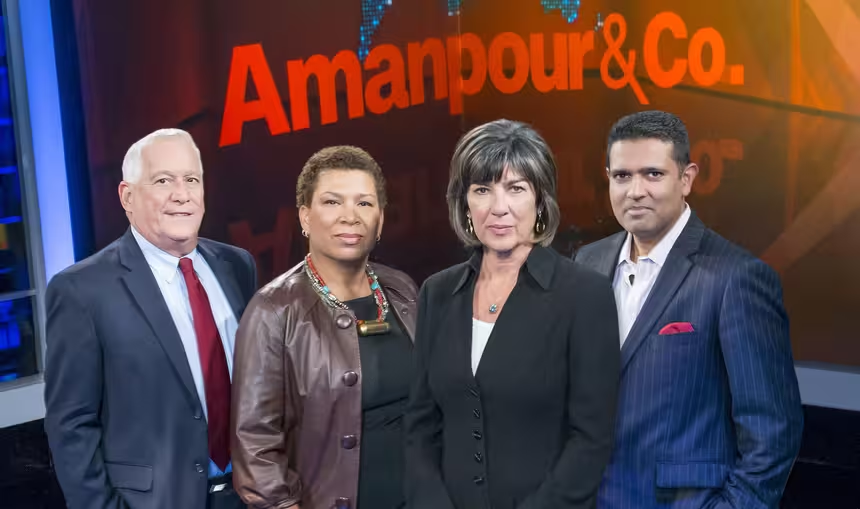
PBS and WNET, in collaboration with CNN, launched Amanpour and Company in September 2018. The series features wide-ranging, in-depth conversations with global thought leaders and cultural influencers on issues impacting the world each day, from politics, business, technology and arts, to science and sports.Providing Support for PBS.org
Learn Moreabout PBS online sponsorship(engaging music) - Hello, everyone, and welcome to Amanpour & Company.
Here's what's coming up.
- We are playing Russian roulette with our planets.
- [Christiane] Hotter and hotter, as climate records continue to shatter, I speak to Professor Leah Stokes and writer George Packer, who's just back from scorching Phoenix, Arizona.
Then.. - Finally, to the game of tennis, I love you and will never leave you.
- [Christiane] One of the greatest players in the history of the game, directors Asif Kapadia and Joe Sabia bring us never-before-seen footage of tennis icon Roger Federer's final days on court.
Plus... - African Americans have been very vocal about how unhappy they are with the American two-party system.
- [Christiane] Professor Leah Rigueur talks to Michel Martin about the Black voter dynamics that could swing the U.S. election.
(engaging music continues) - [Announcer 1] Amanpour & Company is made possible by the Anderson Family Endowment, Jim Attwood and Leslie Williams, Candace King Weir, the Family Foundation of Leila and Mickey Strauss, Mark J. Blechner, the Filomen M. D'agostino Foundation, Seton J. Melvin, Charles Rosenblum, Koo and Patricia Yuen.
Committed to bridging cultural differences in our communities, Barbara Hope Zuckerberg.
Additional support provided by these funders and by contributions to your PBS station from viewers like you.
Thank you.
- Welcome to the program, everyone.
I'm Christiane Amanpour in London.
Today, Greece closed schools and even the Acropolis due to soaring temperatures, as G7 leaders travel to Italy to discuss the planet's biggest threats, including the climate crisis.
Last month was the hottest May ever, marking the 12th consecutive month that records were broken.
In North America, a heat dome stretched across Mexico and the Southwest United States in recent weeks, killing dozens of people.
Listen to one woman describe the feeling in Arizona.
- To be honest, it feels like someone grabs a blow dryer and it's just blowing it straight in your face.
That's exactly how it feels.
It's really hot.
Sometimes if you go outside you feel like you can't breathe.
- Caught between increasing climate disaster and toxic partisan politics are people like that, many of whom who are living in the reality of climate change right now.
In a major new cover story for The Atlantic, journalist George Packer spent months reporting from Phoenix, Arizona, exploring the quixotic growth fueling urban expansion even as the water runs dry and the heat kills hundreds.
But Packer found some glimmers of hope writing, quote, "Partisanship mattered less than facts.
Disinformation and conspiratorial thinking had no answer for a dry well."
And George Packer joins me along with Professor Leah Stokes, an expert in climate and energy policy and cohost of the podcast A Matter of Degrees.
Welcome, both of you, to the program.
George Packer, I just wanna start because yours is entitled Phoenix is a Vision of America's Future.
Describe how, what are all the intersecting issues that make it a vision of the future?
- Yeah, The Atlantic wanted me to go somewhere that would give us at least a laboratory where we could see how America is doing and where it's going.
And Phoenix, I think, is about as good a lab as you can find because it really has all the major themes and conflicts and issues of our time.
It has political extremism.
In a big way, every election year is a tense year in Arizona, and this year is no exception.
It has a climate crisis that you just described and that I reported on in my piece with unbearable heat, as well as disappearing water in some parts of the state.
And it also has the border and immigration as a huge factor in the coming election.
Abortion is another one.
It's got this incredible nexus of issues, some of which divide people almost hopelessly and others have this odd effect of overcoming some of the divisions that seem so permanent and insuperable in our country.
- So before we get to some of the policies and things, I just wanna read a little bit from your article 'cause you experienced that extreme heat firsthand and you struggled to walk even a mile from your hotel to an interview without feeling unwell.
Here's a quote.
"Last summer, heat officially helped kill 644 people in Maricopa County.
They were the elderly, the sick, the mentally ill, the isolated, the homeless, the addicted, methamphetamines causes dehydration and fentanyl impairs thought, and those too poor to own or fix or pay for air conditioning, without which a dwelling can become unlivable within an hour.
Even touching the pavement is dangerous."
Were you prepared for that kind of extreme?
- No.
I don't like really hot weather, so I dreaded it.
But when you're in it, you have this sense of real danger, imminent danger.
If I lose my way on a walk, if I stay out too long, if I can't find water, you are risking your life.
And people who are homeless, people who are vulnerable in the ways that I described are risking their lives every day and dying every day.
The emergency rooms over the summer fill up with people coming in whose body temperatures are 106 or 7, which is heat stroke and can be fatal.
People find ways of coping.
The city of Phoenix has lots of innovative methods of allowing people to come inside and cool off in these cooling buses and cooling buildings.
They're trying to plant more trees and build more shelters 'cause it's a kind of naked exposed city in the summer.
But it all feels unsustainable because driving, which is one way to cool off 'cause you're in your car which is air conditioned, is also burning you up because air conditioning causes 4% of global emissions.
And the temperature rises every year.
There is no abating of it.
And who knows where it will be in 25 years.
There is a sense of eight months of the year it's paradise and that's why people move there, and four months of the year it's deadly.
- Leah Stokes, let me ask you about, you know, you study this, you also study the politics around it, environmental politics.
So one of the things that George said, he quoted in his book, in the article, "Whiskey is for drinking, water is for fighting."
There's a lack of water, but apparently people didn't seem to think that that was something that should be an election issue or political issue.
What are you seeing in terms of the politics around this now?
- Well, that's a great question.
The fact is, as we just heard, the climate crisis is happening now.
For decades, it was sort of viewed as a problem for the future, something that would affect our grandchildren or maybe poorer people in developing countries, maybe something for somebody else.
And what we are seeing is that this is the climate crisis.
It is on our doorsteps.
This is what we are seeing in the United States at just 1 1/4 degrees centigrade of warming.
What happens when we blow past that 1.5 degrees target that governments around the world are trying to hold us to?
What if we go to 2 degrees or 2 1/2 degrees?
What does life look like for everyday people?
And so this is becoming a really important political issue.
And in the United States, for example, with the upcoming election this fall, there's gonna be a very clear choice between somebody who says he, quote, "wants to be a dictator on day one to drill, drill, drill," that's, of course, Donald Trump, and somebody who really is the best climate president this country has ever seen and has really focused on this issue.
Will that play out in the election?
Will people show up to vote for President Biden because of his climate record?
I think it's too early to tell, but we're certainly seeing the impacts are hitting everyday Americans every day.
- Leah, I wanna ask you a little bit more about the politics.
'Cause George says, "Solving the problem of water depends on solving the problem of democracy."
Here's another quote, "The Republican Party there is more radical than any other state, but the chief qualification for viability is an embarrassingly discredited belief in rigged elections."
So you've got that.
How does that affect what people think about climate policy, Leah?
Because there are conservative Republicans who do believe, I mean, they may be a small group, but they do believe that climate should be a unifier.
And way back when Republicans were, you know, it wasn't a partisan issue.
- You are absolutely right.
This is something that I've written about in my book and many other political scientists have studied.
In the past, right-wing parties around the world were more supportive of climate action.
For example, George H. W. Bush, and even George W. Bush, were supportive of doing things on climate change.
Unfortunately, the fossil fuel industry has really taken hold of right-wing parties, like the Republican Party in the United States, but many right-wing parties around the world.
They have become really a chief constituency in the Republican Party.
You'll hear, for example, Senator Whitehouse from Rhode Island talk about this a lot.
The unlimited campaign contributions that we're seeing in the post-Citizens United world means that fossil fuel companies can pour so much money into our elections.
And they really have, for example, primary, the few Republicans, people like Representative Bob Inglis, who cared about climate change.
And even people like, for example, Senator McCain from Arizona who cared about climate change.
These people were challenged in part with fossil fuel money by having these primary challenges.
And that is part of why the Republican Party has moved so far away from climate action.
- And George, when you were getting testimonials from all these people, "Whiskey is for drinking, water is for fighting," but on the other hand, there's no conspiracy theory, I'm paraphrasing now, that can account for a dry well.
What feeling did you get from ordinary people in Phoenix about whether this was an issue that should be legislated, that climate should be something that governments, not just individuals, take care of?
- I think when you put it in the biggest terms possible, which is climate change, it immediately gets pulled into the vortex of the culture wars and the partisan wars.
The sides line up, and nothing gets done legislatively.
But if you look at it locally and in terms of a community's water supply or even the well in somebody's backyard in a rural county, a conservative rural county in Southern Arizona, once people find that they're losing their water, in Arizona, it's partly because in rural areas there is no regulation.
Phoenix is highly regulated and Phoenix has a lot of water.
It's not about to run out, but exurban communities around Phoenix and even more rural areas around the state are risking their groundwater.
And it's because it's unregulated and big agribusinesses are coming in from out of state, and even from other countries, and pumping relentlessly.
Local people, including MAGA Republicans, are upset about that and are now starting to demand that their state representatives allow legislation to pass that would regulate groundwater.
It's still stuck in the partisan gears of the Arizona State Legislature, but what's interesting to me is to watch actual personal experience of that incontrovertible fact, "My well is dry," change the mind of a voter.
And that seems to me like the beginning of a sane politics around climate.
- In other words, when it happens to me, no matter what side of the political aisle I am on, I can see the devastating effects of it.
And in your piece, basically, you say, "Joe Biden's infrastructure, microchip, climate bills are sending billions of dollars to the valley," where you were, "but I hardly ever heard them mention."
I wanna ask both of you, basically, we're not hearing much about climate in any of the political manifestos and talking points that both parties are using right now on the campaign trail.
Leah, let me ask you about that.
Do you think people will vote on climate?
Young people?
- Well, I certainly hope so.
The fact is the Republicans have put out a plan.
It's called Project 2025.
And people like Bill McKibben have written about this in The Nation.
And it is a very detailed plan for how to dismantle our federal infrastructure.
Things like getting rid of the National Oceanic and Atmospheric Administration, which literally just keeps track of data around what is happening to our Earth.
They wanna dismantle the Environmental Protection Agency.
We saw what a first Trump administration would do.
Rolling back almost a hundred environmental rules, pulling us out of the Paris Climate Agreement.
And what does a well-organized second Trump administration look like?
If you wanna know what it looks like, look at that Project 2025 document.
It's very scary.
By contrast, what the Biden folks wanna do is they wanna keep delivering.
And as you're saying, why don't people know about it more?
Well, this law is just beginning to roll out.
And we really need those four more years for all of those jobs to start rolling into these communities, for people to get electric vehicles, for them to put in a heat pump, to start seeing those benefits.
Laws take time to really take hold.
And with those crucial years before 2030, whoever wins this fall election will really be rewriting world history when it comes to the climate crisis.
So I certainly hope people understand the climate stakes of this election because they're monumental.
- Well, interestingly, one of his previous transition people did say that they would reverse everything that Biden has done.
Do either of you know whether any of Biden's climate initiatives have sort of baked in or all or many of them reversible?
George?
- Well, what I would add to what Professor Stokes said is I'm not sure that policy and voting are as connected as we think they are or as they used to be.
I think people vote more and more along what I would call tribal lines.
"This is my identity, this is who I vote for."
And if they discover that Biden's three big legislative achievements have brought a battery plant to their town, they may not think, "Therefore, I will vote for Biden."
It may just kinda go in one ear and out the other.
I saw a lot of that, just national politics and the ins and outs of Washington legislation having very little effect on people's thinking about the election.
And it's also, I think, the failure of the Biden administration itself to defend its achievements and to speak for them.
And that goes to the president himself who is not a master of rhetoric, and rhetoric is important in politics.
So that doesn't quite answer your question, but I do think we shouldn't expect there to be a logical cause and effect if a bill gets passed by a president that leads to certain electoral results.
- And Professor Stokes, overseas, we've just seen the European elections, and the Greens didn't do very well, which is very different to what happened the last time where there were these parliamentary elections.
All this emotion and enthusiasm around Greta Thunberg, which really powered a green sort of momentum in Europe a few years ago, seems to have not materialized this time.
What are you seeing overseas as well?
'Cause even the Europeans have tried to have a green recovery, so to speak.
- Yeah, I mean, look, the polling going into those elections in the last few days was worse than what the actual outcome was.
It's true that the Green Parties did not do very well and there was some surging in the far-right, but it was not as bad as people were predicting in the polls.
And the coalition that will continue to govern does want climate action.
And, of course, as you know, what really matters is who is controlling the countries in the European Union.
So, for example, the election coming up in the UK within a month, which looks like the Labour Party may regain government.
It's going to be crucial that they actually govern on climate change, that they use these years up till 2030 to make a difference.
Because as you were saying, we could be seeing rollbacks in the United States.
In fact, we would be if Donald Trump becomes president.
And so countries around the world really need to be electing climate leaders and having them deliver because 2030 is just really one election cycle away.
The elections this year will determine the fate of our climate goals.
- Because that is one of those benchmark years for achieving all the dates and the limits that we've been told by the UN.
We have been reporting on young people, for instance, in Montana in the United States and elsewhere, elderly people in the U.S. and in places like, I think it was Switzerland, who took the authorities, government, whoever it was, to court for their own human rights in terms of the right to be healthy and to have their wildlife, et cetera.
Do you think, Leah and even George, that they have weight in the political universe right now?
First to you, Professor Stokes.
- Yeah, I really think that George's reporting is showing what the front lines of climate change look like, as are these court cases.
People are connecting the dots.
They're starting to understand that climate change is happening now.
That's even starting to break some of the partisan division, as George was talking about.
And so these court cases are really starting to change the dialogue.
There's also laws beginning to be passed, like in Vermont, really just in the last couple weeks, that say that the fossil fuel companies who lied about climate change, they will be responsible for paying for some of the damages that they caused.
So we're really moving into the climate change era where damages are happening now, and I think that is going to start to shift the politics.
- And last, final quick word to you, George, did you come away with any optimism from all of that very intense reporting?
- Again, when I was very close to people's lives as they lived them and as they experienced them, yes, people were sane, they were rational, and they made rational choices about what they needed in order to make sure they would have water or even they would not die of heat.
But I think the bigger this issue gets, the more abstract, the more global, the harder it is to move people on it.
Climate is a very low priority in most polls before elections.
It matters hugely who gets elected, as Professor Stokes was saying, but it doesn't necessarily get people elected.
And that's the worry I have year after year and why we keep kicking the can down the road.
- George Packer, Professor Leah Stokes, thank you both very much indeed for joining us.
Next, we turn to a true legend.
When tennis great Roger Federer retired two years ago, it was the end of an extraordinary career.
In Grand Slam after Grand Slam, he racked up the titles while appearing eerily calm and grounded.
Not for him, the tantrums of other greats like McEnroe or even Djokovic.
Now a new documentary takes look at the enigmatic Swiss giant, following him behind the scenes in the last 12 days of his career.
Here's a clip from the trailer.
- I thought until this morning I had emotions in check, but I can feel it coming up.
(crowd cheering) - [Speaker 1] He will play the Laver Cup.
That'll be his last match of his career.
Djokovic, Nadal, Murray, they're all gonna be there.
- [Roger] To know that I will not have this feeling again, it's painful.
- [Speaker 2] A mountain of memories are flooding back to him right now.
- These are the nerves I'm gonna miss once I'm officially retired.
Finally, to the game of tennis, I love you and will never leave you.
- The film is called "Federer: 12 Final Days," and it is co-directed by Asif Kapadia, known for highly acclaimed documentaries like "Amy" and "Senna," and Joe Sabia, best known as the creator of Vogue's "73 Questions."
And both join me here on set.
Let me ask you first, did you come up with this?
How did it come about?
- Well, I was saying I didn't search for this, this kind of searched for me.
Because in 2019, I interviewed Roger for "73 Questions."
And it was the best interview that we've done.
He had a good experience, I had a good experience.
I kept in touch with his team.
So when 2022 comes around, I get invited into his office where his agent, Tony, says, "Top secret, don't tell anyone, but Roger's gonna retire from the sport of tennis next week, and he's gonna do it via his Instagram page in an audio message.
And then 12 days after that, he's gonna play his last match.
Should we film something?"
I'm like, "Of course, you should film something."
- So film something as a home video, a personal memento, or as a documentary?
- He's a private guy.
So I think there were reservations, especially from Roger.
Like, "I don't wanna put this out to the world, I'm so private."
The opportunity arose to say, "Okay, well, we can go in his home for the first time.
We're gonna capture his children for the first time.
His wife, Mirka, may give an interview for the first time in 20 years."
I definitely agreed that this should be something that's private.
It should probably never see the light of day.
And that gave Roger the comfort to allow me, another cameraman, and a sound guy to capture it all.
- And then, Asif, how did you come into this?
I mean, obviously, you have a record as the preeminent sports and other documentarians, but how did you get into this?
- I knew nothing.
(laughs) I didn't know any of this.
- You didn't even know Roger Federer was gonna resign?
- No, I didn't know anything about that.
I didn't know Joe.
I just was sent some material, sent a link saying, "Have a look at this.
Would you be interested in kind of turning it into a feature film?
Because this has been created, it's a home movie, no one's meant to see it.
To be honest, at the beginning I was like, "I'm not sure, not sure this is for me."
But I watched it and I found it really emotional.
And I thought, "This is interesting 'cause it's (indistinct)."
It's not a life story, it's about getting old.
- Exactly, exactly.
It's not the whole arc of a fantastic career.
It's those 12 final days.
So emotional, I'm going to play a clip, you've given us a few clips.
I mean, I think it's quite funny because Federer's known for being quite emotional.
Let's play this clip.
- What was that?
- What was that?
- [Speaker 3] Yeah, no problem.
- I feel like I'm ready to start (laughs) and get it behind me.
That's how I feel, my God.
Hopefully, I will not be using those tissues today.
But I'm an emotional guy, so we'll never know.
- Were you having to sort of navigate the tap works throughout?
- I just arrived from a flight from Switzerland that morning.
And I'm in that room.
I lost my luggage, it didn't arrive for days.
And we're just figuring out, "How are we gonna do this with just two cameras and a sound guy?"
So everything you see is just so, there's no time to prep, there's no time to plan.
Just shoot and see what happens.
So he's in that moment, you're watching the feels, you're watching the nerves, you're watching him go through something like looking off of a edge of a cliff and feeling like you're about to jump.
And that was that moment, that was the tension in the room.
It was so special.
- And then you who knew nothing about it, how did you then shape the story?
What was it about this actually really interesting end of a person's career?
- Yeah.
So for me, it is always interesting to kinda say, "Well, what is this film gonna be?
What is it about?"
I'm of a certain age now, and I'm looking at going, well, I'm a director, I hope I can carry on directing in my 60s, 70s, 80s if I want.
A lot of my heroes carried on till really late in life.
If you're an athlete, there's a point where your body just can't do it anymore.
So I thought that was interesting.
And also the way I read this, like my other films, I was given this archive.
There's all this material of a particular period of time.
I didn't know Joe at the time, I didn't know anything.
I haven't met Roger.
And I just started looking at the material with my editor, Abby.
And then the idea was, well, let's keep it for what it is.
Let's just protect that form for a period of time.
But through it, we go off to tangents, we go to the past, there's like the history of great tennis players that all appear at different points, McEnroe, Laver, Borg, and we say a little bit about each of them.
There is archive but it's not- - Nadal.
- [Asif] And Nadal, of course, and his friends and his rivals.
We're in the locker room, we're in the car, we're in the elevator, we meet the family.
And it was just this idea of telling a character story, but through a very small framing device, and I thought that was interesting.
I hadn't really seen that before.
- No, I hadn't either.
I will say that for the first 27 minutes I was, you know, it's an hour and 27 minutes, and I was trying to figure out where you're going, what you're doing, 'cause that was the first bit of him announcing and all the rest of it.
But then it suddenly got into this chapter.
People don't like to talk about aging.
They don't want to talk about retiring.
They don't want to be knocked off their pedestal.
Was it just the knee?
What was it that caused him to retire then?
Was it the injuries?
- I think the knee surgeries had a large part to do with it for sure.
I think the knees made him a different player.
But more significantly, I think it forced him to be just a normal human to realize that age catches up with everyone at a certain point.
This is something that Asif latched onto when Roger's coach, Severin, says that epic line, "Athletes die twice."
And I think what you're noticing is a real-time, moment-by-moment observation and realization of this fact.
And that's what makes it so compelling is that this is so raw, (chuckles) there's a subtlety to this.
But even more importantly, the fact that no one's giving their say about how it all needs to unfold.
There's no development executives telling Roger how to do this.
Roger's not telling us how to capture this.
So you're capturing something that feels unique in a time where everyone expects for docs to be so big and so loud and- - Exactly, and the fact that he was just going to retire, I mean, he was one of the greatest ever, and he was just gonna put something on social media goes to what you just said, there was no big direction about how to step off the stage.
And I wanna play this clip because we see him himself comparing his own temperament to, let's say Djokovic's.
- [Commentator] Federer fans in the beginning didn't really like him because they just thought, "Well, Rogers like a bit more easy.
(chuckles) He does it with ease."
Then Novak came in with his strong personality and that unbelievable grit wanting to win at all costs.
- [Roger] I know that this was something I was criticized a lot heavily.
Why wouldn't I fight more when losing?
I didn't quite understand what that meant.
Do I have to grunt?
Do I have to sweat more?
Do I have to shout more?
Do I have to be more aggressive towards my opponents?
What is it?
I tried, but that was all an act.
I'm not like that.
It's not my personality.
- I just think that's such a fascinating insight, Joe.
Really tricky to make that balance.
- Yeah, I credit Asif for figuring out how to make the archive go deeper than the surface that I scratched.
And that was Asif's job in pulling that up.
- Yeah, no, but I just mean that the fact that he had to deal with his public persona.
Was he going to scream and shout and do a tantrum?
But he didn't.
I don't know whether you ever discussed anything like that with him in the "73 questions."
- Oh, no, no, no, definitely not that.
I think the thing that was interesting about "73 Questions" is that you see him engaging with the ball kids and spending time to talk to them.
You see him answering questions like, what rival do you dread playing the most and enjoy playing the most?
And his answer is Rafael Nadal.
A little bit of a precursor to what you see.
But what I think is really more interesting is what you don't see in "73 Questions," is specifically him about to play his last slam where he made it to the finals.
He ended up losing to Djokovic.
But this is a guy who has his knee injuries on his mind.
This is a guy who's so concerned that his wife and his family are going to witness something catastrophic, given this knee situation, the anxiety in that.
So I think the relief and the release that everyone feels when watching this, knowing that he finally got through this retirement, "Okay, he did it safely, he did it with class, he did it with elegance," is something that's very palpable.
- I actually got to interview him in 2015 at Wimbledon, and I sort of delicately broached the issue of, because I'd been told by people who knew him that as a kid he had been quite emotional.
He wasn't above throwing a racket 'round and his parents had to get him in hand and tell him how to behave.
So this is our clip.
You seem to have this equanimity about you.
Losing doesn't put you into some kind of vortex of despair.
Andy Murray's mother has been quoted as saying, "When he lost to you in 2012 here, he was desperate and sad and weeping for days."
- Right.
- It affects some people, but it doesn't seem to affect you.
- Not so much, you know.
I agree, I think I used to be so emotional when I was younger that I learned from that.
I cried too often when I was younger, all the way from I'd say 8 to about 20.
It was unbelievably emotional years for me.
Every time I lost, I would basically cry.
So even as a pro, sometimes on court, sometimes I could manage to get off the court and then break down, which was better.
Eventually, I got my act together.
Now I take it like a man, and five minutes later I'm fine again.
Of course, I'm also disappointed that I have to either wait a year until Wimbledon rolls around or till the next Olympic comes around.
You know, it takes four years It goes with the territory.
You can't win them all, but what you can do is give it all you have.
And once you have no regrets, I think, you can accept losses also a little bit easier.
- I think it's amazing.
I think it's really amazing.
First of all, that he's a grown man who is not afraid to show his emotions.
Therefore, gives a lot of boys and men permission to show their emotions.
But I wonder you- - It's a film with lots of grown men crying.
- Yes, it really is, (laughs) especially when it showed the end and the final scene.
- It really is.
What happens is he sets everyone else off because he's coming to the end of his career, and all of his rivals are there in the room, and they can see, "It's gonna be me soon.
What am I gonna do?"
And all of them are thinking, "What next?
What do we do now?"
- Oh, I didn't think that, I just thought they were sad.
You're right, of course, because now Nadal is in question, Djokovic had to pull out of Roland-Garros and had surgery for his meniscus.
- It's happening, you can't fight time.
So that's what's really interesting.
It's about him, but it's really about them.
And I think the audience, all of us go through this moment, saying, "We come to the end of a certain part of our life, what are we gonna do next?"
So that's what I find kind of powerful.
It's quite subtle compared to some of the other films I've done.
- Yes.
- But it's also quite Roger.
That's him, he's quite contained, very Swiss, comes up, turns up on time, really, really polite and a gentleman, but he's got all this emotion underneath it.
And I think that seeing these athletes be so open with their emotions, I've not seen anything like that.
- Yeah, I mean, I was gonna ask you how it compared to, for instance, I mean, I know Senna was not alive when you did it, but Diego Maradona, Senna, their personas, how did they compare in this kind of regard?
- I think for me, the challenge is to look at the material, study the archive, try to understand their psyche, and then the film has to be true to the character.
So Amy is about Amy and she's very different to Roger.
I don't know if Roger's ever been to Camden.
They're very different where they're from.
And so the film has gotta be true to the person you're making it about.
And so that's the thing.
Rather than imposing a style on each one, it's really about the film is kind of a reference or a vision visually of the person.
And Roger's very different.
Tennis is very different to Formula One.
Tennis is very different to football if you're from a favela in South America and live in Naples.
That's not the same as Wimbledon.
So the films aren't gonna be the same.
- I believe the next clip we have, I think it's about the Laver Cup, the final meeting of them all and his final game.
Let's just play this little clip.
(dispirited music) (people cheering) - [Roger] I guess seeing all the other players, that was hard.
They were so emotional.
Their whole career, I've been there.
- It is, I mean, the audience was crying, everybody was crying.
When you see that, what do you think, obviously, they had such a bond, they all respected Roger, they all respected each other, they were just so top of the game.
Do you think that we will see another rival?
I mean, when you see people like Carlos and Jannik Sinner, do you think that we're gonna see another great rivalry, that Roger has inspired a whole new and younger generation of male players?
- If you asked me this question years ago, I wouldn't know how to answer 'cause I wasn't a tennis fan.
But after this experience, I watched tennis (chuckles) enough to be able to have an opinion to say that, yes, the new generation is playing at a level I think a lot of people have never witnessed before.
And I think people like Roger, Rafa, of course Djokovic, have inspired a whole generation to kind of break through to a level unseen before.
But the question, I think on a lot of people's minds, and I was really captivated by the unanimity of how everyone agrees that Roger did it most beautifully.
- Yes, because I think everybody struggles with how to do it.
And that's why this film is so interesting in that regard.
I wanna play my final clip.
It's about Mirka, his wife.
And as you said, she's basically never given an interview.
This isn't her actually, this is Roger talking about it, but it is very interesting.
- [Roger] It's only afterwards where I started to realize how much Mirka's been suffering.
I don't remember her begging me to stop, but, of course, she was asking the question, "Why are we still doing this?"
I know that for her sitting there, she really didn't like that anymore because she could feel I was not gonna be the best anymore.
- We've got 30 seconds.
Her value.
- She's the person who moves me the most in the film.
Whenever she turns up on the screen and speaks, and is also emotional, she is the one that makes me cry personally.
Tennis is so unusual.
No other sport has the wife or the girlfriend or the family constantly there to cut away to.
You don't have that in football.
You don't have that in rugby.
Tennis is all a part of the story, isn't it?
It's the family and the coach and the wife or girlfriend.
- And that was a great story.
- Or husband.
- They met at the Australia Olympics.
She was a tennis player.
Injury forced her to retire early and she supported him forever.
- Incredible woman.
- And it's a really, really good film.
And it comes out on the 20th, correct?
Next week.
- Yeah.
- Wonderful, Joe Sabia, Asif Kapadia, thank you so much indeed.
Now, as the U.S. November election draws closer, Republicans and Democrats are treading a fine line between appealing to their loyal base and undecided voters.
For Democrats, Black voters have historically been a bastion of support, but recent data warns against taking them for granted.
In fact, a Pew Research poll showed about half would replace both presidential candidates, hinting at their growing disaffection with the Democratic Party.
And to understand why, Michel Martin speaks with Leah Rigueur, associate professor of history at Johns Hopkins University.
- Thanks, Christiane.
Professor Leah Rigueur, thank you so much for joining us.
- Thanks for having me.
- As we are speaking now, there have been a slew of headlines about African American voters, Black voters, and their sort of ambivalent feelings about the candidates.
So why don't we just, before we kinda dig into the data, why don't we just kind of just drill down and say what are the most important themes to be looking at right now and what's just noise?
- So I think some of the things that we should be looking at are the levels of dissatisfaction with the American political process.
African Americans have been very vocal about how unhappy they are with the American two-party system.
And a lot of it, I think, has to do with overall trends in the larger country.
And in that respect, African Americans are just like their white counterparts, or their Asian counterparts, or their Latino counterparts.
They deeply care about the economy, they care about social mobility, they care about their communities.
And for many of these people, they have seen that the policies that either the Biden administration has touted, or, in some cases, that the Trump administration has touted, that none of those have actually affected their lived experience.
So when you see African Americans and when we interview African Americans or poll them across a wide field of data, we tend to see overwhelmingly that they are deeply unhappy with their position and their lived experience within the United States.
- Is this more of an issue for Democrats writ large than it is for Republicans?
Because we keep seeing how there are Republicans who aren't in love with their choice either.
I guess what I'm asking you is are African American voters dissatisfied because of their lived experience as Black people or are they dissatisfied because Democrats overall are satisfied and because they tend to be Democrats?
- So it's all of the above.
And I will tell you that this is a larger problem for the Democratic Party than it is for the Republican Party.
One of the things that we've seen over the last several presidential cycles is that Republican candidates can win without a majority or even a large percentage of the Black vote.
But we also know that Democrats can win with the help of this very large and loyal Black base of voters.
And so the real problem is the enthusiasm problem.
Democrats need Black voters in order to win presidential elections.
Republicans only need a small sliver of Black voters in order to win elections.
And this is why I say that in many ways it's an uphill battle for Democrats in this respect.
Republicans only need a low turnout from Black voters in order to win elections as of the last really 50 some-odd years.
And so part of what the Democrats are facing is we have this incredibly loyal base, a bloc of voters for whom no other demographic within the United States functions this way.
And yet because they have been so loyal and because they vote as a bloc in overwhelming numbers for the Democratic Party and have done so since, really, 1964, we begin to see that Democrats are taking Black voters for granted or treat it in very superficial ways.
Black voters have expressed over the years both anger, disenchantment, disillusionment, with the feeling that they aren't being appreciated in the way that the Republican Party appreciates its white base.
So it is a question of loyalty, but it's also a question of "What have you done for us lately?"
- According to a survey from GenForward at the University of Chicago, this survey found that 17% of Black voters would vote for Donald Trump if the elections were held today.
Today being when the poll was taken.
First of all, do you think that's a valid number?
And secondly, what do you make of it?
- I think the number, it's probably off a little bit.
One of the things that we see is the number that people give in these kind of polling data tends to be offset by, at the end of the day when people go into the ballot box, they either vote for the Democratic candidate or they don't vote at all.
It manifests itself as a non-vote at the top of the ticket.
But I also wanna remind people that anything within the range of 18, roughly 18%, is actually within the norm of the last 50 some-odd years.
We tend not to see it as the norm because of the Obama era.
- Ah, interesting.
- In the Obama era, those numbers are just astronomical because of the overwhelming level of Black support for the first Black president.
But what we see starting in 2016 really is a return to the average.
So I like to say that when we see these Trump numbers, whether they were in 2016, 2020, or 2024, we are seeing a return to home, that essentially Black people who vote for the Republican Party are coming home.
The other thing that I think is important to keep in mind is that when Black people perceive very little difference between the two major political parties, really one of three things happens.
Either they vote for a third-party candidate, they don't vote altogether, or in very small numbers, within the mean of what we're seeing with the GenForward, I think, polling data, they will vote for and support Republicans.
So I think that tells us something about how Black voters perceive the Democratic Party, or at least 17 to 20%.
We also know that younger Black voters are increasingly expressing dissatisfaction with the Democratic Party.
Many of them have indicated that they view President Biden and his administration, whether rightly or wrongly, they view that administration as either indifferent or outwardly hostile to issues of civil rights.
- Say more about that.
Why?
Behind closed doors, or even really not behind closed doors, as a lot of the democratic strategists will express surprise and dismay.
They're like, "Well, what about Kamala Harris, the first African American/South Asian person to hold that seat?
What about all the efforts that the president has made on college loans, to cancel that debt?"
They look at things like that and they go, "What's the story?"
What is that?
- One of the pushbacks I always get, including from Democratic strategists, or even just the general public, is, "Well, why are we so concerned?
The number is still like 80% of African Americans or Black voters support the Democratic candidates."
And yes, that may be true, but it's also true that there is a slow trickle of Black voters who are expressing dissatisfaction and also articulating a kind of argument about the failures of the Democratic Party.
And so part of what I would put forward is that we're not necessarily seeing a robust effort on the part of Republicans.
They're not winning Black voters over because of their policies or procedures or programs, but instead because of the failures of the Democratic Party to connect organically and authentically to a very, I think, tense section, cross-section, of Black voters.
And in that case, one of the things that we know is that there is a way in which the Democratic Party has completely missed an opportunity to really get down organically and understand the needs, the desires, and the frustrations of Black voters in many ways.
- What does that look like?
The Obama approach, maybe you could argue the Obama-Biden approach, has been to act on policy without labeling it as being for the benefit of these groups.
Their approach has been, "We're gonna work on policy and we're going to present this policy as beneficial to the country at large, and read between the lines."
If you cancel student debt, who has the most student debt?
It's certain groups.
If you make healthcare more widely available through the Affordable Care Act, read between the lines, who does it benefit?
Is it really that the messaging needs to be, "This is for you," or are there other policies that the Democrats aren't pursuing that African Americans identify and say, "You're failing us."
- All of the above.
And I would think back to the 2020 Democratic primaries where there was a real conversation, an actual real conversation between the candidates, the front runner candidates both in the 2020 and 2016 presidential primaries, about what would it look like to have policies that are aimed specifically at African American communities.
In 2020, President Biden said, "I will appoint a Black woman to the Supreme Court."
And he did it.
And it was one of the most powerful things that he could do, even though the naming of a Black woman and saying, "I want to put a Black woman on the Supreme Court" is something that may have alienated ostensibly racist people, that maybe the Democrats needed to win.
And yet it paid off political dividends.
It paid off heavily.
And it was rewarding, essentially, the most loyal constituency of his base.
- What else should the administration be doing that they're not?
- Voting rights, criminal justice reform, and some kind of large economic incentive.
And I don't wanna take away from the ways in which the Biden administration has actually done those things through colorblind policy.
They have done that.
The messaging around it though is deeply important, particularly in the way that you are conveying to audiences who feel left behind.
One of the things that the Trump administration did very well is that they spoke explicitly to their core base, the people that they needed to win.
And a lot of people I think were taken aback by that.
But, actually, if you look at it on the grand scheme of things, it was an incredibly important strategy.
You need people enthusiastic around these things, but you also need policy wins, very big policy wins.
And so I think for many audiences, you can point and say, "Well, I'm being gridlocked."
And all those things are true.
"I'm being blocked out of Congress.
It's not possible to do these things."
But that's not what audiences see.
They see themselves being left behind.
- We've talked about policy, we've talked about sort of messaging, but do you think that there are some other factors as well behind the disaffection of Black voters?
- The number one problem is disaffection with policy and lived experience.
But something else that we've seen really just explode over the last eight years is that there's a concerted cyber effort, international cyber effort, that is explicitly aimed at Black voters, and Black people more generally.
It pops up across these various kind of technological platforms, including Instagram, Facebook, Twitter, now known as X, TikTok.
One of the things that's remarkable about these, I think, concerted efforts is that they are built on kernels of truth and frustration that African Americans and Black voters have with the Democratic Party.
And then of course what happens is that these things are blown up into misinformation, into people in digital blackface.
These kinds of conversations that take on a life of their own.
And then the other thing that we know is that it is very hard, if not impossible, to track how these things are showing up.
- I know during the last election, there were a couple of accounts that were very much a product of Russian troll farms who were basically studying sort of points of division in the American society and actively kind of poking at them.
- Exactly.
And so I think the best kind of misinformation or disinformation is the kind that starts from a kernel of truth because it makes it far more believable, or kernel of frustration.
So if you know that, for example, Black men feel very strongly about the criminal justice system and about the disproportionate way in which the American criminal justice system has treated Black people, and you know that there's some way in which Joe Biden, President Joe Biden, was involved in the passage of, say, the crime bill in the 1990s or things of that nature, it is very easy to take that and to blow it up into something entirely different and to keep hitting people and hammering people on this issue.
- You mentioned Black men.
Is there a way in which the disaffection, let's just say attitudes writ large about the Democratic Party, the Biden administration, among Black voters, does it cut differently depending on who you are?
I guess what I'm wondering, does this cut differently based on gender?
- There's absolutely a gender component.
I wanna clarify this first by suggesting the overwhelming majority of Black voters, male or female, support the Democratic Party and support Democratic candidates.
With that being said, Black people that vote Republican in presidential elections, they tend to be overwhelmingly Black men.
And there are a couple of reasons for this.
I think one of them is this idea of an individual and kind of frustration, the sense of an individualism and frustration with these larger political institutions.
Take the George Floyd moment.
Many Black men looked at that and said, "This is a failure of American political institutions."
But it's not just a failure of the Republican Party.
That's not how Black men viewed that.
They viewed it as overall an overarching frustration and failure with the American system.
Policing and things of that nature.
And they see it as a bipartisan failure.
But what that allows them to do, particularly given that their sense of individualism is much higher than Black women, is to think, "How can I then vote in a way that best benefits myself?"
Black women have a much, much more difficult time divorcing themselves from this idea of the collective best interests of the race.
And that's where we really begin to see these differences.
It's also true that there's a certain cross-section within the Black male population that is attracted, I think, to Donald Trump's sense of, essentially, machismo and authoritarianism.
They like that he is, essentially, a strong man.
He is seen as strong.
They don't see him as weak.
So I think that there are significant gender differences that actually end up playing out in really important political ways.
- Former President Trump, candidate Trump has said that he's not going to announce his vice-presidential nominee until the convention.
There seem to be two African American men who seem to be in the running for that slot.
South Carolina Senator Tim Scott and the Florida Congressman Byron Donalds.
And I was just wondering, does that matter?
Do you think that matters?
- It matters, but not for Black audiences.
It matters for white audiences.
- Interesting.
- Let me explain a little bit.
One of the things that we see over and over with Black audiences is that there is a particular kind of candidate, Black candidate, that has enormous amount of appeal.
Think Barack Obama.
They have to be authentically and organically connected to Black communities.
They have to seem invested in, essentially, the uplift or the betterment of Black communities.
Neither one, and I would particularly point to the congressman's remarks the other day where he romanticized Jim Crow.
I would point to the fact that both of them have white spouses.
That matters to Black voters.
And one of the things that we know from studies about Black Republicans and Black audiences is that Black audiences actually treat Black Republicans more harshly than they do white Republicans that have to hold the exact same views.
- Interesting.
- Why?
Because they view those Black Republicans as traitors, as betraying the best interest of the Black communities.
Now, where it matters though is for white audiences, particularly white audiences that are deeply uncomfortable with Donald Trump's brand of bigotry, xenophobia, and racism.
Tim Scott is a reassurance.
Says, "Well, if Tim Scott supports Donald Trump, then he can't be that bad, correct?"
It provides a kind of shield for accusations of racism, of bigotry, and xenophobia.
And I do actually think politically, from a political calculation point of view, that's very important.
- Before we let you go, the Biden administration, or the Biden campaign, has seemed to have really stepped up its outreach.
I mean, there are a lot of events.
As we are speaking now, there's a Juneteenth celebration.
I just wondered, do things like that matter?
- They do matter.
But I wanna remind people that the Democratic Party actually has a much harder battle right now than the Republican Party in terms of its relationship to Black voters.
One of the things that they really need to pay attention to and really invest money into are these organic listening conversations.
Sit down with Black voters and say, "Tell us what you want."
And then listen rather than lecture.
It's the same advice that I gave in my book to Republicans.
If you're actually serious about winning over Black voters, sit down and listen.
Don't start six months before an election.
And I think it's a tall charge, but it's not too late.
And certainly, if the Democratic Party is willing to invest money and time and effort, they can win back those voters who seem disaffected and disenchanted with their relationship with the Democratic Party.
It is absolutely not too late.
- Professor Leah Rigueur, thank you so much for joining us and sharing these insights with us.
- Thanks for having me.
- And fascinating analysis there.
Finally tonight, toothbrushes, bottle caps, and beach toys, trash that has sunk to the bottom of our oceans and polluted our beaches has resurfaced as art in this New York Aquarium exhibit called Washed Ashore.
35 larger than life sculptures try to provoke viewers into thinking about how plastic is threatening the health of our planet.
As rising sea levels continue to jeopardize coastal cities and temperatures breaking alarming records, protecting our oceans and marine wildlife has become ever more crucial.
And that's it for our program tonight.
If you want to find out what's coming up every night, sign up for our newsletter at PBS.org/Amanpour.
Thanks for watching, and join us again tomorrow night.
(pleasant music) - [Announcer 1] Amanpour & Company is made possible by the Anderson Family Endowment, Jim Attwood and Leslie Williams, Candace King Weir, the Family Foundation of Leila and Mickey Strauss, Mark J. Blechner, the Filomen M. D'agostino Foundation, Seton J. Melvin, Charles Rosenblum, Koo and Patricia Yuen.
Committed to bridging cultural differences in our communities, Barbara Hope Zuckerberg.
Additional support provided by these funders and by contributions to your PBS station from viewers like you.
Thank you.
(light music) (gentle music) - [Announcer 2] You're watching PBS.
 New Episode
- News and Public Affairs

Top journalists deliver compelling original analysis of the hour's headlines.

- News and Public Affairs

FRONTLINE is investigative journalism that questions, explains and changes our world.

 New Episode
 New Episode

 New Episode
 New Episode
 New Episode
 New Episode
Support for PBS provided by: