
August 27, 2024
8/27/2024 | 55m 51sVideo has Closed Captions
Nathalie Tocci; Thierry Arnaud; Julia Louis-Dreyfus; Daina O. Pusić; Nicholas Kristof
Nathalie Tocci and Thierry Arnaud discuss the latest from this week's G7 meeting in Italy. Actress Julia Louis-Dreyfus and director Daina O. Pusić explore grief and love in their film "Tuesday." Journalist Nicholas Kristof talks about his new memoir "Chasing Hope: A Reporter's Life" and how he remains hopeful through his reporting on life's darkest moments.
Problems playing video? | Closed Captioning Feedback
Problems playing video? | Closed Captioning Feedback
August 27, 2024
8/27/2024 | 55m 51sVideo has Closed Captions
Nathalie Tocci and Thierry Arnaud discuss the latest from this week's G7 meeting in Italy. Actress Julia Louis-Dreyfus and director Daina O. Pusić explore grief and love in their film "Tuesday." Journalist Nicholas Kristof talks about his new memoir "Chasing Hope: A Reporter's Life" and how he remains hopeful through his reporting on life's darkest moments.
Problems playing video? | Closed Captioning Feedback
How to Watch Amanpour and Company
Amanpour and Company is available to stream on pbs.org and the free PBS App, available on iPhone, Apple TV, Android TV, Android smartphones, Amazon Fire TV, Amazon Fire Tablet, Roku, Samsung Smart TV, and Vizio.
Watch Amanpour and Company on PBS
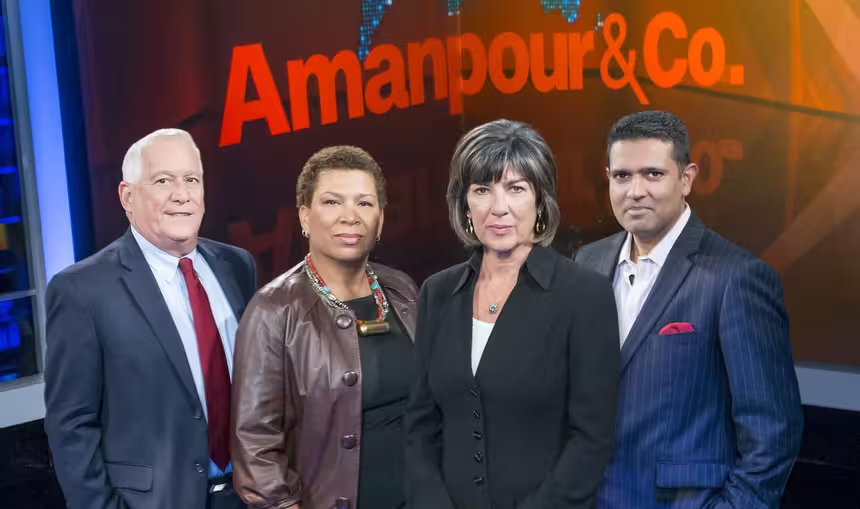
PBS and WNET, in collaboration with CNN, launched Amanpour and Company in September 2018. The series features wide-ranging, in-depth conversations with global thought leaders and cultural influencers on issues impacting the world each day, from politics, business, technology and arts, to science and sports.Providing Support for PBS.org
Learn Moreabout PBS online sponsorship(dramatic music) - Hello everyone and welcome to "Amanpour & Co.".
Here's what's coming up, (Prime Minister Meloni speaking in Italian) - [Christiane] Riding high on her election win, Italy's populist Prime Minister Giorgia Meloni welcomes the world's most powerful leaders to Puglia.
We look at Europe at a turning point.
Then.
- I don't know what I am without you, who I am without you, I don't know what the world is without you in it.
- [Christiane] The queen of comedy, Julia Louis-Dreyfus, gets serious in her new movie, "Tuesday".
The actress and the film's director joined me.
Plus.
- Side by side with the worst of humanity, Walter, you invariably find the very best.
- [Christiane] Chasing hope, journalist Nicholas Kristof tells Walter Isaacson how he finds light in the world's darkest corners.
(dramatic music) - [Announcer] "Amanpour & Co." is made possible by the Anderson Family Endowment, Jim Attwood and Leslie Williams, Candace King Weir, the family foundation of Leila and Mickey Strauss, Mark J. Blechner, the Filomen M. D'Agostino Foundation, Seton J. Melvin, Charles Rosenblum, Koo and Patricia Yuen, committed to bridging cultural differences in our communities, Barbara Hope Zuckerberg.
Additional support provided by these funders and by contributions to your PBS station from viewers like you.
Thank you.
- Welcome to the program everyone.
I'm Christiane Amanpour in London.
Today, in Italy, G7 leaders have agreed to loan Kyiv about $50 billion backed by the profits from Russia's frozen investments.
It's been a banner week for the summit host, Italy's Prime Minister Giorgia Meloni.
Fresh off a big win in the European elections, the far right leader has welcomed her G7 peers to Puglia.
But that's not all, Meloni has also invited a slew of other power players like Ukraine's President Volodymyr Zelenskyy, India's Prime Minister Narendra Modi, and South Africa's Cyril Ramaphosa.
An embolden Meloni stands in stark contrast to her counterparts like France's Emmanuel Macron, and Germany's Olaf Scholz, who are on very shaky ground after their parties took a beating from the far right this weekend.
Nonetheless, there are important issues to hash out.
And top of the agenda is of course, Ukraine and Gaza.
I'm joined by Nathalie Tocci, political scientist and former advisor to the EU's foreign policy chief, along with Thierry Arnaud, senior international correspondent for the French channel BFMTV.
Welcome to both of you.
Thanks for being with us.
Nathalie, can I start with you first, because in Italy at the G7, they actually, did agree to make this loan to Kyiv based on Russian frozen assets.
Now, Russia is furious.
It says there'll be painful retaliatory measures.
How significant is this moment for Ukraine, Nathalie?
- Well, I mean, of course, Christiane, this agreement had been in the pipeline for quite some time, and the US had been pushing for it for quite some time.
It was actually, the European countries that had been resisting, and essentially, the reason why, it's mainly the Europeans that have been caving in the sense of, you know, contributing to providing the guarantee to the guarantee.
Because of course, the big question really is, you know, what if the guarantee that is provided by those Russian assets were to somehow no longer be available, for instance, because of a quote unquote peace agreement, then who would actually, you know, guarantee that guarantee?
And for a long time there was, you know, haggling over this point.
It seems to me that it is mainly been the Europeans that have been backtracking on some of their resistance.
And I actually, think that the reason why this is happening is because of a growing fear that if the agreement is not reached now, then it could be a lot harder to reach in a few months time.
Especially, if the elections in the United States were to see a return of Donald Trump to the White House.
So, in a sense, you know, cash in whatever agreement you can get in now, because the future may actually, be far more troubled.
So, I think, you know, although, of course, it's an extremely positive development that this agreement has been reached, and as I said, it has been in the pipeline really for quite, perhaps for a little bit too long.
It's been, you know, a long time in the making.
But the reason why it actually ended up in this final squeeze is because of a fear that in future things could get far nastier.
- Well, let me turn to you, Thierry Arnaud, because in France for instance, you have this far right surge.
Would a Prime Minister Bardella or a President Le Pen, would they, you know, put the brakes on this kind of thing?
Because as, you know, many of the far right leaders, including Le Pen and others, have been criticized for their closer links to Vladimir Putin.
- They have indeed.
The fact of the matter is that over the past few weeks and month, their position has moved towards a more Ukraine-friendly attitude.
They were basically, opposing any kind of aid, whether military or financial for Ukraine initially, but they've come a long way since then.
And as much as they have disapproved the president's latest moves, for example, providing fighter jets to Ukraine as he's promised to do, and training the pilots as well, obviously, by the end of the year, he has also talked about deploying French military instructors in Ukraine.
The way we would like to do it would be as part of a European coalition.
But on those two specific aspects, obviously, neither Marine Le Pen or Jordan Bardella would approve of that and would sign off on it.
But when it comes to financially supporting Ukraine or providing some kind of military equipment, they are now much more open to this than they were only a few weeks ago.
- I want to come back to more on Macron and his political issues right now.
But first I wanna ask in relation to Giorgia Meloni, Nathalie, you know, some of the editorials have been saying that, you know, this G7 is six lame ducks and Giorgia Meloni.
In other words, as we know, many of the leaders there took a real drubbing.
Do you agree with that image and that she now is really cemented as the solid European leader?
- Well, I mean, it's clear that, you know, out of those leaders, she is the one that came out electorally strengthened.
So, that is, I think a fact.
I actually, though think that this narrative is overblown.
Firstly, I think that Italy is presiding this G7 in extremely complicated times.
It's actually, a G7 that with the exception of this one agreement on the Russian frozen assets, actually, has no real deliverables and it has no real deliverables precisely because in general, the situation within the West has weakened really quite substantially.
When it comes to Meloni herself, I also think that although over the last few months, and it's not just with the election, it's really been, you know, a narrative building up over the last few months of, you know, Meloni being the queen maker in Europe, and what is her position?
These have sort of gone line.
We may be reaching the end of that story.
And what I mean by this is that there comes a point where you kind of need to make a choice, right?
And there's only so long that you can play this Dr. Jekyll, Mr. Hyde game, which has been going on for the last year and a half, frankly speaking, of being very hard lined domestically and appearing to be rather malleable on foreign policy issues.
There will come a point, and especially, when it comes to the decisions concerning the future cohort of European leaders, that Meloni will have to choose whether to actually, make the definitive move towards moderation, and essentially, end up being given the electoral results at European level.
The small fish still the small fish in a big pond, or return to what probably her real beliefs and quote unquote values are and move to the right, especially, looking ahead at what may be happening in France soon.
- Right.
Well, there she is in Italy, domestically, her politics are much different, as you said, to her foreign policy.
And they're much more right wing on all the social issues and other such issues.
So, Thierry Arnaud, your president, Macron, is at this G7 meeting, I mean, along with Olaf Scholz, of course, but Macron's thrown down the gauntlet and has decided to go all in on a big gamble to make the French decide whether they really want the far right.
How is it being taken?
How are the French looking at it?
What are you all seeing when you talk to people and interview people and report on this?
- Well, with a lot of puzzlement and astonishment as to what the President has decided to do.
And most of the people you talk to do not necessarily understand why he has come to this decision.
So, he has some explaining to do, which he started doing yesterday by holding a press conference.
And essentially, I think he did it for two reasons.
The first one is, who he is.
He is a man with a lot of pride, he hates losing, he hates being in a corner.
And when he finds himself in a situation where he holds very few strong cards, instead of doing the reasonable thing, which would be folding, he's gonna go all in, which is exactly what he has done.
And it's also his assessment of the current political situation.
First of all, the loss is hard to overstate, I mean, how bad it is.
And the conclusion he has drawn is that, if not now, he would've had to do it anywhere within the next few weeks or month.
He was expecting, for example, a motion of no confidence to be adopted in parliament by the fall over the next budget.
And in that particular case, the government would've had to resign and he would've had to call this election.
So, might as well doing now out of his own initiative as opposed to having to play defense in a few months time.
- That's interesting, yeah.
- And the political gamble he's making is this one.
The political gamble he's making now, is this one.
He thinks that in essence a parliamentary election is very different from the European election.
The defeat he has been submitted to is in his opinion, first and foremost, the expression of a lot of anger.
But it's one thing to be very angry and to express it by supporting the far right, it's quite different to vote for a parliament, which is going to hand over power to Marine Le Pen and Jordan Bardella.
And in his opinion, the French are not ready to go that far yet.
It's a bet that governing parties have been making for the past 20 years.
And if you look at what's been happening for 20 years, is that each time so far they have won that bet, but the margin by which they have won is getting narrower and narrower and maybe it's going to disappear within the next few weeks.
- So, I was gonna ask you that, because you know, there's one sort of, I mean, the leader of the traditional right wing party, La République, he has called for an alliance with the Le Penistas.
And he has had a lot of pushback from within his own traditional party.
Let's not forget it's the party of Charles De Gaulle who actually, fought to rid France of the fascists and their inheritors.
Are you surprised that this kind of red line between the regular parties and the far right has disappeared?
- No, because you will always find people in Eric Ciotti, the leader of this particular party, is one of them that think that the only way to win now, the only way for them to get back to power, is through that alliance.
So, it's, you know, it goes against the history of the party.
It goes against the nature of its policies in many ways.
But, you know, there are people like him who think that they want to run the country, they want to have a seat in the government, and the only way to do this now is to align with Marine Le Pen.
You know, when you look at these results of the European election, they're really spectacular, because, you know, Rassemblement National Party came ahead in 93% of French cities, of all French cities, big and small.
If you look at all the social passes, if you look at all the age groups she's had almost everywhere now even where she used to be traditionally quite weak.
So, the wave of that election in her favor has been very strong.
And it's a momentum that's going to be very hard to stop before the next election.
- Gosh, yeah, you seem to have a pessimistic view of how it's going to turn out.
So, we'll see, but obviously, these leaders who are at the G7, Nathalie, also have another raging war on their hands, and that is between Israel and Hamas, and the essential flattening of Gaza, and the terrible humanitarian crisis, plus the fact that there are still Israeli hostages inside Gaza.
Now, I just wonder what you think, because the Secretary of State is there, I think, having come back from inconclusive ceasefire talks in the region and every day they're faced with pictures like the one I'm going to put up, and it's really awful.
Images of suffering, which are horrific.
This is a Palestinian child in Gaza.
His name is Amjad Kanu, he's three years old, he weighs five kilos.
He's suffering from, you know, severe malnutrition.
It's the kind of thing I've seen when I've covered famine, you know, famine countries.
The UN says almost 3,000 children being cut off from treatment for moderate and severe acute malnutrition in southern Gaza.
They're at risk of dying in front of their family.
So, I'm saying all this, because clearly that is what the leaders also are faced with.
How are they going to alleviate this humanitarian condition, while also trying to bring about a ceasefire and end the actual war?
- Well, you know, Christiane, I think, you know, the tragedy of this moment is that whereas diplomacy over the last eight months, I mean, obviously, failed, but it was in a sense trying at least to get to a deal, for instance, on the hostage release and a ceasefire.
Now, that, that plan is in theory there, and, of course, it has been endorsed by the UN Security Council.
What the G7 will do is, I presume, sign up to that very plan.
But in a sense, we're in this odd situation in which there is a plan that presumably is Israel's plan.
Hamas has kind of conditionally accepted it so long as there are certain clarifications made, but Israel itself doesn't actually, seem to be committed to presumably what its own plan is.
And so, in a sense, we're back to a pre 7th of October situation in which diplomacy on the quote unquote Middle East peace process for years, in fact, for decades, it became, in a sense an excuse for things on the ground to deteriorate even further.
And so, I fear that we're getting into this situation now once again, but, of course, in a far more dramatic, and in humanitarian terms, catastrophic situation, in which in a sense, leaders can all be happy there's a plan and we all sign up to it, but then nothing really happens, right?
And no one really actually, makes Israel comply to what presumably its own plan is.
- Nathalie, of course, the US has put the burden completely on Hamas and they've demanded that Hamas come up and say yes to this.
But you're right, Israel publicly has not endorsed this peace plan.
Can I ask a final question to you, Arnaud?
I mean you're watching from there.
This G7 is somewhat different.
Meloni has invited a whole slew of people from, you know, powerful presidents from Latin America, India, you know, prime minister, South Africa, et cetera.
They're trying to get the global south on board, particularly, to buy into their narrative of what's happening in Ukraine.
How do you see that developing on, Thierry?
- Well, I think it's gonna be very hard work.
I don't know about you, Christiane, but I cannot recall any G7 summit in recent memory in which the French President, the German Chancellor, the British Prime Minister, found themselves in such a weak political situation that it was hard to imagine that their pressure would be able to carry a lot of weight vis-a-vis those representatives of the global south.
So, I think it's essential that they try, because on the other side of the equation, you have, obviously, China together with Russia pushing extremely hard to convince them to align their world views to that of Beijing and Moscow.
So, there has to be an argument, there has to be, beyond this invitation, you know, a worldview presented to these leaders that makes sense to them as well.
So, I think it's very important that they are invited.
It's very important that it's discussed this very difficult world situation with those Western leaders specifically.
But because of the situation they're in today, I think again, what they have to say will, unfortunately, carry a lot less weight than it could have maybe a couple of years ago.
- And from your perspective, Nathalie, as somebody who used to advise, you know, the EU foreign policy establishment?
- Well, you know, I mean if you take the G7 of two years ago, the German presidency G7, that was actually, the first time, you know, so the war had already started in Ukraine and we realized that we had a problem with the global south and there was a kind of real effort being made.
You know, that was the first time the South Africa and Senegal and Indonesia and India were invited.
And at that time, of course, we realized that the global south was not quite totally aligned with us, but we were still with the quote unquote global majority.
Yeah, I mean, just think about votes in the UN General Assembly on Ukraine.
The problem is that making that effort now with war in the Middle East, - Okay.
- In which our reputation and credibility in that global south has, you know, collapsed makes it a far, far harder challenge.
- Okay, it's been really great talking to you, Nathalie Tocci, Thierry Arnaud.
Thank you so much for joining us tonight.
Now, Russia has formally sent an espionage case against the jailed American Wall Street Journal reporter Evan Gershkovich to court.
He's been detained in Moscow since March of last year.
In response today, the Wall Street Journal said, "Evan Gershkovich is facing a false and baseless charge.
Evan is a journalist.
The Russian regime's smearing of Evan is repugnant, disgusting, and based on calculated and transparent lies.
We continue to demand his immediate release."
As, of course, does the journalistic community.
Now, another noteworthy meeting is happening inside Italy tomorrow, and this one is in Vatican City.
The Pope, who is a fan of cracking jokes, is hosting some of the world's best comedians.
The church says it's in support of comedy contributing to a more empathetic world.
Whoopi Goldberg, Stephen Colbert, Chris Rock, Conan O'Brien, they'll all be there along with my next guest, one of the queens of comedy, Julia Louis-Dreyfus.
She's given us lots of laughs in "Seinfeld" and "Veep", but her new movie "Tuesday" is much more serious.
The story centers on a mother played by Louis-Dreyfus and her daughter, Tuesday, who is dying.
And when the mother struggles to accept this reality, Death itself appears in the form of a giant parrot and begins pecking her towards acceptance.
Here's a clip from the trailer.
- You, you made, you made my head silent.
- Who are you talking to?
- Can you please just come out so she can see you?
(winds fluttering) - Madam, you need to say goodbye to your daughter.
(somber music) - [Tuesday] You have to get strong now.
- I can't.
- You can.
And you have to let me help you.
- Life, every life ends.
- The magical reel this fable is written and directed by Daina O. Pusic who joined Julia to explain how this strangest of concepts help them reach a universal truth.
Julia Louis Dreyfus and Daina O. Pusic, welcome to the program.
- Thank you for having us both.
- Thank you so much.
- It's an extraordinary film.
It's very weird at least to start off.
But I just wanna first start by asking you, Julia, I guess people do typecast you a little bit with the comedy thing, but you've done, you know, clearly a number of films that aren't comedy.
And I wondered what about this one attracted you?
- Well, what attracted me to this role was the script, of course, but the script in a very fantasy, magical realism kind of way, explores issues of grief, death, dying, denial, acceptance in addition to really exploring the bond between parent and child.
All of those themes were, of course, they're very fundamental and they really appealed to me, to explore from a storytelling point of view.
- And it should be noted that one of the main stars anyway, is a CGI giant morphing parrot.
I mean the two of you, how did you bond over this?
'Cause it could have gone horribly wrong or it could have been as it is really interesting.
- Well, Daina and I met over Zoom a number of times to talk in depth about the script, and Daina is, obviously, a very emotionally intelligent person and a true artist in every sense of the word.
And really it was quite clear to me, and she can speak more to this, that her desire in terms of the animated parrot as it were, was to make this as beautiful and otherworldly and rooted in reality in such a way so that it would propel the story forward and give it proper sort of profundity.
- So, Daina, tell me about it, because it's kind of an unusual vehicle.
The parrot is Death, the Grim Reaper.
- Well, I really, I designed Death the way that I did really through a sort of a process of deduction.
I knew what the character was like, I knew what he needed to do in the film.
I knew he needed to talk, which parrots are famous for, and I knew he needed to sing and dance and tell jokes.
I felt also that his personality was sort of birdlike.
He is kind of cuddly and friendly in one moment, and then at the turn of the head is frightening and foreign and dangerous.
And I also felt that, you know, I needed to not just make him a parrot, but also make him a monster to push the reality of what he was, because I felt that would be more believable in the visual effects.
- Yeah, that's really interesting to hear you describe that.
And you talk about, you know, using that vehicle, that parrot, to sort of push off certain realities and not play around, but essentially, you know, inhabit this reality, which turns out, Julia, your character, the mother, is trying to delay, deny the obvious, which is that your daughter, Tuesday, is dying, and has an incurable disease.
And I wanna play just this clip, which is from the so-called bathroom scene where you are, essentially, telling her, you know, to get a grip weirdly, or let's just play it.
- It's the reality of the situation, isn't it?
This is what parents do, they do what they have to do, okay?
And it's good to be honest about that.
So you need to look reality in the eye instead of just getting angry at me about it.
- Are you being serious right now?
- Gosh, the actress who plays Tuesday is just so phenomenal and that is, I mean, that's exactly the best line, because there you are telling her to, you know, get a grip and she's the one dying.
Just, Julia, put that into context because you've spun a whole load of lies just to get out of the house so that you don't have to confront your dying daughter.
- Yes, exactly.
I would say that the dysfunction that we sort of begin the film with is that my daughter in the film is really the parent to me.
And my character is in such pain and suffering that she is refuses to face the reality that her daughter is in.
And so, she's making one decision after another that doesn't seem on its face, these are not nurturing decisions, and which includes not working.
She's overcome with depression, she's selling off everything that's in their house to make ends meet.
Nothing makes real rational sense, but I have to say, as someone who played the character, I certainly, understand where she's coming from.
And by the end of the film, the tables will have turned in the sense that my character, Zora, realizes that it's time for her to parent her child in the way that's necessary and critical.
- Well, I was gonna do it later, but since you bring it up, I'm gonna play this later clip, which is about how you are in fact realizing what exactly is going on and the dynamic.
Here's this clip.
- I don't know what I am without you, who I am without you.
I don't know what the world is without you in it.
I have absolutely no idea.
And because of that, I think, I don't know, I was scared.
I was, I was fighting for my own life, but I love you so much more than me, and this is your life.
And from now on, we're gonna do what's best for you.
- It is really, really, really powerful.
And it's almost like you are finally being the adult, giving her the permission to be the child and to finish her journey, which you will do together.
- Exactly.
That's exactly right.
Yeah.
But what's so fascinating to me too about this film is that everything that in this fantastical reality that Daina has so brilliantly created, it's very believable scenario, the lengths to which this mother, Zora, will go to keep her child from harm, from death.
And it's a fantastical journey that makes sense, I think in so many ways on an emotional and psychological level.
- Daina, I wanna ask you, did you write this as well?
And what about your experience or where you grow up or, I mean, I know your country was caught up in the Balkan wars, I don't know, but what about death and grief and parenthood were you trying to explore as well?
- I did write it as well.
If I were to describe this film, I would say it's a accumulation of my thoughts and feelings in life up until this point really.
And making this film is to process everything that's happened so far in a way.
I wanted to explore the familial relationship, which I have then as well in my short films before between mother and daughter.
And the intensity with which that type of love comes.
That intensity sometimes brings not just love, but in a way also hate, tension.
Because when feelings run high to that extent in such a extreme way, tenderness and love run hand in hand almost with violence and misunderstanding.
So, this is a type of real messy love and relationship that I was really interested in exploring just because of my own life and my own experiences.
And in terms of my relationship with death, you know, I feel, and I hope that that's what the film speaks to and that the audience feels that when they watch the film.
That really, you know, if we are, you know, life has its meaning and it gains its weight and wonder and meaning, because of the fact that it has an expiration date.
And if we were to live our life understanding death and acknowledging it, then we are more likely to live a fuller and a happier life.
- You know, what makes sense is that very few people talk about death.
I mean, as you, Julie, I think I've heard you say, "We are all going to die.
Everybody is going to die.
Everybody we know is going to die, and we have to talk about it and understand it."
And I thought there was the part of the film that makes death sort of less scary maybe is again the parrot where there's a serious comedy bit there where you decide you're gonna eat the parrot, Julia, as the mother and try to kill death.
- Yeah, exactly.
That's what I do.
That's my maternal instinct coming out.
I fight Death to death, and when that doesn't work, I consume him.
- You do indeed.
And the vomiting him up again, I mean, the whole thing that is pretty inspired.
I mean, it's very funny, it's very meaningful, it's very dramatic and, you know, it's very clear.
I also thought what was really interesting is the parrot is like the vehicle, the dying daughter and Death are in a bond and a complicit bond to try to to bring you along as the mother, Julia.
- Exactly, which is what is such a remarkable sort of turn of events in the storytelling of this film.
Everybody's trying to negotiate with one another.
Tuesday's trying to negotiate with Death to negotiate with her mother to, you know?
I mean, it is a masterclass in, I don't know what the word I would use for, but it's so outrageous it's marvelous, and it to me makes complete and utter sense.
And I loved everything about making this film with Daina.
I have to say it's been a complete joy.
- Let me just ask you also about what's going gangbusters for you and that is your podcast "Wiser Than Me".
What are you getting out of that?
- One thing that's vastly surprised me is the reaction, I think, you know, I felt a need to have these conversations personally.
And then it turns out many millions of people feel the need as well to hear these conversations.
And so, I am honored to be talking to these women sitting at the feet of these women to glean their wisdom from what I see as the sort of the front lines of life.
Women often as they age become less visible.
And that's a tremendous, well, that's a tremendous missed opportunity for the rest of the universe, because women in particular, have an enormous amount of wisdom, I think.
Perhaps even more than the other gender.
(Christine and Julia laughing) - I'm sure all three women here would agree.
- But anyway, yes, exactly.
But anyway, yeah, I'm very happy with how it's been received for sure.
- And what about comedy?
Obviously, you are burnt into everybody's minds with "Seinfeld", with "Veep".
What is it that you like about comedy?
Because you're obviously, taking to this other stuff like a duck to water.
I mean, you know, you're not type cast, but you are so good at the other as well.
What do you like about it?
- Well, what's not to like?
I mean, it's such an elevated experience to hear people laugh and it's a blessing really.
And it's something I've sort of in my career have sort of fallen into.
Most of the jobs I've gotten in my career have been comedic.
So, I love doing comedy, but having said that, I love doing drama and they're related in so many ways and what I really like is trying new things and trying and sinking my teeth into material that's unfamiliar and challenging and artistically satisfying.
So, that's what I'm looking for.
I don't wanna do anything derivative.
And certainly, this film is not that.
- No, it's not.
And I just talking about new things.
I hear that you have been selected or invited as a number of prominent comedians going to visit the Pope.
What do you think he wants to know?
- You know what?
Honestly, I have no idea.
I have no idea what this is gonna be like.
And if, you know, tell me, because I don't.
But you know, the Pope wants to meet, I'm like, "Sure, let's see what this is gonna be about."
- Yeah.
- I'm interested.
- Yeah, well, there's a drama in there somewhere.
And Daina O. Pusic, finally, what's next on your agenda?
I mean, this was, you know, this was a particular drama.
What's next?
- Make another one.
- Okay.
- Hopefully, if they let me, that's, yeah.
- All right, well, that's a good way to end, Daina O. Pusic, Julia Louis-Dreyfus, thank you so much indeed.
- Thank you.
- Thank you.
- And we had that conversation earlier this week just ahead of when the film comes out, which is tomorrow.
We turn next to someone who spent his career reporting on death and darkness around the world.
And yet, in his new memoir, New York Times columnist, Nicholas Kristof says, "He is chasing hope."
He speaks to Walter Isaacson about that and the people that he's met along the way who help him to remain optimistic.
- Thank you, Christiane.
And Nick Kristof, welcome back to the show.
- Great to be with you.
- For 40 years you've been covering everything from sex trafficking to child health issues and genocide, and yet, you got this new memoir out and you say, "Chasing hope."
What do you mean by the chasing hope?
- Hmm.
So, you know, people meet me for the first time, because I've been covering all these grim topics.
They always expect I'm to be this dower pessimist, but the truth is that the backdrop that we don't always acknowledge in journalism is an extraordinary improvement in the human condition around the world.
You know, fewer kids dying, fewer people malnourished, fewer people disabled by disease, more people literate, women more empowered.
And also, I think at the same time, you know, side by side with the worst of humanity, Walter, you invariably find the very best.
You find people of just amazing courage, strength, resilience, who have left me utterly inspired about our capacity that still take on all these very real challenges around us.
- Your journalism has had a crusading aspect without necessarily being partisan or political or even ideological.
And in some ways I see your journalism in the tradition of 100 years ago with Ida Tarbell and Upton Sinclair.
Are those the models for you?
- Yeah, I think that's exactly right.
It's not so much trying to change people's views about issues that are on the agenda, but rather trying to cover issues that are off the agenda and thereby project them onto the agenda in ways that will lead them to be resolved.
And you know, I think that mimics changes in the way history has unfolded.
That we used to think of history as what kings did, and then there was this, you know, revolution in history writing.
So, it was about what happened to societies, to women, to kids, et cetera.
And I think likewise, the journalism needs to be a little less about what presidents did yesterday and more about the broad changes happening in society and including those left behind.
- You made your name in some ways by covering Tiananmen Square, by rushing into it when you were there for the New York Times.
And yet, I read in your book there was an interesting thing that you say, "One of the things I learned is that victims sometimes lie."
Walk me through how you got that realization.
- So, I was on Tiananmen Square that night when troops opened fire, and I knew that they had slaughtered unarmed protesters, but I also knew, for example, that they had not sent tanks through the tents with a lot of students inside them.
That the Tiananmen Square had not been knee deep in blood, et cetera.
And I had been very careful to get figures from each of the hospitals about how many people had died.
My estimate was 400 to 800 people dying in Beijing.
And then in the days after, there were all this talk about, you know, tens of thousands of people dying at Tiananmen, and the square being knee deep in blood.
And, you know, I realized that we, in journalism, it's intuitive of us to be skeptical and to challenge accounts by perpetrators of massacres by dictators.
But it's also, I think, natural for us to be sympathetic and less skeptical of victims, but victims exaggerate, they lie.
And when you have suffered terribly, you're incentivized to say that, you know, something you heard about, that you actually witnessed it.
And one of the things that I learned from that night is that it's important for us as journalists, if we care deeply about getting the truth to actually, you know, be as skeptical of victims as we are perpetrators.
- When you covered Darfur, you got in there, I think using United Airlines mileage card, you kind of snuck in, broke the rules, and it actually, started a global movement to focus on the atrocities that were happening in Darfur.
How did you learn about those and how did you decide to embrace that as a sort of journalistic cause?
- So, a lot of what I have done has really been about serendipity.
You know, I made one trip in which I saw, you know, horrible sex trafficking and then that led me to more coverage of it.
And likewise, I had heard rumors about atrocities in Darfur.
I didn't know if they were true.
I made one trip to the Chad Sudan border where I was able to interview refugees.
You described what had happened, you described villages being destroyed, bodies thrown into wells.
So, those villages have become uninhabitable, you know, met a 4-year-old girl who carried her baby sister eight days to get there after her parents had been killed.
And I was horrified.
And you can't just go back to your family and hug your kids and then just forget about what happened.
It haunts you.
And so, the way we fight back is with our laptops and our cameras, but that means going back and getting more stories and trying to figure out what can, you know, can spill people's coffee in the morning and get them to call the member of Congress or call the White House.
And so, that meant trying to sneak into Darfur.
And it did become kind of an obsession with me that, you know, the more victims I met, the more I actually, saw firsthand those villages.
It did become something of an obsession.
- And one of the things you do is you personalize, in other words, an atrocity in Darfur is a concept and people can't get, but if you meet one or two people and they become very personal, you can relate to it.
Explain to me the role of personalizing a tragedy like that.
- Yeah, that frankly, that came out of a frustration that my early reporting about Darfur just did not seem terribly effective.
And in particular, at that time in New York City, there were these two hawks, these two red-tailed hawks, who had been nesting in a building and then the building took apart their nest, because didn't like the bird droppings.
And all New York City was up in arms about these two homeless hawks.
And I thought, how is it that I can't generate the same outrage about hundreds of thousands of people being slaughtered?
And so, that led me to the work in social psychology and neuroscience about what makes people care.
And it turns out it's basically, about two things.
It's about individual stories, it's an emotional connection, not a rational one.
And secondly, it's about some possibility that if people do care about it, there can be a better outcome.
And I think these are things we journalists do wrong.
We talk about millions of people suffering from some crisis, and we often focus so much on all that is going wrong, that we don't acknowledge the possibility of better outcomes.
And so, I've since then really tried to tell individual stories and likewise, to look at this backdrop of progress just so that look, we can do better.
And if people do get engaged, we can save lives.
- One of the things I love about your journalism is that in an era of hot takes, when everybody's gotta be a hero or a villain and know exactly what side they're on, you are often conflicted and you lay out the reasons you're conflicted.
And recently, it's been on the Gaza Israel war front, and you say that sometimes a just war can turn unjust.
Tell me, do you think that's what's happened now that the Israeli war in Gaza has become unjust?
- That's exactly what I think.
I think that on October 7th, Israel had every right to use military means to go after Hamas and indeed not just their right to go after Hamas, but really an obligation to do so to reestablish deterrence, which I think had failed.
But that did not mean using 2,000 pound bombs to destroy entire neighborhoods in Gaza.
That did not mean cutting off the flow of food in particular.
And you know, things like birthing kits, because birthing kits have little tiny scissors in them to cut a umbilical cord.
And I think then the US became complicit in that brutality in Gaza, because President Biden was too slow to use the leverage that we had, which was essentially, protecting Israel in the UN and shipping offensive weapons to Israel.
So, you know, there's no doubt about the horror of October 7th, but I think there's also no doubt about the horror of what followed.
And while I don't believe that there is a moral equivalence between Israel and Hamas, I do believe that there is a moral equivalence between the children of Israel and the children of Gaza, and I think we've neglected that.
- You covered the horrors of Darfur and you became a fan of Senator Joe Biden then, because he was a person of compassion.
But you say, "I wonder where has that Joe Biden gone?
Gaza has become the albatross around Biden's neck.
It will be part of his legacy, an element of his obituary, a blot on his campaign."
What are you driving at that Joe Biden has lost the compassion that he had before when it comes to Gaza?
- I don't think that he's lost his compassion.
I think that's actually deep within him.
And he also showed it during the Bosnia genocide.
But I think that he has just preternaturally, I think it's in his DNA to side with Israel whenever there is some kind of a conflict.
I think he is of an age of a generation where he thinks of Israel as enormously fragile and vulnerable, and just rushes to embrace its leader.
And I think that has made him too slow in using the leverage that we have, such as the flow of weapons to pressure Israel to do what he's asked it to do from the beginning.
So, you know, Biden was, I think, very good right from his first trip to Israel to call in Israel to show restraint, to remind Israel that the US made mistakes after 9/11 in ways that did not advance their own security.
But when Netanyahu rebuffed him and ignored him, then at that point, I think Biden was way too slow to create consequences and to use that leverage.
And diplomacy, as you know, is not just about making requests, it's also about twisting arms.
Biden has been unwilling to do that.
And I think that is what has aggravated the crisis in Gaza and led to our own complicity in those results.
- You've written about, you know, your father's example as a refugee seeking asylum here, and yet, recently, I've noticed that you've turned against having borders that would allow a lot of asylum.
You've supported Joe Biden's new rule, cracking down on the borders.
How tough was it for you to wrestle with that?
- You know, it's a little hard for the son of a refugee who benefited from America's generosity toward refugees to feel a little bit like you're pulling up the ladder after you're here.
But I think that what was going on with the asylum system in the US was unsustainable, both in the US and in Europe.
It laid the groundwork for extreme right wing populists who are bad for refugees, for asylum seekers, for absolutely everybody.
And I think another thing that shaped my thinking was coming from rural Oregon, Yamhill, Oregon, a working class area, it was evident that, you know, there are costs to rising immigration and those who struggle are those who are high school dropouts or certainly, who haven't go to college, who are competing with immigrant laborers and these are folks who have already suffered enormously.
I think we need to be careful about inflicting more damage on them.
So, for that kind of combination of reasons, I thought that it was important to back Biden in trying to bring back some order to the asylum process.
- I'm gonna read you a sentence in the book that struck me, "In a way that I had never imagined at the beginning of my career, I now felt that reporting on international crises helped me better understand my own country and the risks it faces."
Tell me what it helped you understand and what risks are we facing?
- I think that comes partly out of the struggles of my own community in rural Oregon, which like a lot of working class communities around the country, lost jobs, then meth arrived.
At this point, more than a third of the kids in my old school bus are gone from drugs, alcohol, and suicide.
That led to a deep hostility to what people would call elites to conspiracy theories.
A lot of, you know, my friends didn't wanna get vaccinated.
They became prone to demagogues, to people pointing towards scapegoats.
A couple of friends have talked about taking up arms to get their country back.
And I've seen in other countries how things can fall apart and become unglued when there are scapegoats.
When people feel disenfranchised and dispossessed.
And in Europe, we've seen how the extreme right, a bigoted extreme right can gain ground remarkably quickly.
- But let's focus on Oregon and Yamhill, Oregon, which is where you now live.
That's a striking thing that one third of the kids you rode the school bus with have died of either suicide, depression, or drug overdoses, or addiction.
And that's tied in to the both mistrust of the elites and the populist backlash.
Most journalists in America are out of touch with things like that.
Why is it that this is not better understood and we don't even seem to have a good language to write about it?
- I think that, look, I spent a lot of time in Iraq and Afghanistan covering those wars and they were important to cover, but every two and a half weeks we lose more Americans to drugs, alcohol and suicide than we lost in 20 years of war in Iraq and Afghanistan.
And I don't think that'll be in journalism, I don't think our elected leaders, I don't think the public has come to grips with the pain across the country in so many homes, the devastation in so many communities.
Nor have we devoted the resources to try to get these places back on their feet.
And so, when people feel neglected and ignored and in some cases betrayed, they're not entirely wrong.
And if we are gonna heal the divisions and address these conspiracy theories and make this soil less fertile for demagogues, then we also have to address that broader opportunity gap.
And I think there's sometimes, you know, people think this is just the white working class.
I think that it was initially, most obvious in the white working class, but increasingly, we've seen people of color, likewise working class people of color, likewise feeling the same sense of betrayal and neglect.
And this is fundamentally, I think about lack of opportunity.
And I think we can do a lot better.
Education I think is the best antidote to this.
If we try to figure out how people can become competitive, you know, we've gotta do a better job educating, giving them a skill set so they can compete in the 21st century.
And when one in seven kids still doesn't graduate from high school, we are failing them.
We fail them before they fail us.
- Nick Kristof, thank you so much for joining us.
- Good to be with you, Walter.
- And finally tonight, a horsey homecoming.
After nearly two centuries, wild horses have been reintroduced to their natural habitat on the grassy plains of Kazakhstan.
Czech military aircraft airlifted the endangered animals all the way from Prague and Berlin where they'd been living in zoos.
Of course, in-flight meals were provided and they received a warm welcome.
It's not just the horses that benefit, their grazing also helps to prevent the spread of non-native plants and fires in those plains.
So, it's win-win.
And that's it for our program tonight.
If you want to find out what's coming up every night, sign up for our newsletter at pbs.org/amanpour.
Thanks for watching and goodbye from London.
(dramatic music) - [Announcer] "Amanpour & Co." is made possible by the Anderson Family Endowment, Jim Attwood and Leslie Williams.
Candace King Weir, the family foundation of Leila and Mickey Strauss.
Mark J. Blechner, the Filomen M. D'Agostino Foundation, Seton J. Melvin, Charles Rosenblum, Koo and Patricia Yuen, committed to bridging cultural differences in our communities, Barbara Hope Zuckerberg.
Additional support provided by these funders and by contributions to your PBS station from viewers like you.
Thank you.
(suspenseful music) (bright music) - [Announcer] You're watching PBS.

- News and Public Affairs

Top journalists deliver compelling original analysis of the hour's headlines.

- News and Public Affairs

FRONTLINE is investigative journalism that questions, explains and changes our world.












Support for PBS provided by: