
August 29, 2024
Season 3 Episode 64 | 27m 31sVideo has Closed Captions
Differing views on school choice legislation.
Both sides of the school choice issue weigh in as Kentuckians get set to decide this November whether public money can be used for private schools, findings from a new report on school safety in Kentucky and, a University of Kentucky entomologist explains why the risk of getting mosquito-borne viruses could be greater this year.
Problems playing video? | Closed Captioning Feedback
Problems playing video? | Closed Captioning Feedback
Kentucky Edition is a local public television program presented by KET
August 29, 2024
Season 3 Episode 64 | 27m 31sVideo has Closed Captions
Both sides of the school choice issue weigh in as Kentuckians get set to decide this November whether public money can be used for private schools, findings from a new report on school safety in Kentucky and, a University of Kentucky entomologist explains why the risk of getting mosquito-borne viruses could be greater this year.
Problems playing video? | Closed Captioning Feedback
How to Watch Kentucky Edition
Kentucky Edition is available to stream on pbs.org and the free PBS App, available on iPhone, Apple TV, Android TV, Android smartphones, Amazon Fire TV, Amazon Fire Tablet, Roku, Samsung Smart TV, and Vizio.
Providing Support for PBS.org
Learn Moreabout PBS online sponsorship♪ >> It's a win win for everybody.
Our rural communities will be devastated.
>> One issue, 2 perspectives inside into a question voters will answer in November concerning your child's education.
A new report examines the safety of Kentucky schools.
What's working and where improvements could be made.
>> In 2023 at Kentucky Sigh over 1900 individuals lose their wise, lose their lives to overdoses.
>> But there are resources out there that can help.
Production of Kentucky Edition is made possible in part by the KET Millennium Fund.
♪ ♪ ♪ Good Evening and welcome to Kentucky EDITION on this Thursday, August, the 29th, I'm Kristine and filling in for Renee Shaw.
Thank you so much for joining us.
Another group is taking action against a Kentucky lawmaker who's accused of inappropriate actions involving women.
>> The Louisville Democratic Party is asking state Representative Daniel Grossberg to avoid its local events and meetings.
The news comes after multiple reports by the Lexington Herald-Leader involving women who say Grossberg sent an inappropriate for harassing messages and that some were sexual in nature.
Roseburg has denied the allegations.
Still, House Democrats removed Grossberg from their cars.
This and from his interim committees last month today on social media, the Louisville to get Democratic Party said, quote, We believe that every individual deserves an environment free from harassment that we understand the claims against Representative Grossberg are allegations at this point in time.
We are asking that he temporarily refrain from participating in LDP events and meetings on the Legislative Ethics Commission investigates is in this process.
Last week.
Governor Andy Beshear called the allegations very concerning.
Today he was asked if he was going to call for Grossberg to resign.
He told the Herald-Leader, quote, I hope Representative Grossberg is giving serious thought and having discussions with family members about whether a public office is the best or most appropriate place for him to be at this time.
This November, Kentucky INS will decide whether to open the door for school choice legislation.
A ballot measure would allow the Kentucky General Assembly to authorize public money for private schools.
Supporters say it gives families more choice in how their children are educated.
Those against it say it will drain funding from public education were Rodgers examines both sides of the issue in Warren County.
>> We just want to get involved.
Warren County Superintendent Rob Clayton paying a visit to the district's to 12 academy.
It's just a few weeks into the new school year, but Clayton's mind is already on early November.
>> We're talking about changing the Constitution without any understanding of how that change will impact public school funding.
>> He's referring to amendment to a ballot measure that would allow the state legislature to move forward on using public funds for private education.
You're going to find anyone that has an understanding of how public school funds are dispersed across the commonwealth.
They're going to have grave concerns with amending our Constitution.
No school, no matter how good it is, can be the perfect fit for every child.
Despite concerns from some school administrators, supporters like Doctor Gary Houchins say it would expand educational opportunity.
I became convinced some time ago that school choice policies are a great way to give ordinary families.
>> The same kind of privilege that affluent families enjoy every day.
Houchins currently has one child and private school.
Another at a public high school.
It's not a rejection of the assigned public school.
If a family makes a different choice, they're just saying for our particular child, this other school is the better fit.
It's critical that our public schools are funded adequately.
>> To ensure that we are providing our students with opportunities that will set them up for success.
>> Clayton says funding for public education has been challenging over the past 2 decades and he fears this move would make things worse.
>> We're in a situation where it would require additional fines if we increase the number of students that are receiving taxpayer dollars to fund their education.
>> State education dollars will not move from a public school to a private school and or anything that we could possibly do under amendment 2.
The only way that a school could be significantly impacted by this is if lots and lots of students left the public school system.
And we just know from the experience of other states that that's not what supporters say.
This amendment would make private schools more accessible for low-income and marginalized families to Waukee, for example, was when the first >> communities that embraced school choice is a policy and that movement was driven by low income, primarily families of color who wanted more opportunities for the air.
And Clayton says his observation is that most families benefiting from bouncers are already sending their children to private school.
>> We've seen it play out in numerous states have gone down this path before us and the data is very clear that the number of students, low-income minority students taking advantage of these school vouchers and tax scholarship credits is minuscule.
>> Ultimately Houghton's believes greenlighting school choice would help close the achievement gap.
Everybody in the state benefits when more kids are able to learn in school environments where they can truly thrive.
Meanwhile, Clayton says public schools are the foundation of our democracy.
It's also a core component of economic development, educating 91% of our students.
>> Public schools are going to be here today.
They're going to be here 100 years from now.
Our business and industry leaders are counting on us.
>> For Kentucky edition, I'm Laura Rogers.
Kentucky voters will decide on amendment 2 and the number November 5th general election.
School districts need to do a better job of having a plan in place for serious incidents.
That's one of the takeaways from the annual school safety report just released by the Kentucky Justice and Public Safety Cabinet.
This is the 4th year for the report from the office of the State School security marshal in Wilcox.
He laid out ways districts can improve their safety plans after completing a risk assessment for every locally controlled school district.
He recommends teachers and staff have a plan for critical incidents that districts maintain emergency operation plans and for teachers to continue securing school entrances.
In his report, Wilcox says, quote, unfortunately, swatting incidents are on the rise and plans and procedures must be in place for a measured response.
This can only be done in collaboration with local first responder agencies.
The report also says the number of school resource officers or sro's in Kentucky is up.
28% still only 68% of Kentucky schools have an assigned SRO.
They've been required in every school since 2022, but districts haven't always been able to attract and pay sro's.
That was one reason behind Senate Bill 2, which the Kentucky General Assembly passed this year.
It allows school districts to hire retired law enforcement and military veterans to be armed guards.
Senate bill 2 goes into effect next year.
Money is on the way to help victims of crime in Kentucky.
Governor Bush years office announced almost 15 million in funding will go toward resources and services for victims of violence.
More than 100 organizations and projects across the state will get funding from the federal Victims of Crime Act.
Grant the Victims of Crime Act prioritizes services to victims of child abuse, sexual assault and domestic violence.
Survivors of homicide and victims, a burglary theft, drug and alcohol related crimes.
According to the governor's office, the funding will provide additional therapeutic services for crime victims in the state.
More train nurses to conduct forensic exact exams for victims of domestic and intimate partner violence and more assistance navigating the criminal justice process.
Governor Andy Beshear is political action committee is out with a new round of endorsements today.
Bashir launched the federal PAC called in this together back in January with a focus on helping more Democrats get elected in swing state in Republican strongholds, candidates receiving support today are U.S.
Senator Tammy Baldwin of Wisconsin U.S.
Senator Bob Casey of Pennsylvania.
And Congress.
Congresswoman Alissa Slotkin of Michigan who is running for U.S. Senate seat and Washington gubernatorial candidate Attorney General Bob Ferguson.
According to the PAC, Bashir will be traveling to Texas, Kansas, North Carolina, Pennsylvania, in the coming weeks.
Opponents of a new law banning certain vaping products in Kentucky are planning another legal challenge.
The Kentucky Landon reports a vape store representative with the Kentucky Smoke-free Association has filed paperwork to challenge the dismissal of a previous lawsuit in July, a Franklin Circuit Court judge ruled House Bill 11 does not violate Kentucky's constitution.
The bill was signed into law earlier this year.
It limits the sale of vaping products to a small number of brands approved by the FDA, which supporters say will help crack down on underage vaping.
The new law goes into effect January.
1st.
A new state-of-the-art facility is opening in Scott County.
Its specialty producing gases, American, welding and gas says its search, multiple sites to find the perfect spot for its new Bill.
Plante.
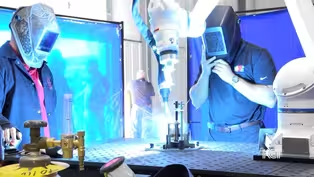
Only to find it near one of their facilities in Georgetown on Wednesday, they cut the ribbon on the 9.6 million plant in Georgetown.
>> Well, this is a historical event for a WGN, America and gas.
It's been a long project coming.
It certainly have a lot of growth and unit growth.
I really feel the need for more space.
>> Along with that, we needed a very safe environment for our teammates that produce the medical and industrial gases here in central Kentucky used in manufacturing.
We're using cutting fabrication.
We also are are able to boost your gas and for some spec class helium are gone.
Nitrogen atmospheric gases, obviously the oxygen that are going to regional hospitals around for for patients and families within Central Kentucky.
We also have propane we're more industrial use automation robotics.
>> And tables for all those whose gases.
♪ >> We look at multiple locations, multiple counties.
This is a location in Georgetown that we have been in for probably the past 15 years.
And we had some space underneath our feet.
Our facility here is is a little over 20,000 Square Feet facility will be producing eyes, as I said, industrial gases, medical gases around Central Kentucky.
These gases, actually we'll touch other states around us from Indiana, Ohio, West Virginia, Tennessee, and even travel into the into the Carolinas.
We try to make things easier for our part.
Teammates do their jobs to try to make it easier for customers to do business with us.
So with the product that comes in, it comes in a liquid form.
So your OB-GYN, your nitrogen now, this gives us the ability for to safely feel those products.
Are those products?
In a very safe manner to where it's less physical handling far teammates in it that are actually in here doing the filling up the gas historically plans.
The manual.
>> Which means all the equipment is here today is all automated.
It's just put 10% much safer for people who are pretty slim.
>> This facility will be producing and distributing about 40,000 soldiers and mud by early October.
So it's a flagship facility for us.
It will be for years if not decades.
Well, it's it's really exciting for all of us to be here.
>> American welding and gas says when it's fully operational, it will have 45 employees at the facility.
♪ A mosquito virus that's rarely found in the U.S. is making headlines.
It's called ETA for short and it recently led to one person dying in the northeast.
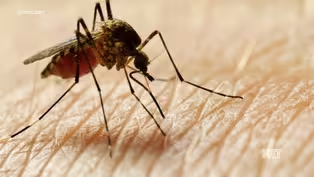
While there haven't been any cases 7 in Kentucky, we aren't immune from other mosquitoes spread viruses and this heat is not helping in today's health news, an entomologist explains why mosquito season maybe lasting longer.
>> It's certain requirements of the law is also known as you need.
This is a virus.
It's primarily found in birds and then it's factored by very specific mosquito amongst birds.
It's called the black killed mosquito.
There are occasions, though, where the birds that are fed on may also be done by other species of mosquito and those other species of mosquito may occasionally by things like humans or horses.
And so when that happens, there is the potential to build this bridge from the birds sort of these expensive courses and factor the pathogen there.
But then we're called a dead-end hosts because once it's inside of us, it doesn't reach the levels that it needs to in order to be picked up by another species of mosquito and moved from me to you or for me to a horse or vice versa.
This is a relatively speaking, a rare mosquito-borne illness in the United States, particularly when you would compare it to something like West Nile virus or what have you so West Nile virus, it's one of the more common mosquito-borne illnesses that we still out here in the United States.
It's not as common necessarily in Kentucky compared to some other states states with more migratory birds.
They're the ones that end up seemingly with more cases of it.
The people who get it are sometimes it's about where they develop a fever and other symptoms.
Sometimes people will develop a serious reaction to it.
Sometimes fatal.
And so it starts in the summer.
It continues through fall again.
It's a it's an insect borne pathogen.
So it's picked up by mosquitoes, usually from a bird.
And then it's the factored into a human.
When we think about climate and mosquitoes, mosquitoes are tied to things like extreme rainy periods or periods of wetness.
Mosquitos have a semi aquatic life cycle.
They lay their eggs in areas that either have water or will soon have water potentially.
Some of them may lay their eggs or that seems very dry.
But it's kind of a flood zone.
Think of a ditch or something like that where the water will eventually rise in the bags will get wet.
And then the hatch.
So they are tied to climate and that way they need that moisture.
If we have periods of extreme what nus like we had in May, I think it was the 7th wettest May on record here in Kentucky and then periods of dryness like we've had over the last couple months.
You can see mosquito populations kind of go through these big ships, these big peaks and valleys.
But then as soon as the water starts to return, more mosquitoes are going to start to come out and we can control some of that.
People can go out and do things like buckets and tires and other containers that are collected water on their property.
There's other things that increase your appeal to mosquitoes.
One of them was actually consuming adult beverages, alcohol beverages.
You become more attractive after that.
So people are just inherently more attractive.
The mosquitoes, people who are higher in ways people who are pregnant.
Those folks are going to create more of a an appealing smell to the mosquitoes.
So some things you can't overcome, but other things we can kind of cover up with these recounts and try to KET ourselves safe.
>> Wednesday was international overdose Awareness Day at the University of Kentucky.
The Kentucky Injury Prevention Research Center held an event to educate the community on the state's overdose rates and prevention resources.
We're holding overdose awareness Day to continue to raise awareness around opioid overdoses.
>> In 2023, Kentucky Sigh over 1900 individuals lose their allies, lose their lives to overdoses.
And so we want to continue to make sure that people are aware and aware of any resources that we also have available here.
So that's what today is about helping it reached out to the university community and our students.
We set up the room in a way where we have kind of different topic areas.
So when you first walk in, there's a table that's just about injury prevention in general since that is the research category that overdoses falls under.
And so there we have general information about our research center.
What we do at KIPP Rick and how students can get involved.
Then we have a table that's on resources.
So we our team that run our find help now.
K why Dot Org website, which is where individuals can go to find substance use disorder treatment, they can find recovery, housing.
They can find mental health treatment and they can also find the locks and distribution sites across the state.
So no matter where you are in the state of Kentucky, you can go to find help.
Now K why DOT org and find a near real-time availability for resources.
And then we also have a harm reduction table.
And then we also have live demonstration in training on the lock.
So we have someone from the Kentucky Department of Public Health.
He's doing trainings and providing naloxone KET to all the students who come through.
So we want to cut continue to raise awareness and also just make sure that the people in our communities are equipped with the resources and are aware of where they can find them and where they can help others.
According to the centers, 2023 data.
There's been an increase in overdoses among black Kentuckians.
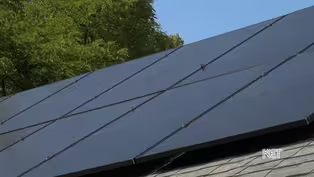
♪ >> Solar panels are an increasingly popular, a popular way to lower your energy bill and reduce your carbon footprint.
But the time cost research necessary to install them look to be a hurdle for many Solarize.
Lexington is a city program designed to make solar installation easy and accessible.
It's only in its second year, but organizers say it's already been a big success.
>> Solar, as a Lexington connects our residents with that vetted installer to help take them through a step-by-step process of the installation and also gives them a discount up to 15% up the host cell.
>> Cost?
Well, I was just googling information about solar panels and I just stumbled upon it online and I looked into it.
And at first I thought it was.
>> I was too good to be true.
We've already.
And then at the installers.
So the homeowner war, the small business owner knows that.
And the hard work has been done.
They're getting someone that they can trust.
They can help them through this process.
>> Within.
Not even a month, they called me and they scheduled today to come out and and then about a month after that is when they came out and put the solar panels that they check the roof out.
They checked the angle of the sun and made sure that my house was in the proper position.
They were awesome.
They explained everything to me is, you know, there's an app that they explained how to work it.
You know how to read it.
So right now I'm not cut into any of my >> electricity through the.
>> Through the regular.
>> Electric box.
It's also where it's been also there today, solar.
>> Is actually going to help with the bottom line and their utility bill significantly because the solar panels are powered by the sun.
And so our reliance on degree, it is a less and so in doing so you're paying less of a utility bill.
>> It's gone down.
It's gone down quite a bit.
I actually used to be on like a budget plan with KU.
I'm sure a lot of people are, but now it's gone down so much.
I've canceled the budget plan and, you know, one month, I think my bill was, you know, like $20 that went down a lot.
2023 was very successful.
It was really very popular, a new program and it took off.
>> We had over 600 interest once filled out.
And in the end, we had 76 in styles done.
Ghana is an interest form to fill out online and there is no fee and there's no obligation to do that.
That deadline was extended because we were getting good tracks.
And really we're starting to get a lot more interest forms filled out.
And so there was momentum and to really take advantage of that in the excitement for solar, we decided to extend that deadline.
>> Since the program started, the city has awarded 2 million dollars in grants for free installation to those who qualify grant applications for 2024.
Have closed.
But the solarize LAX program is still accepting general applications through Monday.
From one source of energy to another.
The Kentucky Coal Museum is in Harlan County housed in a former coal mining company store.
The museum aims to educate visitors on the history of coal mining in eastern Kentucky.
Our friends at Kentucky life went to the Kentucky life went to the museum to check it out.
We're having a great time here today at the Kentucky Coal Museum.
This is Amanda Hughes.
She is the curator of the museum.
Amanda, thank you so much for letting us be here today.
Thank you all for coming.
Now, clearly, we're not in a coal part of the museum right now, but tell us about what this this mocked up drugstore is.
Well, actually, it's a diner.
Okay.
When the coal company shut down, there was a gentleman who purchased it, and he had built a building in his backyard and had all of this on display in a building.
And so they would have their get togethers, reunion, things like that there.
Well, when he passed away, he'd requested his family to find a place to donate it to.
And so they they donated it to us.
So this actually existed here in the town at some point?
Well, this was actually in leather wood.
Okay.
But the coal museum, why is it important to have something here, Amanda, that really kind of celebrates it and tracks the history of coal in this region, do you think?
Well, I think it's important because it's unfortunately becoming a thing of the past.
And so as you got more and more children that grows up in the area, they don't unless they have family that actually work in the mine, they really don't know what it means.
And so in order to keep that tradition alive and the history of it, I think it's important to have a museum or anything that documents that.
And you talk about those family members I was reading online, you all were talking about people whose grandparents or parents had maybe lived here in the coal camp when that was a thing, bringing the grandkids to kind of see what the family used to do.
That's got to be fulfilling to you all to see those families kind of passing that knowledge down.
It is, yes.
We love it when people come in and like, well, this is my grandchild and they live in so-and-so and so they don't know nothing about this place.
Right.
Wonderful.
And this used to be the company store.
And a lot of folks, myself included, I had never really heard of the concept of the company store until that famous 16 ton song where it talks about, Oh, you're sold to the company store.
How important was a company store like this to a community to be able to to provide goods and services to the people who lived here?
From my understanding, it was very important because back then, up until like the sixties, when they outlawed you being able to make your own money, they made scrip.
And so the companies usually paid most of the workers in scrip.
And so you could only use of the scrip in the company store.
You couldn't take it outside of that town and spend it.
And so the commissary was real important to the people because they supplied everything for clothing, their food.
Pharmacy, stuff like the widespread stores.
Food.
They even had like like, for example, here, this one sold coffins downstairs in the basement.
They had coffins on display and sold while in the basement.
But you had to work for the company and use the script that hear in the store.
So.
Wow.
What's your favorite part of the museum?
I would say probably the memorial exhibit.
And so we have letters from trapped miners that they had found, like either etched on the wall or like on paper or something that they might have had on them sometime before they passed away after being trapped.
So that's probably my favorite.
That's about that is really is that's one of the signs, really heart touching.
Final question.
If somebody came here, what's the one thing you want them to walk away with?
What's the one thing you would hope that they would take away from here?
And I guess a better understanding of the local heritage.
And kind of what people what it was like for people when they used to live here and how that all came together.
Yes.
Again, Amanda Hughes, curator of the Kentucky Gold Museum.
Thanks for letting us explore around it.
Thank you.
All.
museum to check it out.
You can see that story again.
And many other great Kentucky life pieces online on-demand at K T Dot Org.
We hope you'll join us again tomorrow night at 6.30, Eastern 5.30, central for Kentucky Edition where we inform connect and inspire.
>> Subscribe to our Kentucky Dish addition email newsletter and watch full episodes and clips Akt Dot Org.
You can also find Kentucky Edition on the PBS video app on your mobile device and smart TV.
Thank you so much for joining us.
A wonderfully.
♪
The Buzz on Mosquito-Borne Viruses
Video has Closed Captions
Clip: S3 Ep64 | 3m 36s | Kentucky's risk for mosquito-borne viruses. (3m 36s)
New Fill Plant to Open in Georgetown
Video has Closed Captions
Clip: S3 Ep64 | 3m 2s | Ribbon cut on new gas-manufacturing plant in Georgetown. (3m 2s)

Video has Closed Captions
Clip: S3 Ep64 | 2m 7s | Event brings attention to state's overdose rates. (2m 7s)
Video has Closed Captions
Clip: S3 Ep64 | 4m 5s | Differing views on school choice legislation. (4m 5s)

Video has Closed Captions
Clip: S3 Ep64 | 1m 32s | Findings from a new report on school safety in Kentucky. (1m 32s)
Solar Panel Program Grows in Lexington
Video has Closed Captions
Clip: S3 Ep64 | 3m 18s | Solarize Lexington offers progra for second year. (3m 18s)
Providing Support for PBS.org
Learn Moreabout PBS online sponsorship
- News and Public Affairs

Top journalists deliver compelling original analysis of the hour's headlines.

- News and Public Affairs

FRONTLINE is investigative journalism that questions, explains and changes our world.












Support for PBS provided by:
Kentucky Edition is a local public television program presented by KET