
August 8, 2024
Season 3 Episode 49 | 27m 30sVideo has Closed Captions
A summary of the day's news across the state, plus fascinating places, people and...
A summary of the day's major developments, with Kentucky-wide reporting, includes interviews with those affecting public policy decisions and explores fascinating places, people and events. Renee Shaw hosts.
Problems playing video? | Closed Captioning Feedback
Problems playing video? | Closed Captioning Feedback
Kentucky Edition is a local public television program presented by KET
August 8, 2024
Season 3 Episode 49 | 27m 30sVideo has Closed Captions
A summary of the day's major developments, with Kentucky-wide reporting, includes interviews with those affecting public policy decisions and explores fascinating places, people and events. Renee Shaw hosts.
Problems playing video? | Closed Captioning Feedback
How to Watch Kentucky Edition
Kentucky Edition is available to stream on pbs.org and the free PBS App, available on iPhone, Apple TV, Android TV, Android smartphones, Amazon Fire TV, Amazon Fire Tablet, Roku, Samsung Smart TV, and Vizio.
Providing Support for PBS.org
Learn Moreabout PBS online sponsorship♪ >> I'm confident it will be much improved.
Keys largest school district hopes to move past last year's school boss fiasco.
>> We made over 1650 Derby hats.
Check out the extra special souvenir.
Some legislators to calm from NCSL.
We wanted to be able to invite students and say, hey, >> this is what it's like to be in the industry.
>> And how it turns out making a splash in the bourbon business.
>> Production of Kentucky Edition is made possible in part by the KET Millennium Fund.
♪ ♪ >> Good evening and welcome to Kentucky EDITION on this Thursday.
August, the 8th, I'm Renee Shaw.
Good to be with you on this Thursday night in 2018, Kentucky band child marriage.
In most cases.
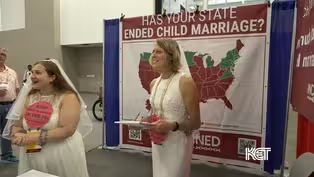
>> Now no one under 17 can get married at the National Conference of State Legislatures summit in Louisville this week, a forced marriage survivor told KET that Kentucky needs to look at this issue again.
Our June Leffler has more as Kentucky edition goes on the road Brady.
Recent New Jersey was forced into an arranged marriage when she was 19.
>> After 15 years she left her abusive husband.
Today she wears a wedding gown and chains as protests, symbols.
She advocates nationally for age limits on marriage and says Kentucky should do more.
>> So 17 was a good for stopped.
Unfortunately, 17 is still child marriage.
A 17 year-old, even the most mature 17 year-old.
Does not have the full rights of adult tight.
We don't get that until the day.
You turn 18 until you get the full rights of adults have the right to leave home and to a domestic violence shelter, retain an attorney with the legal action in their own name.
So you have those rights we can too easily be forced into marriage.
6 years ago, child welfare advocates pushed Kentucky's General Assembly to rewrite the law.
The head let kids of any age.
Mary.
>> Kentuckyian Donna Pollard spoke publicly about how her husband started grooming her when she was 14.
>> My mother consented tense, having a dating and then 2 years later when I was 16, she consented to my marriage to him.
Well, I think at the time she was looking to offload the burden of having a teenager at him, quite honestly, she was 45 years old when she had me in her pregnancy with me was extremely unexpected and unwanted and I always KET growing have that I was not someone that she wanted in her life.
And that's why when people say, well, what about parents that consent to their children be Mary?
But I think we need to consider is that oftentimes what seems to be pretty whole consent is actually parental coercion.
>> Now, 17 year-old son, Kentucky can marry if they have completed a high school education and get a judge's approval before the passage of Senate Bill.
48 6 years ago, the girl could marry at any age if she was pregnant and received a judge's approval for Kentucky edition.
I'm John Leffler.
>> Thank you.
June one year before the law changed the Kentucky Center for Investigative Reporting reported that since 2000 84% of marriages involving a minor were between a girl and an adult man.
Just 7% were between 2 minors.
One of the prominent topics discussed at this year's summit in Louisville with the National Conference of State Legislatures was artificial intelligence from using AI to power state governments to building an AI ready workforce to the use of AI to misrepresent a political opponents campaign.
There was a lot of ground to cover Republican state and amaze Bledsoe of Lexington, Kentucky was one of the speakers discussing the technology.
I caught up with her on the last day of the summit yesterday.
and amaze Bledsoe from Lexington.
It's good to see you.
Thank you.
Thank you.
Nice to be saying, well, this conference has been tremendous.
This is the final day that we're speaking of it.
And you are right from the start of the gate.
>> We're already holding sessions about artificial intelligence and tell us what you talked about and what kind of questions people have about how to get the policy right in their states.
Sure.
We've we've actually had a number of AI sessions here at this at the TSA, which has been a lot of fun to go to.
They have different focuses.
So the one that did die that I did I campaigning in elections.
>> How do we think about deepfakes are preventing deepfakes are disclosing when someone uses AI to do a campaign video or speeches or grads are are images.
And so it was a there's a pretty good session just on that side of a I yeah, I can imagine.
Now we're in this very robust presidential election year.
And there are, of course, a lot of other races that are on ballots.
>> Across the country, Kentucky included.
So if there ever was a time to really talk about identifying what is a deep fake and what is not because you really can't tell the difference.
You really can't.
And so even our own legislation and a bill is sponsored last year.
So no one.
31, we had a disclosure on it.
But now what you're seeing is they're able to remove disclosure, somebody else, you know, screenshots that takes its closure off, reset it.
So that's the problem.
The technology no government does not.
It's not set up well to respond quickly.
We're not we're not for that.
If you have that child know the tech is moving way quicker.
The government legislation is going to regulations going to KET up into.
That's really the challenge I think is trying to find a way to KET voters informed, be authentic about what they're seeing knowing that it's true.
Yeah.
And also trying to be mindful of it is it could be really hard to regulate in a way that's responsive.
Well, and I think you make a really good point about you just spoke artificial intelligence in terms of campaigns, but it is multidimensional multi multi multi faceted.
I mean, in every aspect of our economy.
>> Artificial intelligence will have some type of presents.
No question the use of that.
Just a state government to think about how we might use it for customer relations are constituent services.
That's a really low risk area.
You could to find that the data, if you Here's what we wanted to put out.
You could probably do some really good.
>> You know, response of things for for the Commonwealth.
What health care job classification to talk about taxes.
You talk about how we might use it for energy policy year.
You know, decision-making policy.
That is a that is much higher risk is so I think on that continuum that even in state government, where is it appropriate to use you kind of go from low-risk to high-risk, right?
Let's lean in with low We can be in response to the innovative that do good things.
And let's be a little more mindful of the high risk and pull back a little bit.
Will it since I think Kentucky is being pretty intentional on even having that spectrum light out, right?
Because we know there's been legislation proposed in previous sessions dealing with this and kind of pulled back.
In supple, let's study it some more.
>> And have a task force that at the time were speaking.
He's going to meet the following week.
That's right.
So that seems very intentional.
Take may be small baby steps.
You don't want to necessarily be first, but you want to be right to try to do what?
No question.
And I think that the commonwealth that the teenagers who are using AI, they're going to be part of that world.
It's not coming is not going away, right?
I want to put the genie back in the How do we regulate how we protect kids?
How do we use it as a really mindful of its appropriate use and also regular light.
It's going to KET changing changing so quickly.
So yeah, the framework someone asked me este on the panel, do the background tech and I was like, no, my undergrad isn't philosophy.
No, not of it.
But this isn't this full conversation.
Yeah, it is a full staff.
Go one.
Where is it appropriate?
Why are we using it?
There is this who should be making the decisions on that?
Yes, that's really well.
I think we're trying to get more attention.
But the framework more than just trying to regulate tech.
Well, I think you make a really good point that you don't have to guess I have a tech background or have a legal background and a lot of ethical issues to sort through and not having bad philosophical background certainly allows.
You have critically think through why you're doing what you're doing.
So I'd for many people want to like, well, we're just a few months out for the next legislative session.
Do you anticipate there being legislation or just kind of building up on the task force and and maybe it's addressing like you said, the low-risk low hanging fruit is often we say and then graduating up as things unfold.
Bubbly.
But I'm more likely, I think where we would really like to have at least some guidance or policy framework that says here's how we're approaching the commonwealth, the state government to be regulating the private sector as a whole different right conversation.
But at least for state government PRI put some guardrails out.
Here's where it's appropriate load high medium risk and try to lean into that policy.
And then it's technical.
You know how we treat government officials are elected officials is different and how I treat to put private citizen so they have deep fake that maybe it gets them.
That's different.
Youth kids with pornography and they're so much time on that side of it.
So I think we'll probably do some tailored legislation.
And also, I think one of the things we're talking about, some of the legislators is what's already in law that you could just adapt to use some different words.
So you can cut this.
What are the president-elect in legislature law and then just add some of this piece to ride in creating a whole different, you know.
>> Well, also at the NCSL Summit in Louisville this week, former Arkansas Razorbacks coach Jack Crowe.
Was there promoting injury prevention and youth sports.
The coach Safely Foundation has created a low-cost service to train coaches direct ignited the signs of a concussion.
The training program also teaches coaches how to prevent them.
>> You take all the athletes from grade first grade all the way through all pro.
Okay.
60% of all those would be 14.
The number maybe 70%.
And yet it's where coaches are volunteers and their organizations have no standards to protect him like you do in high school.
High schools do a great job colleges.
Do a great job.
The pros do a great job.
We just don't have anything for the largest, most vulnerable population.
So we do in 2 states, Alabama and Arkansas.
We have a disparate.
You.
Sports organizations are 400,000 of them estimated by the sporting good industry.
They're becoming very privatized.
Private organizations.
We don't always look at risk factors.
And it is a gigantic business and it is motivated by money when a green research says that EU sports is a 76 billion dollar industry.
That's bigger than the NFL and Major League Baseball put together so the money is driving this shift.
Standards have gotten left behind.
Because she has happened.
Girls are more vulnerable.
Girls are more vulnerable.
The ACL tears there is a way to manage that.
And so this is all cold body of knowledge.
It's not rocket science.
We take in 75 minutes.
We get a certification.
The parents know you're certified and just win, win, win.
The policy has to start with who's been affected by policy.
And the reality is every parent is concerned.
This every parent, those who vote.
And if they were just put some information to what the concerns are.
It would go through public health with this is a this is a public health epidemic.
You sports is a recognizable CDC and I each clearly define epidemic.
>> Every state has a concussion.
Well, to some degree.
Is it implemented?
There's no data to tell you whether it's implement.
We have a date, a delivery system that will tell you because of concussion course is inside of this course as part of the school's everything that's in the concussion walls.
But I think as long as it's pretty simple, as long as you look at it from your own living room.
Most of these legislators are grandparents, though, just think about when they were standing on the sideline watching their grandchild play.
Did they have concerns for their safety?
All you got to do's.
Just carry that into a policy room and you will make this policy.
>> The coach safely Foundation hopes to reach all 50 states and inspire state legislators to require more training for public and private youth sports organizations.
The closing reception of and csl took place at Churchill Downs yesterday evening.
And the Derby Museum helped make more attendees.
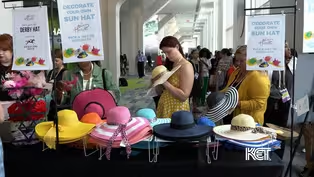
Look the part during the attendants participants had the opportunity to create their own derby.
Hats at the had a tube station allowing them to take home a piece of local culture.
>> So over the past 2 days at the convention center's we made over 1650 Derby hats before the conference attendees.
This is big dacula.
>> And maybe it took 8 minutes.
Maybe and I am just the real and I've been out.
He's out there.
People wanted to just take a picture of the hat first, they're going to pick their base.
>> Which is either going to be a there.
We had like a sun hat, a fascinator base or at the door and then they're going to get their band their centerpiece, which could be a flower or a little bow.
There's all different colors and options where they pick their centerpiece and then they're going to pick out their feathers.
So once they've just picked up, although says for the Derby hat, they're going to come out and our staff and volunteers are going to assemble it for them.
>> And then they're going to be on their way with their very under.
We had that chose the color because I'm of that.
And some of the University of Kansas, OK?
And so part of that is our color.
So use the hour will be able to use this hat on different occasions.
It really was a fun thing to do at the conference when we spend so much time in meeting.
And in the plenary sessions that I chair one tomorrow.
So I'm really glad because I want them in able to come out again.
And and get is out.
It was just a lot of fun.
The attendees absolutely right that we had.
>> Then women there were a few kids them in are just as excited on their site about their heads.
>> They're coming to Louisville.
They know they're going to Churchill Downs and even if they don't know a ton about horse they know people were hads to the Kentucky Derby.
So it's a great way for the Derby museum to share some of the history and some of the tradition and that go along with the Kentucky Derby.
If you watch the Kentucky Derby, what do they showcase?
>> That hat that people are aware it right.
So now you you can go to the place they do have watched on TV.
With your.
Specially made hat for you.
I don't think any of us have had the experience I've been able to choose.
All the materials and the caller via hat and watch someone make it for you.
>> The last few years, the idea of having something that is an activation or make intake or sending folks home with a souvenir has really taken off.
And it's just a fun way to not just learn about something but to interact with something and then get and then go home and and show off what you created in Louisville, Kentucky, home of the Kentucky Derby.
>> That's pretty cool.
That attitude experience is currently available at the Kentucky Derby Museum on Thursdays as part of a program on the History of Derby hats.
Now, speaking of horse racing, the equine industry generates 6 and a half billion dollars a year in economic activity and Maine, 60,000 jobs in Kentucky.
Now what's the focus of a new equine caucus in the Kentucky General Assembly?
Details in Tonights legislative update.
State representative Steve Bratcher, Republican from Elizabeth Town will be the House chair of that caucus state and amaze Bledsoe.
A Republican from Lexington who we heard from earlier will serve as Senate chair.
The Equine Caucus will examine issues affecting the equine industry advocate for policies that will help it grow.
We continue to learn more news about Democratic State Representative Daniel Grossberg of Louisville who was under investigation for an alleged inappropriate misconduct towards women.
The Lexington Herald-Leader broke that story last week.
Today the paper published a story about a satirical advice column that Grossberg author authored in College where he used the name Sketchy Day and to offer dating advice.
Kentucky's Legislative Research Commission is investigating Grossberg on accusations of inappropriate behavior, including text messages to women in today's Herald leader article Grossberg attorney continued to deny any wrongdoing and instead said the Democratic lawmaker from Louisville has, quote, a Nuro divergent diagnosis, which throughout his life has caused him to make some people feel uncomfortable.
Former Republican governor Matt Bevin's adopted 17 year-old son is back in the United States.
We told you Monday authorities removed the sign and other boys from an abusive facility in Jamaica the Sunday Times of London reported that while other parents picked up their children, Matt and Glenna Bevin did not, according to the Lexington Herald leader, a nonprofit foundations as the sun is back in the U.S..
But it will not say where for privacy reasons today, the 8th of August is an important day in Kentucky history.
Many western Kentucky communities celebrate emancipation from slavery on August, the 8th and there are different theories about why some say it's because future President Andrew Johnson freed the people he owned on August 8, 18.
63 others say news of the Emancipation Proclamation didn't reach enslaved people in western Kentucky until that day.
While there's disagreement about what prompted today's observances, there's agreement about why the day needs to be remembered.
The enslavement is a part of American history.
It's not black history.
It's American history.
Not a very fun part of American history.
It doesn't make us feel all warm and comfortable.
We come together to celebrate the freedom sacrifice of so many African-Americans.
>> So many other people to end slavery.
>> And to bring people together this show, everybody that the important thing is that we get along its people.
>> Paducah, Hopkinsville, Russellville and Allensville are among the Kentucky communities that observe the 8th of August.
♪ >> Today was the first day back to school for Jefferson County Public School students.
>> More in today's education Matters.
Report School age kids and Louisville have been preparing to get back in the classroom while the district has been focused on safe and smooth bus routes.
JCPS is currently under the microscope and the state legislature and part for the transportation disaster that took place last year, which at some students on buses until almost 10:00PM this morning.
And this afternoon, all eyes were on Kentucky's largest school district to see if they could get students home in a timely manner.
Earlier today, JCPS Superintendent Doctor Marty Pollio said he's hopeful.
>> It seems like it's going very well.
I mean, we've got some pretty significant traffic out there on the roads.
But I guess when you add 500, 50 buses and all the parents driving their cars are going to have increased traffic.
So I think we had some traffic issues.
But other than that from, you know, I've been at schools.
I'm quarters, but from everything I hear it's going very well.
We put in a lot of systems, too, make sure if there are is and there will be issues.
I mean, once again, I mean, there are, you know, the vast majority of our kids will be home by 5.30.
And you know, that use that to start to finish times earlier will be much earlier than that.
But, you know, I mean, we'll have some one-off situations that will have to deal with, which is maybe a kid falling asleep on the bus and missing their stop or a parent of a kindergartner not being at the stop that then we have to figure take them to a facility, one of our facilities and figure out how we get them home and make sure the parent is there.
So those are issues that will deal with this afternoon.
But I'm confident it will be much improved.
>> Earlier this year, the Jefferson County Board of Education shows to cut bus routes to almost all magnet in traditional schools at the request of the district's transportation department.
The district has said they may be able to restore some of those routes later this year, depending on their number of bus drivers.
And south central Kentucky, Metcalf County Schools won't return to the classroom until later this month, but they're already working to make it a smooth transition for the incoming freshman class.
The high school held a special event today to get the class of 2028 acclimated to their new surroundings.
It's a chance for them to learn school rules and expectations get class schedules and learn their way around and have a little fun getting to know each other administrators say one thing they're cracking down on this year is smart phone distractions in class.
>> Our students are exposed to so much and have so much access to social media and information on a regular in their daily life.
Every day we are to the focus this year is going to be cutting down on that distraction in the classroom to help drive and help direct that focus on the academic on to what's actually going on.
And we're allowing them to have their phones were just making it known that the expectation is not to have him out in the classroom.
>> There are about 130 students in the new freshman class at Metcalf County High School Principal Joseph Eaton says one big change he's seen over the past several years is an increase in dual credit opportunities.
He also says the hiring shortage has improved at a school and he hasn't had as many new positions to fill this year.
♪ >> The James Institute for Kentucky Spirits welcomed its first class of interns at the beginning of May.
Since then, they've been making their own bourbon and doing research projects on different aspects of the industry.
>> We always sought out to give students firsthand experience of what it's like to be in the industry as soon as we're able to get our DSP license to say, yes, we can legally make this facility.
We wanted to be able to invite students and and say, hey, this is what it's like to be in the industry.
Iran, the production facility in the distillery.
>> I'm also a supervising all the interns for the internship program, educating them and how to work in the production facility space.
We started all the interns extensive safety training after that first week of safety responsible.
We went to strain production.
So the students got firsthand experience of.
All right.
Let's dive right in.
This is how you make for a set of this program because >> my family has a history in the river My parents work with the Kda.
The Kentucky Distillers Association and pretty much since I was a child of and brought to many distilleries throughout UK and the Commonwealth itself and I mean not fell in love with it personally.
My great, great grandfather's gem and then Booker now is my great uncle.
>> I was I was very interested for my family's standpoint.
>> The students >> Making Bourbon Day in and day out from loading up grains to plow checking for many patients to running the stills they're doing every aspect of the process and contributing to these individual different research patches and such.
And then they're also working on their individual research projects as well.
>> I'm currently working on the Heritage Rain project for a Virginia state.
And so they were we're just getting started.
Actually got grains late July.
They are sending us their descendants like I want to say, a different varieties of heritage.
Grains.
2 pretty much produce a small batch of not a silly whiskey.
Both small batch of just a run through of a single distillation.
>> I researched a microorganism called judgment.
It's the same thing that you smell.
It rains or when there's fresh, wet soil, smells kind of damp like a wet So what we find is that gets in the grains and water that's being used to whiskeys and bourbons and causes an awful ever off taste.
>> I was kind of very anxious going but we've had many people come and talk to us and they sent us or e-mail their private contact information just for if you have any questions.
E-mail me call me.
And that's that's wonderful people and information.
Our the biggest use of like what you need in the industry.
I hope that we can KET building connections with other distilleries and breweries and pumping out kids that are really, really trained in really well knowledge in the world about our production.
>> The internship ends next Friday, but some of the interns like Duncan Gregory, who use all will continue their research projects into the fall and will attend an industry conference and marched network with professionals in the industry.
>> Well, today is International Cat Day.
And if you own a cat, you have plenty of company.
The American Veterinary Medical Association says that 32% of Kentucky households have at least one cat making Kentucky 11th among the 50 states.
Vermont is number one with about 44% of homes with cats, Americans own about 58 million cats.
The international Fund for animal welfare created International Cat Day and to as a way to teach people ways to care for and help their little cats.
A cute high and some of those pictures are of KET owners.
Got to do it for us tonight.
We hope to see you right back here again tomorrow night.
We'll talk about politics, of course, as we go inside Kentucky politics and so much more on Kentucky EDITION.
I'll see you tomorrow night.
Take you can.
♪
Video has Closed Captions
Clip: S3 Ep49 | 3m 17s | The James B. Beam Institute for Kentucky Spirits welcomed its first class of interns in May. (3m 17s)
Video has Closed Captions
Clip: S3 Ep49 | 2m 49s | Child marriage laws are discussed at NCSL. (2m 49s)
Former Coach Working to Make Youth Sports Safer
Video has Closed Captions
Clip: S3 Ep49 | 3m 19s | Coach Jack Crowe to adopt a program to train coaches to recognize the signs of a concussion. (3m 19s)
Video has Closed Captions
Clip: S3 Ep49 | 2m 59s | The Derby Museum sent NCSL attendees home with a piece of Louisville culture. (2m 59s)
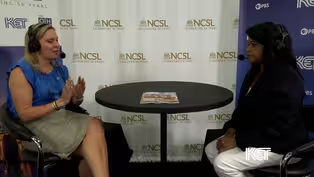
Kentucky Senator discusses A.I. at NCSL
Video has Closed Captions
Clip: S3 Ep49 | 5m 45s | State Sen. Amanda Mays Bledsoe discusses A.I. at NCSL. (5m 45s)
Providing Support for PBS.org
Learn Moreabout PBS online sponsorship
- News and Public Affairs

Top journalists deliver compelling original analysis of the hour's headlines.

- News and Public Affairs

FRONTLINE is investigative journalism that questions, explains and changes our world.












Support for PBS provided by:
Kentucky Edition is a local public television program presented by KET