Vermont This Week
August 9, 2024
8/9/2024 | 26m 45sVideo has Closed Captions
PCB Testing in Vermont schools | Primary election | State braces for more heavy rainfall
PCB Testing in Vermont schools | Primary election | State braces for more heavy rainfall | Panel: Colin Flanders - Moderator, Seven Days; Sarah Mearhoff - VTDigger; Tim McQuiston - Vermont Business Magazine; Alison Novak - Seven Days.
Problems playing video? | Closed Captioning Feedback
Problems playing video? | Closed Captioning Feedback
Vermont This Week is a local public television program presented by Vermont Public
Sponsored in part by Lintilhac Foundation and Milne Travel.
Support provided by:


Vermont This Week
August 9, 2024
8/9/2024 | 26m 45sVideo has Closed Captions
PCB Testing in Vermont schools | Primary election | State braces for more heavy rainfall | Panel: Colin Flanders - Moderator, Seven Days; Sarah Mearhoff - VTDigger; Tim McQuiston - Vermont Business Magazine; Alison Novak - Seven Days.
Problems playing video? | Closed Captioning Feedback
How to Watch Vermont This Week
Vermont This Week is available to stream on pbs.org and the free PBS App, available on iPhone, Apple TV, Android TV, Android smartphones, Amazon Fire TV, Amazon Fire Tablet, Roku, Samsung Smart TV, and Vizio.
Support the crew
Help Mitch keep the conversations going as a member of Vermont Public. Join us today and support independent journalism.Providing Support for PBS.org
Learn Moreabout PBS online sponsorshipAfter a bill to pause the state's PCB testing program failed to pass this legislative session.
Schools across the state continue to struggle with mitigation efforts.
I think one of our biggest challenges has been to, make sure that the agencies all understand how important it is for students to be on time and in person for the start of the school year.
That's what is best for their, their social, emotional and mental health, as well as for the academics.
And so that that's really what the school district is focused on, on trying to make sure happens.
Plus, a look ahead to next week's primary election and flood fatigue.
Vermonters braced for tropical storm remnants that could bring heavy rainfall and possible flooding to parts of the state.
That, and more ahead on Vermont this Week.
From the Vermont public studio in Winooski.
This is Vermont this Week.
Made possible in part by the Lintilhac Foundation and Milne Travel.
Thanks for being with us.
I'm Colin Flanders and for Mitch.
It's Friday, August 9th.
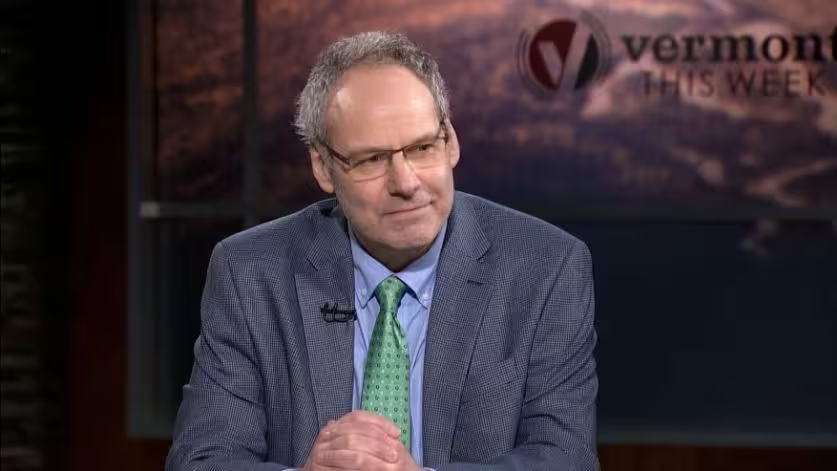
Joining us on the panel today, we have Tim Mcquiston, editor of Vermont Business Magazine, education reporter Alison Novak, and statehouse bureau chief Sarah Mearhoff from VtDigger.
Thanks for being here, everyone.
I'd like to kick off the conversation with an update on a story that brings in one of one o my favorite journalism genres, and that is the well-intended decision that snowball into a bureaucratic nightmare.
And I'm talking, in this case, about Vermont's years long crusade against PCBs, an acronym that I imagine will be haunting the dreams of education officials for years to come.
The background here is that Vermont began testing schools for the airborne chemicals a few years ago, after they were discovered at Burlington High School.
A little under half of the 350 schools that qualify for testing have been tested so far, and of those, 44 have levels that require action from the state.
Now, Allison, you've been following this and have become quite an expert on this topic.
reluctantly, maybe.
But, you had a really interesting story this week about how this is playing out on the local level.
Tell us what you found out.
Sure.
So since this began, the testing began about two years ago.
I've talked to a lot of administrators just about how this testing program has affected the day to day operations of their schools.
And I think it has become quite a quagmire in terms of those schools who find high levels of PCBs and then have to do a number of different things like close classrooms, closed gymnasiums, all sorts of things.
And North Country Union High School is one of the worst situations.
If it's not probably the worst since Burlington High School.
And so about a year ago, they found elevated levels of PCBs in dozens of classrooms and other spaces in their school, and so have been working for the past year to try to figure out how t kind of get those levels down.
So they did about $1 million worth of mitigation this year, and lo and behold, they tested in June.
The levels were not much better.
And in some cases, and some rooms were actually a lot higher than they had been initially, which has happene to some other schools as well.
and so now they're in the midst of this $5 million project this summer to mitigate PCBs.
Problem is the test results won't be back until right around when school starts.
And so they don't know if they're going to be able to use the spaces, the classroom spaces.
And so if that's the case, they're going to have to make an alternative plan.
But they're not that many good options.
And so they're in quite a quite a bind right now.
Yeah.
And as the son of an educator in, person in New York, I know that summer for education administrators is not a time to relax.
That's really a time to get ready for the school year.
And now this is throwing an entire wrench in it.
I can't imagine what they're going through in this moment.
Yeah.
So seeing the pictures of the school, like, completely covered in plastic and sealed up.
they said they've had to shift a lot of things aroun when it comes to summer school and different program that they offer in the summer.
And yeah, this has really consumed a lot of time for both the superintendent, Eileen Collins, and the principal, Chris Young.
And, they could be focusing on other things that are kind of more substantive, but instead they're focusing on this issue of PCBs, and whether or not they're going to be able to bring kids back on time.
The school board met this week.
And, basically, officer authorized the administrators to, try to open school on time and in person and do whatever they could do to make that happen.
I think there is still a question of whether the testing is going to be back and if it's not back.
I think the Department of Health doesn't want the school to use those rooms that have high levels of PCBs above immediate action levels, which are kind of the levels that Vermont has said, you know, you can't use the space if the levels are above a certain amount.
So, I think it's still kind of a pretty active situation.
And, you know, the time time is ticking, in terms of when school starts and so I'll continue to follow it and see what happens.
But it's definitely a toug situation up there in Newport.
Yeah.
And of course this is not happening and happening in a vacuum.
Right?
I mean, this is coming amid a broader conversation statewide about how are we paying for our schools and what can we afford.
Representative Peter Conlin, the Democratic chair of the House Education Committee, has been pushing to pause the program and has been suggesting that the state needs to take on a bigger funding role.
And he had some comments about this this week.
This is a public health initiative.
It's not an education initiative.
so probably property taxes are not the best place to be funding it.
There's millions and millions and millions of dollars still to be spent on this mitigation program.
where that money comes from, I don't know.
You know, as someone who grew up during the asbestos era, how dangerous.
Is this is this, something that they really.
It's really, really huge health problem.
So I think kind of the jury's still out there.
There's not a lot of studies on airborne PCB, inhalation.
so there are studies like showing that people working in factories where PCBs are manufactured have had health problems and it has been deemed like a probable carcinogen.
but I think, you know, when we come when we're talking about risk, I think, you know, some administrators might argue that the risk of students being, you know, remote learning, doing remote learning, being out of school, having to, you know, learn in trailers, that type of thing like that might kind of be more risky in terms of, like the impact on students than, you know, breathing in some PCBs.
But the Department of Health has held a pretty, pretty strong line, saying like, no, like if we set these levels for a reason and if they're over this, over these levels, we do not want student and teachers in the classroom.
Yeah.
Thanks, Alison.
education spending will, of course, be a hot topic as we head into the next legislative session, and we'll soon have a better idea of who might be making those decisions.
Sarah, we in the media have been a bit spoiled in recent years of some really exciting primaries.
I think, there was a broad consensus.
This is not one of those years.
This is some of the more sleepier races we've had in some time.
Yet I still think there are some things out there to warm the cold hearts of U political reporters out there.
And so I'm just curious, what are you paying attentio to heading into Tuesday night?
Me and my cold, cold heart are, paying attention to the not a huge number of state wide contested primaries.
To be completely honest with you, I think statewide we're looking at the race for lieutenant governor.
that is one where there are indeed two primary candidates on both sides of the aisle.
now, I think the most interesting race is this year down ballot because of, like you said, education spending is such a hot topic to spending at large is such a hot topic in, Montpelier as of late.
So, like a direct example of this is Representative Emily Kornheiser down in Brattleboro.
She has a primary challenger who is directly questioning in forums and, you know, campaign mailers and whatnot.
Representative Kornheiser says decisions over the past couple of years, particularly as chair of House Ways and Means.
And so really kind of putting the centering campaign messaging around fiscal issues, so I think that that is something that's really interesting that we're looking at.
now, I think that a lot of those races are going to become most interesting in the fall, to be totally honest with you, a lot of these races, if they even have primary contests, it might be on one side, not the other, and it's going to get really interesting when we get down to, you know, actual like Democrat versus Republican or even independent, you know, independents can still jump in.
So, I think a lot more to come in the fall.
Yeah.
And you, you know, I just got done saying that this is kind of a sleepy time, but you did challenge that in a story this week, which I think will be talked about for some time to come.
And that is the lieutenant governor's race.
And sitting Lieutenant governor David Zuckerman, faced a complaint in 2023 about some of his conduct in the state House.
I honestly don't even know where to begin about how to summarize this case.
I'm wondering, can you just tell us what happened here?
Sure.
So what happened was, at the start of the biennium in January 2023, Lieutenant Governor David Zuckerman was coming back into the building after a two year hiatus out of the, post.
As you'll remember, after his unsuccessful run for governor.
and so he came back into the building, and one of the first things that he did was he started inviting, first and second term legislators who he didn't already have a relationship with into his office, to, you know, meet, greet, you know, get to know one another sort of thing during these one on one meetings.
But then also even outside of that context, just in the statehouse halls and general area, a number of legislators have reported that the lieutenant governor approached the in some fashion and offered up menstrual products, which were stashed in his chief of staff's office.
there were a drawer of products.
And basically how these conversations went was he was like, hey, if you ever need or know someone who needs, these sorts of products, I have them in the spot.
And, my chief of staff's office and some folks were really bothered by that and felt deeply uncomfortable and were like, why did you come up to me and approached me about this?
This feels weird, is how representative Heather Chase told me about it.
and in particular, in her case, it was that she had a one on one meeting with the lieutenant governor, and that's when he brought up these products and their location, his office.
that meeting with representative Heather Chase ended up resulting in a complaint that she filed to both the state ethics Commission and then two investigatory internal panels in the House.
and what's really interesting about this story, I think, is that there's really very little oversight that can be done of executive officials.
even if, I mean, I think let's leave it up to people's interpretations, whether they thought that some sort of sanctions were necessary, but it was even possible because Lieutenant Governor David Zuckerman is a member of the executive branch.
and this was regarding his conduct with members of the legislative branch.
So what ended up happening was that, House and Senate leadership got involved, basically roped the lieutenant governor into a meeting and kind of verbally reprimanded him, followed up by a written warning.
and then it ended up coming out.
you know, just this week was when my story came out.
Yeah.
And you sat down, as I say, you talked to the lieutenant governor for at some length about this.
Tell us a little bit about what he said.
How did he see this go down?
Yeah.
So basically I yeah, I talked to the lieutenant governor for over an hour actually.
and we really, you know, talked through his sid of the story and in his words, you know, he was just trying to do a good thing.
He thinks that, you know, menstrual products are a human right, and that he saw a need going unfilled in the state House that these products should be provided for free was his view.
And so he was just trying to kind of offer that up.
Now, what I hav heard from other folks is that that's all well and good, but the it's the approaching and the, the, the broaching of the subject unprovoked and unasked for, by women in particular.
That was what rubbed people the wrong way, frankly, about this.
and for that he, you know, told me that he was very sorry for making people uncomfortable, but he stands by that.
He was just trying to do the right thing and kind of help out, you know, people who need those products.
Yeah.
And just to close the loop on this one, why did it come to light?
Now?
I think there's some people who have seen the timing, obviously.
Right before the election.
They think it's politically motivated.
I just want to ask you the timing.
I mean, you've talked to all the sources involved.
What is it about this moment?
So I talked with Representative Heather Chace at length.
Also.
We talked for a very, very long time, one on one.
And she told me that when she filed her complaint and it, it she it came to the conclusion that nothing could really be done about it.
she was like, okay, I did my best.
I tried, and she was kind of ready to let it lie pretty much as it closed last year.
What happened this year?
According to representative Chase, she told me tha she was notified, essentially, that the lieutenant governor approached the investigatory panels and asked to see what she said on the record and put his own statement on the record to basically tell his side of the story.
and it was at that point that, in Representative Chase's words, she thought that was an indication that, he wasn't moving on and that he wasn't, in her view, sorry for what he did that he essentially kind of wanted to get the last word is how she put it to me.
now, I asked the lieutenant governor about that, and he was very tight lipped, frankly.
He was like that's a confidential process.
you know, I can't be telling you about the the workings of these investigatory panels, which is we could probably have an entire show on the fact that these sorts of panels and these internal investigations in the state House.
Yes, it's true.
They remain confidential.
Unless someone, you know, like representative Chase comes forward and put some light on it.
But in most cases, these things never make the light of day.
and so as far as the timing piece, that was this spring, according to representative Chase, that the lieutenant governor kind of like open this back up.
And she said, you know what I think people need to know, especially ahead of an election, that this behavior occurred and that he is not over it.
Thank you.
Thanks.
Important reporting.
we move on now to what seems to be coming, a weekly conversation on this show.
And that's unfortunately heavy rainfall.
Vermont has been bracing as Tropical Storm Debbie marches its way up the east coast.
The National Weather Service was warning at one point about five inches of rain could hit.
I think we have about 1 to 2 so far at this time of this taping, and there are some indications that the storm may be moving a little more west than originally feared.
But still, everyone in the state is on edge.
speaking at a press conference today, state officials said, cautioned Vermonters to remain vigilant.
We have a clip here from Public Safety Commissioner Jennifer Morrison.
Understand your risks based on where you live.
What do I mean by that?
I mean pay attention to the local conditions, hyper local conditions.
Debby is going to hit differently depending on where you are in Vermont.
Please don't count on the water running the way it normally does and keep your heads up.
If you are near a river, stream or brook.
Now, Sarah, it feels like we are just tuning in to a press conference.
At the press conference about this you watch today.
I mean, what was your takeaway?
It's like Groundhog Day really.
At this point it feels like, and I will say, I say that, but also, I do think it's important for Vermonters to know that each of these storms is really different.
Like in terms of, the way that it hits us, like last summer, we had just like relentless rains.
It felt like leading up into that deluge in July.
and then whereas this July, when we had like, all of that flash flooding and whatnot, it was just that flash flooding, which is very differen in profile and how it damages, infrastructure and land, all of that.
So anyway, yes, this just keeps happening.
It feels like, it's obviously a warmer, wetter climate than, previous.
And, I think the interesting thing that's come up in some of these press conferences is that a the state is trying to recover from one natural disaster, another one hits and it's just like this, almost like doom spiral of just recover respond, recover, respond over and over before one is done leading into the next.
Yeah.
And I think the mental health impacts of that are becoming increasingly apparent.
And also a concern of state leaders.
I know they've been talking about that a lot.
Sam, I want to do a hard pivot here to some sunnier news.
And that is, Vermont's fiscal outlook.
We received some, new figures this week about the tax revenues.
I will be honest with you, when these things pop across my newsfeeds, I often my eyes glaze over.
I did I mean, the numbers are so big, I don't really know what to think, but, as we can see here, I mean, fiscal year to date, it's about $140 million.
So why should we care about this?
I mean, what does this mean?
And what are the state officials saying we should do with that, extra money?
Well, it's amazing because there's not enough of it, right?
Because my property taxes went up about 18%.
So there's not even enough money in the system to pay for all this.
But what's driving that number and these numbers for the last few years is the personal income tax has been doing very, very well.
Wages are up.
You know, we can discount some of that to inflation.
Although it's not it doesn't quite have the same impact in Vermont because of because of the wage structure so high relative to the rest of the country.
But the governor today, I asked him about this specifically, about what to do with all this money.
So it's one time money you just can't, you know, put it into the budget.
You should do something, you know, maybe it'll it'll come back and you know, pay for PCB cleanup.
Although I don't think that's going to happen, but, but it's one time money should do a one time thing with it.
Now, the, the, the emergency board, which, which sets the, the tax revenue levels every year.
They met at the end of July.
They said, oh, yeah, things are going great.
We're going to see we're going to increase almost $200 million.
And what we think the general fund is going to be.
two days later, the stock market crashed.
And there's all these recession fears.
Now it's it's come back u in the last few days almost to but to the level of where it was in, in, in the beginning of June.
So it's not it's not really that far back.
In fact the Nasdaq is a little bit worse.
But you know, it does set you on edge.
You know what it did?
The revenues are doing much better than they thought a year and a half ago.
They thought they they would have come down by now.
But the the personal income tax is still going crazy.
We have all this money.
You know, I was thinking about the flood recovery and we have all this money sitting around.
I think it's over $200 million still in the bank.
And it's generating all this interest for the state.
It's the fourth largest, part of the revenue stream right now.
The just interest on that, all this money sitting there.
Well, how are they going to get all this money?
There's going to be money.
More from the federal government for this flood recovery from FEMA.
How are they going to get all this work done?
Because, you know, Sarah was saying it just keeps backing up.
You not only have the regular stuff you want to pay for.
Now you have every year now we're having more infrastructure which is very, very expensive.
you know, Allison was talking about the cost of just these PCB.
What if it is, you know, 30 high schools that need all this remediation?
That's just going to be enormous numbers.
So the numbers are enormous.
They're really good.
the Vermont economy on paper is doing really, really well.
But can we afford, you know, all this other stuff that's going on and, and, the governors, you know, I'm not sure I think so, but we have on.
So maybe not as sunny as I just put us up to be, but no.
That's great.
Well, here we are.
It's raining again today, so it's not as sunny as it was.
Allison, I know that you have also been knee deep in financial reports over the last few weeks, digging into what happened at the Sarah Sarah Hobart Community Center, a beloved Burlington nonprofit, that suddenly closed this summer.
And when news broke about this, the executive director said at the time, it's a mix of factors, that are impacting a lot of nonprofits across the state.
But, I have heard you over the last few weeks just on the phones nonstop talking to people, and you learn there's more to the story.
Tell us what you found out.
Yeah.
So I think it's important to note that Sarah Holbrook has been around since 1937.
It's one of the oldest nonprofits in Burlington, along with the King Street Youth Center and the Boys and Girls Club.
Kind of formed this triangle of youth support, in Burlington.
And so, last year it did close its early childhood education program.
So I think there was a little bit of concern that, you know, things weren't going well.
They also just built like a brand new building.
They renovated their building and doubled the size in 2020.
That was finished.
and, you know, I talked to about seven former employees who told me that over the last couple of years, there's just been a pretty dire financial picture.
And behind the scenes, just a lot of kind of really interesting and and upsetting things going on with money missing from 401 K accounts.
with bonuses that were promised to early childhood educators that were never delivered, credit cards, company credit cards being maxed out.
and also a lot of bills not being paid.
so it was a pretty toxic work environment, I would say.
two years ago, there was an outgoing office manager who tried to sound the alarm to the board chair.
She wrote a letter basically saying like, things are going really poorly.
I'm really worried about this organization that's so important, and I want to be able to sit down with you and tell you what's going on.
The board chair thanked her, but never followed up.
and so, when you look at the 990 forums, the last two years of the 990 forms, Sara Holbrook lost a combined $1 million in the last couple of years, and never seemed to make any kind of public plea, to show how severe the situation was and in some cases, alienated donors that had donated a lot of money to the capital campaign, who felt like, you know, they never got a thank you.
They didn't know what was going on.
They didn't get a holiday appeal.
and so there's a lot more to the story, I think, than just a tough time for nonprofits.
Yeah.
And that's what struck me in particular is the failure to raise the alarm.
And I think that's why so many people are upset is because they had no idea that we were approaching this situation.
And I think I just covered recently, Planned Parenthood of Northern New England just came out and said, we are hemorrhaging money.
We need help, or else we're going to start closing clinics.
And the idea is that if people support you they'll come to your, defense.
And in this case, that didn't happen.
And the problem is, like you said in Burlington, there's not a lot of other places to step in.
And I know you talk to them.
There is a question, right, of where all these kids are going to go.
Yeah, I mean I think that some of the other youth programs in Burlington are trying to figure out if they have spots.
And I mean, the one kind of positive, piece of news is that the Champlain Housing Trust is in discussions to purchase that building.
and they would be like if they, if that goes through in the next couple of months, is what Michael Monti of the Champlain Housing Trust told me, that they would be able to kind of ensure that Sara Holbrook, as an organization, is able to pay off all its debts and there's extensive debts, and, hopefully that center, that beautiful center, which has views of Lake Champlain, is kind of a state of the art, like child care and, children's facility could be used as a, you know, child care center for another organization that serves youth.
Yeah.
thanks, Alison.
Great reporting on that.
another, big Vermont organization is undergoing its own leadership change this week.
We heard that the MLA of the president of the University of Vermont is leaving for a new job in Arizona.
Tim, I know you've been paying attention to this.
it sounds like they're pretty happy with the guy they got, like, watch the, the presentation from the regions of the, Arizona State.
And they couldn't have been more tickled pink to get some rest.
They've been going through a lot of problems.
They have a deficit that's pushing $200 million.
they just changed over the chair of the board.
their president stepped down after taking a pay cut.
things were pretty miserable there.
And, you know, we talked to Syrus just in March, and he said, oh, I'm staying here.
I'm not looking, but I think that just fell into his lap.
They they I'm sure they looked around and said, what?
What's going really well?
And University of Vermont is doing really, really well, compared to it, especially compared to the University of Arizona.
So they, I would love to know what the, the timeline of all this was when he sent out his letter on August 1st, he sort of indicated that I can't wait to see what the future is here for UVM.
But obviously he was always knee deep in this, and it was eerily similar to when he came here because he was the only finalist they named.
it's the there now.
The universities are now doing this anonymity thing because they don't want to scare people off.
Well, they are so happy.
Sir.
Ash looked really happy at this event and they're actually holding a press conference as we speak right now.
Yeah.
And the big question then for UVM is what's next?
I mean, they're going to have to go through a president.
They've been really, really fortunate for the last few presidents and what they've doing.
So it's going to be a high bar.
Yeah.
In the 30s we have here I do want to note some, a nice little attempt here this weekend to break a Guinness World Record.
We have Emmy Awar winning director Andy Mitchell is preparing to launch his latest film, Inside the Mind of a Dog, on Netflix this month.
And he wants the subjects of the movie to show up to a special screening.
They're hoping to get at least 200, maybe 250 dogs to come watch it.
that's my kind of record.
that's all we have.
We'll have to leave it there today.
thanks to our panel, Tim Mcquiston, editor of Vermont Business Magazine, Alison Novak with Seven Days and Sarah Mearhoff with VtDigger.
I'm Colin Flanders for Seven Days.
Thanks for being here.

- News and Public Affairs

Top journalists deliver compelling original analysis of the hour's headlines.

- News and Public Affairs

FRONTLINE is investigative journalism that questions, explains and changes our world.












Support for PBS provided by:
Vermont This Week is a local public television program presented by Vermont Public
Sponsored in part by Lintilhac Foundation and Milne Travel.