
Author Cheryl Thompson discusses her book, conversations with Tuskegee Airmen
Season 54 Episode 40 | 26m 46sVideo has Closed Captions
Author Cheryl Thompson talks about her book, “Forgotten Souls"
Author Cheryl Thompson talks about her book, “Forgotten Souls,” which tells the story of the 27 Tuskegee Airmen who went missing during World War II. Plus, we’ll bring you conversations with two of the legendary Tuskegee Airmen.
Problems playing video? | Closed Captioning Feedback
Problems playing video? | Closed Captioning Feedback
American Black Journal is a local public television program presented by Detroit PBS
Author Cheryl Thompson discusses her book, conversations with Tuskegee Airmen
Season 54 Episode 40 | 26m 46sVideo has Closed Captions
Author Cheryl Thompson talks about her book, “Forgotten Souls,” which tells the story of the 27 Tuskegee Airmen who went missing during World War II. Plus, we’ll bring you conversations with two of the legendary Tuskegee Airmen.
Problems playing video? | Closed Captioning Feedback
Where to Watch American Black Journal
American Black Journal is available to stream on pbs.org and the PBS app.
Providing Support for PBS.org
Learn Moreabout PBS online sponsorship- Just ahead on "American Black Journal," author Cheryl Thompson is here to talk about her book, "Forgotten Souls," which tells the story of the Tuskegee Airmen, who never returned from their missions during World War II.
Plus, we'll bring you conversations with two of the legendary Tuskegee Airmen.
Don't go anywhere.
"American Black Journal" starts right now.
- [Announcer] Across our MASCO family of companies, our goal is to deliver better living possibilities and make positive changes in the neighborhoods where we live, work, and do business.
MASCO, a Michigan company since 1929.
Support also provided by the Cynthia & Edsel Ford Fund for Journalism at Detroit PBS.
- [Announcer 2] The DTE Foundation is a proud sponsor of Detroit PBS.
(screen whooshing) Through our giving, we are committed to meeting the needs of the communities we serve statewide, to help ensure a bright and thriving future for all.
(screen whooshing) Learn more at dtefoundation.com.
- [Announcer 3] Also brought to you by Nissan Foundation and viewers like you.
Thank you.
(upbeat music) - Welcome to "American Black Journal."
I'm Stephen Henderson.
The book titled "Forgotten Souls" examines the lives of 27 Tuskegee Airmen who went missing during World War II.
The legendary all-Black fighter squadron were the first African-American pilots in the US Armed Forces.
"Forgotten Souls" is written by award-winning NPR investigative reporter, Cheryl Thompson, whose late father was a Tuskegee Airmen.
I caught up with her recently to talk about the book.
It's great to have you with us here on "American Black Journal."
Thanks for joining.
- Thanks for having me, Stephen.
- Yeah, so I love the title of this book, "Forgotten Souls, The Lost Tuskegee Airmen."
Let's start with what this story is about.
You know, here in Detroit, we know lots about Tuskegee Airmen.
We have lots of them around and celebrate them all the time.
But this is a story that I didn't know until you wrote this book.
- Well, that's good because this is a story I didn't know, right?
(Stephen laughing) And so it is the story of 27 of the famed pilots, who flew in Europe who disappeared, and they never came back and no one really went looking for them.
And it started when one of my colleagues at the "Washington Post," I was still at the "Washington Post" then, one of my colleagues had done this amazing story on the remains of someone that the government thought might have been an airman.
And so the "Post," rightfully so, played it on the front page, and it turns out it was one.
And I said to him, and he knew that, you know, I have this Tuskegee history, that my dad was a Tuskegee Airmen.
And so I asked him, I said, "Do you think there are others who are missing?"
And he says, "Absolutely."
And I said to him, I looked at him, I said, "You know, this is your book."
And he said, "No, Cheryl, this is your book."
- It's your book.
- Your book.
And that's how it started.
It just kind of fell into my lap, but it is the story of these men and really what their families have gone through over, you know, eight decades, basically, of not getting any closure.
- Of not knowing.
Yeah, yeah.
- Not knowing.
- When you think of these airmen and what they endured, not just in terms of the war effort that they were a part of, but of course what they had to endure to even get to that place, and then of course what many of them endured when they came home, it's almost unimaginable, I guess, to pile on top of that, the idea that you just kind of disappear at the end of it all.
Tell us about some of the circumstances that, you know, that lead to these disappearances.
- Well, one of the things that I found most noteworthy for me as an investigative journalist is that a lot of them, of the 27, more than a third of them disappeared after their planes had trouble, engine trouble, mechanical trouble.
And to me, that was troubling, no pun intended, (chuckles) but I was like, "Well, wait a minute, how does that happen?"
And so that was part of it because these planes, some of them were hand-me-downs, as one of the airmen told me, they were hand-me-downs, and the mechanics did their best to keep them up and running, but, you know, things happened.
And so that was part of it.
And then sometimes they would go down in enemy territory and because there was a war going on, it was too dangerous to try and look for them at the time, but that doesn't mean that they couldn't have gone to search for them after.
- Yeah.
- And so, yeah.
- And the idea that they weren't looked for, I mean, again, there is this profound imbalance in the way that these airmen were treated.
Is that just about discrimination?
Is that just about these were African Americans and there wasn't enough value placed on their lives?
- I think that's part of it for sure, because you remember, they didn't want these men.
The government did not want these young Black men flying planes.
They wanted them in the military during a war, but not in those positions, right?
They wanted them in lesser positions.
And so it was really the NAACP and it was the "Pittsburgh Black Press" and other Black media that fought hard to get these men into this program to create this program.
And so the government, you know, at some point had to acquiesce because there was a war going on and they needed all the bodies they could get.
But a lot of it was that.
I mean, one of the things I found in my research was a report from... There was a report from 19, I believe it was 1925, from the War Department that basically said these Black men were inadequate in every way.
They weren't smart enough, they weren't savvy enough, they weren't leaders, they couldn't follow directions, you know.
It was just all of these really negative things that I was, I don't know why I was surprised, but I was shocked when I read a lot of this stuff.
- Yeah.
And of course, they go on to prove all of it, not just wrong, but abjectly wrong, right?
I mean, the performance of these airmen, you know, in the war stands out by any standard.
- These men were amazing, right?
Most of them had college educations.
Not all of them were college graduates.
As a matter of fact, there was one from Bloomfield Hills, Harry T. Stewart, who I spent time, we did a Zoom.
He was one of the first Zoom calls I did early on in this process, and we talked many times over the years, over the almost five years that I was working on this book.
And he was one who was actually a high school dropout and went back after the war and got his degree and was very successful.
And he didn't want anyone to know.
And he said when the conversation came up when they were over in Italy and the conversation came up about education, he would always change the subject because he didn't want the guys to know that he was less educated than they were.
But he was still smart and savvy and they were so dedicated.
It always amazes me.
They wanted to protect this country and serve their country and the way they were treated and they were still determined.
And I say in the book that they were resilient, they were.
They took a lot of stuff off of not only the government, but people around them, right?
They were mistreated.
They were denied, you know, when the war ended and these guys had hours upon hours of flying time.
Not one of them could get a job as a pilot with a commercial airline.
Not one.
- Yeah.
Yeah.
I mean, the discrimination they face during the war doesn't just go away because they came home.
And that continues up, you know, into the 1950s after the Korean War as well, you know.
Black veterans come home if they live in the South, for instance, and can't vote, you know.
I mean, unbelievable things that still stand in their way.
Your dad was a Tuskegee Airmen.
I do wonder what it was like to be, you know, reporting on this story while thinking about, you know, your own dad and your own family's experience with this.
- Well, you know, I always say that I kick myself for not paying more attention to those stories that he would tell ad nauseum.
(Stephen laughing) You know, I would say to him, "Dad, please don't bring out your photo album when my dad comes to pick me up, you know.
Please spare me."
But he would tell these stories.
I mean, he had such fond memories of that time in Ramitelli and in Europe, and occasionally some guys would come by the house.
My brother likes to tell the story of one day, he was young, he was probably in grade school maybe, and he came home, he was playing basketball at the local school, and he came home and there was a guy sitting at our dining room table because our dining room table was sort of a gathering spot in Chicago when people would come to the house.
And there was this big guy there at the table, and my dad said, "Oh, son, let me introduce you.
This is a Chappie James.
This is my son Michael."
And I was like, "Wait a minute, what?"
Right?
(Stephen chuckling) But that didn't mean anything to my brother then.
But it's like, "Are you kidding me?"
Like, so these kinds of things that we had really no idea because those men at that time, A, they didn't discuss things.
- Right.
- They didn't talk about the war.
They didn't talk about their experiences much at the time.
And then to think that somebody, you know, that my dad, I didn't know that he was in the cadet class with General Charles McGee, who was probably one of the most famous of the Tuskegee Airmen until I went to Alabama and I was looking, I was doing my research and the librarian bought me a cadet yearbook and I'm going through it and I said, "Oh, there's General McGee.
And, oh, there's William Williams who's on the cover of the book."
And I looked down in the left corner, bottom left, I was like, "It's my dad."
- There's my dad, right?
(chuckles) - People were looking at me like, "What is her problem?"
(chuckles) You know, and it was just like I learned so much about my dad through this process, you know.
I went to St.
Louis to get personnel files and there were things I learned.
Some, you know, I don't talk about because statute of limitations does not run out, but I learned a lot about my dad.
And I wonder during this process, which goes back to your original question, is, you know, I wonder what he would've thought of me doing this book.
Would he have been proud?
Would he have... You know, I mean, because if you had asked me, Stephen, I never... History, military, oh, not my thing.
I'm a criminal justice crime kind of political reporter kind of girl, right?
But this was so rewarding for me, and I learned so much about history, and I learned so much about these amazing men, and I learned so much about my fabulous father who I adore.
- Yeah.
Yeah.
No, well, it's a wonderful story.
And I think in many ways, it's a way to bring just a little justice to the injustice of what happened to these airmen.
And even though you're talking about these specific ones who were missing, you know, that injustice, you know, reflects on all of them in some ways.
So I'm sure your dad would be really proud that you brought them some measure of justice in the end.
- And also, I think, I like to think so.
Thank you for saying that.
And also, for me, it was, I hope that I gave these families a little bit of closure - Sure.
- because they hadn't talked to anybody in decades from the government.
And when I started calling them, I would always open with, "Hey, my dad was a Tuskegee Airmen," and they all just opened their arms to me.
And I think they were just so happy that somebody cared, you know, that somebody took the time, and the stories they had were just incredible stories, and they had photos, and they had kept letters, and they had all these things that really made this book what it is.
And it's because of those families and their selflessness and allowing me to invade their lives.
And you know how we are as reporters.
We can get invade.
- That's right.
(laughs) (Cheryl laughing) That's right.
That's right.
(laughs) All right, Cheryl, it's always great to talk with you and very sincere congratulations - Thank you so much.
- on this book.
Thanks for being with us.
- Thanks for having me.
- There are only a few of the original Tuskegee Airmen who are still alive today.
In honor of them and the members we've lost, we'd like to replay some interviews we conducted with a couple of these World War II heroes.
First up is Frederick Henry Sr.
who passed away in 2020.
He was a guest on "American Black Journal" in 2017 when he was 94 years old.
Here's a portion of that conversation.
Tell me what it was like to decide that you wanted to be a pilot in a time when they were saying Black people could not be pilots.
- Well, I wanted to prove them wrong, but I went in for pilot training, but I didn't have enough education, so I had to go into the Army Air Force, military policeman, and that's where I served at Tuskegee.
- At Tuskegee.
And talk about the things that you did.
- Well, the things I did was patrolling the airport, I mean, the base and town.
We had important places like the finance department, the water tower, keeping the people in line, and that was my job.
- Yeah, what was the environment like though there where they were saying... There was this question about whether African Americans could do this work, could be pilots in the war.
- Oh, yeah, well, every day they asked me, "Why did you join the Air Corps?"
I said, "I joined because they said we couldn't join it."
(Stephen laughing) We didn't have no Air Corps for Blacks.
All the Air Corps was for white boys, and they joined it to gain popularity.
So we did our best to prove them wrong.
- Right, right.
Some of the people you served with, of course, went on to perform unbelievable feats during this war.
Talk about how that... - Yeah, when I was with the 99th, same squadron that Coleman Young was with.
I didn't know him at that time, but I heard about him.
And we had segregation on the post when I first got there, but they changed commanders and later on they took the segregation off the post and made it free for everybody.
- Right, and what was that like, that change, when they made things integrated?
I would imagine that wasn't necessarily- - Well, when we first went there, when we went to the movies, whites was always first.
Blacks had to line up.
The bus would go pick up the white people before they picked us up.
If enough room, we could get on.
If it wasn't, they'd leave us there.
- Right.
- So they changed all that.
They started picking them up as they were supposed to, to start with in the Black area and wound up in the white.
- Yeah, and what were the reactions of the white soldiers when they changed this, and to the idea of Black pilots?
- Well, the white soldier didn't want to accept it.
They had a threatened court-martial to the white officers to obey what the Black officers had to say.
- Yeah.
Yeah.
You lived a long time after the war.
Talk about how you've seen things change in terms of opportunity for African Americans.
Obviously, it's not the same it was when you signed up for the war.
- No, you were safe as long as you stayed on the post, but when you left the post, you took your heart in your hand.
They almost had a riot in Tuskegee, so they said no Black military policemen could carry guns in the town of Tuskegee.
- Wow.
- But we didn't carry them.
We carried them on the Jeep.
(Stephen laughing) We didn't have them on us, but we knew where they were.
- Right.
- We weren't too far away from them.
- Yeah.
Did you feel like you were in danger in the town there?
- Yeah.
Oh, yeah.
- [Stephen] Yeah.
Talk about what Tuskegee, the town, was like back then.
- Well, the town was segregated just like it was here.
Detroit was segregated too.
- Uh-huh.
- I knew what segregation was before I even got there.
- Right, I think a lot of people forget that, that Detroit was segregated, even though it was in North.
- Detroit was really segregated.
Only thing here, we didn't have to ride in the back of buses, but we didn't have any bus drivers, no streetcar drivers, nobody on the council, nobody represent us in the downtown until Coleman Young took over.
- Right, talk about when you came back from the war, came back to Detroit.
Did you feel different?
Did you feel as though there was going to be more opportunity because of what you did during the war?
- No, I didn't.
I felt the same as it was when I left.
It was the same thing when I got back here.
The war didn't change anything.
Civil rights changed our position in this country.
- Yeah.
Let's turn now to Lieutenant Colonel Alexander Jefferson, who passed away in 2022.
His last appearance here on "American Black Journal" was in 2021 when the Tuskegee Airmen were celebrating 80 years since the squadron was activated by President Franklin D. Roosevelt.
Brian Smith, president of the Tuskegee Airmen National Museum, and Pamela Alexander, who was with the Ford Fund at the time, joined Lieutenant Colonel Jefferson in a conversation about the museum's new home inside the Charles H. Wright Museum of African American History.
Take a look.
Lieutenant Colonel Jefferson, it's hard to imagine how long ago all this happened, but for you, this was a firsthand experience.
Tell us about joining the Tuskegee Airmen.
- Golly, that's a lifetime.
Well, mainly, you got to understand, all men considered for the 99th had to be college graduates.
This is part of the whole training of being a pilot.
I used to tell nobody wants a dumb dumb.
(Stephen chuckling) I'm serious.
In order to be a pilot, even the whites, the program itself, the nine months, the war took all the men who were college graduates, and then they had to take high school graduates and put them through three months of concentrated math and science to get them along.
And it was interesting, exciting, awfully exciting.
I can't explain how exciting it was.
- And the idea that this, of course, made you into a pilot, which, you know, that's something you get to keep for the rest of your life.
Tell us what that's meant after the war, being a pilot.
- Well, after the war, I wanted to be a pilot, but the opportunity was not there because racism, segregation, discrimination denied many of us the opportunity to fly.
Some stayed in the military.
These are the men who were college graduates, no, high school graduates who went through three months of extra training.
And when the war ended, they had an obligation to stay in, and the service allowed them to stay in.
These are the ones who actually flew Korea and further.
But I was kicked out, literally, and became a teacher.
- Another high calling though.
(chuckles) - It was exciting to be a teacher.
- I can imagine.
- To teach sixth, seventh, and eighth grades science, and you're trying to get across an idea and have the youngster look at you all of a sudden and say, "Oh yeah.
Bingo."
(Stephen laughing) - Right.
- I actually understand.
- That's the best feeling at all.
- Yeah.
Brian, Lieutenant Colonel Jefferson's memories, of course, are part of what you guys are celebrating at the museum.
It's amazing to hear their stories, but it's also really amazing to be able to have them in the way that you do at the museum and to be able to share them with people.
- One of the main reasons, one of the main reasons for our museum, I'm sorry, it's escaped.
We want to emphasize Blacks in aviation, starting with the people who started in Chicago and other Blacks who started.
It's a hard road, and we have a... There's a display... Brian, where's that display of St.
Louis?
- Yes, we have several murals in airports around the country, Los Angeles, St.
Louis, and there might be one in Denver.
- Well, this is the one put out by St.
Louis with all, starting out with Bessie Coleman and all the people in Chicago, and including all the Tuskegee Airmen.
Even the space.
Blacks have gone into space.
- Yes.
- And the museum tries to cover the history of African Americans in aviation.
We do start with Bessie Coleman and end up with today's fighter that is Red Tail in honor of the Tuskegee Airmen.
The Air Force has named a fighter, Red Hawk, in honor of the Tuskegee Airmen.
Our mission is to inspire young people to not only pursue careers in aviation, but aerospace science.
We want them to - Aerospace.
- go to Mars.
So having Colonel Jefferson and Alexander, I'm sorry, Harry Stewart around, it's great to get them together, listen to their stories, stories you don't hear in their books, and it's amazing to have them inspire the young people.
- We here at Detroit PBS salute the fame Tuskegee Airmen for their bravery, their strength, and of course, their service to our country.
That's going to do it for us this week.
You can find out more about our guests at americanblackjournal.org and connect with us anytime on social media.
Take care and we'll see you next time.
(bright music) - [Announcer] Across our MASCO family of companies, our goal is to deliver better living possibilities and make positive changes in the neighborhoods where we live, work, and do business.
MASCO, a Michigan company since 1929.
Support also provided by the Cynthia & Edsel Ford Fund for Journalism at Detroit PBS.
- [Announcer 2] The DTE Foundation is a proud sponsor of Detroit PBS.
(screen whooshing) Through our giving, we are committed to meeting the needs of the communities we serve statewide to help ensure a bright and thriving future for all.
(screen whooshing) Learn more at dtefoundation.com.
- [Announcer 3] Also brought to you by Nissan Foundation and viewers like you.
Thank you.
(bright music)
 New
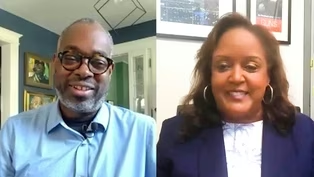
NewClip: S54 Ep40 | 12m 5s | Cheryl Thompson explores the stories of 27 of the Black combat pilots who went missing during WWII. (12m 5s)
 New
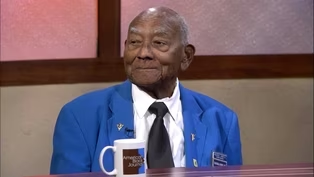
NewConversation with Tuskegee Airman: Frederick Henry
Clip: S54 Ep40 | 5m 46s | Frederick Henry, who passed away in 2020, was a guest on American Black Journal in 2017. (5m 46s)
 New
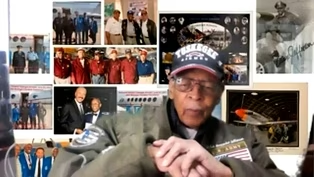
NewConversation with Tuskegee Airman: Lt. Col. Alexander Jefferson
Clip: S54 Ep40 | 6m 40s | interview with Lt. Col. Alexander Jefferson, who passed away in 2022. (6m 40s)
Providing Support for PBS.org
Learn Moreabout PBS online sponsorship New Episode
- News and Public Affairs

Top journalists deliver compelling original analysis of the hour's headlines.
 New Episode
- News and Public Affairs

Today's top journalists discuss Washington's current political events and public affairs.
 New Season
 New Episode
 New Episode
 New Episode
 New Episode



 New Episode
 New Episode
Support for PBS provided by:
American Black Journal is a local public television program presented by Detroit PBS