Traverse Talks with Sueann Ramella
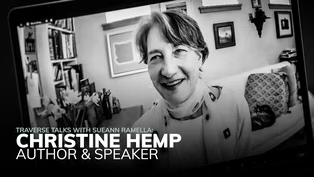
Author Christine Hemp
12/21/2021 | 37m 48sVideo has Closed Captions
Author Christine Hemp On Finding Your True North.
Author Christine Hemp talks about her latest book, a memoir Wild Ride Home, finding red flags in relationships, taking care of aging parents and always keeping your true north. Christine is not only an author, but poet, musician, speaker and teacher. Her work as been featured on NPR, TEDx, Humanities Washington and the Harvard Magazine, among others.
Problems playing video? | Closed Captioning Feedback
Problems playing video? | Closed Captioning Feedback
Traverse Talks with Sueann Ramella is a local public television program presented by NWPB
Traverse Talks with Sueann Ramella
Author Christine Hemp
12/21/2021 | 37m 48sVideo has Closed Captions
Author Christine Hemp talks about her latest book, a memoir Wild Ride Home, finding red flags in relationships, taking care of aging parents and always keeping your true north. Christine is not only an author, but poet, musician, speaker and teacher. Her work as been featured on NPR, TEDx, Humanities Washington and the Harvard Magazine, among others.
Problems playing video? | Closed Captioning Feedback
How to Watch Traverse Talks with Sueann Ramella
Traverse Talks with Sueann Ramella is available to stream on pbs.org and the free PBS App, available on iPhone, Apple TV, Android TV, Android smartphones, Amazon Fire TV, Amazon Fire Tablet, Roku, Samsung Smart TV, and Vizio.
Providing Support for PBS.org
Learn Moreabout PBS online sponsorship(bright upbeat music) - [Sueann] Horse stories are really relationship stories.
This magnificent animal touches into your soul.
And many of us fall in love with them.
And like in any relationship they can take advantage of us and be naughty.
Well, just like humans, isn't it?
Author Christine Hemp wrote "Wild Ride Home: Love, Loss, and a Little White Horse, a Family Memoir".
She'll talk about the broken relationship that she had with an ex, her mother's dementia, her father's end of life decision and seeking delight.
She'll do a wonderful poetry reading.
And of course, we'll talk about the horse that she loves.
(bright upbeat music) "Wild Ride Home" is not just for horse people.
What I have pulled out of it is a lot about relationships and your personal experience.
It is of course your memoir, but specifically there's some areas I would really like to talk about.
First is this moment when you have this horse Buddy and you're training with him and a man named Ken notices that Buddy, I can't remember if he pushes you against a post or he, the horse essentially disrespects you and the trainer or Ken says, "Did you notice that?"
And says that that's not okay.
So it was really about respect.
So how and why did that moment resonate with you?
If you can explain to our listener?
- [Christine] Well, it was a beautiful moment and I would say that that moment in the book helped me understand another relationship that is also in the book is a man I had to leave and sort of come back home to the Pacific Northwest that's part of the memoir.
But that moment with Buddy was really regulatory to me because I thought Buddy was being affectionate.
And of course I was so smitten with him that I just adored him.
And though he wasn't really mean at that moment.
There was a moment when he was taking up more space, he was entering my bubble without permission, just as if a human would come up to you and talk a little close to your face and you feel like, "Ooh, could you please step back?"
That's the feeling that we actually get when we're tuned in to human interaction, as well as horse interaction.
So that was a pivotal moment for me.
And when Ken said that, that "Look, he's not your scratching post."
I began to learn through Buddy very, very subtle moments in human relationships as well.
So it was a moment where I enjoyed making it a scene in the book because it did resonate.
- [Sueann] And this particular moment, it leads into another question in the book about that relationship with your former fiance.
And if you don't mind, could you explain why you liked this person enough to want to marry them, but then how it fell apart?
- [Christine] Well, that was a complicated time.
I think there were moments of pure unadulterated excitement about being with someone who seemed like a kindred spirit and a little bit like being smitten with a horse.
You're just dazzled by the relationship.
And I often called it to myself, high octane.
It was high octane.
He was very, very smart, very talented, but also had a deep wound in him that I could not see then.
Interestingly enough, that happened is, and you see, in my book with horses, horses often have wound from a relationship with a human.
And so that is something you have to address, but I was not prepared for the kind of actually psychotic behavior that happened with my then fiance, not at all prepared and felt almost sort of, it was just so spooky to have the reality shift within that relationship.
And he could just sort of go in a moment's notice and I don't mean physical abuse, but psychological sort of aggression.
That was very, very confusing to me.
So, but I do as you know, in the book, know that I keep my true north.
And when I finally stepped back to see what was happening, it was clear that I just had to leave.
So I ruin the story, but I'm not sure if that answers your question, but the, what was I attracted to was so many good things.
We were both fly fishermen.
You know, we were writers and painters and he was funny and fun and charming, charming with my family.
- [Sueann] Oh, that's always a kicker when the family.
Yeah.
If, especially if the mum likes them, then you're like, "This is a go."
And I guess I'm wondering and without ruining what's in the book, no spoilers, but just how did you stay with your true north?
And by that, you know, I assume that means you, you were in tune with yourself to know that this isn't how I want to live or be with a person, because I feel as if so many, particularly our younger people may not be getting this type of mentorship and relationships so if you could share.
- [Christine] Well, I have to say that my family is my true north and now I call my husband, my family too.
My now husband.
I realized that it was contrary to my very being, because it was a lie and the lie of it because we were so charming in public and he was so lovely and then sometimes we'd get home and there was, it just was frightening, you know, that he would turn.
And obviously I know now the wounds of his childhood were so deep.
He had a very famous father and not well taken care of.
I didn't really realize that that was going to be a problem.
But the true north for me was I couldn't do the lie.
You know, that he was this person and I was with him.
It became, it became ridiculous.
And I think that's why, interestingly enough, in this last four years of leadership is not political.
It's just looking at readership when there are lies, there is an alternate reality that's happening that, it really kind of did a weird thing to me cause I thought, wow, that was, that was similar to what I went through.
Reality shifts in begging to know isn't true, you know?
- [Sueann] Yes and I'm so thankful that you were aware of, of that and that I have a lovely family.
And so we both are blessed with, with good families.
So I often worry about those who don't, because they have to dig a little deeper to find that true north, like I've tried to teach my daughter, like here's a red flag when they're completely controlling and you're not seeing your friends anymore.
(laughs) - [Christine] Yes.
Oh sweet.
Yes.
That's really interesting.
And my family did too.
They saw it and said, you know, I came home.
And what you say is really interesting too, about younger women and men too.
Mentorship is super important.
You know, I think so.
And whether you're a parent or an aunt or a school teacher, or writing a book or whatever, that that's really important now.
And I feel for the younger generation too right now is sort of stuck in this zoom thing.
And are they cultivating people who they can feel they can trust.
- [Sueann] Yes.
This book, "Wild Ride Home", Christine, I feel would be an excellent book mentor if you may, because you tackle a lot of personal issues within yourself and your family, very authentic way.
So I really felt connected with you.
And in particular, the three experiences that I wanted to talk about that I think would be helpful to the listener is one, your mother and dementia, and then your father's illness and then death and the way he chose to go about that.
But we already covered the relationship part.
So we'll move on from there.
What can you say to those who have a loved one going through dementia?
One, how did you cope and what advice do you have for them?
- [Christine] Those are really good questions because a lot of people are having that happen right now.
And I think the first thing that comes to mind, which is an earmark of my family is laughing.
As you found out in the book.
I mean, there are many funny places with my mother in the stages of Alzheimer's where she says funny things.
And I say funny things, and if you can laugh about it, it's easier.
It also alleviates the addition of an Alzheimer's patient.
And my mother lived with it for, gosh, I'd say almost a decade.
So I came home and it was a long time before she died eight years or so almost a decade.
And when I came home, this was happening.
So what's interesting.
What was interesting for me in writing the memoir is that I came home thinking I needed help from this crash of my love affair and my whole idea of my life and all this.
And I landed with my mother in the early stages of Alzheimer's.
So I quickly shifted to caregiving with my sister and my brother back east.
And that changed me.
You know, I realized that, wow, I've come back now to another alternate reality, which is Alzheimer's, you know, that is the reality of all time.
But I think advice is to laugh.
Advice is to acknowledge that other reality, unlike the former fiance with an Alzheimer's parent or friend, you acknowledge that reality.
So there isn't some kind of what, you know, okay, mom, you know, she would just, you know, invent things like I was way up there.
I said, oh, really mom went, you know, where was it?
Tell me about it.
So that there's, the agitation is lifted.
That's one little hand laughing and acknowledging their reality.
- [Sueann] Oh, Christine, that is so helpful because I would say typically a person would wanna correct them into our reality because you love them and care and you want them to know this is real, but I have heard of these other techniques where you just go along with their story and the family seemed to be able to cope better that way.
What gave you this idea?
- [Christine] I just think it was a natural climate of my family dynamic that we laugh a lot, even when things are grim.
And also, I think it just became clear that that kept her calmer.
- [Sueann] And you didn't feel like you were lying to yourself or to her?
- [Christine] Not really.
I mean, sometimes you had to say, but mom, now we're eating lunch.
You know, we'd get done with our lunch.
And then she'd say, "Are we having any lunch?"
And I'd say, "Well, mom, we had our lunch."
But there were times when it was very hard because when we did have to give a caregiver, it felt like a betrayal, but we needed someone to cover when we were, you know, trying to coordinate our care.
And that was hard.
But she to giving my mother credit, even in Alzheimer's, you know, she went was things, she was malleable.
And when we moved her to the place which you read about in the book, she went with it and I give her credit for that.
And she still remained hers essence on some level till the end.
And I think if your givers can think of that as something to remember that the essence of your family member is back in there, they are there somewhere.
And mostly it's audible.
Like the sounds, I'd read it aloud to my mother poems and she remembered them and know them and could recite them with me.
So the ear is really, really important for Alzheimer's.
And I played music for her, played my flute and my siblings and I sang with her.
And those things are the things that is that essence way back there.
And it gives all of us, I think, some kind of comfort thinking, well, you know, we're all thinking, are we going that way?
None of us knows, right?
Someday in know, whoa, but there'll be our essence.
Also it's important right now in general, I can see that all the crises we're having right now in terms of, you know, communication and agitation between people and parties and whatever, really looking for our essence is what I guess it's my job as an artist.
To continue.
It's that connecting that connecting even with somebody who has dementia or somebody has a different political party, where are the avenues?
Where are those avenues that take us in to that essence of who we are?
- [Sueann] Oh, amen sister.
That's good.
(upbeat music) - [Announcer] Wants to see behind the scenes photos and videos from things like local productions, pledge drives and life around the NWPB studios, then follow NWPB's Instagram account by searching NWPB broadcasting and hitting the follow button.
(upbeat music) - [Sueann] One of your bio's it says Christine hemp approaches communication skills as both utterly crucial and grounded in delight.
That that word delight is intriguing to me, especially for us here in this podcast, because we had a poet Ross Gay, and he wrote a book on delight and finding the light, even in the smallest of things.
So can you explain a little bit about what delight means to you and what you mean that our communication skills need to be grounded in delight?
- [Christine] Yeah.
It's interesting.
Delight is a word I use a lot, interestingly enough, because I do delight in the world.
I'm really glad to be living on planet earth and delight starts just like Ross Gay in and those particulars.
And if I look for those rather than, "Oh, how many more days is this pandemic going to go on?"
You know, we're all in the slug right now.
We're in just such a slog.
It's in the rhythms of this last year.
You know, everybody gets hopeful and then we were, but I think to continue to look for the delight, whether that's just your cup of coffee in the morning with your husband or, you know, your child saying on zoom (laughs) one strand who had a kid who went back to school for a while, you know, they opened the schools and he'd never been to school before.
And it's a friend told me that.
She said, "Well, mum it was so good at school and all the children were real."
(both laughing) - [Sueann] Oh, that is delightful.
- [Christine] That now delight, you see, you used that word.
- [Sueann] Yeah.
Because right Christine, like the energy and the love you put into this memoir and how you mentioned it sent out into the universe.
I feel as if there is this energy that's unseen, but the minute people open and read it, they consume and feel the energy within them.
And so if we choose to pick words or push out more delight, we can have a positive impact on those around us.
I think faster and more beautifully than if we choose to focus on the negative.
I feel as if it may be weird to say it, but there are times in my social media feed where I just see a friend who posts, I don't know who needs to hear this, but things are difficult and your feelings are real and things will work out.
(laughs) - [Christine] That's really interesting.
Well, I've read a poem 30 today for this time of COVID.
And I wondered if you wanted me to read it and it's a brand new poem, but I call it a Psalm in the time of COVID.
My friend who nearly died, but it didn't say the only words she spoke that month were thank you.
And I love you.
One need not to have shaken hands with death to no such kneel and kiss the ground gratefulness.
Today, for instance, I thank the two remaining inches of my latte, the fog draping, the firs outside my window and oh, the cats impossible not to praise their mighty motors for noble cutlery, spooning, happily sequestered in the kitchen drawer.
Ah, and thanks to this Tercon derogate pencil, number two and friends who never tell you what your problem is.
Hallelujah to the baby wrens long flown, who hatched in my fishing creel, dental floss, and the check I found in the recycle bin for hand sewn, teal and Aqua masks for breathing deep, who ha for the words like bromance and in Canab doula for all the mistakes I've ever made, finally, a nod to all listeners and purveyors of kind words who may or may not be reading this.
Thank you.
I love you.
- [Sueann] Brilliant Christine.
Oh, you got me.
(Christine laughs) You notice the little things, the important things.
(Christine laughs) Gosh, darn it.
This podcast is like, I just expect, now that I'm going to be crying, (Christine laughs) I'm just letting the beauty of that moment linger there for a minute.
Before I ask something, that's completely bizarre.
I had this feeling, I was tired of hearing people say, thank you for your service, because I felt like it started to become a platitude and losing its meaning, particularly when they said thank you for your service.
'Cause I was feeling like I'm acknowledging that you're here to serve me during this pandemic, but I don't necessarily support you being paid more for it.
And my thanks should be enough.
And I don't mean to take away from that beautiful poem, but I'm just wondering if you're the person that I could ask could you help me figure out that thought and why it may be wrong or right.
- [Christine] Figure out this, let me get this.
Let me hear if I've heard you correctly, you're saying thank you can be empty?
- [Sueann] Yeah.
Particularly with this, with when we say to a grocery clerk, thank you for your service.
- [Christine] Yeah, it sounds patronizing.
- [Sueann] A bit.
- [Christine] Yeah.
Yeah.
I understand that.
Yeah.
That's a little patronizing.
- [Sueann] I feel we do that to our veterans too now is almost like a one-off if I just say thank you for your service, I don't really need to do the work to fully understand the sacrifices you have made.
- [Christine] Yeah.
That's really an interesting point too.
And I think that is, is true.
I guess what I would say.
And I'm feeling my way through the answer to this is that, is there another way of thank you in language that's a little different for example, the particulars we were talking about the tiny things.
Do you know your grocery clerks name?
Right?
Like Debbie, like we have a clerk here who's been working through the pandemic at the QFC.
And I think, you know, I, instead of saying, thanks, Debbie, you know, it's just like, how are you doing today?
What a time?
Huh?
You know, how's the locks it down going that's in a way that's more particular.
It seems to me then that sort of, yeah.
Thank you for your service with the military.
I know just what you mean.
Yeah.
I wouldn't, I wouldn't say that to them because if I were in a more sort of, I would say their names, does that make sense maybe?
- [Sueann] Yes.
And that helps.
And it helps me a lot to deal with why I was feeling aggravated by.
(laughs) - [Christine] Yeah.
Because it's a hallmark thing.
It becomes just like you say, kind of a cliche.
So our challenge with language now was so much quit Twitter.
And not that Twitter's bad or good.
I make no judgment about the social media.
It is opened up so many wonderful things and sometimes it can be a weapon and all that.
But our challenge as a culture now with our language is to make it fresh, keeping it fresh and new and real and true.
- [Sueann] I love it, Christine.
Yes.
And you're so good at that.
I mean, I was listening to your, you did a talk with humanities, Washington, from Homer to hashtags and you said this line, oh my gosh.
Christine said, "Our oldest language is poetry and we danced it and sang it it is in our DNA, poetry was the historian of the tribe."
Oh yeah.
And the way you described the history of the printing press and related it to today's social media, I mean, let me just tell you listener that Christine, in a matter of five minutes, took a span of like, what was that hundreds of years and said, "Nothing is new here people, Twitter existed, it was called the Gutenberg press."
And people were freaking out back then and everybody thought society was ruined back then.
It's because more people were talking and then you let everybody have access to the books.
That's terrible idea.
And now you're like, everybody has access to print their own thoughts.
And yet we eventually figured things out, right?
The truth event truth eventually comes out.
So I feel like it eased my anxiety over this idea that social media is ruining our lives.
(laughs) - [Christine] I'm glad to hear it because I think the kind of creativity that has gone into these platforms, but I think that social has also brought us together in so many ways.
And also there is incredible language going on in social media.
I mean, like you said, you were going through Instagram and you see a poem that you needed to read, but no, there's nothing new under the sun, but we're feeling very sort of shell shocked about it and okay, so what do we do with the shell shock?
What do we do with our surprise and our anxiety and how do we move together through this and kind of share and laugh about it as well.
- [Sueann] Yes.
And that comes back to your book and your family, your dad recently passed away.
He had leukemia.
And what I found extraordinary about this story about your dad is he chose to unplug.
If that's the right way to say it, he didn't want to stay in the hospital.
He basically, to me, it sounded like chose to die.
And your family is so tight knit from what I can gather.
I mean, I know you have issues in your family, like everybody else's, but you all seem very close.
So what do you do when a parent says, I wanna die because we don't really want to talk about death.
- [Christine] No, our culture doesn't talk about death at all.
And when in fact death is everything all the time, I live near a forest here and I will Buddy, my horse and I ride through the forest and everything we see is both burgeoning in life and death.
The stumps are down because the tree is dead, but it's feeding.
It was like, we don't in this culture, have an idea that's larger than the event itself.
At least culturally, I'm not saying people don't, but it's really interesting how we can't acknowledge it.
It's should be hidden when death is all around us all the time (laughs) you know?
And, and I think you ask how our family handled it.
Well, we were aware of my father's volition of his clear idea of himself and what he chose.
He always had a very strong way of going about his life.
He chose something and he went toward it and this was something he did not want the quality of life to go down.
And he just felt like it was time to step out, like time to leave the party.
And it was very difficult to also challenge him.
Not that he was mean about it.
It was just that he was so sure which gave us confidence.
And of course we were with him, you know, we saw him to the other side right to the edge of the other side.
And to do that and to sit with death with your parents, with your friends, to sit with dying people is a way to make you less nervous about dying yourself.
- [Sueann] Yes.
Yes.
Because we avoid it.
That's why we are afraid.
Okay.
So in that part, in your family, your father's personality then was really like, I have chosen this.
And I find that in my personal experience, a little unusual because sometimes the adult children take over and they make the choice when their parent dies.
And I have not seen that turnout well.
And so your father sounds like he had what I would call a good death.
- [Christine] Yes, he did.
That's a good point.
Yeah, he did.
- [Sueann] What advice do you have for adult children who can't let go or let their parents decide?
- [Christine] Well first I would probably urge them to talk to each other first so that they're all in concert with this decision.
And to allow that to first be a stable place for them and that they don't feel threatened by siblings.
I guess I'd also advice is such a funny word, but I would invite them to look at their own fears about death and what is the scariest thing that might happen.
And my father used to say about what would happen, what is the worst thing that could happen?
Will you die?
And even that, you know, when my father used to say that to us as kids, you know, if we didn't get, you know, what we wanted or something, and it sort of made death seem not miss final thing, but something else, you know, what, what is it that you're afraid of was sitting with someone who's leaving the planet?
My experiences have been so beautiful because I faced that fear.
- [Sueann] Like I said earlier, I think your book "Wild Ride Home" is very authentic as it approaches and tells a story of these many events in your life.
That I think people, if you have a parent who has dementia or a parent who is aging, or if you've been in or getting out of a relationship that was frankly abusive emotionally, this book could be very helpful.
(laughs) - [Christine] I'm glad it could.
That's a nice thing.
You know, when you, when it's gone and in the world, it's just a magical thing that people respond to it and, and write me letters and tell me that it's helped them.
And that it was a good story.
You know, that it's such for an artist, you know, to have people respond is one of the greatest gifts in the world.
You kind of can't believe it.
You know, if you're an artist, you say, gee, did I make that really did that really happen?
(both laughing) How did I do that?
Where did that come from?
You know, and it was a long haul with that book, but you know, it's such a blessing to be able to share the work.
I think any artist of any kind feels that way to be able to share it with the world.
That's the really thing.
- [Sueann] That's wonderful because what artists do is they connect us to many parts of ourselves, our souls, and each other.
I feel as if we need more focus on the arts, just for our mental stability.
(guitar music) - [Announcer] This podcast, like so many programs on NWPB is brought to you courtesy of donors, people who watch and listen to NWPB for thought-provoking programs, like "Traverse Talks", people who give what they can to pay for current programs and technology for future programs, you can join them, donate any amount that's right for you at nwpb.org.
And thank you.
(guitar music) - [Sueann] What are you working on now?
- [Christine] Well, I just put together a new collection of poems where this poem is in that I read you it's called "Jealous Waters" and it has several parts.
And one part is actually poems in the time of COVID.
So there are a few of those, and a bunch of them are written in the voices of Greek gods or biblical characters, mythic, mythic characters, but in their voices.
So, you know, I've got one with Mary in there, a little nerves about, you know, having a baby, I've got Buddha talking about his body.
(laughs) They're really fun.
And Orpheus, and (indistinct) where Orpheus has to go into the underworld to rescue her.
But in my version, she didn't want to come- - [Sueann] Oh my, oh, this has gotta be fun.
- [Christine] You know, it's just interesting how poetry you were talking about how poetry sort of meets the needs and people.
And I really loved your interview of Jericho Brown.
I just love his poems and your interview was so beautiful.
And he talked about how his language is affected by his church upbringing, right?
The children, everybody had to speak and talk and language being given out, and that affected his poems and how, how he was an orator, even as a child.
And I think those cadences of where we come from affect our language.
And I thought all of us have a different kind of upbringing.
Some not in church.
I grew up in the Episcopal church with the liturgical rhythms of that language.
And I think that affects us.
I really do.
And even writing those poems in the voice of like Mary and Joseph made me look at this stories differently.
- [Sueann] Oh, wow.
- [Christine] All of those characters and the cadences of their speech.
And so growing up with the Episcopalian cadences of prayers and the whole liturgy, I think that has affected my poems too.
And so when we think of sound in language and how, you know, the sounds of words, it's, you know, music, right?
So now I've completely forgotten.
- [Sueann] Oh, I don't care.
I love what we're talking about.
(laughs) - [Christine] Oh, about the poetry.
And yeah, I'm excited about this manuscript, "Jealous Waters" and I'm right.
I'm digging the title because it can mean so many things, but it also means jealous means also being mindful and careful and taking care of something.
So.
- [Sueann] Oh my goodness, what?
- [Christine] Isn't that interesting?
- [Sueann] Yes.
So is it because you have, you noticed something that you want it for yourself, so you have to reflect on that.
- [Christine] Maybe I'm thinking that also, maybe in those old Testament, God phrases, you know, I am a jealous God.
I always thought that was just awful.
Well, I'm thinking, forgive me if I'm wrong, but I'm thinking that he's a jealous God.
He wants to take care of the tribe, right?
So, you know, it's, let's see, where is my manuscript here?
If I even put that other meaning on the manuscript, jealous, pronounced, jealous, which we all know, fiercely protective, vigilant, watchful, and mindful.
- [Sueann] And yet it's such a negative reflection in our society.
- [Christine] Yeah.
- [Sueann] Wow.
- [Christine] Isn't that interesting?
- [Sueann] Well, this just goes back to you and finding delight in words.
I mean, going and researching the meanings of things can just change a paradigm, right?
- [Christine] Doesn't it?
- [Sueann] Oh yeah.
- [Christine] You're absolutely right.
- [Sueann] Well now I'm not so mad at God because (laughs) Well, good God.
I think I understand you a little bit more now.
(laughs) It's because you care.
(both laughing) - [Christine] Religion is a loaded, a loaded subject in our world today too.
But I think it's all because we are really searching deeper.
This pandemic has made us closed in, but it also has made us go even further in, does that make sense further into ourselves and asking those questions is God mad or what you know is he causing all the world.
It fires and storms and earthquakes and pandemics, you know, but if we go inside ourselves to find that essence that we were talking about earlier, it seems that this can be a really quality time for all of us.
- [Sueann] I heard in the Washington post, they had, oh, woman of Sikh, religion.
And I think she was at a non-denominational church and she was giving a sermon.
They invited her to talk.
And my takeaway was when she said, this is a time of birthing.
And when you birth, you breathe, you push endure, but I'm totally ruining it.
But I just, you saying this about going within our country, I felt as if her sermon was a reflection of the state of things for us in America is that we are birthing something and it is not easy to do.
And if you don't do it, you die.
- [Christine] Exactly.
That's really, really interesting.
And how about the poet for the inauguration?
- [Sueann] Oh, yes.
- [Christine] She said very much the same thing.
- [Sueann] That was the, oh, I'm getting goosebumps.
Well, Christine, thank you so much for your time.
And it was such a pleasure having this conversation with you.
Thank you for your work.
And I particularly love that you focused on Buddy the horse.
Cause I feel like that helps people understand themselves more when we do it through a creature.
(both laughing) - [Christine] Well, Sueann what a lovely interview with you.
I just loved every minute of it.
You're wonderful at this and you're doing what you should be doing in the world, (mumbles).
- [Sueann] Oh Christine, thank you.
(upbeat music) That's author, poet, speaker, coach, Christine Hemp, her book "Wild Ride Home: Love, Loss, and a Little White Horse, a Family Memoir" can be found or ordered at an independent bookseller near you.
I hope you enjoyed this conversation and learn something useful.
This is "Traverse Talks" I'm Sueann Ramella (upbeat music)
Author Christine Hemp - Conversation Highlights
Video has Closed Captions
Clip: 12/21/2021 | 3m 50s | Conversation highlights from author, peach, coach, speaker and teacher Christine Hemp. (3m 50s)
Providing Support for PBS.org
Learn Moreabout PBS online sponsorship













Support for PBS provided by:
Traverse Talks with Sueann Ramella is a local public television program presented by NWPB