Traverse Talks with Sueann Ramella
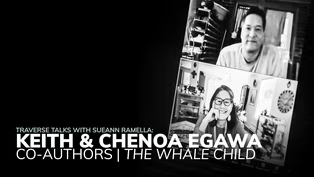
Authors Keith And Chenoa Egawa
1/10/2022 | 37m 33sVideo has Closed Captions
Siblings And Co-Authors, Keith And Chenoa Egawa On How All Of Our Connections Shape Us.
Siblings and co-authors of a children’s book Keith and Chenoa Egawa talk about their book The Whale Child, the rollercoaster life story of their grandparents and how they came to be, and growing up trying to maintain their many cultural identities. Both Keith and Chenoa are members of the Coast Salish of the Lummi and S’Klallam Nations of Washington state.
Problems playing video? | Closed Captioning Feedback
Problems playing video? | Closed Captioning Feedback
Traverse Talks with Sueann Ramella is a local public television program presented by NWPB
Traverse Talks with Sueann Ramella
Authors Keith And Chenoa Egawa
1/10/2022 | 37m 33sVideo has Closed Captions
Siblings and co-authors of a children’s book Keith and Chenoa Egawa talk about their book The Whale Child, the rollercoaster life story of their grandparents and how they came to be, and growing up trying to maintain their many cultural identities. Both Keith and Chenoa are members of the Coast Salish of the Lummi and S’Klallam Nations of Washington state.
Problems playing video? | Closed Captioning Feedback
How to Watch Traverse Talks with Sueann Ramella
Traverse Talks with Sueann Ramella is available to stream on pbs.org and the free PBS App, available on iPhone, Apple TV, Android TV, Android smartphones, Amazon Fire TV, Amazon Fire Tablet, Roku, Samsung Smart TV, and Vizio.
Providing Support for PBS.org
Learn Moreabout PBS online sponsorship(upbeat music) - [Sueanne] So that recent heat wave across the Northwest, that had me thinking really deeply about climate change or climate shift or whatever you wanna call it so it doesn't sound so political, but just sounds like the new reality.
And if you feel overwhelmed by it all, I know I do, imagine how kids feel.
Brother and sister authors, Keith and Chenoa Egawa, well, they wrote a book called "The Whale Child", it's to help empower children to take care of the earth.
And you'll hear about the story and also the resources in it for teachers and how two Coastal Salish tribal members have Japanese ancestry.
I hope you enjoy this conversation of Traverse Talks.
(upbeat music) Let's talk about "The Whale Child", is a book written for older kids, maybe seven to 12, a chapter book, beautifully done, love the story.
And we'll talk about that more in depth, but I was wondering if you could, for our listener, give an overview of what "The Whale Child" is about.
- [Keith] Yeah, I'll go ahead and Chenoa you can add to it also.
So it's a story and so tere's a little girl who, she's native and she lives on the Coast of Washington.
And then there's the whale child, he's a humpback whale.
And so he and his mother are doing all the migratory routes that the whales do.
And she begins to show him all of the things that are happening in the world that are bad, you know, the environmental degradation, rising temperatures, overfishing, pollution, et cetera.
And so the spirit of the water chooses the whale child to become a human boy for a short period so that he can come to dry land and meet this little girl, Alex, and basically take her around her homeland, a place that she's very familiar with, but show her all these different, bad things that are happening, things to the wildlife, things to the land itself, the air or the water.
So he basically, he represents that alarm in nature, or the message from nature saying, "Look, what's happening we're facing some serious problems that could be unsurvivable.
People need to learn about these things and then start making the appropriate changes."
So that, Chenoa anything to add?
- [Chenoa] Yeah, so in the beginning too, it's acknowledging the living spirit of the water and the water is almost one of the characters as well, knowing that the water is the one that gives us life and the water witnesses our life, and knows what we go through and what our life is like and sees the whale child and knows that this is a perfect child to be able to carry this responsibility, that this is his purpose, and that he also has family on land.
That it's not just his whale family, but that everything is interconnected and he has a family on the land.
And so through the grace and the magic and that spirit of the water, he's transformed into a human boy to carry out this task of reaching his human sister on the land and letting her know from his perspective as a whale what's going on in the oceans and in the world.
And she combines that with her traditional Coast Salish teachings and picks up that responsibility to be one of the children who's gonna be speaking up for the earth and teach the other children how to be caretakers of the earth.
Again, to remember again, that this is what we need to do.
- [Sueanne] Right there, there's a point in the book where Shiny, the whale child, tells Alex, his sister, the girl that, in a dream state, that you know these things, you know how to take care of the earth and the water and the land, but we keep forgetting and remembering and forgetting.
And that really resonated with me as a human condition, that we keep learning our lessons and forgetting them.
So I was wondering in your opinion, why do you think that is?
We know we need to take care of our planet, but we forget.
- [Chenoa] I think it's part of the conditioning by the powers that be in the world, because I feel that if we all remembered the power of what we are and how we are, and that we're a part of this earth, that people wouldn't be able to control us, that there's income to be made, that money is a big motivator because money makes us want to buy things that we don't really need, but we're being trained to think we need these things and they're taking us further and further from our connection to the earth, as we rely and depend upon all of our machines.
And we are not machines, we are not, we're not machines.
We're nature, we're earth.
And so I feel like a lot of it is intentional to control people, manipulate and to make money.
- [Keith] Yeah, right.
Yeah 'cause when you think about people, we're basically hunter gatherers.
I mean that all cultures, if you go back far enough at some point every race, their origin, their people were hunter gatherers.
And then yeah, like Chenoa was saying, I don't have the answer, but yeah, there's this greed, this desire for more at any cost and consumption and more consumption and brought us to the industrial revolution.
And yeah, I think just that money and greed and how it's easy for people to ignore what's important and what matters and how to live the guarantees, the survival of human beings forever for each generation just kind of just conveniently gets ignored, even though it's so obvious.
- [Chenoa] Our educational system too, does not teach us about our connection to the earth.
And it doesn't teach us to follow things.
Like Keith and I were talking, and I'm sure you remember the time there were no plastic bottles to drink out of and how bizarre it was when they started showing up.
And we're like, "What?
Buy water drink out of a plastic bottle that is so strange."
But our children don't even know that there was a time when you didn't do that.
Or in the story, we talk about the time when our family would drink from the rivers and which rivers can you drink from now without getting really sick?
And so it's something about that oral tradition that we have as native people.
It's like, remember your story, remember your history because in there, all the lessons about life and what we've gone through are there, and we don't want you to repeat these mistakes.
So you need to know what it is to be a good person, responsible person, a respectful person, and how to take care of these things so that they're here for the future.
And I think our education today does not do that.
It's more about how do you become a corporate leader?
How do you... - [Sueanne] How do you get a job?
- [Chenoa] Yeah, how do you get a job?
- [Sueanne] How do you get a job and make your money so you can get your iPhone?
- [Chenoa] Right.
Yeah.
- [Keith] Exactly.
Yeah.
- [Sueanne] There's another section in the book where Alex, the girl, is questioning the whale child, "How do I do this?
How do I tell people the story?
How do I take care of the planet?"
And I mean, personally, I was like, "That's a huge load."
(laughs) But he says, it is the children who are going to save this planet.
So you have to share the story.
And part of that is he says, "It's one small step in the right direction."
And I'm wondering what you think, specifically children can do that's a good step in the right direction.
- [Keith] Well, one piece of that is the education, is the learning about the... You know, it's hard, it's frightening for kids that young, but it's really important that they learn the reality of where we are globally right now in terms of the environment and all the things we're talking about, you know, pollution, climate change, over consumption, chopping down all the forests to raise cattle, et cetera.
So part of it is learning about it.
And then in that process, they need to be given some... Because they're kids and they need to be given some easy options, as first steps.
And I think it's simple things to begin with, like what Chenoa was talking about with the plastic water bottles, is being aware of just how they use water every day, how long we leave the faucet running, washing cars, watering lawns, and just being aware of, oh yeah, this, that really is a huge waste water, especially when you consider billions of people and just learning little things, little conservation type things they can do themselves.
And then of course, as they grow older, the idea is that they keep learning more and more and do begin tackling the more difficult things like the big problem solving and solutions.
But Chenoa, what do you think?
- [Chenoa] I think like looking at what we have in our home, what comes into our home?
What is it made of?
Where did it come from?
And where is it going when it leaves?
And so you could take a product like a cleaning product, is it toxic?
Would you drink it?
Can you put it on your skin?
It's going in the water, it's going in the earth.
We're made of the water we're made of the earth.
So start looking at cleaning up those things, start paying attention.
You don't need a plastic water bottle.
You can use the same thing over and over and just clean it.
And the plastic, where does it go?
Where does the plastic bottle go?
You got it at the store, that's convenient.
You take it home, you drink it, in five minutes you're throwing that thing in the garbage and you didn't use it for anything else.
Nothing else, it's just garbage, and then you multiply that by the billions of people and why there's more plastic in the ocean now than animals and creatures.
- [Sueanne] Yeah.
- [Chenoa] And I think also planting a garden at home and understanding how life grows and how to tend to life.
And looking at the products that we like to eat, the food.
Has it been touched by man?
And if so, how much?
Is it packaged?
What's it packaged in?
Is it mixed with preservatives?
Does it have palm oil that's taking all the home of the chimpanzees?
- [Keith] Clear cutting entire rainforests.
- [Chenoa] Clear cutting entire rainforests so that we can have palm oil.
And so we really need to not just be blind consumers, we've got to look at where things are coming from and how we're using them, how they're impacting us and where is it going when we conveniently place our garbage can at the edge of the house.
- [Sueanne] Chenoa you say a couple of things, the word convenient, that is just so much a part of our, you know, big Western culture is convenient and comfort.
And when I think of those words, it is always about single use, buy, throw it away.
So it's almost as if it's ingrained in the way we live today and I don't think Americans are willing to be uncomfortable or inconvenienced.
- [Keith] Exactly, right.
I think about exactly that, as when you look at the pushback...
Okay, like here's an example.
So like think of mask wearing, I still am blown away by the fact that it became politicized.
You know, people not so much in America, but you see folks from other countries, when they would go to the doctor's office, they would be wearing a mask by their own decision, because we know, it's obvious fact, if you're sick, a mask keeps you from getting other people sick or keeps you from getting sick if you're, that's just always been a known thing.
And so when you look at the pushback over the mask issue, imagine tackling something like the beef industry, which is just a colossal offender on every level and we don't need pounds of beef every month.
You know what I mean?
But when that conversation comes up, you'd be met with violent resistance if people think you wanna take away their beef and so you're right.
It's the, how do you get through that barrier of, "We want all this stuff that we've always been used to, regardless of the cost."
- [Sueanne] You know, while you were talking an idea came to me, is you tackle that when the planet makes it uncomfortable, (chuckles) 'cause the planet isn't gonna make it comfortable for you to have a steak every day, because there won't be enough water to feed that animal.
- [Keith] Yeah.
- [Sueanne] I would like humans to not need pain to make positive change.
And maybe between your book and the way people are raising their kids, to be more aware, it's a culture shift perhaps, without having to suffer with that.
So like with my children, my daughter loves the little, the barbie clothes, the tiny little things.
And I try really hard to go to the thrift store to save money, but also because it's there, it exists already, why do we need to buy a new one?
But it's just nothing but tiny little plastic things.
And so we discuss all the time, "You do not need any more of this.
You have plenty of barbie shoes and it hurts the environment.
Some creature's gonna eat it, it's gonna get buried, it's going to last forever.
And what was the point?
So you could be entertained for a couple of weeks?"
And so we try to, we're working through it and boy is at a hard brain synapse to rewire.
- [Keith] it is, it is.
- [Chenoa] Right.
Right.
- [Keith] Yeah.
- [Sueanne] So back to the book, we're talking about the children sharing this story and talking to each other, but also in the back, you have a way for teachers to address some core questions.
What made you decide to put basically a teaching plan in the back of the book?
- [Chenoa] At first, we talked with a publishers and they had that idea.
They thought this would be a really wonderful idea to use this as a guide for teaching kids about these topics.
And so we started through their recommendation and then they actually hired another girl to go through and align it with the curriculum so that it was something that teachers could just immediately put to use and not have to figure out how to design a whole program.
- [Sueanne] Yeah, I mean, teachers have been so busy this past year.
- [Chenoa] Yes.
- [Sueanne] This is excellent because you just open up the back and right away by grade level, there's core questions, there's ideas for essays, there's actually physical ideas of things kids can do hands-on - [Chenoa] Right.
- [Sueanne] and I really appreciated that.
And that was one of the reasons why when this book was introduced to me, I found it so fascinating because it's one thing to write a good story, but it's another to really get it into and talk about the education and the words behind it.
So that's awesome.
- [Keith] Yeah, and also, like I mentioned before, because it is a such a heavy topic for kids, so when we were working on this, we were asking ourselves the question, so when a kid gets through this story, one of our primary hopes for it is that it's just opening a door for them and they're gonna continue to learn more and research and watch documentaries, talk about the subjects and that also the light bulb went off of "Wait, what if we actually, at the end, had something that encouraged parents and teachers to then help the kids digest and discuss what they just read and experienced?"
So yeah, that was a big part of it is trying to make sure that there's that follow-up, that you don't just enjoy a story and then move on to something else and forget about it.
(upbeat music) - [Announcer] At nwpb.org you can find news, music, art, and culture.
Never miss out on stories from your community by bookmarking, nwpb.org, a website that engages, enlightens and entertains.
(upbeat music) - [Sueanne] Keith and Chenoa, your last name it's not Lummi or indigenous, it's actually Japanese.
Can you tell me how you got your last name?
- [Keith] Yeah, so our paternal grandfather was Japanese and Hawaiian from Lahaina and his wife, our grandmother was pretty much full-blooded native, Lummi and S'Klallam.
- [Sueanne] Your grandfather is Japanese, Hawaiian.
- [Keith] Japanese and Hawaiian.
Yeah.
- [Sueanne] And your grandmother indigenous?
- [Keith] Yeah, yeah.
She was pretty much full.
I think there was a little bit of English in there, but pretty much close to full-blood Native American.
- [Sueanne] Did you two have ties with both of your heritages?
- [Keith] No, so our grandfather, he was in Lahaina as a kid when Lahaina was literally a one general store and ship would come in periodically bringing supplies.
So it was literally just huts and this general store and his mother, I think there was a sibling group of, Chenoa, was it like 10 kids?
And she gave him a way to an uncle who lived down the beach and it was a terrible abusive situation.
So he stowed away on a sugar cane boat to San Francisco whenhe was somewhere around 10 or 11 with a couple other local boys and basically lived on his own.
He found like an uncle in San Francisco and he lived in the back of his restaurant.
So he was alone from then on.
He had zero contact with his family and so we never met any of them.
- [Sueanne] Wow.
- [Keith] Yeah.
- [Chenoa] It gets more, I mean he... - [Keith] There's much more.
- [Chenoa] It's a fascinating story.
- [Keith] It is.
Yeah.
- [Chenoa] Oh my God.
- [Sueanne] Please tell me a little bit more about how that journey led to you two.
- [Chenoa] So then he met that uncle in San Francisco and he started doing selling papers on the the street corner.
But he used to go down and watch this boxing gym, all the people at the boxing gym and there was the manager's name, he was a Black man named Sam.
Sam would see my grandpa come and watch all the fighters training.
And one day he asked him if he wanted to learn how to box.
And so my grandpa had wanted to, and he came in and Sam trained him and then he became a professional lightweight boxer.
And he traveled up the Coast and with doing fights.
And at one point they wanted him to throw a fight and he was just really, you know, did not wanna do that, but he had no choice.
And so he threw that fight and then he just walked away, but go ahead, he made it up to Seattle.
- [Keith] Yeah, so it was actually organized crime where he was an up and coming kid.
So they made him throw the fight, and so he did.
And he carried that with him.
I remember him talking about it when he was in his late '80s.
And you could tell he still felt horrible about himself.
That's when he quit boxing and just carried that self-imposed stigma.
He referred to himself as a bum for throwing that fight, but he was pressured, basically by the mafia.
- [Chenoa] And then he met grandma at the Dime store in Seattle.
She was working, our native grandma was working at a Dime store... - [Keith] I thought it was a candy store.
- [Chenoa] Or candy store.
Yeah.
So they met and then they fell in love and then they had my dad and aunt and uncle, but during World War Two, because of his Japanese blood, they lost their entire farm.
They had five acres, a home, animals, and they had to walk away with just what they could carry.
And he was sent to Minidoka in Idaho for five or six years.
- [Keith] And so what happened is, so he went to Minidoka to be interned.
And so my grandmother and our dad and uncle and aunt, because they were just part Japanese and were more Native American, they didn't have to go.
So they went to the reservation to stay with relatives and they missed him so much.
They went to whatever government agency it would be and volunteered to be interned with him, and they were.
So they were also at an internment camp in Idaho for the duration of World War Two.
- [Sueanne] Oh my gosh you two.
- [Chenoa] Yeah, I mean it's amazing, amazing story.
- [Keith] And also we can't miss this part because it's also such a big piece of the family history, but of their marriage.
So our grandmother, who is native, so I'm not sure how familiar you are with it.
But one of the big government implemented policies, efforts to disintegrate native culture following the Indian wars and all that part of it were over, was to forcibly put native kids into boarding schools where they wouldn't see their families and they would make sure they were forbidden from speaking their language so they would lose that connection and the languages with the intention that the languages would die out.
So our grandmother was, I always say, I don't know if she was the last generation, but if she wasn't, it was close to it.
But I believe she was one of the last generations to be forcibly removed where government agents came to the house and got her and her siblings and took them away to boarding school.
And she told the stories about kids being beaten and chained to posts for speaking native and so Chenoa, she went to Chemawa in Oregon?
- [Chenoa] Yes.
- [Keith] Was the boarding school.
Yeah, so one of the last ones to forcibly be removed.
So their whole experience is unbelievably painful.
- [Chenoa] Yeah.
It's amazing that we're here actually.
I think it's amaizing.
- [Keith] Yeah.
Yeah.
- [Sueanne] Waah.
Holy moly.
- [Chenoa] Yeah.
(laughs) - [Sueanne] Okay, I just need a moment because the story you just told me in my head is so vivid.
I seriously think this would make a most amazing screenplay from your grandfather, not your great-grandfather.
- [Chenoa] Grandfather.
- [Sueanne] It's your grandfather that's so... That's yesterday.
(laughs) - [Chenoa] Yeah.
Right.
- [Keith] What you're getting at is a big regret of mine because I've been writing since I was a kid, it was one of those things where I periodically would tell myself, "Okay, you need to make the point of sitting down with all of them and getting everything you possibly can written down."
And so, like the stories we're telling, we did pick up things here and there, but I never did what it really took to get the history and then our dad, he also realized the importance of that, and he went out and bought a tape recorder, this was before CD recorders and all those are even gone.
But he had this big old tape recorder, and I was excited too, he was like, I'm gonna sit down and I I'm gonna, 'cause he knew their histories really well.
And he got cancer and died and he never even was able to start.
So we have information and some really powerful stories, but the whole, like a continuum of their lives is something we don't have.
- [Chenoa] Yeah.
- [Keith] It's in pieces.
- [Chenoa] And things like dad would say too, like they lived in Woodinville and they were really the only mixed race family in Woodinville at that time.
And a lot of discrimination and I remember dad was saying, sometimes some of their Lummi family would come down to visit and then they would, riding home in the school bus, and they were riding next to the car load of Lummi family members that were coming to visit.
And my dad said he could see, but he was kind of embarrassed, but he was saying, it was this beautiful picture.
And it was, he said that people in the back were asleep and they had their hair was like blowing out the window and they were driving alongside of the bus and... - [Keith] And what happened is one of the little boys in the seat next to him, jumped up and he goes, "Look at those Indians."
- [Chenoa] Oh, yeah.
- [Keith] And that's where my dad, he was excited.
They were there to visit, but he was embarrassed because he was so different, but right and all that long black hair flowing out there.
'Cause it might've been a convertible or maybe just the windows were down, but yeah, that's a really good story.
- [Chenoa] Yeah.
- [Sueanne] Oh my goodness.
That just really points to so many things that your dad had to blend.
- [Chenoa] Yeah.
- [Sueanne] And yet he was so, he loved his people.
So it's like living two lives and code switching and all that and... - [Chenoa] Yeah.
- [Sueanne] And they didn't have the words for it then.
- [Chenoa] Yeah.
- [Keith] Right.
- [Sueanne] Wow.
Thanks for sharing that with me.
And I think the world needs to know your grandfather and grandmother's story because they have forgotten about the Japanese internment camps.
They have forgotten about the abuse, even in Asian communities, because life was hard in Hawaii.
And then your own grandmother was taken away.
And here are these two young, from broken background, totally taken away from their culture people meet and fall in love.
It's almost like they made each other whole again.
- [Keith] Yeah.
It's amaizing.
- [Sueanne] What a love story.
(Chenoa laughing) (cool music) - [Announcer] This podcast is brought to you by NWPB donors.
A gift of $5 a month supports the production of this program and it makes you eligible for NWPB Passport.
With Passport, you have access to an on-demand library of more than 1500 episodes of PBS favorites.
Come to nwpb.org and click on the donate button at the top.
(upbeat music) - [Sueanne] Would you consider yourself part of the Lummi tribe or Coast Salish?
- [Chenoa] Yeah, we're part of the Lummi tribe.
And then we're also, and we say, Lummi Nation.
- [Sueanne] Lummi Nation.
- [Chenoa] Lummi Nation.
And we always acknowledge the S'Klallam side too, because that's where great grandma and grandpa were born.
So they're Jamestown S'Klallam.
And then they had to move to Lummi because that was at the time when the reservations were being established and they had an auntie who lived up in the woods by herself on Lummi and she contacted the family and she asked them, "Please, will you come and live with me?
I'm really loving me back here in the woods."
And so the family moved by canoe and they went and they built a little house in the woods with auntie so that they could all be together.
So we ended up being enrolled Lummi when the whole enrollment thing started, then we became Lummi tribal members, but great-grandma would tell us we're Lummi, we're Sklallam, we're Flathead, we're Klamath.
She told us that we had these other tribe bloodlines in us as well, but that's how the government system, you know, it doesn't recognize the whole thing.
(laughs) - [Sueanne] Yes, because the government system doesn't like things to be complicated.
(all laughing) Pick one.
- [Chenoa] Yeah.
Pick one.
- [Sueanne] When you do the race thing, pick...
I was surprised recently when I was filling out my COVID shots, that it allowed me to pick more than one and they had something other than Asian, they actually listed a couple of different Asian types and I was like, "Wow, we're progressing."
- [Keith] Yeah.
- [Sueanne] Now I can pick white and Korean.
- [Keith] Yeah.
- [Sueanne] This is great.
In this time and age of identity, did you always feel like you knew who you were or did you go through an identity crisis?
- [Keith] So still going back to when you asked about our parents originally, that was actually another aspect of their parenting was that awareness always being there and that connection always being there and our mom by the way actually is entirely of Northern European descent.
But the cultural piece was that aspect of us was always there as far back as I can remember.
- [Chenoa] Yeah, and I think I remember going through a little bit of an identity crisis as a kid.
Even with that, I remember we just looked different than everybody else.
And we would go to Japanese gatherings, (indistinct), and we were involved up at Lummi, go visit our family and our grandma and be involved in different gatherings, but I always felt like I didn't look like anybody.
And I just wished like, "Why couldn't I just be one of these and just feel like I'm really part of it?"
But I realized, so for me, I've been searching and my native heritage has led me on the most beautiful journey of going really deep into the teachings, like really deep into the spiritual side and learning about the healing wisdom and the wisdom of our ancestors and the stories and living that.
And so I remember there was one person I met from South Africa and I used to introduce myself and say, "My name is Chenoa Egawa, I'm, Lummi, S'Klallam, Hawaiian, Japanese, English, Irish, Scottish, Norwegian and Swedish.
I'm just all mixed up."
And I would say, "I'm just all mixed up."
And then this one South Afrikaner man told me, "Don't ever say that again."
He said, "Don't, you don't have to say that."
He said, "Every single lineage that you carry has its own unique beauty and power and teaching and you are all of those.
And so don't ever say you're like that anymore.
You're not mixed up at all.
You have drinks."
- [Keith] Right.
- [Chenoa] And it changed in that moment.
And then I could come and see, as we travel, I could see people don't don't know where I'm from.
And I fit in everywhere.
- [Keith] That's right.
- [Chenoa] And I'm an international.
- [Keith] And I was aware of that too growing up.
I was always aware that I looked different because our grade school, middle school, high school was probably 95% Caucasian.
So yeah, I was aware of that subliminally, at least all the time.
- [Sueanne] Oh, that's really good advice.
Especially now, as we are approaching more kids of mixed race heritage, right?
Like the census says whatever by year 2030, 2040, a majority of people will be of mixed race, which I am really fascinated by.
And thanks for sharing that.
So when you were doing your own personal journey and getting into the spiritual side of things that reminded me of a part in the book where the whale child tells Alex that the answers are there, she just has to, what I essentially interpreted is, be quiet and still and look at the animals and listen to the environment and hear it.
And that is something we don't do.
We don't sit still and just be, and listen, because you're wasting time.
Is that more of a westernized ideal of being?
Because I feel Indigenous First peoples are perhaps better at just being.
- [Chenoa] So, yeah, I think that that was how we all were at one time, because we were living off the land no matter where we came from, our place of origin, we had to survive by working with the land and the animals and the plants and the water.
And so there's a lot of peace and quiet time and you're connecting with nature and you're not stressed out by your phone and you're not stressed out by your busy work schedule.
It was more about survival and being in tune with hearing and feeling, we even talk about that a lot, like the people of old or the indigenous cultures that have had less contact with Westerners have more of this purity about them that is sensitive to the surroundings, to the nature, to an insight, to an intuition that gets supplanted by this overactive mind.
And in our teachings, we say everything, the heart is the guide.
This one is supposed to help the heart carry out what the heart is saying.
But in our Western culture, it flipped around to now, it's the mind that thinks it knows everything and the heart is just left on the back burner.
And so that is a Western way, is this busy-ness and this overactive mind.
And go ahead, Keith.
- [Keith] Sorry, and Chenoa, tell the story you tell about, it links to the stillness thing and nature.
The story you tell about when I was little up in the reservation in the grass waiting for animals and great grandma watching.
- [Chenoa] Yeah, so our great grandma, we would go up to the Lummi Rez and visit our great-grandma.
And my brother would always bring coffee cans, old coffee cans, and punch holes in the lids.
And he would immediately, when we would get there, he'd run outside and he'd be down in the grass and just waiting for creatures to come, snakes and different kinds of bugs and insects.
And he would be so patient and so still, and so quiet.
And my great-grandma would look at him and said, he's like the old people look at him, he can sit there and be still and quiet and focus and he's listening and feeling.
And she said that that's how the old people were.
And so he was always like that from the time of being really little.
- [Sueanne] Keith, that's like a huge compliment.
- [Chenoa] It's a huge compliment.
Yeah.
- [Keith] Yeah.
- [Chenoa] Huge compliment.
- [Keith] Yeah.
It's a great story.
- [Sueanne] Well, I love that she said you were like the old people, but I have to ask you about your names.
Keith, you have a very westernized name.
Why is that?
- [Keith] I'm not sure.
- [Chenoa] I know why.
- [Keith] Chenoa you know, right?
'Cause our oldest sister, her name is LaTanya.
- [Chenoa] Mom was worried that you would get teased more because you were a boy.
So the girls, it's a little more acceptable with the girls, but she didn't want him to get teased.
And so she picked that name that he would not have any extra trouble.
- [Sueanne] Yeah, I think maybe it was you that I was talking with about that because that stood out to me a little bit.
And Keith, this is totally just me wondering, I was wondering if it would be easier for him to blend and get a job because his name was Keith instead of an indigenous or an Asian sounding name.
- [Keith] Yeah, that could have been their thinking back then because, they both, they experienced a lot of racism as a mixed couple.
And so in terms of their thinking, that definitely could have been a factor.
- [Sueanne] Interesting.
Yeah.
And Chenoa, do you feel like you lost out on opportunities or being teased too much because your name wasn't westernized?
- [Chenoa] Me?
No.
No.
I think for me it was the right name.
(all laughing) And for him too, you know what it means?
- [Sueanne] Yes, of course.
- [Chenoa] Now it's helpful.
The name is actually helpful, I think.
- [Sueanne] Good.
- [Chenoa] Yeah.
- [Sueanne] Thank you so much for your time and bringing a voice through this story for children to learn how to take care of the environment and also be encouraged to learn about First Nations peoples.
And I really appreciate the both of you sharing your personal stories, of your family as well.
- [Chenoa] Oh, thank you so much for having us, Sueanne.
We really appreciate it.
- [Sueanne] Yeah.
- [Keith] Yeah, we really appreciate it.
- [Chenoa] We had a fun conversation.
- [Sueanne] Oh, I appreciate you guys.
- [Chenoa] Thank you so much.
Grateful.
- [Keith] It's really good talking to you.
Take care.
- [Chenoa] Yeah, it's really great.
- [Sueanne] Nice talking to you too.
Bye.
- [Chenoa] You have a great day.
- [Sueanne] You too.
- [Chenoa] Okay.
Thank you.
Bye-bye.
- [Sueanne] Bye.
That's the authors of "The Whale Child", Keith and Chenoa Egawa.
You can get this Northwest book at independent booksellers near you.
And for more on "The Whale Child", there are many videos and resources if you Google the book.
And thanks for listening to Traverse Talks, I'm Sueanne Ramella.
(upbeat music)
Authors Keith And Chenoa Egawa - Conversation Highlights
Video has Closed Captions
Clip: 1/10/2022 | 3m 45s | Conversation highlights from co-authors and environmentalists Keith and Chenoa Egawa. (3m 45s)
Providing Support for PBS.org
Learn Moreabout PBS online sponsorship












Support for PBS provided by:
Traverse Talks with Sueann Ramella is a local public television program presented by NWPB