
Autism Center Trains First Responders Across Kentucky
Clip: Season 5 Episode 58 | 3m 31sVideo has Closed Captions
Kentucky Autism Center helps first responders improve interactions with autistic people.
Established by the General Assembly 30 years ago, the Kentucky Autism Training Center serves autistic individuals and their families in all 120 counties. Part of its mission is training first responders on how to have successful interactions with autistic people. our Mackenzie Spink tells us more about how the training center works to improve the public safety of Kentuckians with autism.
Problems playing video? | Closed Captioning Feedback
Problems playing video? | Closed Captioning Feedback
Kentucky Edition is a local public television program presented by KET
Autism Center Trains First Responders Across Kentucky
Clip: Season 5 Episode 58 | 3m 31sVideo has Closed Captions
Established by the General Assembly 30 years ago, the Kentucky Autism Training Center serves autistic individuals and their families in all 120 counties. Part of its mission is training first responders on how to have successful interactions with autistic people. our Mackenzie Spink tells us more about how the training center works to improve the public safety of Kentuckians with autism.
Problems playing video? | Closed Captioning Feedback
Where to Watch Kentucky Edition
Kentucky Edition is available to stream on pbs.org and the PBS app.
Providing Support for PBS.org
Learn Moreabout PBS online sponsorshipEstablished by the General Assembly 30 years ago, the Kentucky Autism Training Center serves autistic individuals and their families in all 120 counties.
Part of its mission is training first responders on how to have successful interactions with autistic people.
Our Makenzie Spink tells us more about how the training center works to improve the public safety of Kentuckians with autism.
According to the Autism Society, approximately 1 in 5 young adults with autism will interact with law enforcement before the age of 21.
The Kentucky Autism Training Center wants first responders to have the tools they need to ensure these interactions are safe and effective.
Our goal is not to create autism experts.
Our goal is to provide tools that help responders recognize situations, communicate more effectively, and achieve safer outcomes.
The center's deputy director says individuals with autism can often have communication differences that make it difficult for an officer to interpret their behavior.
As you can imagine, for that officer, their wheels are turning.
What on earth is going on?
Why is this person not responding to my questions?
Why are they pacing?
Why are they by this busy roadway?
Different observers may come to different conclusions.
So some of the most common that individuals might consider are that the individual is simply not compliant, or maybe they are under the influence of some substance, or maybe it's a mental health crisis occurring.
In reality, that individual may simply be autistic and overwhelmed by the environment.
The Autism Training Center surveyed its participants over the last four years, and found that 23% of first responders said they felt knowledgeable about autism before the training.
That number increased to 91% after the training.
It's just often a few simple adjustments that are needed to help support that interaction.
It could be something as simple as helping the individual get to an environment that has less input, right?
That's not as noisy, not as many people.
It could be that you need to shift your language and maybe use very direct language.
And maybe it's also that whenever you are asking questions of this person, you are doing it too quickly to rapidly.
Not giving enough time for them to process the information and provide the answer.
Kuli cook says the demand for training is only growing.
In 2000, the centers for Disease Control estimated that there were approximately 1 in 150 children with the diagnosis of autism.
Today, estimates are approximately 1 in 31.
Today, virtually every first responder in Kentucky will interact with autistic individuals throughout their career.
The Autism Training Center provides this training for free, not only to law enforcement groups, but also to search and rescue teams, hospital staff, fire departments, and more.
For Kentucky, Edition, I'm McKenzie Spink.
The Kentucky Autism Training Center is housed at the University of Louisville's College of Education and Human Development.
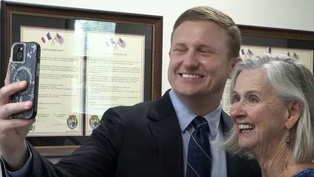
Candidate for 6th District Gets Support from Former Governor
Video has Closed Captions
Clip: S5 Ep58 | 3m 4s | Former Kentucky governor hits campaign trail for Democrat trying to turn a red seat blue. (3m 4s)
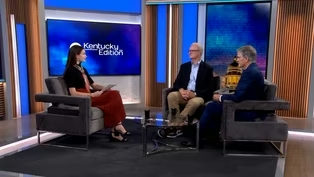
Video has Closed Captions
Clip: S5 Ep58 | 7m 46s | Inside Kentucky Politics with Trey Grayson and Bob Babbage. (7m 46s)

Vintage Bourbon Market Spurs Calls for Law Changes
Video has Closed Captions
Clip: S5 Ep58 | 2m 46s | Retailers urge changes to Kentucky laws governing vintage bourbon sales. (2m 46s)
Providing Support for PBS.org
Learn Moreabout PBS online sponsorship New Episode
- News and Public Affairs

Top journalists deliver compelling original analysis of the hour's headlines.

- News and Public Affairs

Today's top journalists discuss Washington's current political events and public affairs.
 New Season
 New Episode

 New Episode

 New Episode

 New Episode
 New Episode
Support for PBS provided by:
Kentucky Edition is a local public television program presented by KET