
Backlash against DEI, AACHM’s new home, Cost of housing
Season 52 Episode 40 | 26m 46sVideo has Closed Captions
Backlash against DEI, AACHM’s new home and the cost of housing’s impact on young voters.
Stephen Henderson talks with The LEE Group President & CEO Mark S. Lee about the backlash against DEI efforts in the workplace. The African American Cultural and Historical Museum of Washtenaw County secures a new home in Ann Arbor. Plus, PBS News Hour Student Reporting Labs Gwen Ifill Legacy Fellow Maria Witcher explores the high cost of housing and how it could drive young voters to the polls.
Problems playing video? | Closed Captioning Feedback
Problems playing video? | Closed Captioning Feedback
American Black Journal is a local public television program presented by Detroit PBS
Backlash against DEI, AACHM’s new home, Cost of housing
Season 52 Episode 40 | 26m 46sVideo has Closed Captions
Stephen Henderson talks with The LEE Group President & CEO Mark S. Lee about the backlash against DEI efforts in the workplace. The African American Cultural and Historical Museum of Washtenaw County secures a new home in Ann Arbor. Plus, PBS News Hour Student Reporting Labs Gwen Ifill Legacy Fellow Maria Witcher explores the high cost of housing and how it could drive young voters to the polls.
Problems playing video? | Closed Captioning Feedback
How to Watch American Black Journal
American Black Journal is available to stream on pbs.org and the free PBS App, available on iPhone, Apple TV, Android TV, Android smartphones, Amazon Fire TV, Amazon Fire Tablet, Roku, Samsung Smart TV, and Vizio.
Providing Support for PBS.org
Learn Moreabout PBS online sponsorship- We've got a really great show coming up for you on "American Black Journal."
Diversity, equity, and inclusion is absolutely under attack right now in corporate America.
We're gonna talk about what is fueling that controversy.
Plus we'll look at a major issue that's on the minds of voters this election season.
Also coming up, a museum focusing on the African-American experience gets a permanent home in Ann Arbor.
Stay where you are.
"American Black Journal" starts right now.
- [Announcer] From Delta faucets to Behr paint, Masco Corporation is proud to deliver products that enhance the way consumers all over the world experience and enjoy their living spaces.
Masco, serving Michigan communities since 1929.
Support also provided by the Cynthia and Edsel Ford Fund for Journalism at Detroit PBS.
- [Announcer] DTE Foundation is a proud sponsor of Detroit PBS.
Among the state's largest foundations committed to Michigan-focused giving, we support organizations that are doing exceptional work in our state.
Learn more at dtefoundation.com.
- [Announcer] Also brought to you by Nissan Foundation, and viewers like you, thank you.
(upbeat music) - Welcome to "American Black Journal."
I'm your host, Stephen Henderson.
Diversity, equity, and inclusion was the rallying cry four years ago when George Floyd was murdered by Minneapolis police.
Corporations hired Chief Diversity Officers and instituted a lot of DEI policies.
But now, DEI is under fire in business, education, and in politics.
Many large companies are scaling back their DEI efforts.
DEI Programs on college campuses are under attack, and some Republicans have called Democratic presidential candidate Kamala Harris a "DEI hire."
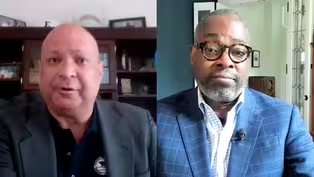
I spoke with Mark Lee, President and CEO of the Lee Group about what's driving this controversy over DEI.
So this is a topic we could talk about all the time, I feel, but I do think there's a point in stopping to note that four years ago, we thought we were in a different point in the conversation and that we would be headed in a different direction.
It does seem now, if you look around like we are at least back where we started four years ago, if not maybe back even further.
Often the backlash to progress or attempts at progress is stronger than those efforts themselves.
Is is that too dark of a read on what's going on with DEI right now?
- I don't think it's too dark of a read, Stephen, and thanks for having me again.
I think that's reality.
The reality of the situation is certainly four years ago, we know what happened, obviously the whole George Floyd situation, organizations were screaming from the top of the mountaintop, if you will, these statements, these DEI statements of commitment and saying, "We're gonna in invest the resources and people in other programs to make sure that we begin to balance the playing field."
All was certainly a good thought.
And what we did notice over that period of time was there was an enhancement and increase in investment and resources.
However, over the last four years, we're beginning to get a sense where people or organizations I should say in some cases are beginning to pull back.
They won't necessarily, some are saying it publicly, some are not saying it publicly, but what we're beginning to notice is that many DEI professionals have left that field because of the lack of resources.
Some organizations, as I just referenced, have pulled back in terms of level of support as well.
And then finally, the other piece is driving this as well, we are in a political season, let's cut to the chase, and certain sides of the aisle, I'm not gonna say which side of course are driving the argument that is DEI worth the investment, quite frankly.
- Yeah.
What are some of the things that we saw improve while there was this attention on the issue, and as you point out, some investment, I mean there was some money that got invested.
There were hires that were made to try to improve climate and representation at lots of places in corporate America.
Does corporate America look different now, at least part because in some part because of DEI?
- Yes, we have seen improvement in terms of what has improved.
We have seen overall representation in terms of all levels of the organization improve, right?
When the investment started four years ago, I believe approximately 9% of the senior level positions are of African-American or Black people/African-Americans in those leadership positions.
However, that's compared to about 13 to 14% of the total US population.
So we're still behind when it comes to trying to balance the playing field.
The senior level, that number's even lower.
So as we go throughout the levels of the organization, yes, we do see more level, we still see more diversity throughout the entire levels of the organization.
But again, at the senior levels, there's still a shortfall.
And I think that continues to be the challenge.
Another improvement that we have seen, I would suggest is we have seen an awareness of this issue.
So right after George Floyd, it was certainly top of mind through a lot of people.
It was put at the top of the list, a wordy list.
And again, that was another plus.
So I think those were a couple of the positives, but the bottom line is there's still a gap between representation across the entire population and also at certain levels across the organization.
- And so if you lose in these organizations, the people who were championing this, these DEI officers whose jobs were created and were filled with people who were just, you know, sometimes you just need somebody in the room to say, "Hey, hold on a second.
What about this?
Or what about this person?
Or have we thought about it this way?"
When you take that away, do you wipe out that progress that we've made?
Or do you just kind of stall it where it is?
I mean, are we in threat of losing the things that we did get?
Or is this just a question of maybe we've hit a a plateau again and can't go any further?
- Whenever you're not at the table, you lose the opportunity of progress.
That's really the bottom line.
And you and I have had this conversation before, when you have a diverse leadership team, you have the opportunity to increase your business revenue by 18 to 20% according to the Boston Consulting Group.
Why is that?
Because you're bringing diverse backgrounds to the table, people who understand the different experiences of the consumer base.
So if I take that away from the table, again, we're going back to a much more humble genius mindset where people don't necessarily understand how a decision might affect a particular group out there.
So I would argue that, you know, is it stalled?
Yes.
But if you take someone away from the table, yes, you in fact do lose progress.
Let's look at it this way.
We're living in a renaissance of our Detroit sports teams right now, right?
And if you look at the success of our teams or any sports team for that matter or any business, they have a diverse group of individuals who've come together for the collective cause.
And if they have a common mission, hopefully you have a level of success.
Same thing from a business perspective.
If you have a collective mission with diverse backgrounds, ideas, thoughts and ideas, I would argue they have a better opportunity of increasing your revenue.
And I think that's what businesses need to continue to confront in our challenge to focus on is having those diverse ideas in the workplace.
- Yeah.
When we think about ways to compensate for the consequences of this backlash, one of the things I think about is how we as African-Americans try to hold companies more accountable for the way they lean into diversity.
If there's a company that's not hiring African-Americans, if there are banks that don't seem to be lending to African-American businesses, it seems like we have a hard time getting their attention to tell them, "Look, it's not okay that you're not just gonna keep on doing what you're doing and keep our business."
How do we do better at that accountability?
- A couple of ways.
One is internally, many organizations have since launched employee resource groups or ERGs.
So internally, I would challenge those groups to challenge their folks internally, in other words, hold people accountable, and really there should be an internal scorecard that should be shared within the leadership members of the organization and throughout the organization.
If anyone's falling short within that space, it's critical that leadership have their feet held to the fire, right?
Externally, I would argue as well that it's important that we continue to engage different organizations.
No, I'm not talking about protesting, I'm not talking about this or that.
But again, the consumer base has an opportunity to challenge organizations as well.
And I think it's important that we engage different companies, organizations, whatever they might be, for-profit, not-for-profit, that basically says okay, you've made this commitment to the community and we're gonna push back on you and say what level of progress have you made since you made that commitment?
So internally, it's okay for an employee to challenge the different employee resource groups.
I also understand the hesitancy there because people are afraid if they raise the issue, there's a chance that they might certainly, there might be some repercussions with that.
So you gotta be cautious with that.
And then externally, organizations should hold companies accountable for the decisions in this space.
- Yeah.
Last question really.
Like I said, this issue has been around for a long time.
Sometimes there's progress, sometimes there's backsliding.
What's the, I guess rally point for moving past this backlash at this point?
I mean, it's pretty intense right now.
It won't be forever, but how do we get back to the space of at least discussing the need for the consciousness about DEI in the corporate space and getting CEOs or maybe keeping them in the space where they think, "All right, this is something that we still have to work on."
- The rallying cry is very simple.
It's good for the business, it's good for the community, it's good for your organization, no ands, ifs, or butts, and I think we need to continue to push that message out.
Don't just say we need to get rid of it because you wanna make this a conversation du jour, the issue du jour.
Whether it's on the political side, take the politics out of it.
From a business perspective, the rallying cry is very simple.
Again, one more time, it's good for the business, it's good for the organization, and it's the right thing to do, and we always have to keep that front and center.
If we ever lose that message right there, my concern is we will continue to lose the momentum that we initially had four years ago.
If we adopt that message moving forward, the momentum can be certainly rebooted and continue to make progress, it's a very important space.
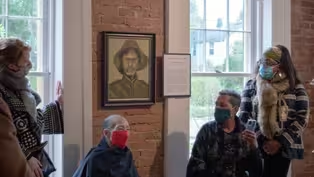
- Finally today, the African American Cultural and Historical Museum of Washtenaw County is finally going to get a permanent home.
The museum is gonna celebrate its grand opening at the Byrd Center Ann Arbor in November.
Founded 31 years ago, the museum has a collection of artifacts, photos, oral histories, documents, and other items that are donated from the African-American community.
Here's my conversation with the museum's Board Chair, Dr. Debby Mitchell Covington.
Tell me the story about this African-American History museum that is gonna open in Ann Arbor.
- Yes, so the museum started in 1993 and there was a gathering of the AKAs in Ann Arbor.
It's the Delta Psi Omega chapter of the Alpha Kappa Alpha sorority.
It was their Founder's Day in 1993.
And their guest speaker was Dr. Margaret Taylor-Burroughs, she was the keynote speaker.
And she challenged those in the audience to start an African-American museum in our community.
So she challenged those folks in the audience and they took the challenge, a few dedicated folks took on the challenge, and they started a museum right after that.
And since it started, the museum has presented over 100 programs and events and curated exhibits throughout the county.
And we've collaborated and partnered with several arts and culture institutions in the city and organizations.
We've had rich partnerships with the University of Michigan, several of the departments.
And we've also partnered with other arts organizations through Eastern Michigan University's Museum Studies Program as well.
- So give me an idea of the kinds of things that would make an African-American museum in Ann Arbor, for instance, different and special in a way that would distinguish it from the Wright Museum here in Detroit or the other African-American history museums around the country.
Tell me a little about that history in Washtenaw County.
- So the thing that makes our museum unique is that we really focus on local history.
So we have the community engaged in sharing their artifacts and things that they dig up in their basements or someone dies, and then we receive a bundle of programs from churches, church activities.
And we comb through that and piece together history.
And we started a Underground Railroad tour, and it's called The Journey to Freedom Underground Railroad Tour of Washtenaw County.
And it's officially registered with the US Parks National Underground Railroad Network to Freedom program.
And that happened in 2004.
So the tour covers 32 documented sites, buildings, and stories of three paths to freedom in Canada that run through Washtenaw County.
So because we're situated so close to Detroit, this was right along the path to the Underground Railroad.
Many people don't realize that a lot of the Black settlement in Ypsilanti in particular was people who ran away from slavery and self-emancipated and ended up in Ypsilanti.
You may be familiar with the fact that Elijah McCoy and his family lived here.
So there's rich history around that.
And the other thing that I found very interesting was, as we're talking in this age of diversity, equity, and inclusion, my high school grad, I'm a local resident, I grew up in Ann Arbor, and my high school reunion came about.
And some of my white school classmates were like, "We have been doing diversity in Ann Arbor for a long time."
They weren't aware that the Underground Railroad ran through Ann Arbor.
So those are some of the things that make it unique.
- Yeah.
So let's talk about this physical space, what that means to the museum and what people will experience.
- I love that question.
So for 28 years, we operated as a museum without walls.
And in 2021, we leased a space in Ann Arbor and we immediately began to look for a permanent home.
So we, in 2022, we purchased a 140-year-old farmhouse that was owned by Dr. David Byrd and his wife, Letitia Byrd.
And Letitia is one of the founding members of the museum.
And her desire was always that that building would be the permanent home for the museum.
So in 2022, we were able to purchase the building outright for cash.
So there's no overhead.
So that, you can imagine what that means, exactly.
And because we're a 501C3, it's a tax-exempt property.
So we are just really on great financial footing to be able to move forward.
And there's nothing like ownership.
There's nothing like ownership.
So this is a place that will be a gathering space for the community.
It will, I can envision Saturday morning chess games with young men and young women and older men and older women in the space playing chess.
And just passing on that generational wisdom.
It means that we can have all kinds of programming that we were limited by our other space.
So we have plenty of parking.
We're looking forward to the multiple types of exhibits that we will do.
Our opening exhibit is called "Holding Space for African-American History."
And we will, in each of our galleries, there will be a piece of the history of the museum and the people from the community and their lives.
So we're really excited about our November opening.
- Yeah, yeah.
So the idea of an African-American history museum in Ann Arbor is huge for African-Americans, but it seems to be that it's also important for the entire population to be able to experience and understand and learn about how important African-American presence is and has been in a place where not everybody thinks of that issue when they think about that place.
- You're absolutely correct.
And over the years, we have been able to build successful partnerships with other groups in the community.
And we have elevated Black history in the county.
So now when people think about, okay, what are we going to do in the old, what we call the old Black neighborhood, they stop and say, "Wait a minute, we can't do this without consulting the African-American Cultural and Historical Museum" because so many of the individuals that are in leadership positions now have gone on the Underground Railroad tours.
They toured our exhibits in the leased space.
And also, we offer tours and history lessons for students in the public schools.
So it definitely has impacted the larger majority.
And it's becoming more and more critical as we see the erosion of progress because of this anti-woke anti-DEI movement across the country.
So museums like ours become even more important to the African-American community, but also to the broader community.
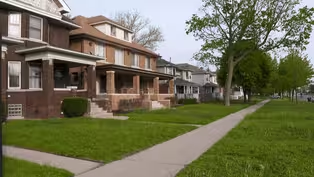
- We're getting closer to the November elections.
And one of the major issues for young adults across the country is a lack of affordable housing.
Many cannot afford to buy their first home.
Maria Witcher, a PBS NewsHour Student Reporting Labs Gwen Ifill Legacy Fellow, spoke with experts at the University of Michigan about how this issue could drive young voters to the polls.
- [Maria] The American dream of owning a home or even renting one is turning into a nightmare.
Home prices have jumped 47% since 2020.
And half of all renters nationwide are cost-burdened, meaning they spend more than 30% of their income on rent, according to the 2024 Harvard University Housing Study.
University of Michigan Associate Professor Roshanak Mehdipanah is the Director of the Housing Solutions for Health Equity Initiative.
- Housing has shifted from this idea of a basic human right to now becoming a commodity, right?
It's your investment.
It's no longer seen as this basic shelter that every human should have.
And so when you move into that investment territory, that's when things get more difficult.
- [Maria] And a 2024 Detroit Metro area community study found the cost of housing is on voters' minds.
Mara Ostfeld is the University of Michigan faculty lead of the study.
She says that about 50% of Detroiters prioritize some element of housing costs as an issue that they want the government to address.
- When people say the economy, they're talking about housing.
When people say cost of living, they're talking about housing.
Even when people talk about schools, they're talking about housing.
It's one of those things that really permeates all of the policy issues that we see creeping up as a really big concern for Detroiters and Americans throughout the country.
- [Maria] Affordable housing is one of the top concerns for young people.
- We really saw this pop out among younger Detroiters, and this is consistent with national polls that younger Detroiters and younger Americans are far more concerned about the cost of housing, especially as they're entering into that phase of their life where they're starting to pay their own rent or starting to put down payments on their own homes.
- [Maria] A 2024 Harvard Kennedy School Youth Poll found that 56% of people ages 18 to 29 nationwide say housing is more important than other issues in the United States today.
Mehdipanah says the reasons housing costs hit younger people harder are complex.
- And this can be attributed to multiple factors, including housing that is more expensive, and many more hurdles or barriers for individuals to have to cross from credit scores to having enough of a down payment and such.
And now we're at a time where interest rates are so high that it all makes it very difficult for younger folks to buy their first home.
- [Maria] Mehdipanah says solutions include expanding eviction protection programs to protect renters facing financial hardship.
And also adds that contractors are often not motivated to build affordable housing because of lower profit margins.
Government policies could change that.
- Cost of living is seen as something that's really dictated more heavily by federal policies and by local policies.
- [Maria] Addressing issues important to young voters may be especially important in a key swing state like Michigan.
- If we wanna see more young voters participate in the electoral process, then we need to pay more attention to the issues that they're saying are their top concerns.
And housing is clearly high ranked among them.
Voters are looking for candidates to say they hear the concerns of the public and that they have a plan to address that.
- [Maria] Reporting from Ann Arbor, I'm Maria Witcher, A PBS News Student Reporting Labs Gwen Ifill Legacy Fellow.
- That'll do it for us this week.
You can find more about our guests at americanblackjournal.org.
And as always, connect with us any time on social media.
Take care and we'll see you next time.
(upbeat music) - [Announcer] From Delta faucets to Behr paint, Masco Corporation is proud to deliver products that enhance the way consumers all over the world experience and enjoy their living spaces.
Masco, serving Michigan communities since 1929.
Support also provided by the Cynthia and Edsel Ford Fund for Journalism at Detroit PBS.
- [Announcer] DTE Foundation is a proud sponsor of Detroit PBS.
Among the state's largest foundations committed to Michigan-focused giving, we support organizations that are doing exceptional work in our state.
Learn more at dtefoundation.com.
- [Announcer] Also brought to you by Nissan Foundation, and viewers like you, thank you.
(bright music)
African American Cultural & Historical Museum’s new home
Video has Closed Captions
Clip: S52 Ep40 | 8m 58s | The African American Cultural and Historical Museum secures a new home in Ann Arbor. (8m 58s)
Cost of housing ranks high among young voters ahead of 2024 election
Video has Closed Captions
Clip: S52 Ep40 | 3m 54s | Affordable housing is a top concern for young voters ahead of 2024 presidential election. (3m 54s)
Large corporations scaling back DEI efforts in the wake of backlash
Video has Closed Captions
Clip: S52 Ep40 | 11m 2s | Large corporations and companies are scaling back DEI efforts in the wake of backlash. (11m 2s)
Providing Support for PBS.org
Learn Moreabout PBS online sponsorship
- News and Public Affairs

Top journalists deliver compelling original analysis of the hour's headlines.

- News and Public Affairs

FRONTLINE is investigative journalism that questions, explains and changes our world.












Support for PBS provided by:
American Black Journal is a local public television program presented by Detroit PBS