
Badger State Bounties
Season 8 Episode 8 | 26m 47sVideo has Closed Captions
Angela Fitzgerald visits the Madison Eastside Farmers Market to check out their offerings.
Farmers Markets are a staple in Wisconsin, so host Angela Fitzgerald is visiting the Eastside Farmers Market in Madison to check out their offerings and even get a taste test or two. We see what else the state has to offer by diving into a new set of stories. It’s an all-new episode for all the senses to enjoy.
Problems playing video? | Closed Captioning Feedback
Problems playing video? | Closed Captioning Feedback
Wisconsin Life is a local public television program presented by PBS Wisconsin
Funding for Wisconsin Life is provided by the Wooden Nickel Fund, Mary and Lowell Peterson, A.C.V. and Mary Elston Family, Leon Price & Lily Postel, Stanley J. Cottrill Fund, UW...
Badger State Bounties
Season 8 Episode 8 | 26m 47sVideo has Closed Captions
Farmers Markets are a staple in Wisconsin, so host Angela Fitzgerald is visiting the Eastside Farmers Market in Madison to check out their offerings and even get a taste test or two. We see what else the state has to offer by diving into a new set of stories. It’s an all-new episode for all the senses to enjoy.
Problems playing video? | Closed Captioning Feedback
How to Watch Wisconsin Life
Wisconsin Life is available to stream on pbs.org and the free PBS App, available on iPhone, Apple TV, Android TV, Android smartphones, Amazon Fire TV, Amazon Fire Tablet, Roku, Samsung Smart TV, and Vizio.
Providing Support for PBS.org
Learn Moreabout PBS online sponsorship- The following program is a PBS Wisconsin original production.
- Coming up on Wisconsin Life: we celebrate food and farming with a baker who's known as "The Pie Guy," a schoolteacher turning a barn into a classroom, [whistles] a farmer with a sustainable approach to growing, and we share stories and dishes from our "Food Traditions" project.
It's all ahead on Wisconsin Life.
- Funding for Wisconsin Life is provided by Lowell and Mary Peterson, Alliant Energy, Stanley J. Cottrill Fund, American Transmission Company, Focus Fund for Wisconsin Programs, and Friends of PBS Wisconsin.
- Hi, and welcome to Wisconsin Life.
I'm Angela Fitzgerald.
Farmers' Markets are a staple in Wisconsin and we're here at the Eastside Farmers' Market in Madison to see what this one is all about.
Located in McPike Park in the heart of Madison's isthmus, this market is held on Tuesday evenings from April through October.
With the goal of bringing fresh produce to a busy neighborhood, offerings are seasonal.
This week's harvests are plentiful with fruits, veggies, as well as other culinary delights.
It's a way for growers to connect directly with the people they serve and a way for folks to enjoy fresh foods, and it's all local-- Wisconsin, homegrown.
We'll get a chance to check out some fresh produce, meet some farmers, and maybe have a taste test or two.
Before that, let's dig into our first story.
We go to Milwaukee, where a baker known as "The Pie Guy" is creating tasty treats.
[playful jazz music] - We got free pie samples, folks.
You guys are gonna hurt my feelings if you don't try my pie.
C'mon.
Pie is very universal.
And I think it can be a bridge.
Thank you, ma'am.
I'm definitely doing my part for diversity at some markets.
[chuckling] Sometimes it's culture shock for some people, you know.
I'm black and Puerto Rican.
I'm from the city.
I'm from the hood.
Thank you so much.
Sometimes, just looking at me, people, they don't know how to take me at first.
Oh, I'd be happy to help you out.
But I'm selling pie.
I know that you're going to love me at some point 'cause I-- you're going to love this pie and I make the pie.
You're going to love me; I know this.
- Woman: Best pie on the entire planet right here.
- You become kind of safe when you bake pie.
- Don't miss your chance to get a pie before we sell out yet again.
- There's a picture of 'em.
I've got two brothers.
One is three years older.
One's three years younger.
And so, I was the middle child.
From my grandma, I learned to, how to take care of people with food.
She would cook for about 34 people every Thanksgiving.
I would hang out with her and just watch.
And then after a while, you know, you can only hang out in the kitchen so long before they, you know, "Grab this, do this, put this in there."
And then, they put you to work.
That's how I learned how to cook.
This is another one of my grandma's pots.
I got two of them.
[tap, tap] Literally, the business was built with that pot.
[click, hum] You know, that was the pot I used to even cook sweet potatoes and do whatever.
She passed, and I always felt that she's with us anyway.
But, you know, she has to know that I'm selling pie.
You know, she has to know that.
This is me back selling investments, my investment days.
I sold investments for ten years.
The prospect of helping people with their investments was attractive to me.
And the funny thing is I used to think that being an investment adviser was really rewarding.
And, uh, it is.
But it's nothing compared to somebody gets one... one forkful of pie.
You're not going to love your mutual fund.
You know, you're going to worry about it.
To get to that love, you know, where you can get there so quick with a pie or with food.
Yes, it's true.
Baking and cooking, for me, was definitely a stress reliever.
You're getting big, man.
- Think that's good?
- Ah, little more, little more.
When Johnathan was born, it's become kind of full circle.
- Johnathan Dye: That's kinda' cool.
[blender buzzes] [joking, chuckling] - I had already had thoughts of starting a pie business down the road.
I was in an Asian grocery store, and I discovered these Okinawan purple yams.
Then one day, a light bulb went off, like, "Wow, I bet I could make a pretty mean sweet potato pie."
Fortunately, I was out of work and had been out of work for quite some time.
I got to the point where I wasn't going to ask anybody else for a job.
I just needed to figure out what was next.
And we went and got a couple dozen eggs and got started.
[whistling melody] I knew what I could do, you know.
I knew I could make the pies.
I knew I could sell the pies.
- Woman: The pecan has something in it.
I'm trying to figure out what the taste is.
- Man: Well, is it good?
- Mr. Dye: We put love in it.
[man chuckles] - Woman: It's good.
- Man: Man,... delicious.
- Thank you, sir.
It kind of grew organically and slowly in the beginning.
- Thank you so much.
- All right, sir.
- Thanks a lot.
- Nice meeting you.
- A good day would be, I get up and bake a few pies, and I'd sell them.
And, you know, I'd pick Johnathan up from school, and, you know, we would make dinner.
And, you know, I make enough money to make dinner.
Felt better than most of the days that I had selling investments, you know.
Something about working for yourself.
If there was criticism... what would it be?
- It's too tasty.
- "It's too tasty."
That's not criticism.
- Yes, it is.
- We got free pie samples, guys, c'mon.
Then, the farmers' markets came along.
Best pies anywhere.
The first time somebody called me "The Pie Guy," I wasn't ready for it.
And they yelled across the street, "Hey, Pie Guy!"
I'm like, "What?
Who?"
I'm thinking, "Nooooooo..." And then, pretty early, pretty quickly, I got-- I love it now.
It's awesome, you know, to be recognized for something that you do.
When someone genuinely takes a bite, and they're like shocked that it's that good, that's, you know, that's the best praise you can get.
You know, a pie can remind you of your grandma.
It can bring you a warm feeling back, and that is very necessary.
It's not a necessity, but it's close.
[background conversation] - We're now off to Medford, where a schoolteacher is getting students away from their desks and onto the farm.
[strumming acoustic guitar] - Main Street in Medford looks like many rural communities... home to the Taylor County Courthouse... and is surrounded by farm country.
- Lisa Kopp: Medford is fairly rural.
- So, maybe it's not surprising when you walk into Lisa Kopp's high school class that you find this.
[chirping] - If you have a chick right now, can you perch it on your finger?
You can see how they have the desirable instinct to just want to perch.
I did not grow up on a farm.
Ever since I was little, I had a really big passion for animals.
Chicks are flock animals, right?
- It's a passion Lisa passes on to her students, and most of them didn't grow up on a farm either.
- I'll have a class of about 25 to 30.
Only about 2 to 3 kids are still on that production farm.
So youth, even in this rural community, are almost two generations removed from that farm.
- Putting these kids back on the farm... is just steps away from their traditional classroom.
- All right, hey, you guys, let's go to the barn.
- It's a really fun thing to be able to come to school and know that, "Hey, you're going to the barn today."
♪ ♪ - This is the Medford High School barn.
- They're expected to be over here when class starts and they get back to the building when their next class starts.
- We have chickens, a calf, pig, sheep, rabbit, and one cat.
[scratch] They're very comfortable with us.
Hi!
- There you go.
Loosen it and get it over two ears.
- Lisa saw the problem... - If we expect farmers to continue in this next generation, we need to teach them.
Good job!
- And the solution.
- Good girl.
- We need to show them what tasks, literally, need to be done to be that farmer.
This is our bull calf we have here at school.
It's more engaging for students to learn if you actually have the animal.
And this barn is engaging.
[bull calf whuffs] - You can put some more feed into here.
Good job, girls [chicken "Tuk-tuk-kah"] They have to collect eggs every day.
Chickens, they lay eggs about every two days.
And we need to go collect those.
We sell those at school.
They get a grade for doing chores.
That's part of their class expectations: that they wear rubber boots, and they get in there and use a pitchfork, and they feed them, they water them, and they move them around, they lead them.
Walk him down the road, stretch his legs a little bit.
- It's a lesson most of these students won't get at home... or anywhere else.
- Lisa Kopp: This project is extremely unique.
There are not a lot of schools that have a farm.
So, the farm itself is run by high schoolers.
It's owned by the district.
- As the number of Wisconsin farms continues to dwindle... Lisa sees this hands-on classroom becoming all the more important.
- And just get used to that being on her head.
Yep, so if you want to put it on her feet.
- We consume vegetables, we consume meat, and do you know where your meat is coming from?
- We need to show the students that "Hey, some of these tasks-- raising sheep, raising pork, raising beef cattle-- you can do on a small scale at home."
This is Marvin.
He's a red and white Holstein.
And he is growing really well.
There are so many life lessons that can be learned on a farm setting.
And I'm trying to replicate that farm setting here, in this school farm.
- If one barn is good, two barns must be better.
- We're building a new barn where my classroom will be next year.
So, we're going to have to already expand the barn that we just finished building because of the student numbers going up and the demand for another Ag teacher.
Can you see how, over time, the lamb, it's kind of getting it?
It learns to not fight it, is relaxing a little bit more.
- Lisa sees it as securing the future for farming and the community that rallied around her dream.
- Oh, my gosh.
The Medford community has been so helpful.
And they do see the need for this education because a lot of the youth are not on the farm.
They're not thinking of these career paths and their future.
- I actually donated six pigs to this project because I feel strongly about it.
I'm really happy that she made it happen.
She's such a huge role model.
- It is for our next generation.
And if we don't show them how to do these things, they're not going to do it.
- Alright, that'll be $4.
- Here you go.
- Thank you.
- Thank you.
- I'm here at the Eastside Farmers' Market, checking out all the tasty treats and even meeting a few of the growers.
Fresh foods, homemade products, and tasty cheeses.
Local farmers' markets are great places to explore and that's just what I've come to do at the Madison Eastside Farmers' Market.
One of my first stops is to meet Farmer John to sample a Wisconsin favorite, cheese curds.
- Hello.
- Oh, hi there.
- How are you?
- Really gouda, how are you?
[Angela laughs] - It occurred to me that's a bad pun.
Sorry, I still use it, though.
- I'm super interested in one of your flavors.
Which one do you recommend?
- I recommend-- garlic is the largest selling flavor.
I personally like the dill ones myself.
- Hmm.
- And do you know what the cheese curds are?
- Um, I've-- not really.
Let me not pretend.
So, please tell me more about it.
- Cheese curds are the first step in making cheese.
So, this was milk this morning from my dairy farm.
- Okay.
- We've been doing this for four generations.
My father was the first John, and then, I'm John, the third.
This is Farmer Johnna over here.
Have to try one of my garlic cheese curds there.
- Okay.
- It's garlic and basil.
We made it fresh this morning.
- Oh.
- So, fresh cheese curds should come with curds and whey.
Here's a little bit of the whey left there.
- Is that, like, the milk left over?
- Yes, it's the leftover milk.
It's got that garlic and basil flavor, and it's still get that freshness of the curd.
- I love the extra flavor boost.
Thank you.
- Yeah, you're welcome.
- Thank you very much, yes, yeah.
Thanks for shopping at Farmer Johns'.
- Thank you.
Nice meeting you, Farmer Johnna.
[laughing] With my cheese craving satisfied, it's time to see what else the market has to offer and even meet a few new friends.
- Here's some flowers.
- Oh, thank you.
Oh, thank you!
Thank you so much.
[laughing] - Hello.
- Emily Ruzicka: Hi, how are you today?
- Good, how are you?
- I'm good, thanks.
Have you ever had Dashelito's hot sauce?
- I have not, and I'm a big hot sauce fan.
- Alright!
- So, what do you suggest?
I see loads of options.
- Sure, yep, so all of our hot sauces are laid out here.
We have eight varietals.
They're all made locally here in Madison.
- Okay.
- These are your little taster bottles.
- I think I want to try the red honey so it's this one?
- Yep, you got it.
That's one of my favorites It's really good on pizza.
- Ooh!
- And I mean, right, like... - And I squirted more than the milder ones, so I'm chancing it.
- If you like hot sauce, you'll be-- I mean, they're not-- Again, they're not made to, like, blow you up, you know.
They're made to make you feel a little better.
- Actually, good.
- Good, I'm glad.
I really like that.
Thank you so much.
- Hello.
- Hello.
- How are you?
- Good.
- Markets like these are a great way to support local agriculture.
Let's meet someone else supporting their community.
We meet a farmer in Viola who hopes to usher in a new era of restoration agriculture.
♪ ♪ - Within ten days, we'll be picking every single day for about six weeks.
- As a farmer, Mark Shepard appears hard to pin down.
- We have four different spots where springs have started again.
- He's obviously not growing acres of corn and soybeans, and while he grows asparagus, he only has a few rows.
- We started out 20 years ago with what's called "alley cropping," where you grow a row of trees between your fields.
- He grows hazelnuts and chestnuts, so you could call him a nut farmer, but that's only part of the story.
[nuts clinking together] He's also growing apples, pears, berries, mushrooms, and a dozen other crops.
[high-pitched whistle] - Hi, piggers.
Come on, guys!
I'm passionate about the woods and trees and plants and animals and all that.
How you doing, piggers?
- Mark Shepard sees himself as a farmer for a new era of restoration agriculture.
- Why should we work and spend money and inputs and resources trying to keep something alive that wants to die?
And why are we trying to kill the stuff that wants to live?
Why don't we figure out how to farm the stuff that wants to live and keep improving that system as it goes along?
Wow, that's good.
- New Forest Farm near Viola is living proof of Mark's hypothesis that you don't need big tractors and chemicals to grow enough food to feed the world.
- How do we get those same staple foods for the human race while not destroying ecosystems but actually restoring ecosystems?
♪ ♪ - Mark and his wife came here in 1995 from Alaska.
- Mark Shepard: It was a farmed-out rocky, barren landscape.
- Mark's idea was to find species that flourished without help yet still produced a harvest.
He planted apple trees, chestnut trees, and hazelnuts.
Then he left them alone.
- My maintenance technique-- I call it STUN, Sheer Total Utter Neglect.
- He selected for the heartiest and most abundant trees, and he planted organic produce in between.
- When we got started here, most grocery stores didn't even have an organic section for produce.
- What's remarkable is that Mark can grow anything of quality on this land at all.
The slopes were highly eroded, and the clay soils that remained couldn't hold much water.
Mark adopted a simple philosophy on water.
- If the rain falls on this farm, it belongs on this farm.
- Every alley has a ditch or swale next to the trees to hold water.
[raindrops hitting water] Overflow rain goes to what's called a "pocket pond."
- Actually, like, the key to the whole entire farm, believe it or not.
- If the pond fills up, water flows out to the ridges through another swale.
- Just two weeks ago, we got a 3 1/2-inch rainfall.
The neighbor's 60 acres of rain just came roaring down our valley, and in about an hour and a half, it was gone.
- Mark's rain never left his farm.
- This system is designed to capture the big thunderstorms.
- All the trees and water have an extra benefit.
Native birds, frogs, and insects have returned and provide pest control and a little beauty.
- That's sometimes my best paycheck.
I really, really like the natural world.
And to hear all these birds singing in the morning.
To hear the frogs singing in the ponds.
- Acre for acre, Mark's version of multi-crop or polyculture farming doesn't produce as many calories as a cornfield.
But he says the equation is skewed.
- What are the true costs of running a system like that?
You look at the corn across the street without the big tractors, the big equipment, the fossil fuels used to run it, the chemicals for herbicides and fertilizers and all that.
The system doesn't work.
- Mark has one tractor and can run his farm without it if needed.
A windmill provides the power for his processing shed.
[wind turbine blades hum] - We don't have to use fossil fuels if we don't want to.
- Mark doesn't say other farmers need to eliminate corn, but adding trees can reduce erosion, provide habitat and add a crop.
- So you still get your corn and your beans and then you'll get extra because we're going up into the third dimension with our perennial plants.
- It works even better for pasture-fed cattle.
- With slightly shaded pastures, the grass actually grows faster, grows longer, and the cattle actually graze longer because they're more comfortable.
- Now Mark is exporting his idea across the world.
- We can restore natural ecosystems all across the planet while paying our bills as profitable ventures.
So I think what's surprised me is how popular it has become.
- Mark says farmers are naturally resistant to change, but he thinks his farm proves the system can work.
- Look at the economic development we can do simultaneous with environmental benefits.
Come on, people, let's wake up!
Look at the opportunity in front of us.
It's really quite simple.
And we'll put another pond down there, and then we'll send it back in through our hazelnuts.
♪ ♪ - Now, we're sharing stories from our "Food Traditions" series exploring food and culture in Wisconsin with a chef from the Ho-Chunk Nation working to honor indigenous foodways.
[speaking Ho-Chunk] - Hainipi (Good morning), Hocak raasra Hahemaaniwinga (my Hocak name is Walks in the Dark [night]) hingaire egi maixete raasra Elena Terry.
(and my English name is Elena Terry.)
I'm a member of the Ho-Chunk Nation.
I think, as a chef, it's my responsibility to kind of be the last voice of these ingredients and to showcase them in a way that they'll be appreciated and highlight their natural flavors.
Also, to have good feelings when you're in the kitchen because all of that gets transferred into the food and to treat your ingredients with the highest amount of respect and care because they gave their life to nourish you.
Ooh, looks perfect!
Especially when you're cooking, you have all of your senses stimulated, and you're creating memories as you go.
So, you know the smell, you know the texture and the feel and what you want it to feel like.
Beautiful!
So, the name of the dish we'll be making today is 'SassSquash.'
[laughs] And although it isn't a traditional dish, it incorporates a lot of the ingredients that are from Wisconsin.
And my favorite ingredient, which is squash, I think is really underutilized, and so, it's a good way to showcase what the flavor development of that can be.
I blend the squash and the maple for sweetness, and then nuts.
[food processor whirs] And then, we're just going to spread it out.
And I like adding a cranberry sauce because it gives it a little bit of a sour, and it's not completely sweet note, and it compliments it perfectly.
Yeah, see, they're starting to pop open.
That's what I want.
And it really is, when we use our ingredients, it gives you a connection to your ancestors and makes you realize the responsibility you have as a steward of the land and caring for it and just making sure that these ingredients are going to be there for the next generation, as well.
I like to think that I came from warriors, [traditional singing] I came from resilience and strength and endurance, and, you know, being able to make something of nothing and being able to get your family back to the lands that they came from.
I feel the strength of generations telling me that, "You can do it," you know?
Every time I try this, it's like the first time that I've tried it, and it always surprises me.
It's delicious.
[traditional Native American singing] ♪ ♪ - Our last story from our "Food Tradition" series takes us back to Milwaukee with an aspiring chef welcoming us into his kitchen to share dishes he lovingly describes as "grandmother's food."
♪ ♪ [silverware and dishes clanging] [chopping] - Food every day, you have to eat every day.
[sizzling, children talking] Everyone eat food, yes, everyone eat food.
I miss the food, I was young.
[food sizzling] [rolling, flattening dough] Grandmother food.
We are always taste grandmother food.
I keep trying to cook to get better and better, yeah.
When I cooking my family around with me.
They look at, "What dishes, Daddy?
What dishes you are cooking?"
So, I told them that this is...
This is from the Myanmar food, yeah, Myanmar dishes, yeah.
When I cook the food, my son also like it.
Then, my son bigger, he will be remember, "This is my daddy.
Always cooked for us, yeah."
So, we like to share with like family, friends.
Any community, friend or yeah.
We can enjoy together.
♪ ♪ - I've got my veggies so it's time to wrap up my trip here at the Eastside Farmers' Market.
Learn more about the people and places you've seen today at Wisconsin Life dot org.
Send me your favorite farmers' market recipes or other stories we can share by emailing stories at Wisconsin Life dot org.
While there, check out the Wisconsin Life "Food Traditions" project featuring cooks from around the state, cooking with us, and even sharing recipes.
I'm Angela Fitzgerald, and this is our Wisconsin Life .
Bye!
♪ ♪ - Funding for Wisconsin Life is provided by Lowell and Mary Peterson, Alliant Energy, Stanley J. Cottrill Fund, American Transmission Company, Focus Fund for Wisconsin Programs, and Friends of PBS Wisconsin.
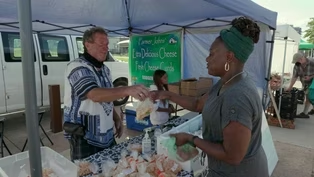
Angela Fitzgerald visits Madison Eastside Farmers Market
Clip: S8 Ep8 | 2m 42s | Angela Fitzgerald visits the Madison Eastside Farmers Market to check out their offerings. (2m 42s)
Providing Support for PBS.org
Learn Moreabout PBS online sponsorship













Support for PBS provided by:
Wisconsin Life is a local public television program presented by PBS Wisconsin
Funding for Wisconsin Life is provided by the Wooden Nickel Fund, Mary and Lowell Peterson, A.C.V. and Mary Elston Family, Leon Price & Lily Postel, Stanley J. Cottrill Fund, UW...