
Ballet, A Surf Dog, & Newts on the Loose (Episode 801)
Season 8 Episode 1 | 26m 32sVideo has Closed Captions
An electic mix of stories about ballet, a runaway dog, and newts in a wetland.
Welcome to the first episode of Season 8! We explore how the Tallahassee Ballet lifted itself out of the pandemic to invite everyone to the party. Plus, we meet a canine on the run named Surf Dog (who doesn't even surf) but who did run right into the hearts of an entire community. And the newest generation of kids takes over a WFSU EcoAdventure as striped newts are released into the wild.
Problems playing video? | Closed Captioning Feedback
Problems playing video? | Closed Captioning Feedback
Local Routes is a local public television program presented by WFSU
Ballet, A Surf Dog, & Newts on the Loose (Episode 801)
Season 8 Episode 1 | 26m 32sVideo has Closed Captions
Welcome to the first episode of Season 8! We explore how the Tallahassee Ballet lifted itself out of the pandemic to invite everyone to the party. Plus, we meet a canine on the run named Surf Dog (who doesn't even surf) but who did run right into the hearts of an entire community. And the newest generation of kids takes over a WFSU EcoAdventure as striped newts are released into the wild.
Problems playing video? | Closed Captioning Feedback
How to Watch Local Routes
Local Routes is available to stream on pbs.org and the free PBS App, available on iPhone, Apple TV, Android TV, Android smartphones, Amazon Fire TV, Amazon Fire Tablet, Roku, Samsung Smart TV, and Vizio.
Providing Support for PBS.org
Learn Moreabout PBS online sponsorshipThe Gulf winds blow through canopy roads all the way to Thomasville.
The native names written on the land echoed through the red clay hills, where the scent of long leaf Florida pine reach upon c ross that Georgia Line.
Stroll through Tallahassee town or southern Appalachee bound, bound take the local roots and journey down the we call the home.
Take a local roots and journey down the roads we called our home.
Welcome to Local Routes.
I'm Suzanne Smith with WFIU Public Media.
And today I'm outside of the Opperman Music Hall on Florida State University's campus, where the Tallahassee Ballet recently kicked off their 50th season with an evening of music and dance performing the sounds of Brazil.
Now, this 50th anniversary season is a big deal for the ballet in more ways than one.
Just a few short years ago, when the pandemic shut down public performances, there was no guarantee that the ballet would reach this milestone, thanks in part to a grant from PBS for the Arts WFSU’s Rheannah Wynter was able to look at the resiliency of the ballet and how they created something that invited everyone to the party.
And to keep going forward.
The Tallahassee Ballet is a pre-professional Company.
Their goal is to become professional dancers.
<MUSIC> My role as the artistic director is the vision.
If I'm planning a program, I'm thinking, what's the outcome?
What is the outcome going to be not just up there dancing and whatever, but is there a message or not?
This is a very small community.
This is not a big dance town persay... like New York City, Atlanta, Georgia or Houston Ballet.
So this is a smallish community, the challenge is, is getting people to buy into what you're doing.
And how does it impact them.
[MUSIC] Invitation to the party was the very first time that I've done something that was so diverse, where you had gospel.
You had opera.
You had are R and B. and you had latin.
The title Invitation to the Party was the title of the book by the author Donna Walker-Kuhne.
I've always been intrigued by the title, and it's about bringing together partnerships, diversity and collaborations.
And I always wondered, how can I make this work, this onstage?
Doing a diverse program for any community is important because it's because it engages everyone is when you don't do anything that has ay type of diversity is what you continue to separate, and that's what we don’t want to do.
So when you see the word diversity, people say, Oh, it makes you go okay.
But a lot of people say, But they don't do it.
I'm doing it.
The whole idea was to have a good feel performance.
And even more so now to sit on the climate in which we live.
Because right now the world is very dark.
My concern about the future of organization during the pandemic is that we were no longer going to have dancers.
My concern was how the doors are going to open next year.
How long is this going to last?
How are we going to maintain what we had?
Are we going to be able to come back from this?
I always look at the company as being my children.
It was important that we still maintain that level of family and that I can continue to communicate with them.
And there were moments where I knew there were way for me to say something Where were you going to go back when it's going to be over?
And sadly, I cannot answer those questions.
It's easy to say, I'm done and be out the door, but you can't.
If if you're passionate, if you love something.
There was no way I could just walk out the door, you know?
No way.
[music] Bringing people together under one umbrella is important.
It is even more so a need and a desire after the pandemic, it takes you to a whole different place, just for a moment.
Even more so now.
It wasn't what people expected.
They didn't expect the curtain opening.
You got a gospel choir singing.
And this is why we go to the theatre.
To be engaged, not entertain you can be entertain turning on the tv.
If you're engaged with something, you become a part of that, part of your spirit.
So you want to stand up, you want to clap, you want to feel good.
You want to tap your foot.
So when I saw that people start standing up in the very first beginning of the performance, all I could think was mission accomplished.
Tyrone Brooks, you did it.
That was my goal, is to bring people off their chairs to a happy place.
[music] This has been a popular project for us and the Tallahassee Ballet since its release online earlier this summer.
More than 54,000 people have laid eyes on this project.
You can share it yourself.
Just head to WFSU.org slash Local Routes.
While you're there, also sign up for our Community Calendar newsletter to stay on top of the many other art performances happening here in our community.
The Tallahassee Ballet's next performance will be in December at Ruby Diamond Concert Hall right behind me.
They're going to be performing the annual holiday favorite, The Nutcracker.
Go to their website for more details.
Just about a year ago, the Tallahassee Symphony Orchestra and WFSU Public Media came together to start work on a pandemic project of our own.
We even recorded some of it right behind us here at Ruby Dimond Concert Hall.
It all began with the TSO receiving a grant from the National Endowment for the Arts to create a video project that showed children how the individual instruments worked and how they come together to create a full performance.
It took a year, but in the end it became the TSO Symphonic Safari Adventure.
Hello.
I'm Violetta Vibratto but you can call me Vi.
Hi, I'm Roger.
Roger Rhythm.
Join us on the TSO Symphonic Safari Adventure.
Let's go.
[MUSIC] We are going to meet the members of a brass quintet.
Would you?
Could you play a piece for us?
We would love to hear it.
[MUSIC] Now we're going to meet a cellist.
A saxophonist.
A trumpet Player.
A horn player.
And so my mouthpiece actually comes a part.
[BUZZING SOUND] The vibration of the double reed produces the sound.
Wow.
[HIGH PITCHED SOUND] [TOOT] Woo!
[LAUGHTER] [VIOLIN TRILLING] It's a cool story because the trombone chose me.
[DRUMMING] [SAXOPHONE TRILLING] [STRINGS PLAYING] Probably the most fun I had traveling with the bass was to play in an orchestra at the Super Bowl.
What is the furthest place which you've ever traveled?
Furthest I've been is China.
Oh, that's exciting.
That's like on the other side.
Yes.
of the world.
Oh, what does a conductor do?
On one level, the conductor helps keep the orchestra together, but that's just the beginning of our job.
[MUSIC] That was pretty awesome!
There are 22 videos in this project ranging from about 10 minutes each to just under 20 minutes for the full 1812 performance.
Learn more at TSO Safari dot org.
Our next story is about the adventures of a road wandering pooch originally known as Surf Dog.
Don't let the name fool you.
This dog did not surf, but he did run and as WFSU’s Mike Plummer will tell us he ran straight into the hearts of an entire community.
He is scared of thunder and he's scared of fireworks.
And that's what initiated him to start running on the road.
This is the dog-gondest gone dog story I've ever heard.
It's about a dog who didn't like thunder and a whole community who fell in love with him.
Back in 2017, when this story kind of unfolded, I had been volunteering at the shelter for several years before that, and when Surf started running on the road, I was kind of recruited because he used to have places in Crawfordsville that he would hang out.
And that's where I lived too.
When a storm would come or there would be fireworks that the telephones would just light up with people calling in about blonde dog that was walking on the side of the road and they were worried about him getting hit.
He was just a stray yellow dog who would hang around Surf Road in Ochlocknee, Florida.
But when thunderstorms would erupt, he would start running the white line along highways 98 and 319.
Sometimes for days at a time.
Flash forward to maybe a year, a year later or so.
And then I found out that he was in had landed over here in this area by Surf Road.
I could drive up alongside of him or get out and he would come by me, but he wouldn't even slow down.
It didn't matter what you had for him to eat or anything.
He was going to keep moving when the weather was bad.
A Facebook page was put together so people could report his sightings and track his movements.
And he was smart, thwarting all attempts of capture.
The locals called him Surf Dog.
Everybody was concerned for him and everyone tried to catch him, which just was not possible.
You know, you could get up close to him or you could try and intercept him, you know, with a hot dog or a steak or whatever.
And he just had his head down and in a trot going down that white line, going away from what was frightening him.
And when a dog is running scared, they won't, you know, they just they have like blinders on.
They just keep going.
And that's what he did.
And when the thunder ended or wherever he got, you know, going to turn around, come back.
It just dawned on me that feeding him occasionally, wasn't gettin' it cause I don't want to eat occasionally.
I want to eat regular.
So then I started feeding him daily.
Then it just went from there.
Surf Dog had made a friend.
Bill Russell would see that he had food to eat.
Their meeting place was the water tower on Surf Road.
Well, I would pull up in the morning.
When I came by the bushes over there, I would start looking for him and a lot of mornings he would come running and and come right here and I always parked here because his food bowl and his water bowl and his little shelter that he never used were all right there.
And I would have... not often was it regular straight dog food?
Always.
We always cooked up the chicken and dumplings, chicken and rice leftovers.
He ate a lot of scraps.
But anyway, I would get meat treats and put them on the tailgate here and the boy would stand there with his feet on the tailgate and eat his treats.
And then we'd go over and he'd eat his food and drink.
Bill started calling him Buddy and Bill would write about their meetings and conversations on Surf's Facebook page, Buddy didn't really talk, but Bill could still hear.
And I would sit on the bench drinking my coffee and sometime he would come over, and I'd tear his honey bun.
He had a honey bun, at least one honey bun every day.
And I would tear his honey but in pieces I'd put a piece on my shoe or right beside me or right by my coffee cup and he would come and eat all the honey bun.
He loved honey bun.
Surf Dog, a.k.a.
Buddy had become a local celebrity.
He had over 4000 Facebook friends.
And then the doggondest darn thing happened.
Coming up the road in front of the house I saw I thought it was a little deer running down our fence line.
And I said, Well, there goes a deer.
She said, that ain't a deer, that's surf dog.
And I just said, Why don't you all catch that dog?
And she said, We can't catch him So when I went by him I rolled my window down and said, Come on, boy, come on, come on, come on.
And I rolled my window back up and up the drive we came.
I never paid any more attention to look up in the mirror.
And here he came.
Well, then he came through a fence and got into our pasture and went running down the pasture and he came back and it could get through the gate was open.
He came in, this door was open.
He came in and our back door because we just had them open and in the house he went and then we just kind of looked at each other and said, Now what?
He was limping.
He hadn't eaten.
You know, he just he was in bad shape and we were worried about him.
So we just let him chill, you know, and gave him some meds that would make him feel better and provided him with some food and let him feel safe.
And it was nice to see him safe.
That's right.
Surf Dog, a.k.a.
Buddy was a Gone Dog no more.
He had surrendered his rambling ways for five acres, two more dogs, a miniature horse and a donkey.
Everybody was so concerned about him since he'd been running that time for probably a week or two, just one storm after another.
So he was totally spent.
A social media uproar ensued between the Free Surf Dog faction and the Give Buddy A Home faction.
The controversy was heated but short lived.
The highway is really no place for a dog, They say every dog has his day, but Surf Dog was about to have a whole calendar full of them.
His celebrity was literally sky high.
His name was emblazoned on the Ochlocknee water tower.
He was asked to be the grand marshal of the Panacea Christmas Parade.
Riding in the middle of the road, a dramatized Surf Dude history of his life was penned.
He was voted Tallahassee's top pet, raising over $69,000 for the Be The Solution Spay Neuter Clinic and landing on the cover of Tallahassee magazine.
He even appeared on local entertainment television.
From the beautiful 850 it's live in Tallahassee, North Florida, at its best.
Watch your friends and neighbors on TV.
Oh, to dream of such rarefied air.
Surf, a.k.a.
Buddy was one hot dog.
It actually is a big responsibility, you know, because you've got all these people watching to make sure that you're doing what you're supposed to.
And God forbid, something should happen on our watch to Surf Dog.
I think it's just absolutely great to see that he can come from nothing...an escapee and become one of the more he isn't like Lassie, but he's pretty close.
Surf Dog had gone from homeless road dog to Ochlocknee's favorite son.
And I think that's the dog- gondest, gone dog story I've ever heard.
For WFSU Public Media, I'm Mike Plummer.
Now for a story about a different kind of four legged creature and some two legged creatures as well.
WFSU ecology producer Rob Diaz de Vegas produced this story about a striped Newt release, but he wasn't in charge here.
A trio of kids were.
It was his favorite of venture buddies, Max and Xavi-- his sons-- as well as Max's best friend Olivia.
Here's what happened.
Everybody look at Sharon.
Sharon, this is Lisa.
Lisa, meet Sharon.
Hi.
Rose Axolotl.
And this is your co-host.
Olivia.
And we are here for just.
Releasing some news that was so exciting, wasn't it?
And our co co-host, hubby.
Minnie Mouse beat about to be released by our.
I love.
That.
Oh, I see you.
I see you.
Hmm.
We are releasing stripes in the mountains Sandhills.
In the Apalachicola National Forest, just south of Tallahassee.
We're here to help these news in.
This straight news.
I think that orange was really cool.
Orange.
All the way an ephemeral wetland is a wetland where the water rises and falls depending on the water table.
How are the Newts affected by the most recent drought?
Hmm.
Well, drought certainly affects Newt.
There will be less opportunities for them to breed because there's just less water.
And of course, newts being amphibians, the We're going to go get some videos of the habitat.
So if you don't have a diverse aquatic plant assemblage that's carpeting the bottom of given recipient wetland, you're not going to have much success releasing amphibians in there because they're just going to get consumed by predators.
They won't have anywhere to hide from predators or deposit their eggs.
Important thing that it's not a closed canopy here like it is out there.
We got plenty of sunlight coming through to power.
The aquatic plant diversity here.
It'll take forever to do that.
So they're adding water from the new pond that the roots are going to be put in to so that they can get familiar with it and then dumping out the water from the other pond that they came from.
Yeah, it's a nice idea.
And the zoo.
And they are creating water chemistry that is closer to our pond water.
So we will send them pond water informatio And then as we get closer to release time, they'll start reducing their age or increasing their temperature, whatever they need to do to make it closer so that this acclimation process doesn't take three days, that could be a lot faster by that up and just release them in some vegetation, shallow vegetation, and just kind of gently release them.
You can take pictures while you're doing it.
You can sit in the water and do it.
Okay.
Welcome to the butterfly.
Goodbye, little.
Guy, for.
Us.
And he was a cute little gecko.
And now he's out in the wild and he's going to.
We have.
To buy by.
The squirmy.
So they crawl around on their try and drop out of your hand.
They're really fast and they don't weigh t to feel more than.
One I name you.
So I like how this one and they are.
Oh, no.
And they all wiggling around.
It's amazing.
It's like they're dancing.
Oh, this guy has, like, the weird gills.
He's.
Why did some have gills and some non.
Why does that matter?
Well, you know what?
The ones that don't have gills are typically a little bit older than the ones that do have gills.
The good ones are are called larvae.
And they're that's like the word for juvenile in this case just right now.
And over time, they tend to lose their gills as they grow older and older and they become air breathers.
So that was a fun day with the Striped Newts.
That was amazing.
And they were so cute and tiny.
Absolutely.
Hmm.
But it's not over yet.
We have found.
A blue sea.
Hmm.
Stay away from my blueberries.
They're going.
To my secretary.
For w. I've as you.
I'm axolotl.
I'm Olivia, and I'm familiar.
Sounds be sure to check out the WSC, because you.
Are definitely not.
For the last year, WFSUPublic Media has been working together to create a special series of reports on race in our community.
It's called Not so Black and White.
It focuses on the divided history of our community and how it impacts us all today.
We begin with a Limited Series podcast.
Here's a preview.
On this side of the tracks where we're standing right now was the black side of town over downtown and up on the north side.
That was the white side.
So the train tracks were a physical barrier that separated black from white and white from black.
New podcast episodes of Not so Black and White are dropping each week for the next several weeks.
You can listen to the first episodes through WFSU dot org or through your favorite podcast app.
Later this month, we'll be holding a special discussion and screening of the video portion of this project.
Go to WFSU dot org for more details.
Here's what we're working on for next week's episode of Local Routes.
This is the largest number of snakes that we've released since we started the reintroduction out here at the bluffs and Ravines Preserve.
Tom Sawickys lab discovered a new species of crustacean found in Lake Jackson.
And nowhere else.
I released it!
That's it for this episode of Local Routes.
I'm Suzanne Smith.
You can see these stories and more on our website, WFSU.org/localroutes.
And while you're online, follow us on Facebook and Instagram.
Plus, don't forget to sign up for our Community Calendar newsletter delivered weekly to your email.
It is a great way to stay on top of events happening in person and in the virtual world for everyone at WFIU Public Media.
Thanks for watching.
Have a great week, everyone.
Magnolia Trees greet the southern breeze in the land where the rivers wind.
Seeds that spring up from the past leave us treasures yet to find.
Where our children play along the land our fathers built with honest hands.
Take a moment now, look around at the paradise we have found.
Take the local routes and journey down the roads we call our home.
[MUSIC]
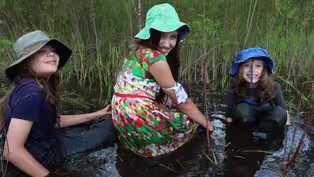
Kids Release Striped Newts and Host a Video About It
Video has Closed Captions
Clip: S8 Ep1 | 5m 15s | Two 11-year-olds and one 8 Year old go on an EcoAdventure to release newts (5m 15s)
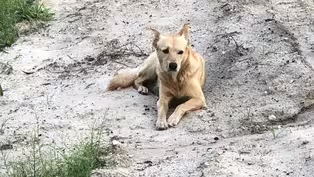
Video has Closed Captions
Clip: S8 Ep1 | 7m 18s | The rags to riches story of a stray yellow dog. Surf Dog, AKA, Buddy has found a home. (7m 18s)
Providing Support for PBS.org
Learn Moreabout PBS online sponsorship













Support for PBS provided by:
Local Routes is a local public television program presented by WFSU