
Bangkok, Thailand: The Big House...of Blessing
Season 1 Episode 105 | 27m 25sVideo has Closed Captions
The Good Road visits the 2nd largest maximum-security prison in Thailand.
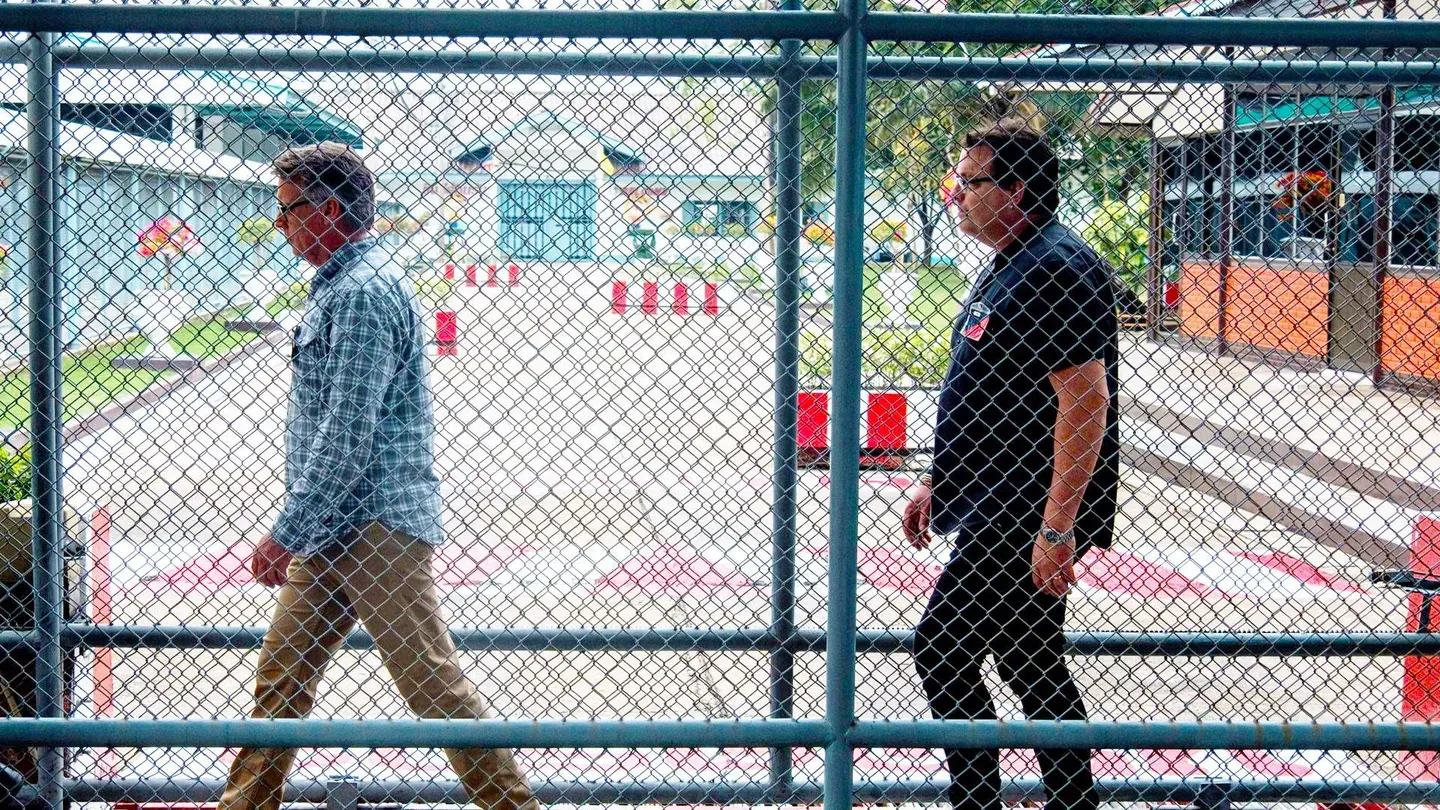
The Good Road returns to Bangkok and ends up in the 2nd largest maximum-security prison in all of Thailand, luckily by invitation. They receive a rare tour of the grounds as well as the cells before speaking to a Thai prisoner about what daily life is like in a Thai prison. Afterward, they discover a unique approach to vocational training and pre-release development at the prison.
Problems playing video? | Closed Captioning Feedback
Problems playing video? | Closed Captioning Feedback
The Good Road is presented by your local public television station.
Distributed nationally by American Public Television
Bangkok, Thailand: The Big House...of Blessing
Season 1 Episode 105 | 27m 25sVideo has Closed Captions
The Good Road returns to Bangkok and ends up in the 2nd largest maximum-security prison in all of Thailand, luckily by invitation. They receive a rare tour of the grounds as well as the cells before speaking to a Thai prisoner about what daily life is like in a Thai prison. Afterward, they discover a unique approach to vocational training and pre-release development at the prison.
Problems playing video? | Closed Captioning Feedback
Where to Watch The Good Road
The Good Road is available to stream on pbs.org and the PBS app.
Providing Support for PBS.org
Learn Moreabout PBS online sponsorshipFunding for The Good Road has been provided by-- There's a lot of good happening all over the globe And to see it all Toyota offers vehicles designed for both for everyday drives and rugged roads, off the beaten path Like the Toyota Tundra, Tacoma and the body on frame Forerunner These offroad machines feature available technology For added traction, performance and capability So no matter where your globetrotting takes you Off-road doesn't mean off limits Proud sponsor of The Good Road Toyota, Let's go places Tomorrow's breakthroughs start with the determination and inspiration of today.
AMD helps solve the world's toughest and most interesting challenges by creating high performance computing technologies.
--and by The Great Courses Plus.
Hundreds of topics from expert instructors to help you expand your knowledge.
Available for streaming anytime, anywhere.
--and by Share More Stories.
Helping companies understand humans one story at a time.
And by Uncommon Giving.
The Generosity Company.
This is Klong Prem Maximum Security Prison in Bangkok, Thailand, the next stop on the good road.
I'm Earl and that's Craig with the red shoes.
Prison wasn't the first place I thought to look for do-gooders and change makers, especially a Thai prison, given the things I've heard, but then, I've never been in a Thai prison.
The extended security didn't surprise me.
It's what came next that did.
These surprising workshops and art studios are one reason we've come to Klong Prem Maximum Security Prison in Bangkok.
They stem from prisoner education programs that give inmates skills and experience to help them reintegrate into society once they're released.
To show you why these programs are so important, we want to first give you a sense of what it's like to serve a sentence here.
Klong Prem is for prison sentences of 15 years or more regardless of the crime.
It means you have murderers, rapists, and drug traffickers, alongside white collar financial criminals and repeat offenders of lesser crimes.
As we come on to the main yard, we are struck by a group of new prisoners doing their exercise for the day.
But after a moment, they usher us off to see the cells.
Are they allowed through the night to leave the cell to go to the bathroom or anything?
Bathroom inside.
The bathroom is inside.
OK.
So this is like 35 people will be in this space.
36 people.
36 people.
So right now there's 26.
26.
So they just put their blanket out and they sleep.
Wow.
It's one thing to see an empty cell and imagine the shoulder to shoulder sleeping arrangements on the cold floor, with nothing but a blanket, it's another to experience that day in and day out.
We asked if we could speak with someone to get a real sense of what it was like to be an inmate here, and they arranged for me to interview Yok, who's serving 16 years for financial crimes and was recently transferred here from another Thai prison.
So you've been here in prison how long?
Two years.
Two years.
So what is a day in the life look like?
Every day is the same in here.
We wake up around half past five in the morning.
After that, day open the cell around half past six.
We go down and take a shower and then we have breakfast.
So if you have normal food for breakfast, what does that look like?
Is it jok or-- Rice and soup.
Most of them is a chicken soup.
The food in Klong Prem is quite OK.
But the food in another prison that I've been before, the food there was not OK for me.
8 o'clock, we go line up.
The roll call.
Yeah, the roll call.
After 8 o'clock, we do exercise for half an hour.
Does that include the marching?
The marching.
The drums, right?
Later, we separate to do the works and then 12, 11, half past 11, the lunch.
After we have lunch, go back to work.
If you do not have any work, exercise and doing the things, you read books or whatever, and then we have dinner at 2 o'clock-- [laughs] in the afternoon.
Dinner at 2 o'clock in the afternoon?
2 o'clock in the afternoon.
And after that, no more food?
No more food after that, but normally they have the shops in every building.
If somebody have enough money to buy, they can buy their own food.
Really?
Everyone looks the same, but it's the experience is very different for some people.
If you have money you can have a slightly nicer life here.
I think everywhere.
[laughs] That's a good point.
It does happen everywhere.
Money changes a lot of things for you.
Even in prison.
What's the worst thing about being in prison?
It's boring actually.
[laughs] You have to do the same thing every day.
Half past 3:00 we have to go into the cell until 6 o'clock in the morning.
We have to stay in the room for like more than 15 hours.
The day that you get out, what do you feel like that day is going to look like?
Do you think about it?
Everyday actually.
I think about it everyday.
[laughs] But I don't know what's going to happen in life inside and life outside this.
Very different.
When you leave here, how do people view someone who's from Klong Prem?
I think the question is, how do you see us?
[laughs] How do I see you?
You feel like someone I could hang out with, go have drinks, and have a good conversation with.
It's the same being inside or outside, we have different kind of people.
I would say most of the people in here they come and cry because it's about money things in their daily life, not-- I mean not inside, but outside.
They have nothing to rely on when they're released.
For me, I have nothing also but I'm lucky.
Like I said, I can, at least I can speak English.
I can work in McDonald's or whatever.
[laughs] So in one sense, you're actually lucky.
Yeah.
I'm very lucky.
[laughs] [drum playing] It's hard to believe that this might be the most interesting part of your day for 15 years or more.
Yok's uncertainty about the future and his sympathy for those prisoners less fortunate than he is cuts to the heart of the problem.
It's very different inside and outside of Klong Prem.
Many prisoners are at a complete loss when they finally walk out of these doors as a free man.
This is why the education and vocational programs are so important.
It's also why we were able to get into Klong Prem without committing a crime.
Because we had a man on the inside, and that man is my dad, Jack Martin.
He started a prison ministry here in Bangkok over 40 years ago that worked inside the prison walls to educate and prepare inmates for their release, while teaching them the gospel, of course.
I used to help.
My father's moved back to the States, but the ministry he began has continued operating in the prison under the leadership of a good friend of mine, Ajan Sunthorn, who we'll meet soon enough.
Now, as Craig said, it's a ministry.
So one of their goals is to spread Christianity through the work with prisoners.
But while Thailand is over 94% Buddhist, conversion is not a requirement, and they will help people regardless of their faith.
This, and the fact that prison officials found that the program is working to help reduce recidivism, may be why the Thai government has allowed them to operate inside the prison for so long.
Klong Prem officials were even inspired to start similar vesicular programs that teach prisoners skills and increase their education level.
Hence the craft and artisan workshops where many prisoners learn real skills that they can take back into society when they're released.
They also make a little bit of money when the products they create are sold in local auctions in markets.
And as Yok said, money makes a difference everywhere.
Even in prison.
We got a tour of the painting, ornamental sculpture, and woodworking shops, where we quickly got into trouble.
[non-english speech] Oh, this is easy, man.
Oh, you've got to be straight.
And watch the ladder.
OK. Are you going at all?
I'm going, man.
How come I'm doing all of the work.
We were asked to stop goofing around, but not before Earl tried to balance something on his nose.
[laughs] He does it everywhere.
Everywhere we go.
I could stay here all night.
Are you sure?
[laughter] That was the end of our Klong Prem experience.
And they seemed happy to see us go.
My old friend, Ajan Sunthorn, took us to see the House of Blessing.
It's the ministry he runs on the outside that supports the pre-release program at Klong Prem.
This program, initially started by my father, starts at the prison prior to a prisoner's release, and supports them as they return to society after the release, by providing lodging, child care, education, and work opportunities.
One of the things I remember as a kid growing up, and this is my earliest memories with the prison work that dad did, was we would pack bags with the food and toothbrush and things, at the family dinner table.
We'd pack those up and send them into prison.
And I think about now, how different it is, but also just how far it's come.
After three or four years working in the church, I know your dad.
Former missionary who is so very popular in Thailand, Mr. Jack Martin, and he is the first guy in Thailand who start the prison work.
I am the same that many people, when you talk about the prisoner or prison, I feel unhappy to get in Thai prison.
So I say, OK, Jack, I will help you a couple of time and you'll find other people, not me.
And from that time, until now, 40 years.
So dad used to talk about, and I think I've even heard you talk about the fact that in Thai society, when you go to prison, you have lost a lot of your value, what is it like for a prisoner coming out of the prison to reenter back into society?
Oh.
[laughs] It's very hard.
Really hard.
I can say, we have three group of the prison after they release.
One group, they have their family to go back, that will be OK. And the second group, this is, they have no place, but they are willing to work in anywhere.
So they need some people to helping them to find a place to stay.
And the third group of the eight prisoner, this is the very very worst.
They don't care for they're going to stay.
They don't care for everything.
They can have money or not, working or not, place to stay or not.
They don't care.
After they released from the prison, maybe 40 to 50%, they come back again.
This estimate refers to the risk of that third group of prisoners who will end up reincarcerated and although the recidivism rates in Thailand are generally lower than in the US, the House of Blessing is committed to bringing these numbers down by providing a safety net for the most vulnerable.
We start this place after we working inside the prison for more than 20 years.
Some prisoner, they are very low on education.
Also opened adult school here and everyone will stay here.
They can develop their education and this is one of our project, the bakery.
This is one activity project to make the communion bread to send to all church that they order for us.
Right.
He is from the prison.
He is a prisoner.
He is the head of working this.
And all the young people that you see, they came from the juvenile detention center.
And now they're making the communion wafers for a lot of churches in Thailand.
[laughs] That's awesome.
Yeah.
Most of the young children who live here.
They came from the juvenile detention center.
Ah, OK. OK. And that building is a prisoner children.
And then here is where are all the adults.
Yes.
.
Yes So you're just transitioning them in different stages of life.
Yeah.
Every prisoner, when they came here, we have a period about three to six month for each of them.
Right.
And during, they stay, we also asking and interview, what do they like to work in the future?
We have some-- we'll continue training around here for them.
And after six month, we would take them to outside to find a job and then we would leave them.
While they always try to keep families together, it's not always possible.
Sunthorn explains that in most cases, one or both of the children's parents are still in prison and they have no one to look after them.
Some of these children were even born in prison.
The Thai state allows for these babies to stay with their mothers in prison for the first year.
But after that, they end up with family, state-run programs, or if the mother chooses, a place like House of Blessing.
The goal is always to reunite the children with their parents when their sentences ended.
But many sentences being 15 years or longer means that the children may be adults by the time their parents are released.
Here's David Chen Nowan, and his mother was in women prison.
He was born in women prison.
And after one year, his mother, she asking us to helping.
She has no one to contact so we picked up this boy, stay here.
Now six years old, I think.
[non-english speech] Seven.
And his mother is still in prison?
Still in prison.
And every month, we take them to see his mother.
So they get to see their mother once a month.
After we bring all these children here, we have a plan for develop their life and their skill and their education.
Each of them will send to the school around here.
So they do go to a local school.
[non-english speech] Good morning.
Good morning.
They're going to sing for you.
And then Craig and I can sing for them.
[laughter] [non-english singing] As you can see the house of blessing works hard to create a safe and loving environment for the children of prisoners they care for, but they work just as hard to support their parents as they prepare for release.
Fish.
[non-english speech] Shrimp.
Oh these are shrimp.
The red.
The red shrimp.
You sell in the market or no?
The Big C Oh, OK.
The Big C come and they buy from us.
Big C, that's a supermarket.
All part of the agricultural program, so the people are-- they're learning skills here?
Yeah.
Agricultural and baking programs aren't your only option here.
They have building programs and guitar making in addition to general education and English lessons.
And if you aren't interested in what they have to offer, they work hard to connect you with a mentor in the field you care about.
Burm a former prisoner turned guitar craftsman shows me around his shop.
This is the guitar shop.
Yes.
[non-english speech] He's proud about his work and he's happy.
It's just like telling the people that making have a good work and they can have a good job.
Those people are in the piece on that they can change their lives.
Outside, Burm tells us about the difference that House of Blessing has made in his life.
[non-english speech] In the past, he has everything.
.
He has money he has friends.
He has all these things.
He's happy because of the drugs.
And now, he's here.
He start his new life.
[non-english speech] So I received you know so I'm going to share it to everyone.
So I want to tell them that their lives will change because he has changed.
Burm, my father, Jack Martin, was very good friends with Ajan Sunthorn, and he would be very happy to know about your life.
I just want you to know that.
He has a new brother too.
I'm his brother now.
[laughter] [non-english speech] [guitar playing] Fa, a convicted murderer was pardoned after participating in a pre-release program, an almost unheard of event.
[non-english speech] So at 19 years old, you went into prison.
How long was your sentence in prison?
[non-english speech] So you had a life sentence in prison.
But you're sitting here now.
So how long did you actually stay in prison?
[non-english speech] So you were in prison for 12 years In 12 years.
What is this program, House of Blessing, what does this mean to people who are prisoners, who are either in prison, or about to get out of prison?
[non-english speech] So House of Blessing helped him, first, to finish his studies in bachelor's degree.
Second, he has work to do.
Because in the prisons, there are so many things that put pressure on them.
So when the team comes, they feel that they really have this hope, because when he came out of the prison, he had nothing.
[non-english speech] Because of that situation, that he was so faithful to God.
[non-english speech] And God is faithful to his promise.
[non-english speech] In one year, there are two amnesty given.
[non-english speech] 22 years, only one.
22 years since.
Only one.
Yeah.
Wow [non-english speech] Thank you to God.
That's right.
Thanks be to God.
[non-english speech] [laughter] Honestly, I was overjoyed to see the work my father had started so many years ago, grow into such a powerful force for good, in my childhood home of Bangkok.
[laughter] Why do you do this work?
Oh, if I can choose.
[laughter] I don't want to do it.
I know that this is keep me very busy.
Yeah.
You know this ministry or this world is only one ministry in Thailand.
I think you have to tell your dad, he start the ministry that no one want to work.
Especially the government.
The government don't have any project like this and anywhere.
This is a project that is involved with the people life.
Right, yeah.
You have to spend your whole life, whole time with them.
I think your dad is so smart to start this.
But if you're asking me why I do this, I think I can say God choose me.
You had no choice.
No choice.
Since that, I just go deeper, deeper, deeper, and the ministry, wider.
wider, wider.
Until now, everyone call me the father of jail.
[laughter] I like that.
I'm going to start calling you that.
So I'm going to ask a very hard question.
This is a Christian ministry and the work is to tell other people about Jesus, and the people that come through here, oftentimes-- They are not Christian.
90%, they are not.
That's why when I accept everyone comes, they will ask here.
I asking them one thing.
They must learn about God.
But if they don't want, I do not control them.
No pressure.
Yeah.
No pressure or control them.
I can work through the government right now because they know us.
We work very very deep and very true.
And they send many, many office to come and learn from us.
The idea of a Thai prison is different than the media and how you see it kind of shown, sometimes, in the west.
And what I've learned from Klong Prem is that you actually have a very close tight partnership with the prison officials.
So I think it's really neat what you do working hand-in-hand with the government and making sure that it accomplishes a goal that they have, which is to basically keep people out of prison, but also, you feel compelled by God to also help make sure that the prisoners have a life beyond prison.
So it's kind of a joint partnership.
Yeah.
So, Ajan, thank you so much.
I really-- every time I'm with you, I enjoy my time.
I know sometimes we cause a little bit of trouble because big cameras and everything but I really appreciate you showing us around.
This is a part of Bangkok people don't normally, and especially in America, get to see.
It was interesting to see a partnership between the Christian church and the Thai state as they worked closely to build a pathway for prisoner rehabilitation.
Thanks to the Thai government's willingness to learn and the Christian ministry's tolerance, their education and vocational programs we're making a real difference for the people they touched.
They focus on what they both agreed on.
Reducing recidivism and giving people a second chance.
Buddhist, Christian, or bureaucrat, it just shows that doing good things with an open mind can bring together unlikely allies, creating partnerships that can change the world, one community at a time.
There's so much more to explore and we want you to join us on The Good Road.
For more in-depth content, meet us on the internet at thegoodroad.tv.
Hear more great stories, connect to organizations, and make sure you download our podcast, Philanthropology.
Funding for The Good Road has been provided by-- Every road is a good road When you're behind the wheel of a Toyota Hybrid From the Toyota Venza and Sienna to Highlander Hybrid and Rav IV Hybrid And with available all-wheel drive these vehicles are designed to go the distance wether your driving to work, school or down the coast of Tanzania Proud sponsor of The Good Road, Toyota Let's go places Tomorrow's breakthroughs start with the determination and inspiration of today.
AMD helps solve the world's toughest and most interesting challenges by creating high performance computing technologies.
--and by The Great Courses Plus.
Hundreds of topics from expert instructors to help you expand your knowledge.
Available for streaming anytime, anywhere.
--and by Share More Stories.
Helping companies understand humans one story at a time.
And by Uncommon Giving.
The Generosity Company.
Credit Music Playing













Support for PBS provided by:
The Good Road is presented by your local public television station.
Distributed nationally by American Public Television