State of Affairs with Steve Adubato
Barbara George Johnson; Heather Prutzman; Samir Nichols
Season 6 Episode 19 | 27m 2sVideo has Closed Captions
Barbara George Johnson; Heather Prutzman; Samir Nichols
Steve Adubato sits down with Barbara George Johnson, Kean University's VP for the Watson Institute, to discuss gun violence and systemic racism; Heather Prutzman, Mother of Organ and Tissue Donor, Joey Savage, remembers Joey and the lives he saved; Samir Nichols, Founder & Executive Director, Superior Arts Institute, highlights his inspiring organization.
Problems playing video? | Closed Captioning Feedback
Problems playing video? | Closed Captioning Feedback
State of Affairs with Steve Adubato is a local public television program presented by NJ PBS
State of Affairs with Steve Adubato
Barbara George Johnson; Heather Prutzman; Samir Nichols
Season 6 Episode 19 | 27m 2sVideo has Closed Captions
Steve Adubato sits down with Barbara George Johnson, Kean University's VP for the Watson Institute, to discuss gun violence and systemic racism; Heather Prutzman, Mother of Organ and Tissue Donor, Joey Savage, remembers Joey and the lives he saved; Samir Nichols, Founder & Executive Director, Superior Arts Institute, highlights his inspiring organization.
Problems playing video? | Closed Captioning Feedback
How to Watch State of Affairs with Steve Adubato
State of Affairs with Steve Adubato is available to stream on pbs.org and the free PBS App, available on iPhone, Apple TV, Android TV, Android smartphones, Amazon Fire TV, Amazon Fire Tablet, Roku, Samsung Smart TV, and Vizio.
Providing Support for PBS.org
Learn Moreabout PBS online sponsorship- [Narrator] Funding for this edition of State of Affairs with Steve Adubato has been provided by The Russell Berrie Foundation.
Making a difference.
New Jersey Sharing Network.
New Jersey'’s Clean Energy program.
Lighting the way to a clean energy future.
Robert Wood Johnson Foundation.
Working for a more a healthier, more equitable New Jersey.
Englewood Health.
Johnson & Johnson.
MD Advantage Insurance Company.
NJM Insurance Group.
Serving New Jersey'’s drivers, homeowners and business owners for more than 100 years.
And by Wells Fargo.
Promotional support provided by NJ.Com, keeping communities informed and connected.
And by Meadowlands Chamber.
Building connections, driving business growth.
[INSPRATIONAL MUSIC] - Steve Adubato here and we're honored to be joined by Barbara George Johnson, Vice President External Affairs at Kean University and also she heads up the John S. Watson Institute For Urban Policy and Research at Kean University.
The executive director there, is that not right?
- Hello, Steve.
Well, first of all, it's a pleasure to be here.
So thank you for having me and I am executive director of the John S. Watson Institute for Urban Policy and Research of Kean University, a mouthful.
- Yeah, I know it is.
But the beauty of this is that we just, Kean University is one of our newest, higher ed partners, and we were talking to Dr. Lamont Repollet, president at Kean, we were brainstorming about what we could and should be focusing on, and we came up with a series, you'll see right up on the screen right now, Urban Matters.
And the John S. Watson Institute is dedicated to urban policy issues.
Barbara, what are the top two or three urban issues that not only that the Institute is focusing on, but that we as a state and nation should be focusing on?
- Oh my goodness, top three is difficult, but let me start by saying that we're looking at after the shootings in Texas, increased gun violence across the country, right?
So we're looking at how we deal as a policy office and doing the research necessary to create the policies that are gonna change that circumstance and that reality in the state of New Jersey and across the country.
- First of all, we're doing literally a couple days, we're taping a couple days after that horrific shooting.
We hope and pray, you know the rest of it.
- Yes.
- But that's when we're taping, go ahead, gun violence next.
- So again, the most advanced nation in the world, we have to do something about that.
We're also interested in looking at infrastructure because again, as we deal with the various natural disasters that have occurred not only in New Jersey, but across the country, we're talking that we just came off of Ida which was a storm that was so unexpected back in September of 2021, so we have to look at infrastructure.
We have to look at climate adaptation and mitigation and urban communities are typically not a part of that conversation as we think of our shoreline most of the time.
But in reality, we have old infrastructure, so we have to look at storm water mitigation, how we deal with various aspects of raining in our community and how we look at decreasing the climate concerns with increased heat in our urban spaces, by increased trees and canopy.
So we're working on those issues as well.
- Before you move to another issue, environmental justice, particularly for urban communities, define what that means to you.
- So we have The Center for the Urban Environment at the Watson Institute, and environmental justice is critical.
It applies to the overburden communities that are mostly black and brown, where incinerators increased particular matter pollution occurs because of the number of industry and factories and so forth that have been the bedrock of urban spaces for a number of decades.
- Yeah, let's put it there.
Let's put it there, right?
- Yes, exactly.
- There is where people are.
Go ahead, I'm sorry.
- There is where people are.
- And we have to understand that that comes from a history of federal regulations that dealt with redlining and creating devalued spaces in our urban centers where investment was lacking for decades and where they did put industry, where did put the smoke stacks, so now that we're dealing on the back end of that, environmental justice says, "Let us have equity "and equality across all playing fields."
Let's ensure that all of our communities have clean air, right, playgrounds and places that young people can play.
Let's decrease the asthma levels, they're due to particulate matter pollution.
And I'm happy to say that Dr. Nikki Sheets, who's a director of The Center for Environmental Justice Program at the Watson Institute and works with the New Jersey Environmental Justice Alliance across the state, they were able to have the first cumulative impact legislation in the country, which helps to reduce emissions from smoke stacks, et cetera, or assesses bringing in new development that will cause an impact or a burden on that community.
So we're very excited to lead the nation in that.
- And stay on that.
The issues of environmental justice you're talking about, connected directly to healthcare, the incidence of asthma in urban communities is in many ways directly connected to the environmental issues you're talking about.
Can we talk, Barbara, about urban issues around healthcare?
Disparities in healthcare?
Disproportionately black and brown mothers and babies, just, it's a horrific situation.
We actually had the governors, the First Lady Tammy Murphy on talking about Nurture NJ, her initiative deal with maternal health.
Talk about healthcare issues in urban communities, particularly for women and babies.
- So let me start by saying that we can't desegregate healthcare from anything else, right, because it's poverty.
Poverty is at the core and discrimination and race, or at the core of the health issues that impact urban communities.
When we have COVID 19 and we're still going through the pandemic, but at the very beginning, we noticed that our essential workers were the ones getting sick, ones that were in the hospitals dying, and we realize that those are lower income, lower paid jobs which typically went to black and brown communities and people who live in those communities.
And so we have to include race, poverty and discrimination, When we talk about healthcare in urban communities.
We also saw the exacerbation of chronic illness.
So asthma, diabetes, hypertension, and all of those things are connected to women in health also when we're talking about maternal health, right?
So I am very much aware of Nurture New Jersey, the First Lady's initiative.
I've been a part of the steering committee working with the First Lady for a number of years on black maternal and infant health in particular.
Unfortunately, black mothers in New Jersey are seven times more likely to die during childbirth than white women.
Black infants are three times more likely to die in the first year of life than white babies.
And this is historical.
And so it disturbs me.
And I will tell you, Steve, that in the beginning of my career, in the mid-80's I worked as a health policy advocate for healthy mothers, healthy babies, looking at advising women on again healthy pregnancies, healthy birth, the whole prenatal experience and postnatal experience.
And here we are 20 plus years later, having the same conversations.
So the goal and the Watson Institute is working with the First Lady's office.
We are in the process of conducting a community engagement and environmental scan of the city of Trenton, as the state looks to create a maternal and infant health institute.
And the hope is that we will never have to go back to having this discussion, that we will equal the playing field and bring equity to this conversation about black maternal health.
- Well, let me do this, you know, I keep talking about the John S. Watson Institute for Urban Policy and Research at Kean University, as if everyone knows who John Watson was and why he mattered so much.
And we will actually, we're gonna be doing a feature on, on John Watson, who I served with way back in the day talking about in the eighties, mid-eighties, I served with him in the state legislature for a short time.
His daughter Congresswoman Bonnie Watson Coleman, we'll be having her on talking about her dad in part of a new series we're doing called Remember Them.
The reason I'm asking you this is a synopsis of who John Watson was and why John Watson mattered so much.
- Absolutely.
I'm honored every day to do this work under the name of John S. Watson.
John Watson was an assemblyman in the state of New Jersey but more importantly, he was a statesman.
So he worked across both sides of the aisle.
And every time I meet someone who is Republican or a Democrat, they speak very highly of John Watson what he was able to do in his various roles in community and how he supported the state and supported the opportunity to have healthy, safe communities across the state, and particularly in Mercer County and the city of Trenton.
So he was also the first chair of an appropriations committee, African American chair of an appropriations committee across the country.
and so that is something that was also, you know something that we admire and that we're happy to be again, associated with that name and the person.
- I served on that finance and appropriation committee when he was the chair.
And he was a mentor for me and so many other legislators who really didn't understand the job.
And he was a, just an extraordinary person that we need to remember.
So thank you.
Before I let you go, I just wanna remind everyone that or let everyone know that you've been named to Senator and former majority leader in the senate Loretta Watson- Loretta Weinberg.
I apologize for that Freudian slip.
She has this power list.
Loretta Weinberg knows who matter, and you made the 2021 Women's Power List, that Senator Weinberg put together.
That's pretty cool.
- It was pretty cool.
You know, I knew Senator Weinberg when I started my career at the ACLU.
So Senator Weinberg was one of the first senators that I worked with on domestic partnership legislation.
So I know her very well, and we worked together throughout the years and I so appreciate and I was honored to be identified as someone to join her list.
- Hey Barbara, thank you to you and Dr. Repollet and everyone at Kean University.
We look forward to more conversations in our Urban Matter series.
Thank you so much.
- Thank you, Steve.
- You guys stay with us.
We'll be right back.
(grand music) - [Announcer] To watch more State of Affairs with Steve Adubato, find us online and follow us on social media.
- We're here at the 5K, the New Jersey Sharing Network 5K.
This is one of the first interviews we've done with an entire team.
But you are the leader of the team.
This is Heather Prutzman, who is the mother of an organ and tissue donor, Joey Savage.
- Yes.
- First of all, to let everybody know.
Joey, a special person.
17 years of age, he signs up to be, did you even know he was gonna do that?
- No.
I had no idea when we went to get his driver's license - His friend and Ryan from boyhood, you know all the way back here, he's laughing.
Did you know?
- I didn't know, but it sounds like something that he'd just go for.
- Yeah.
- He just did it.
- [Heather] Yeah.
- Why do you think he did it?
- He loves people.
He just loved helping people and doing things for people.
So, I think his mindset was, you know what, if I can help people, if something should happen to me further on in life so they can live their lives to the fullest, you know.
'Cause he had such a huge heart and that's my boy, you know.
He decided to sign up.
And he asked me a couple of questions when we were in DMV that day when he got his driver's license and I answered them.
And then, his nickname is J-SAV, so.
And he's very popular.
He's a social butterfly.
And he looked at me a little smirk on his face and said, "After all I am J-SAV."
- He was very confident too wasn't he?
- Yes, not conceded, but confident.
- What happened with him?
- Joey hit a tree with his car driving home and he ended up with massive brain trauma on October 12th, 2017.
And five days later they legally declared him brain dead.
So, organ recovery was the following day and he saved four lives through organ donation.
- Four people were saved.
- [Heather] Yes.
- But it was even more than that.
- Yes.
So, 126 through tissue donation, including myself.
- Including yourself?
- Yes.
- Talk about that.
- So I have a blood and bone marrow cancer, Multiple Myeloma and it ate away at, the Myeloma ate away at the bone marrow in my spine, and I needed major spine surgery.
So I called NJSN right before my surgery.
- Sharing network?
- Yes.
New Jersey Sharing Network in 2019.
August, 'cause my surgery was in September and I talked to Jackie Salvatore and I said, "What are the chances of Joey having any bone left in the bone bank?"
And it already had been two years and she was blown away and she said, "Heather, I'm gonna be honest.
Bone goes very quickly."
So she made a couple calls - Because the, sorry for interrupting 'Cause the demand is so great.
- Right.
Yes, that is exactly right.
She called Laura Lee Brown from MTF Biologics who I'm very dear friends with now.
And Lauren Lee made a couple of phone calls and lo and behold, Joey had three pieces of bone left in the bone bank and two were a perfect match for me.
So my spine surgeon got together with MTF and they made it work.
So Joey gave me my quality of life back.
'Cause I could barely walk going into that surgery.
So I always say that I had Joey's back for 25 years and now he's got mine.
- Talk about this team.
Now I thought this was the team.
- (Heather laughs) - And you said there are 70 others.
- We have about 70 people.
- The name of the team is - Team JSAV 33.
- And you guys made this together.
- Yes, right.
- You made that design.
Tell everyone what that signifies, that picture.
- So Joey was full of life and he was, he worked in New York City.
So, when he was coming home one night from work, he stopped, I guess on the Jer- I'm not exactly sure, but on the Jersey side in front of the skyline.
- Looks like Weehawken, something like that.
Go Ahead.
- Somewhere like that.
And then he had somebody behind him take the picture of him doing that.
So I gave this picture to Ryan and Aaliyah 'cause I wanted them to do his fifth year anniversary of his passing to make it special.
And they added and designed all of this with angel wings and the rays of sun coming down.
So it looks like Joey's coming and meeting the heavens above.
- [Steve] How great a guy was he?
- He was awesome.
I mean, I've known him since I was, like she said, three.
Best friends until, you know, to the last moment.
So, he was awesome.
Everybody, he got along with everybody.
- Let me ask you something.
So you got thousands of people here today at the 5K.
There are efforts like this going on around the country.
But what would you say?
I mean, Joey did it at 17 on his own, told you after - Right - When he got his driver's license.
What would you say to people who are a little bit reluctant or like, I can't make a difference, or what are the odds that I would need it, or someone in my family.
And my wife is an organ donor.
Donated her kidney.
And we didn't think that would've happened.
We don't think, right?
- Right, no.
- No it'll ever happen.
- You don't even think about that.
I would tell everybody to become an organ and tissue donor because the importance of it is beyond measure.
It's just, it helps so many people continue their lives.
And I'll give you an example.
We're very close with Joey's heart recipient.
I thank God every day that we wrote back and forth and we were able to meet him.
Because he's carrying something so precious of my son.
And he is so grateful and appreciative to us, his entire family.
And at the time of transplant, if he hadn't gotten it he would've not made it two weeks later.
That's about how long he had to live.
- Joey saved his life.
- Joey saved his life.
And he was a perfect match in every way.
And now Jim has been able to see two additional grandchildren.
He had eight going into transplant, and now - Jim who has Joey's heart?
- Joey's heart, right.
So, they they're actually walking with us today.
They come every year.
Amazing people.
So, it has helped my healing process.
You know, grieving the life of losing the life of my son.
But, seeing Jim and his continuation because of Joey has been simply amazing.
- First of all, congratulations, and five years.
And I'm sure you think about him all the time.
- Oh every day.
- And like you said, he's got your back.
- He does.
- And you're helping a lot of people today.
Thank you.
- Thank you - Thank all of you.
- Thank you very much for having us.
(grand music) - [Announcer] To watch more State of Affairs with Steve Adubato, find us online and follow us on social media.
- We're now joined by Samir Nichols, founder and executive director of an organization called Superior Arts Institute and a 2022 Russ Berrie Making a Difference Award honoree.
Good to see you again, Samir.
- Thanks, Steve.
Good to see you, too.
It's just been a fun ride since the ceremony.
- The ceremony back in May of 2022.
What made that event, which I've been honored to host and moderate for well over two decades, what made it so special for you to be recognized for making a difference around a lot of other folks who are making a difference?
- I think one of the things that made it so honorable to be a part of it was that I was able to share what we do here in Camden and be able to advocate for artists, right?
And so especially artists of color who've been working long, and so being able to see that people like myself and others throughout the state making a difference was able to be recognized for the long, overdue work that we've been doing.
And so just being able to accept that award was an honor.
So that was my highlight.
- Yeah, and a lot of people were motivated and inspired by the video of talking about you and the organization.
But for those who do not know, Superior Arts Institute and we'll put up the website, describe as succinctly as possible what you do and the impact you're making.
- Absolutely.
So I started Superior Arts when I was 14-years-old in my mother's driveway, here in Camden.
Our goal was to, I went to Camden City Creative Arts High School and I studied dance, ballet, modern, jazz, lyrical.
I was a dance major so I got the chance to have dance in my schedule for four hours of the day.
And what I realized was there was a lack of programming in this city.
So I had to go to Philadelphia.
I had to go to, you know, New York.
I went to Texas for a summer, you know, just to be able to perform and being privileged enough to have, you know, a mom and a dad in a household where I was able to actually grow and understand that work, they supported my journey and I was afforded a different opportunity, but I knew that most people did not have that.
So we grew Superior Arts out of a need to really spark that voice and serve as the foundational builder to the Camden City Creative Arts High School, specifically in the areas of dance and theater.
Since then, the work has grown to a robust arts community here where we now serve the film industry.
We recently were able to tap into the environmental sector where our programming, Advocacy Through Acting, touch on environmental racism and civic issues where we are currently filming a show called "Town Hall: Resolution 50", which airs important- - Whoa, whoa, too fast, too fast.
Say the name again.
- "Town Hall: Resolution 50".
- What's the goal of that?
- The goal of that is to explore advocacy through acting where we get to highlight environmental racism, specifically here in Camden, however through, in the state of New Jersey and throughout, and in black and brown communities across the nation.
- Samir, why do you connect, and I remember when I met met you and I listened to you, that it struck me, the connection between the arts and social justice is very real and powerful and poignant for you, why?
- So living in Camden, you're able to see the work up close and personal.
You're able to feel it and you're able to see what people are going through.
And a few years ago, civic engagement was a big part of my life.
I ran for city committee here under former Mayor Moran and I was able to see the city from a different lens.
So being politically involved sparked a different conversation for me and understanding what that looked like in New Jersey, I was able to see what environmental injustice looked like from a different lens.
And when I realized there was something I could do about it by being connected to local educators, local elected officials, I was able to say, our content was based off of real life issues, that we would be able to advocate to New Jersey elected officials and be able to really spark change.
So that's how the connection became.
- Your passion for the arts kicked in when you were pretty young.
- Absolutely.
- What do you think it was and what is it, that passion, what's it all about?
- I think I was exposed to theater at a very early age.
I had an uncle who practically ran the Suzanne Roberts Theater Company in Philadelphia.
So growing up, being able to go into the theater and see productions, you know, he was a house manager on the original "Wiz".
And so being connected to the Philadelphia circuit for all of my, you know, career, from age seven, up until, you know, going to the theater was a part of our recreational activity in my household.
So we saw what that was like.
Our uncle was largely a part of it.
And so when I came to Camden, I met a lady named Desi Shelton-Seck who runs Camden Repertory Theater.
And I saw that Camden artists were doing it.
And so being from Camden, I didn't realize, you know, working in Philly and not seeing so many opportunities in high school, going to art school, Desi exposed me to some of what was happening here and I just merged and blended the two works that I saw on the national level and wanted to give that back here.
- Samir, you talk about giving back.
I'm curious about something.
Going all the way back to how young you were when, as young as you are now, as young as you were when you got connected to turned on by, into the arts, what's it like for you to see young boys and girls, men and women disproportionately, black and brown, connect to the arts at a very young age and discover a side of themselves they may not even knew existed?
I know, I'm probably over complicating it, but... - No, I think I understand what you're saying.
For me for a long time, I wasn't paid to do this work in the arts and so- - You were not?
You were doing it as a volunteer?
- I was not compensated up until this year, we were actually running our first payroll.
And so what happened was, I was able to better put myself in a position to fundraise for the organization but now, I think what I walked away with is wanting my students to understand that they can be compensated.
So we put a system in place where we give all of our high schoolers stipends for being actors and for being on our production crew.
So understanding that there is a labor industry and that it is a workforce that they can enter upon, that was my walk away, that was my heroism.
And so that is why I do what I do.
And so that was my takeaway.
I wasn't compensated.
So I needed to ensure that the next generation would be stronger than I was.
- Speaking of compensation, the Russ Berrie Award is a monetary award.
Question.
What has been the impact of the Russ Berrie Award to you and to the organization?
- Oh, wow.
So folks told me, you should go on vacation.
Folks told me what I should do with the money.
And I was like, hey, I wasn't paid all this time.
So some people were like, look at it as back pay, look at it as this, I'm like, no.
What will happen is when needed, the money is in a secure space right now.
So when needed the money will be filtered back into the artist community whether that looks like donations.
And we just re-administered a re-grant fund for artists here in Camden, under Superior Art.
So we were able to give away COVID relief aside from the Russ Berrie money, but the Russ Berrie money is tucked away for the rainy day as it was given and awarded.
So it'll be there for when we need it in the organization.
And some guilty pleasures will happen but it'll be tucked away for the philanthropic opportunities that I know will need to be in the sector, so to help other agencies.
So I'm here, I'm a voice.
And if anyone needs me, they know where to find me.
I'm right here in Camden.
- This is Samir Nichols, founder and executive director of Superior Arts Institute, 2022 Russ Barrie Making a Difference Award honoree, making a difference every day.
Thank you, Samir.
Wish you all the best.
- Thank you so much.
Thank you for having me.
- You got it.
Thank you so much for watching.
We'll see you next time.
- [Narrator] State of Affairs with Steve Adubato Is a production of the Caucus Educational Corporation.
Funding has been provided by The Russell Berrie Foundation.
New Jersey Sharing Network.
New Jersey'’s Clean Energy program.
Robert Wood Johnson Foundation.
Englewood Health.
Johnson & Johnson.
MD Advantage Insurance Company.
NJM Insurance Group.
And by Wells Fargo.
Promotional support provided by NJ.Com.
And by Meadowlands Chamber.
- Hi, I'’m Dr. Shereef Elnahal.
Did you know that there are nearly 4,000 New Jerseyans waiting for a life-saving transplant?
And 67 percent of those people are people of color.
Just one organ and tissue donor can save 8 lives and enhance the lives of over 75 people.
Let'’s come together to raise awareness in our diverse communities.
Donation needs diversity.
You have the power to make a difference.
For more information, or to become an organ and tissue donor, visit: www.njsharingnetwork.org.
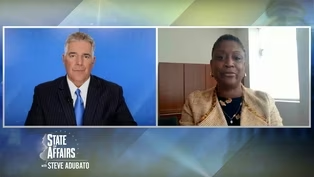
Barbara Johnson Discusses Urban Issues Critical to Society
Video has Closed Captions
Clip: S6 Ep19 | 11m | Barbara Johnson Discusses Critical Urban Issues (11m)
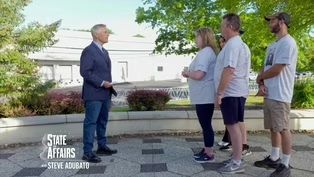
Heather Prutzman Discusses Organ and Tissue Donation
Video has Closed Captions
Clip: S6 Ep19 | 7m 39s | Heather Prutzman Discusses Organ and Tissue Donation (7m 39s)
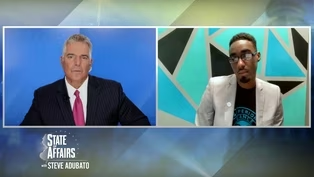
Uplifting the Performing Arts Community in Camden
Video has Closed Captions
Clip: S6 Ep19 | 9m 6s | Uplifting the Performing Arts Community in Camden (9m 6s)
Providing Support for PBS.org
Learn Moreabout PBS online sponsorship
- News and Public Affairs

Top journalists deliver compelling original analysis of the hour's headlines.

- News and Public Affairs

FRONTLINE is investigative journalism that questions, explains and changes our world.












Support for PBS provided by:
State of Affairs with Steve Adubato is a local public television program presented by NJ PBS