One-on-One
Barbara Johnson; Ramin Hastings, MD; Erin Kraus
Season 2022 Episode 2555 | 26m 11sVideo has Closed Captions
Barbara Johnson; Ramin Hastings, MD; Erin Kraus
Steve Adubato sits down with Barbara Johnson, Kean's VP for the Watson Institute, to discuss gun violence and environmental justice; Ramin Hastings, Medical Director of the Structural Heart and Valve Program, Englewood Health, examines how COVID has discouraged people from seeking medical care; Erin Kraus, Make-A-Wish Recipient, recalls her experience going through cancer treatment during COVID.
Problems playing video? | Closed Captioning Feedback
Problems playing video? | Closed Captioning Feedback
One-on-One is a local public television program presented by NJ PBS
One-on-One
Barbara Johnson; Ramin Hastings, MD; Erin Kraus
Season 2022 Episode 2555 | 26m 11sVideo has Closed Captions
Steve Adubato sits down with Barbara Johnson, Kean's VP for the Watson Institute, to discuss gun violence and environmental justice; Ramin Hastings, Medical Director of the Structural Heart and Valve Program, Englewood Health, examines how COVID has discouraged people from seeking medical care; Erin Kraus, Make-A-Wish Recipient, recalls her experience going through cancer treatment during COVID.
Problems playing video? | Closed Captioning Feedback
How to Watch One-on-One
One-on-One is available to stream on pbs.org and the free PBS App, available on iPhone, Apple TV, Android TV, Android smartphones, Amazon Fire TV, Amazon Fire Tablet, Roku, Samsung Smart TV, and Vizio.
Providing Support for PBS.org
Learn Moreabout PBS online sponsorship- [Narrator] Funding for this edition of One-On-One with Steve Adubato has been provided by Fedway Associates, Inc. Delta Dental of New Jersey.
Everyone deserves a healthy smile.
The Healthcare Foundation of New Jersey.
New Brunswick Development Corporation.
The Port Authority of New York and New Jersey.
Moving the region through air, land, rail, and sea.
Seton Hall University.
Showing the world what great minds can do since 1856.
The Russell Berrie Foundation.
Making a difference.
Investors Bank.
And by The Adler Aphasia Center.
Promotional support provided by New Jersey Monthly, the magazine of the Garden State.
Available at newsstands.
And by NJ.Com.
Keeping communities informed and connected.
- This is One-On-One.
- I'm an equal American just like you are.
- The way we change presidents in this country is by voting.
- I'’m hopeful that this is the beginning to accountability.
- Life without dance is boring.
- I don't care how good you are or how good you think you are, there is always something to learn.
- I did do the finale, and guess where my trailer was?
A block away from my apartment, it couldn'’t have been better!
- People call me 'cause they feel nobody's paying attention.
-_ It'’s not all about memorizing and getting information, it'’s what you do with that information.
- (slowly) Start talking right now.
- That's a good question, high five.
(upbeat music) - Steve Adubato here and we're honored to be joined by Barbara George Johnson, Vice President External Affairs at Kean University and also she heads up the John S. Watson Institute For Urban Policy and Research at Kean University.
The executive director there, is that not right?
- Hello, Steve.
Well, first of all, it's a pleasure to be here.
So thank you for having me and I am executive director of the John S. Watson Institute for Urban Policy and Research of Kean University, a mouthful.
- Yeah, I know it is.
But the beauty of this is that we just, Kean University is one of our newest, higher ed partners, and we were talking to Dr. Lamont Repollet, president at Kean, we were brainstorming about what we could and should be focusing on, and we came up with a series, you'll see right up on the screen right now, Urban Matters.
And the John S. Watson Institute is dedicated to urban policy issues.
Barbara, what are the top two or three urban issues that not only that the Institute is focusing on, but that we as a state and nation should be focusing on?
- Oh my goodness, top three is difficult, but let me start by saying that we're looking at after the shootings in Texas, increased gun violence across the country, right?
So we're looking at how we deal as a policy office and doing the research necessary to create the policies that are gonna change that circumstance and that reality in the state of New Jersey and across the country.
- First of all, we're doing literally a couple days, we're taping a couple days after that horrific shooting.
We hope and pray, you know the rest of it.
- Yes.
- But that's when we're taping, go ahead, gun violence next.
- So again, the most advanced nation in the world, we have to do something about that.
We're also interested in looking at infrastructure because again, as we deal with the various natural disasters that have occurred not only in New Jersey, but across the country, we're talking that we just came off of Ida which was a storm that was so unexpected back in September of 2021, so we have to look at infrastructure.
We have to look at climate adaptation and mitigation and urban communities are typically not a part of that conversation as we think of our shoreline most of the time.
But in reality, we have old infrastructure, so we have to look at storm water mitigation, how we deal with various aspects of raining in our community and how we look at decreasing the climate concerns with increased heat in our urban spaces, by increased trees and canopy.
So we're working on those issues as well.
- Before you move to another issue, environmental justice, particularly for urban communities, define what that means to you.
- So we have The Center for the Urban Environment at the Watson Institute, and environmental justice is critical.
It applies to the overburden communities that are mostly black and brown, where incinerators increased particular matter pollution occurs because of the number of industry and factories and so forth that have been the bedrock of urban spaces for a number of decades.
- Yeah, let's put it there.
Let's put it there, right?
- Yes, exactly.
- There is where people are.
Go ahead, I'm sorry.
- There is where people are.
- And we have to understand that that comes from a history of federal regulations that dealt with redlining and creating devalued spaces in our urban centers where investment was lacking for decades and where they did put industry, where did put the smoke stacks, so now that we're dealing on the back end of that, environmental justice says, "Let us have equity "and equality across all playing fields."
Let's ensure that all of our communities have clean air, right, playgrounds and places that young people can play.
Let's decrease the asthma levels, they're due to particulate matter pollution.
And I'm happy to say that Dr. Nikki Sheets, who's a director of The Center for Environmental Justice Program at the Watson Institute and works with the New Jersey Environmental Justice Alliance across the state, they were able to have the first cumulative impact legislation in the country, which helps to reduce emissions from smoke stacks, et cetera, or assesses bringing in new development that will cause an impact or a burden on that community.
So we're very excited to lead the nation in that.
- And stay on that.
The issues of environmental justice you're talking about, connected directly to healthcare, the incidence of asthma in urban communities is in many ways directly connected to the environmental issues you're talking about.
Can we talk, Barbara, about urban issues around healthcare?
Disparities in healthcare?
Disproportionately black and brown mothers and babies, just, it's a horrific situation.
We actually had the governors, the First Lady Tammy Murphy on talking about Nurture NJ, her initiative deal with maternal health.
Talk about healthcare issues in urban communities, particularly for women and babies.
- So let me start by saying that we can't desegregate healthcare from anything else, right, because it's poverty.
Poverty is at the core and discrimination and race, or at the core of the health issues that impact urban communities.
When we have COVID 19 and we're still going through the pandemic, but at the very beginning, we noticed that our essential workers were the ones getting sick, ones that were in the hospitals dying, and we realize that those are lower income, lower paid jobs which typically went to black and brown communities and people who live in those communities.
And so we have to include race, poverty and discrimination, When we talk about healthcare in urban communities.
We also saw the exacerbation of chronic illness.
So asthma, diabetes, hypertension, and all of those things are connected to women in health also when we're talking about maternal health, right?
So I am very much aware of Nurture New Jersey, the First Lady's initiative.
I've been a part of the steering committee working with the First Lady for a number of years on black maternal and infant health in particular.
Unfortunately, black mothers in New Jersey are seven times more likely to die during childbirth than white women.
Black infants are three times more likely to die in the first year of life than white babies.
And this is historical.
And so it disturbs me.
And I will tell you, Steve, that in the beginning of my career, in the mid-80's I worked as a health policy advocate for healthy mothers, healthy babies, looking at advising women on again healthy pregnancies, healthy birth, the whole prenatal experience and postnatal experience.
And here we are 20 plus years later, having the same conversations.
So the goal and the Watson Institute is working with the First Lady's office.
We are in the process of conducting a community engagement and environmental scan of the city of Trenton, as the state looks to create a maternal and infant health institute.
And the hope is that we will never have to go back to having this discussion, that we will equal the playing field and bring equity to this conversation about black maternal health.
- Well, let me do this, you know, I keep talking about the John S. Watson Institute for Urban Policy and Research at Kean University, as if everyone knows who John Watson was and why he mattered so much.
And we will actually, we're gonna be doing a feature on, on John Watson, who I served with way back in the day talking about in the eighties, mid-eighties, I served with him in the state legislature for a short time.
His daughter Congresswoman Bonnie Watson Coleman, we'll be having her on talking about her dad in part of a new series we're doing called Remember Them.
The reason I'm asking you this is a synopsis of who John Watson was and why John Watson mattered so much.
- Absolutely.
I'm honored every day to do this work under the name of John S. Watson.
John Watson was an assemblyman in the state of New Jersey but more importantly, he was a statesman.
So he worked across both sides of the aisle.
And every time I meet someone who is Republican or a Democrat, they speak very highly of John Watson what he was able to do in his various roles in community and how he supported the state and supported the opportunity to have healthy, safe communities across the state, and particularly in Mercer County and the city of Trenton.
So he was also the first chair of an appropriations committee, African American chair of an appropriations committee across the country.
and so that is something that was also, you know something that we admire and that we're happy to be again, associated with that name and the person.
- I served on that finance and appropriation committee when he was the chair.
And he was a mentor for me and so many other legislators who really didn't understand the job.
And he was a, just an extraordinary person that we need to remember.
So thank you.
Before I let you go, I just wanna remind everyone that or let everyone know that you've been named to Senator and former majority leader in the senate Loretta Watson- Loretta Weinberg.
I apologize for that Freudian slip.
She has this power list.
Loretta Weinberg knows who matter, and you made the 2021 Women's Power List, that Senator Weinberg put together.
That's pretty cool.
- It was pretty cool.
You know, I knew Senator Weinberg when I started my career at the ACLU.
So Senator Weinberg was one of the first senators that I worked with on domestic partnership legislation.
So I know her very well, and we worked together throughout the years and I so appreciate and I was honored to be identified as someone to join her list.
- Hey Barbara, thank you to you and Dr. Repollet and everyone at Kean University.
We look forward to more conversations in our Urban Matter series.
Thank you so much.
- Thank you, Steve.
- You guys stay with us.
We'll be right back.
- [Narrator] To watch more One on One with Steve Adubato find us online and follow us on Social media.
- We're now joined by Dr. Ramin Hastings, who is Medical Director of the Structural Heart and Valve Program and an Interventional Radiologist, excuse me, Cardiologist at Englewood Health.
I do not wanna confuse a radiologist with a cardiologist.
You are, in fact, you admit that you are a cardiologist, correct?
- Yes, I am a cardiologist, yes.
- Before we get into this any deeper, why cardiology?
- Yeah, from medical school, you know, I was trying to decide which type of medicine I would wanna get into, and I remember kinda, this was a last minute change.
I did a rotation in cardiology, and I knew right away that this was the field I wanted to go into, and I think the, what really drove me to cardiology is we have so many therapies that can vastly change people's lives in a matter of seconds, you know, and take 'em from a debilitating disease to almost back to normal and back to their regular lives.
And there's just so many areas of cardiology where we could do that.
And I knew right away watching those patients, that this is where I wanted to be.
Certainly was the right decision for me.
- Let me ask you this, how has COVID, particularly long COVID, impacted heart health?
For me, the biggest place where it impacted originally was that people were not coming in for their care, and so, you know, the scariest thing for me is we kind of didn't see heart attacks for several months when COVID first arrived.
And, you know, we knew that they must still be happening, but just people were so scared to come to the hospital that they weren't coming in.
So, you know, a lot of people ended up, you know, not surviving at home, and a lot of that is probably due to COVID, but a lot of that was probably due to not seeking medical care.
And now, as we get into the longer phases of COVID, you know, I worry that people are still kind of hesitant to come to their physician and get those primary care and preventative care measures that could really help them long term.
In terms of long COVID, I mean, we are seeing a lot of patients coming in with long COVID, and a lot of that is thought to be potentially due to some cardiovascular effects, and, you know, some cardiovascular.
- Cardiovascular what?
- Effects, you know, reduced cardiovascular function.
And so, we're seeing the whole gamut of it, and, you know, I think we're just scratching the surface at this point.
And so, as more data comes in, hopefully, we'll have a better understanding.
- Lemme try this.
I was telling you before we got on the air that, you know, my cardiologist is part of my life because there's a family history.
My grandfather, who I never knew, passed away at 44.
My father's younger brother passed away.
My dad, who passed awhile back, had heart issues, and so, the family history issue is always there.
I'm always aware of it, but I keep telling myself I can do certain things.
It's not about me, it's about anyone, 'cause family history comes up a lot.
How much can we do, in spite of our family history, and who smoked and who drank and who did whatever, that's another story.
What can we do for ourselves for our heart health versus, men and women, versus, hey listen, that's just your family history, please, doctor.
- I mean, there's so much that we can do.
You know, simple lifestyle changes are obviously the most important, so eating a healthy diet, exercising, not smoking, you know, is extraordinarily important and is the backbone of the therapy of preventative medicine of people with a family history.
But beyond that, we have so many tools at our disposal to try to help reduce the risk of developing heart disease in patients who are at very high risk, you know, from screening modalities to check for the beginnings of the development of heart disease, to, you know, powerful medicine that can help reduce cholesterol to markedly reduce your risk of developing heart disease in the future.
You know, we have multiple medications now.
Previously, statin therapy was really the only medicine that we had available to us, but as the technology has grown, we now have a whole, a whole armamentarium of medicine that we can give to our patients to help reduce their risk moving forward.
- What is T-A-V-R, TAVR.
- Yeah.
So TAVR is the procedure that changed my life, I'll tell you, Steve.
I mean, it stands for Transcatheter Aortic Valve Replacement.
- Say it again.
- Transcatheter Aortic Valve Replacement.
- Go ahead.
- So Transcatheter Aortic Valve Replacement was originally designed as an alternative to an open heart surgical aortic valve replacement, and it was designed for patients who have aortic stenosis, which is thickening of the aortic valve.
So, as the last valve of the heart connects the pumping chamber to the rest of the body, in our elderly population oftentimes, the valve starts to get thickened and calcified and no longer opens as well as it's supposed to, so it creates, in essence, an obstruction to blood flow out of the heart.
The standard therapy, which has been goin' on for 30 or 40 years now, is open heart surgery and cutting out the diseased valve and replacing it with a new valve.
Transcatheter Valve Replacement is taking that valve, and instead of putting it on a ring that gets sewn into place, it gets mounted on a metal cage that can be compressed, put through the artery in the groin with just a needle stick, The metal cage is then positioned to where your native valve is, and the metal cage is opened, pushing your valve out of the way, and inside the metal cage is the new functioning valve.
So we're able to replace the valve with just a needle stick in the groin and no surgery of any kind.
You know, in our program, I would say about 80 to 90% of people are then sent home the next day, and the recovery from this is extremely minimal.
So we have patients who, you know, after a couple days of being at home and just resting, they're back to their normal lives, and so it's compared to the recovery from open heart surgery, which, especially for our elderly population, you know, can be long and protracted.
And so, this has really become a godsend for that patient population.
The beauty of the treatment was, originally, it was designed as kind of an alternative to patients who could not have open heart surgery, so they were very sick with other medical problems or very frail.
You know, as the technology has advanced, you know, we've recently celebrated our 20th anniversary of the device.
As the technology's advanced, it's now shown to be effective in almost everybody who has aortic stenosis, so even our healthier patients, we can now offer them this groundbreaking treatment.
And so.
- TAVR, T-A-V, I'm sorry for interrupting, T-A-V-R stands again for Trans?
- Catheter Aortic Valve Replacement.
- Wow.
- So a surgical, they they used to call a Surgical Aortic Valve Replacement, or S-A-V-R, and now it stands for Transcatheter Aortic Valve Replacement.
- Dr. Hastings, thank you.
Because heart health is so incredibly important for all of us, whether there's a family history or not.
Thank you for putting things in perspective.
Appreciate it, doctor.
- Yeah, no problem.
- You got it.
Stay with us, we'll be right back, right after this.
- [Narrator] To watch more One on One with Steve Adubato find us online and follow us on Social media.
- All right folks, you're gonna meet one of the most talented teenagers you're ever gonna meet.
That's right, Erin, I'm talking about you.
That's Erin Kraus.
She's a wish recipient of Make-A-Wish New Jersey.
How you doing?
- I'm very good.
How are you?
- Good, I'm great.
Erin and I met in Atlantic City at a wonderful fundraiser for the Make-A-Wish, the folks from Fedway brought us down there and you were the keynote speaker, the guest speaker.
Erin, tell everyone very quickly and we'll put up the website for the Make-A-Wish organization.
Make-A-Wish New Jersey.
You are diagnosed in 2020.
- Yes, November.
- Hodgkin's lymphoma?
- Yes.
describe that, 'cause then I'm gonna go to the wish, which is pretty amazing.
- It was definitely very hard going through treatment, and I believe that going through treatment during COVID absolutely heightened everything.
I definitely wasn't going to school.
I didn't wanna catch COVID, especially with my immune system that did not exist, and I wasn't seeing my friends or really any of my family.
And that was incredibly hard for me, and I knew that support was there but it just, it was hard not seeing anyone there to be with me during it all.
But I knew that they were there supporting me.
- So how do you even know about Make-A-Wish?
- I mean, I've heard crazy stories, like I know someone received a wish had actually went to my school.
He was to see the Foo Fighters.
He wanted to be the drummer.
That was actually a kid from my school.
So that was really like the talk of, like, our school for a very long time, so I feel like that's kind of where I heard it from.
- Yeah, except now you're the talk, so.
- Yeah.
- Here's what happens.
Erin, and again, I was honored to host this event in Atlantic City for Make-A-Wish.
We're tied to the folks at Fedway.
And you, you told this story about your wish.
Now I was still blown away by this.
You're 17 years old and you say, "I want to go to a Rolling Stones concert."
Was that it?
- Yeah.
(chuckles) - And okay, so you go, the concert is in Austin, Texas.
- Yes.
Describe the wish.
- I just felt like I was treated like such a VIP.
I just felt incredibly special.
It was, definitely felt like a my moment kind of thing, and it was just honestly such a once in a life opportunity to go see The Rolling Stones, and I'm incredibly thankful to Make-A-Wish for granting my wish.
And, you know, we got to sit down at like a little VIP section that had like drinks and snacks, and there was candy, and we got like a service there to pick us up and drive us there.
And I actually went to the Museum of Ice Cream afterwards (Steve laughs) 'cause I love ice cream so I had to go.
- You love ice cream and I get the ice cream, and I love The Rolling Stones as well, but it makes more sense for me given my age versus yours.
What the heck is the story with you loving The Rolling Stones 'cause there's gotta be an explanation.
- Yeah, well, when everything shut down, I just felt like there was nothing to do.
I wasn't working.
I basically wasn't going to school and I knew a lot of my friends were into older bands and I'm like, "Oh, let me give them a listen," so I remember originally starting with Foreigner for like the shutdown, and then I went to The Beatles, Styx, Fleetwood Mac, and I eventually got to The Rolling Stones, and AC/DC was there for a while, but now it's The Rolling Stones.
- How great is Mick Jagger?
- He's fantastic.
I mean, I know that he just had open heart surgery a few years ago but it looked like he never had anything wrong with him.
He's jumping on stage.
He's running around and oh my gosh.
Like I'm out of breath watching him and he's 78 now.
Your parents, talk about their involvement in this.
- Yeah, oh my God.
They were so just, I guess confused when I asked for a Rolling Stones trip at first, but then they were like, "Oh yeah, let's go."
They didn't even know that I had gotten into any kind of music like this for their generation.
Like I would be just playing and singing a song just walking around and they'd be like, "I know that song, that's from like when I was a kid, like, why are you listening to that?"
- I love it.
- So they went on a road trip to Austin.
Let me ask you 'cause everyone's wondering, I'm sure, wondering other than your great taste in music and the work that Make-A-Wish does.
Again, the website's been up there.
How's your health right now?
How are you feeling right now?
- I am in remission.
I believe I am actually a year and three months today in remission.
- Wow.
- Yeah.
(chuckles) - I would be remiss if I did not ask because there are parents and there are kids some of whom actually watch public broadcasting and friends of young people who are struggling.
What would be your message to them right now?
- I would just say keep trying, 'cause there's always something on the other side.
Just get through it no matter how hard it is, and you know that you'll make it and you'll be there, and you'll see the other side and you'll see the happiness.
- Did you ever know that you were this tough?
- Not really until, you know, everything stopped with the pandemic and then I knew I was tough, but the pandemic was tough, and then when I was diagnosed it got even tougher, and I guess coming like out of it, I was like, "Wow, I really am that tough."
Like it's crazy, I didn't even know that.
- Yeah, well don't doubt it for a second and I can't even imagine what you've been through, so, I will tell you for hundreds and hundreds of people gave you a standing ovation in Atlantic City at that event for Make-A-Wish.
I will tell you, to the Fedway folks, thank you for introducing me to you and the Make-A-Wish folks, we wish them all the best and you just keep doing well, okay?
- Thank you so much.
- And we're wishing you all the best.
Thanks, Erin Kraus.
She's a superstar.
Thank you.
We'll see you next time.
- [Narrator] One-On-One with Steve Adubato has been a production of the Caucus Educational Corporation.
Funding has been provided by Fedway Associates, Inc. Delta Dental of New Jersey.
The Healthcare Foundation of New Jersey.
New Brunswick Development Corporation.
The Port Authority of New York and New Jersey.
Seton Hall University.
The Russell Berrie Foundation.
Investors Bank.
And by The Adler Aphasia Center.
Promotional support provided by New Jersey Monthly, And by NJ.Com.
- [Narrator] This is the Seton Hall story.
One that comes to life every day on our campus.
This is the place where great minds discover, innovate, collaborate, and find their true calling.
This is the place where passion has a purpose, where learning inspires leading.
The bonds we make, the values we teach, inspire our community to take heart and take action.
This is Seton Hall University.
This is what great minds can do.

Barbara Johnson Discusses Urban Issues Critical to Society
Video has Closed Captions
Clip: S2022 Ep2555 | 10m 58s | Barbara Johnson Discusses Urban Issues Critical to Society (10m 58s)

How COVID has Discouraged People From Seeking Healthcare
Video has Closed Captions
Clip: S2022 Ep2555 | 8m 10s | How COVID has Discouraged People From Seeking Healthcare (8m 10s)
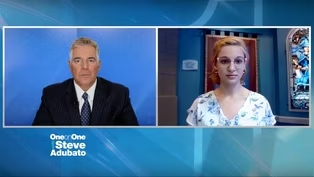
Make-A-Wish Recipient Recalls Her Experience During COVID
Video has Closed Captions
Clip: S2022 Ep2555 | 7m 30s | Make-A-Wish Recipient Recalls Her Experience During COVID (7m 30s)
Providing Support for PBS.org
Learn Moreabout PBS online sponsorship
- News and Public Affairs

Top journalists deliver compelling original analysis of the hour's headlines.

- News and Public Affairs

FRONTLINE is investigative journalism that questions, explains and changes our world.












Support for PBS provided by:
One-on-One is a local public television program presented by NJ PBS