
Batya Ungar-Sargon; Rick Thigpen
1/22/2022 | 25m 33sVideo has Closed Captions
Batya Ungar-Sargon; Rick Thigpen
Batya Ungar-Sargon shares how American journalism underwent a status revolution over the twentieth century, from a blue-collar trade to an elite profession, and the implications of that change on our country today; Rick Thigpen talks about the life and legacy of the late General Colin Powell and the long-lasting impact of his public service on the nation.
Problems playing video? | Closed Captioning Feedback
Problems playing video? | Closed Captioning Feedback
Think Tank with Steve Adubato is a local public television program presented by NJ PBS
Batya Ungar-Sargon; Rick Thigpen
1/22/2022 | 25m 33sVideo has Closed Captions
Batya Ungar-Sargon shares how American journalism underwent a status revolution over the twentieth century, from a blue-collar trade to an elite profession, and the implications of that change on our country today; Rick Thigpen talks about the life and legacy of the late General Colin Powell and the long-lasting impact of his public service on the nation.
Problems playing video? | Closed Captioning Feedback
How to Watch Think Tank with Steve Adubato
Think Tank with Steve Adubato is available to stream on pbs.org and the free PBS App, available on iPhone, Apple TV, Android TV, Android smartphones, Amazon Fire TV, Amazon Fire Tablet, Roku, Samsung Smart TV, and Vizio.
Providing Support for PBS.org
Learn Moreabout PBS online sponsorship- [Narrator] Funding for this edition of Think Tank with Steve Adubato has been provided by Holy Name.
This place is different.
Delta Dental of New Jersey.
Everyone deserves a healthy smile.
Seton Hall University.
Showing the world what great minds can do since 1856.
The Robert Wood Johnson Foundation.
Fedway Associates, Inc. New Jersey Sharing Network.
Suez North America.
Community FoodBank of New Jersey.
And by Summit Health, a provider of primary, specialty, and urgent care.
Promotional support provided by NJ.Com, keeping communities informed and connected.
And by ROI-NJ, informing and connecting businesses in New Jersey.
[MOTIVATIONAL MUSIC] - Hi, I'm Steve Adubato.
For those of us in the media, we have a fair amount of a navel gazing, if you will, soul searching, thinking about who we are, who we're not, who we say we are, the impact we have on American culture and what we all say what we care about the most, American democracy.
We're about to introduce someone who's written a compelling, powerful, and important book about all these subjects and more.
She is Batya Ungar-Sargon.
She's the Deputy Opinion Editor at Newsweek and the author of "Bad News.
How Woke Media is Undermining Democracy".
Batya, thank you so much for joining us.
- Wow.
It's such an honor to be here with you.
- We appreciate it.
Batya, I've seen you on a fair number of other programs, particularly national programs talking about the book.
Tell me if I'm wrong.
The basic premise of the book of that is that we, largely in the media, have changed dramatically who we are, how we've been educated, how much money we make, and the fact that we are largely "out of touch" with the struggles and challenges of most working class Americans who just feel we're either fake or don't represent them or their interests.
Is that right?
- It's right.
And they're not wrong.
They're correct.
So journalism used to be a working class trade.
It was the kind of job you picked up while you did it.
A 1937 survey of the journalism elite of the time, the Washington Cohort, found that less than half of journalists had a college degree.
And a lot of them hadn't even been to high school.
Fast forward to 2015 and you have American journalists are the most highly educated industry in America.
But a survey found that 92% of journalists have a college degree.
The majority of them have a graduate degree.
We are part of the top 10%.
We make a lot more than our fellow Americans.
We live in the coasts, 75% of American journalists live on the coasts.
And as we have become increasingly affluent, extremely highly educated and coastal, Americans have been abandoned by their media.
The working class specifically has been abandoned by a media that used to be among them, used to live among them, used to belong to them.
And now is really part of the elites.
- So let's try to break this down.
Actually, because I get a whole range of newspapers.
Yes.
Old school, actually print newspapers.
One of them is The New York Post.
And I've seen a fair number of your articles that are current, whether it's about the Cuomo brothers or the Jussie Smollett case, I think actually hit today or yesterday, we're taping this program toward the middle or end of December, it will be seen later.
But here's the theme, that basically everything you just said has manifested itself in a disproportionate number of us in the media obsessing about race, obsessing about racial division, obsessing about, and by the way, we on our series tied to public broadcasting, we are not officially public broadcasting, but they're our colleagues, we do a series called "Confronting Racism" at every turn.
Are we part of the problem?
Because we want to look at racial inequities, social justice inequities, or should we say, you know, enough.
- It's such an important question.
Racism of course still exists in America.
There are still areas in American life where racism is essentially state-sponsored.
I'm talking about police brutality.
I'm talking about mass incarceration.
I'm talking about intergenerational poverty in some communities of the American descendants of slaves.
These are moral emergencies.
And we must talk about them.
I'm not talking about that in my book, because the secret is, is that there's no political divide over these issues anymore, right?
Republicans have been at the forefront of prisoner releases for the last decade.
So when you're talking about mass incarceration as a moral emergency in America, there is now bipartisan support for criminal justice reform.
Police reform, right?
Senator Tim Scott proposed a police reform bill in the wake of George Floyd's murder, right?
There's no longer a political divide over these issues.
- Batya, let me push back, I'm not a big fan of interrupting or push back.
Republicans, many, Tim Scott in the Senate being one of them.
However, is it fair to say that so-called Trump Republicans are not as sensitive and as woke, forget about woke, they don't, they don't seem to give a darn about the murder of George Floyd on camera and other issues involving police and minority relations and violence perpetrated disproportionally against those who are Black by police officers.
You believe that all Republicans, including those Republicans, they care as much?
- You know, in the wake of George Floyd's horrific and yes, racist, murder, Lindsey Graham went on national television and talked about the importance of police reform.
Mitch McConnell went on national television and talked about, you know, America's original sin.
Tom Cotton went to a breakfast of Republicans and talked about how Black men encounter the police differently than we do.
And that that is a moral emergency and something we have to deal with.
President Trump released 5,000 Black men from prison.
So I just think that that narrative really is flawed and not accurate.
I, as part of my job, as Newsweek's Deputy Opinion Editor, I, you know, have the misfortune of having to watch Fox News and CNN all day long on two screens in my office.
- Is that what you do?
- It is what I do.
It is, I follow the news and how it's developing.
And I have to tell you that the difference between them and this is the argument I make in my book, the difference between them is not about race and it's not about politics.
It's about class.
Fox News is picturing a viewer that doesn't have a college degree.
And CNN is picturing a viewer that has one.
And I'll tell you something else.
Ahmaud Arbery's murderers were just brought to justice, a jury, almost completely White jury, found them guilty of murder.
And I watched Fox News all day in the wake of that verdict, every single one of the hosts was praising it and praising the American justice system for bringing those lynchers to justice.
- Batya, you raise compelling arguments.
But as I watch, because it's part of my job in public broadcasting, we actually don't believe we have a horse in the race.
You talk a lot about NPR.
You did not talk about much about PBS.
We'll talk about that in a moment.
But as I watch Tucker Carlson, because it's partly my job and I watch him interviewing and doing a special, I believe a one or a longer one hour longer or longer special with the young man who was acquitted for taking that assault rifle onto the streets.
You know the rest of the story and shot people because he said he was at risk.
And so I don't even want to give credit to his name.
I don't want to give any more credit to the situation, but to lionizing him, that's part of the narrative as well.
So it's an, my job is not to defend the CNN or MSNBC, but you do see that there's a disconnect, I hate saying on both sides, because reminds me of something else.
But is there a disconnect on both sides or do you think it's too much of the woke left media?
- You know what that young man said in that Tucker Carlson interview?
- Please.
- He said that he supports Black Lives Matter.
And he said that his experience with the criminal justice system, he said to himself, can you imagine if I was a young man of color, it would have been even worse.
I definitely wouldn't have gotten justice.
I mean, to me, to go on Fox News and say that?
That's really important and I do believe that Kyle Rittenhouse was defending himself.
I think you saw that in the videos.
- I think people saw different things but go ahead.
- So, to me, this political divide is really, I think that we are inventing a political divide.
We are inventing a racial divide when there isn't one anymore.
What there is, is a class divide.
We have an immense class divide.
We have absolutely deplorable levels of income inequality.
The working class of all races has been totally de-platformed.
Our media on the right caters to the top 5% of conservatives.
Our media on the left caters to the top 10% of liberals.
And 90% of Americans have been completely de-platformed by our media.
- Does it force most of us to find media that reinforces what we think we already believe, Batya?
- Yeah, absolutely.
Absolutely.
Although I have to say my book starts in the 19th century, which was this golden era of American journalism because it was a populist journalism that was created by and for the working class, the masses, and it was very partisan.
It was very partisan on behalf of the working class.
They were not objective, partisan media is not the problem.
The problem with our media today is on both sides.
It is partisan on behalf of only the elites of either side.
- What do you believe the implications are potentially for, and the title of the book, "Bad News, How the Woke Media is Undermining Democracy".
Explain the part about undermining democracy, because we've had a series, a mini series called "Democracy at a Crossroads".
You seem to be saying it's not even at a crossroads, we're on the edge of just falling apart and busting apart.
Go ahead please.
- Yeah.
So what I argue in the book is that as journalists, you know, stopped being part of the working class and ascended to the ranks of the elites, they abandoned the working class and they now very much push a view of rule by elite, rule by meritocratic elite, that the smartest people, the most talented people, because they know more, because they have these fancy educations should get to tell other Americans what to think and how to think and who to vote for.
That is fundamentally anti-democratic.
Now I just want to say, you know what I mean by woke, I am not talking again about police reform, which we desperately need.
I'm not talking about criminal justice reform, which we desperately need.
I'm not talking about education reform, which we desperately need.
You know, New York City's public schools are more segregated than Alabama's.
What a shonda, right?
- So are New Jersey's, so are New Jersey's but go ahead.
- Horrible.
Absolutely state-sponsored racism still exists.
What I mean by woke, I'm using the word, not the way it's used in Black slang to refer to all of these things I just mentioned that we have to talk about.
I'm using it the way sociologists use it, to refer to a phenomenon that happened in 2015 that I think we're all going to instantly recognize, which is that in 2015, White liberals became more extreme in their views on race than Black and Latino Americans.
They became more academic in the way they talk about race and just more radical in how they think about it.
They started to think about all White people as being inherently endowed with power and all people of color as having no agency and being powerless.
This is not about police reform.
This is defund the police, a view that affluent White liberals love and that 81% of Black Americans are opposed to, that's what I mean by woke, the de-platforming of the views of working class people of color, including all other working class people, the downwardly mobile middle class to the benefit of highly educated elites.
- Dare I ask?
At the risk of sounding so self-serving because we are a part of the public broadcasting family, although we're an independent media production company, what you believe our role, because I truly believe after 30 years in this business that I, we, those of us who do what we do on our side of the street, don't have a horse in the race.
Our job is to try to put every perspective, credible perspective out there.
What do you believe we can do to have any positive impact?
I'm not even bringing people together, but preserving our so precious and fragile democracy.
- I love that question.
Thank you so much for it.
You know, my book is about contempt.
It's about the contempt that a highly educated elite that I belong to, on the left, I am a lefty, has allowed.
- I'm on an elite, I don't call myself a lefty, but I ascribe to many of the description, many of the things you've described.
- Right?
And I, the contempt that elites and that the media, who are supposed to be telling the great American story, have allowed ourselves, not just to express but to justify through a moral panic about race that is fundamentally flawed.
And that fundamentally fails to capture America.
What we can do is to refuse to express that contempt for our fellow Americans, to refuse to believe the worst about them at a time when more unites us than ever before and more unites.
- More.
- More unites us than divides us.
- We're not as polarized than ever before?
- A hundred percent, a hundred percent.
Polarization is an elite phenomenon.
People are making money off of it.
- Including those 80% of Republicans who voted for Trump, who largely watched Fox News and AO, whatever the heck it's called.
And that, that Biden's not the president, that's united?
They don't even believe Biden's the president.
- Do you know that 66% of Democrats believe that the Russians had interfered in the voting tallies in 2016, and that Trump was not really the president?
We both have this problem.
We both have a problem of conspiratorial thinking.
On the most important issues of America, the values that this great nation was founded on, equality, fighting racism, justice for all, diversity, LGBTQ rights, there is no longer a partisan divide.
That is what matters.
On other issues.
Sure.
Abortion, a healthy democracy should sustain an abortion debate, right?
And that's what you're doing here and why, what your program is so important because you have people who disagree on.
That is how we stitch back together the fabric of American society.
- Batya, I gotta tell you, I'm hoping and praying that people watching us right now on public broadcasting and other platforms are thinking, asking questions, getting your book, and it's called "Bad News How Woke Media" woke used in the way Batya uses it.
"How Woke Media is Undermining Democracy".
Think for yourself, just think for yourself.
Hey Batya, I can't thank you enough.
Best to all of you and your family.
We're doing this around the holiday seasons, have a wonderful new year.
And we look forward to having you back again and continuing the conversation.
All the best.
- Thank you so much for having me, sir, all the best to you.
- My pleasure.
I'm Steve Adubato, stay with us, we'll be right back.
To watch more Think Tank with Steve Adubato, find us online and follow us on social media.
- Hey folks, Steve Adubato here.
Another segment we're having, a compelling, important segment with Rick Thigpen, who is Senior Vice-president of Corporate Citizenship at PSEG.
We're not talking energy in this particular edition, but Rick has been with us many times talking about historical figures, leadership, and this initiative called powering equity and social justice.
Let's start off with General Powell.
I'm a huge fan of his.
Read so much of his work.
I use him in my leadership seminars.
Why does he embody general Powell's life and success powering equity and social justice, Rick?
- Well, he is such an extraordinary story Steve.
He's a gentleman who comes, he's the child of Jamaican immigrants.
Born in Harlem, raised in the south Bronx, went to New York City public schools and city college.
And rose up to be a dedicated American public servant.
He spent a life in the military, an incredibly successful life in the military.
And really helped shape America's destiny into the 21st century.
And he really comes from a very common background.
He's just another example of how the greatness of our country comes from all different sources.
And how America is so special by having people who come from all over the world, come here to contribute.
And our country is truly a better place because of General Powell.
The first African-American chairman of the Joint Chiefs of Staff.
The first African-American National Security Advisor.
And I did that in reverse order.
As National Security Advisor under Ronald Reagan, Chairman of the Joint Chiefs of Staff under George Bush the father.
He was the youngest Chairman of the Joint Chiefs and the first African-American to be Chairman of the Joint Chiefs.
So really remarkable.
And during his tenure the cold war ended, Operation Desert Storm happened, the invasion of Panama happened, the Somalia crisis happened, the Bosnian War happened.
So he really had a unique opportunity to contribute to his country through public service.
And America is a better place because of that son of Jamaican immigrants.
- Let me follow up on this.
By the way, check out General Powell's history, as it relates to his commitment to urban education, particularly in the Bronx and the raising of money, the supporting of education there, and the role of so many.
- America's Promise.
- What's it called again?
- America's Promise was the non-profit he formed dedicated to helping at-risk youth in America.
So, you know, just another way of giving back to the country that had done so much for him.
- Yeah, but there's another piece Rick.
And I always want to touch on this.
As a student of leadership as a teacher leadership, I've been moved by General Powell.
I learned so much from him.
When he gave testimony before the United Nations and mistakenly said that there were "Weapons of mass destruction in Iraq," which was the premise for us going into war.
And later on said it was the greatest regret of his life.
What did it say Rick, about General Powell?
And yes, there was devastation, there was death.
The war may have been unnecessary depending upon how you look at it.
But he said it was my mistake.
I was wrong.
I should have questioned more.
I should not have said that.
What does that say about General Powell's integrity?
- And character, it says enormous amounts.
I'll say two things.
First off, I just recited his military, his very distinguished military career.
But his public service didn't end there.
And as you pointed out, he was also the first African-American to be made Secretary of State of the United States.
And in that capacity, the invasion of Iraq was, as well as Afghanistan happened during his tenure.
And like you said, he looked back at what, at the role he played with deep regret.
As we all know today, not enough public servants are willing to admit when they're wrong and tell the people that they made a mistake, so that we could do better next time.
And to me, it's something to be admired because we all make mistakes.
The willingness to admit it, the willingness to learn from it showed just his love of his country and the depth of his character.
Something that we should all want in our public servants.
And it shows that those characteristics and traits, which we all admire can come from all different types of people who come from all different types of places.
And he's just someone who we should all remember as a role model as to what makes America great.
- So, I'm going to follow up on something.
So for those who are just critical and say he made a mistake, he made a terrible mistake, a deadly mistake.
But being in positions, you and I talk about this on Lessons and Leadership, our sister program that I do with Mary Gamba.
You've said, look, leadership is not about making the right decision in every situation.
It's having the information you have at hand, making the best decision possible.
And when you make a mistake, dare I say, own it.
That's the exception.
That's not the rule, Rick.
- Well, unfortunately, Steve, and you know, the old cliche people who live in glass houses shouldn't throw stones, and I'd like that first stone to be thrown by the person who has made no mistakes themselves.
We all make mistakes.
He admitted his mistake in public.
It was a mistake on a international global stage and it takes enormous courage and character to admit it when you're wrong.
And he knew it.
He'd made a mistake and he wished he hadn't done it.
And I dare say, our country might have been better off if it did not make that mistake.
And I won't go into that war.
But it's a very important character trait for our leaders and more of our leaders need to be able to admit when they're wrong, so that they can go forward and do better the next time.
- Could Colin Powell have been President of the United States?
- Well, that's a, there's two ways to look at that.
By his enormous contributions and-- - By his record.
- He deserved, he was worthy of being considered to be president.
As I mentioned to you, and I remember as a young man, he was an anomaly in my own little world and that he was, he was African-American but promoted by Republican politicians.
First, Ronald Reagan, then George H. W. Bush, then George Bush the son.
And he had a tough political puzzle to solve, to be a African American leader and get the Republican nomination for president.
So politics aside, his life of public service, his dedication to his country certainly made him qualify to be considered as President of the United States, but it just, it was not in the cards for him politically.
Real quick on this final question on General Powell.
What did General Powell's life and legacy mean to all younger people, but disproportionately young people of color from urban areas?
What did it mean to them in terms of what was potentially possible in this nation?
- Well, it shows that everything is possible in this great nation.
It shows that while the color of your skin may influence your life, it does not prevent you from making enormous contributions to this country.
And it does not prevent you from loving America and helping make America a better and greater country.
He's a role model for all of us.
I remember him as a young man thinking, I never thought that was possible.
He's Chairman of the Joint Chiefs of Staff.
The highest military officer in the United States of America.
And there he was a man with capacity, competence, intellects, leadership, and there he was.
And then he even doubled down on it by becoming the Secretary of State.
So it shows what a great country we have.
It shows why our country is great.
We should not forget that he is the son of immigrants.
And he came to this country and helped make it a better place.
And that's really one of the reasons America is the special place and the greatest country on this earth.
Colin Powell once remind us of that.
- Sorry for interrupting Rick.
And if those of you who are wondering, hey, why do we have Rick Thigpen doing this?
Rick and I started an offline conversation a couple of years ago.
Rick is a historian.
He's a student of history on every level.
We actually started with a series that we did, a half-hour special on the history of Drumthwacket.
Drumthwacket, look it up.
If those of you don't know what it is.
And look at our website, steveadubato.org.
Look at the Drumthwacket, special we did, the People's House if you will.
It's an important home in New Jersey.
Governor Murphy is, and first lady, Tammy Murphy, just the last in a long line, the most recent in a long line of governors and their first ladies and first husband in the case of Christie Whitman, who have spent time there, that is the People's House.
Rick understood that more than most, and he encouraged us to do a documentary, and we did.
So Rick, we're going to do a separate segment on General Schwarzkopf.
I can't thank you enough for telling us just a little bit about General Powell and we're talking military history.
Rick thank you so much.
Second segment different one with General Schwarzkopf.
Thanks Rick.
- Thanks, Steve.
And equity and social justice should mean something to all of us.
It's what makes our country great.
- Thank you, Rick.
We'll see you next time.
- [Narrator] Think Tank with Steve Adubato has been a production of the Caucus Educational Corporation.
Funding has been provided by Holy Name.
Delta Dental of New Jersey.
Seton Hall University.
The Robert Wood Johnson Foundation.
Fedway Associates, Inc. New Jersey Sharing Network.
Suez North America.
Community FoodBank of New Jersey.
And by Summit Health.
Promotional support provided by NJ.Com, And by ROI-NJ, - Data shows that many patients have avoided seeking critical health care in the wake of COVID-19 for fear of contracting the virus.
Delaying medical care can have serious consequences, so you should never second guess or ignore your symptoms.
At Holy Name Medical Center we have measures in place to prevent infectious disease from spreading, we're clean, we're open and we're safe for all your health care needs.
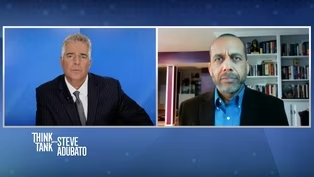
The Life and Legacy of the Late General Colin Powell
Video has Closed Captions
Clip: 1/22/2022 | 10m 13s | The Life and Legacy of the Late General Colin Powell (10m 13s)
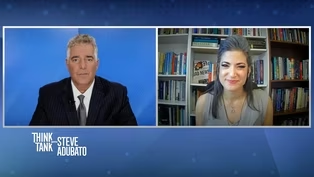
The Revolution of American Journalism
Video has Closed Captions
Clip: 1/22/2022 | 14m 58s | The Revolution of American Journalism (14m 58s)
Providing Support for PBS.org
Learn Moreabout PBS online sponsorship
- News and Public Affairs

Top journalists deliver compelling original analysis of the hour's headlines.

- News and Public Affairs

FRONTLINE is investigative journalism that questions, explains and changes our world.












Support for PBS provided by:
Think Tank with Steve Adubato is a local public television program presented by NJ PBS