
Beach Asparagus & Wild Salmon in Alaska
Episode 5 | 14m 50sVideo has Closed Captions
Chef Pyet DeSpain travels to Tlingit Country on Alaska’s Prince of Wales Island.
On Alaska’s wild Prince of Wales Island, Chef Pyet DeSpain joins Tlingit guides to forage sea asparagus and wild berries, then cooks a coastal feast of salmon, herring eggs, and fireweed jelly for a family meal by the sea.
From
Problems playing video? | Closed Captioning Feedback
Problems playing video? | Closed Captioning Feedback
Beach Asparagus & Wild Salmon in Alaska
Episode 5 | 14m 50sVideo has Closed Captions
On Alaska’s wild Prince of Wales Island, Chef Pyet DeSpain joins Tlingit guides to forage sea asparagus and wild berries, then cooks a coastal feast of salmon, herring eggs, and fireweed jelly for a family meal by the sea.
From
Problems playing video? | Closed Captioning Feedback
How to Watch Spirit Plate
Spirit Plate is available to stream on pbs.org and the free PBS App, available on iPhone, Apple TV, Android TV, Android smartphones, Amazon Fire TV, Amazon Fire Tablet, Roku, Samsung Smart TV, and Vizio.
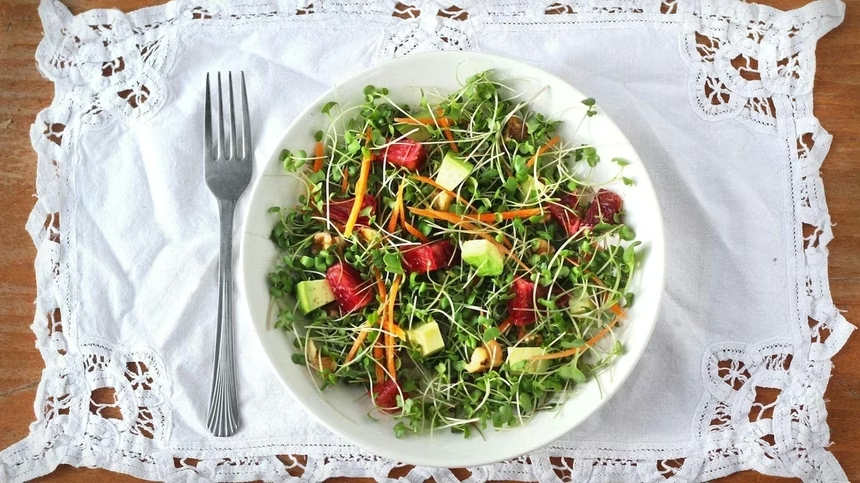
Find Cooking Shows Recipes And More
Discover why PBS is the original home to food and cooking content. From Julia Child to Lidia Bastianich to Pati Jinich, get the best recipes and shows from your favorite chefs.Providing Support for PBS.org
Learn Moreabout PBS online sponsorshipThese are herring eggs that were spawned on hemlock trees.
This is something we always eat as a group.
It's almost like not even as enjoyable if you're not eating with friends and family.
I can hear all your crunches.
We call it Tlingit pop rocks.
Salty, fishy.
I love it.
I'm Chef Pyet DeSpain.
From winning Next Level Chef to cooking for A-listers.
I've made my mark with Indigenous fusion cuisine.
I chased my dream to L.A., but I hit roadblocks.
I spent a year couch surfing, searching for identity and direction.
But what grounded me was food.
The traditional Native American and Mexican recipes of my ancestors.
Now I'm on a mission across the Americas to reconnect with Indigenous foodways and bring their bold, beautiful flavors back to the table.
There's a couple of different trails so.
Okay.
Isn't this an awesome way to spend our Sunday.
I've always wanted to visit Alaska and now is my chance.
Today we're on Prince of Wales Island, in the far reaches of southeast Alaska.
We're here to learn about the foodways of the Tlingit, the People of the Tides.
They've pulled a living from these shores for literally thousands of years.
My guide is Alicia who works with youth on the island.
With us is Gabrielle, a good friend of mine from LA, who has Alaskan Native roots, but like Alicia, grew up in a city far from here.
We'll be gathering ingredients to cook a meal with a Tlingit chef who will show us how this wild landscape ends up on a plate.
So, Alicia, where are we?
We're in Hydaburg or Higdáa G1ándlaay.
This is Dog Salmon Beach.
And we're here to harvest beach asparagus.
Oh, okay.
And the beach asparagus is all these little these plants we see here, right?
Do you them eat them raw?
Yeah.
You can eat them raw.
Very salty, very earthy.
It does taste like it comes from near the sea, where it grows near the sea.
It has a good crunch to it.
Packs a lot of saltiness in that one little bite.
I like it.
I like to go a little further because we want to leave the spot closest to the road for elders.
So if we could walk further away.
Yeah.
Perfect.
In Tlingit, because I'm Tlingit on my dad's side, the word for beach asparagus is sukkáadzi.
There is a ton of beach asparagus here, above the tide line of this inlet.
It's a little late in the season, so she says we want to find one that hasn't started to flower yet.
How do you know if it's flowering?
these ones, where the little white... Oh I see, I see They're still edible and they taste good.
But I prefer non-flowering.
Awesome okay.
So do you want to keep walking a little more?
Yeah, let's walk a little bit more.
Closer to the waterline, a little crab catches my attention.
It's a crab!
Hi little crab!
And Alicia approves of this choice.
I think this is a fine spot.
I like to use a knife or some people use scissors.
I want to prevent pulling up any roots.
I'll just grab a little handful, and then I'm just kind of cutting, just above the root.
Did you grow up here picking the asparagus?
I didn't.
I'm originally from Juneau, or Dzántik<i Héeni I didn't.
I'm originally from Juneau, or Dzántik<i Héeni But it's been harvested for thousands of years.
And I'm a strong believer in trying to incorporate more traditional foods into my diet.
And this is one of my favorite plants in particular, because there's not a lot of hearty vegetation up here as far as traditional food goes.
I was really looking to reconnect culturally, and just wanted to feel more rooted and, so learning more about the plants.
I grew up in the city, so I'm a city native, and I was really connected to, like, the art and the singing and the dancing.
But one thing I didn't always get was the food.
Like, our traditional Indigenous foodways, because I grew up displaced and in the city.
I hear about your family members, Gabby, living until 100 plus years old.
Yeah, yeah, they lived off of the land, berries and all the fish.
And a lot of them lived to be around like 105, I think.
Your great Uncle Claude was 100, right?
Yeah.
Uncle Míijuu.
Yeah.
There's something about the way the Tlingit live with the land that really pulls me in.
It feels endless.
The sea and the forest - like it's all offering itself if you know where to look.
The season is short though.
Just two months to gather, preserve and stockpile before the long Alaskan winter sets in.
Very tart, very yum.
Look how vibrant these are.
Alicia especially wants to harvest fireweed blossoms from this sunny roadside to make jelly for tonight's meal.
All parts of the plant are edible.
It's a mucilaginous plant, and so it's good for digestive issues.
Or like if you're stuck out in the woods and you really hungry, you could split the stalk and suck out the middle part.
These are poisonous.
We eat them, but if you break off some of the cow parsnip and get the juice on you, you'll get really, really, really bad blisters.
We've been foraging with permission in Haida country.
But next we're going to connect with a Tlingit chef who's gathered some riches from the sea to bring it all together.
Are you excited?
This is Kelsey.
She grew up cooking on the island, and is going to teach us some delicious Tlingit recipes that she learned from her mom and dad.
Well, thanks for coming over, Kelsey.
So nice to meet you.
Yeah.
Thank you for having me.
It's such an honor.
Alicia's excited to learn new cooking techniques from Kelsey to continue her journey reconnecting with her traditional foodways.
So you're going to show us some traditional Tlingit recipes today?
Yes.
Just some things that I grew up eating here, with my family and foods that we learned to forage and harvest and hunt.
Yeah, well, I'm excited for that.
So we're going to make a fish soup.
I talked to my aunt, and I said, what is your like when you think about your traditional Tlingit foods, what's the first thing you think of?
And she said fish soup.
Soups I feel like are the most underrated, dishes.
Yeah.
Because they really hug your soul and there's just so much nutrients in them.
It's really, I feel like heartwarming and comforting.
There's been times growing up where we've gotten home, and the kitchen sink has salmon in it or crab or there's a five gallon bucket outside with water filled with clams in it or something.
What a childhood.
Oh, my goodness.
My dad would always say that we eat like kings and queens.
No one else is eating the fresh shrimp and crab, and clams and salmon.
I just felt like you are so spoiled.
I used to be embarrassed because my grandma would send me to school with fish sandwiches and people would say, ew, what is that smell?
You know?
And now I'm like, geez, I was really lucky.
Ok.
So now that all this is finished, do we want to throw all this in a pot?
What's the next step?
I'm going to heat some oil on the stove.
just to prefer to sauté the veggies first myself.
A lot of our foods have always been enjoyed in their simplicity.
Basically just preserving what they could and then eating it fresh.
So these look like they've cooked enough to me.
So I'm going to go ahead and add these potatoes.
and we'll just pour some water over.
And this is some king salmon that we caught this summer.
For the Tlingit, salmon, caught by fish trap, gill, or dip net, is life.
There's a saying in Tlingit: Haa Atxaayi Haa Kusteeyix sitee.
And it means "Our food is our way of life."
And so, traditionally there are songs and dances to celebrate the return of the salmon.
to celebrate the return of the salmon.
The culture is pretty centered around salmon.
The fat can be kind of fishy sometimes, so you can cut it off if you want.
A little less fishy if you take the fat off.
Okay.
And then I have some tweezers here to take out these bones.
I work with youth and it's really, really important.
I don't have any children of my own, but I want our kids to know who they are and where they come from.
And I also want them to know that there isn't one right way to do anything.
Your auntie might do it differently, or your grandpa or your uncle, and that's okay.
Everything just varies a little bit how they do their smokehouse to how you brine your fish.
If you're doing a cold smoked or a hot smoke to how you're canning your fish.
Like this is like other.
Like I always grew up, you never put skin on the jar.
It's ugly.
It's hard to wash off.
You don't do that.
I feel like it sounds kind of bougie, but... I mean, it makes sense to me.
And it looks so pretty when it's no skin on the outside.
And it looks beautiful.
Alicia started the process of making fireweed jelly yesterday by steeping the blossoms.
Now she'll dissolve the sugar and pectin and that infusion.
We'll put it in jars and it will be ready for a sweet treat for our meal later.
I really love opening up a jar in the winter time.
It always reminds me of summer.
Especially in the dark winter months.
It gets tough in the winter time.
Colors from nature.
The color is the best part of it.
My favorite part.
Kelsey's daughter Mirissa couldn't agree more.
While the vegetables in the stew cook we'll get started on the beach asparagus salad.
Today I'm going to use shrimp.
My mom likes to do shrimp always in hers, and it's super good.
And then, I'm actually gonna do a coleslaw dressing.
It's the same everywhere: Mayo, vinegar, and sugar.
Meanwhile I'll peel the cooked shrimp.
So these are local spot prawns and they're very sweet.
So different than what you're going to buy in the bags of shrimp at Costco or somewhere.
Oh nice, I want to eat one now.
Oh yeah.
Super sweet.
Super good.
Wow.
Those shrimps are incredible.
Kelsey decides to use the jarred beach asparagus that Alicia put up from what we picked yesterday.
She said you can use fresh, but the pickling gives the salad a good tangy flavor.
Kind of like potato or macaroni salad.
The next dish I've heard about and I'm really excited to try.
The way they harvest these is amazing.
When the herring spawns in Southeast Alaska, it's a really big deal.
And it is the first sign of everything coming to life for us.
We're getting ready to harvest, to put up food for the next year to come.
So we'll cut hemlock branches and put a bouy on them.
And they'll go and set them out in the water and let the herring spawn on them, and then go back after so many days and get them.
And then we love to eat them fresh, but we also will freeze them.
These were frozen.
And we're going to very lightly blanch them.
Blanching is just a quick dip.
It takes that wild edge off and leaves that ocean pop.
So these are done.
That is a super quick little poach.
And then we will put some butter on it while it's hot so the butter can melt on it.
And then soy sauce.
And you pick the little branches, and there you go.
(Popping sounds) Salty, fishy.
Very like, wild.
(Popping sounds) But in a good way.
Not like an overpowering way.
You know?
I like it.
As an experience.
Like, picking it.
Pulling it.
Try speaking Tlingit when you eat herring eggs.
Because there's a lot of (gutteral sound) sounds They just fly out of your mouth.
And this is like the beauty of the food here that I've noticed within the diet.
You have the most fresh seafood that you could ever ask for.
You don't need to overcomplicate these flavors.
It's just like super straightforward.
Adding things that are complementary, like butter, that extra salt.
Soy sauce.
You know, like just to like, bring an actual pop of like of that umami and salty flavor to it.
But it's really simple.
You don't need to overcomplicate this at all.
It's super fresh.
I love the texture of it.
It's very fun to eat.
I love it.
So do we want to sit down, and eat it like in a meal?
Yeah.
The last thing to finish is the fish soup.
Kelsey says we'll want to eat it right away so the salmon doesn't overcook in the hot broth.
So you see how bright orange the fish is and how this cooked salmon is turning a way lighter color.
Right, and it cooks pretty quickly.
Yeah.
And then we'll serve it with some black seaweed.
Locally harvested, I believe.
Black Seaweed is harvested at low tide in spring and then sun-dried.
High in protein, fiber and vitamins, it's prized by the Tlingit as a condiment or a crunchy snack.
Ok.
I'm going to try a little bit.
Yeah.
Oh, it's really good.
This is the perfect day for a soup I feel like.
It's a little gloomy outside.
And then you have this nice fish soup.
Mom what's that?
What?
Beep beep.
Yum.
Can you pass me the asparagus beach salad?
What a yummy dinner!
So yummy.
Eating with old friends and new friends is the best kind of Spirit Plate.
Yum, yum ,yum!
Simple, local, and alive with the taste of this place.
Yeah.
I can't wait to try it.
It's an offering to the land that provided and to the people who keep knowledge alive.
Today i'm grateful for food, friendship, and the reminder that some places stay with you long after you leave.


- Science and Nature

A documentary series capturing the resilient work of female land stewards across the United States.











Support for PBS provided by: