
Before Soundstages: Hollywood’s First Feature Film Was Made Here
Clip: Season 9 Episode 4 | 7m 58sVideo has Closed Captions
The barn where Hollywood’s first feature film was made.
The Hollywood Heritage barn is where one of the first feature films in Los Angeles was produced in 1913. Though relocated over time, it remains a rare connection to the early days of filmmaking. This segment explores the origins of Hollywood and the humble beginnings of an industry that would shape global culture.
Problems playing video? | Closed Captioning Feedback
Problems playing video? | Closed Captioning Feedback
Lost LA is a local public television program presented by PBS SoCal
Before Soundstages: Hollywood’s First Feature Film Was Made Here
Clip: Season 9 Episode 4 | 7m 58sVideo has Closed Captions
The Hollywood Heritage barn is where one of the first feature films in Los Angeles was produced in 1913. Though relocated over time, it remains a rare connection to the early days of filmmaking. This segment explores the origins of Hollywood and the humble beginnings of an industry that would shape global culture.
Problems playing video? | Closed Captioning Feedback
Where to Watch Lost LA
Lost LA is available to stream on pbs.org and the PBS app.
Providing Support for PBS.org
Learn Moreabout PBS online sponsorshipHi, [?]
Angie, hi.
So excited to be here at.. Welcome to the barn.
This barn is about as close as you can get to the birth of Hollywood as we know it.
Right?
I mean, th.. Even though we're up here in our archives right now, I always tell everybody, this barn tells us several different stories.
It now, sadly, is the oldest structure still standing in Hollywood.
In 1913, Hollywood wasn't Tinseltown yet.
It was a country hamlet of lemon groves and horse barns in what was then known as the Cahuenga Valley.
That's not to say it wasn't already a tourist destination.
The estate of painter Paul de Longpré, with its extensive rose gardens, drew sightseers long before movie stars ever did.
One of them was D.W.
Griffith, who shot his 1910 short film In Old California in de Longpré's garden.
You have some amazing photographs here.
This is not what people picture as Hollywood today.
It was founded by a couple from the Midwest, Henry and Daeida Wilcox.
It wasn't part of Los Angeles City yet.
We were part of what was called the Cahuenga Valley.
We had the Cahuenga Lemon Exchange.
In fact, that's what this barn was really utilized for, was part of the groves.
That's around, what, 1910?
Yes.
Now let's fast forward three years, three and a half years or something like that, and this barn comes into the picture, and also a man named Cecil B. DeMille.
The Squaw Man really took interest to Cecil B. DeMille and Jesse Lasky and Samuel Goldfish because it was the top play at the time.
Yes.
The play was actually adapted into a n.. Why not make it a successful movie?
Again, it's what you'd call hot IP, like there's a bestselling book.
They wanted it to be a full-length feature, meaning it was going to be at least 50 minutes.
It's not going to be these little shorts, which is, again, very experimental because could you get people to sit in a theater?
Here's a letter pertaining to an actress by the name of Red Wing.
The Squaw Man was a story of Native Americans, and Red Wing was one of our earliest of the Native American actresses.
This was them bringing Red Wing here and being part of that film as well.
This letter documents basically her hiring then?
Yes, and then [crosstalk]-- It's just written to Sam Gold.. Don't you love that?
Says Goldfish on there.
Well, that was his name, right?
Then signed by DeMille here in pencil.
Exactly.
Wow.
They decided that the East Coast was just not going to be a place to film this.
What they did is decide to move west.
Cecil B. DeMille got into a train, went to Flagstaff, Arizona, December 1913, and realized it wasn't the climate.
It was cold.
It was damp.
It was rainy.
Got right back on the train and went as far west as he could, which was Los Angeles.
Then, what he did was he stayed at the Alexandria Hotel.
What he ended up doing was sending a telegram back to Jesse L. Lasky and Goldfish out in New York and said, "I'm going to rent this barn."
We have what rarely ever comes out on display, is the original lease agreements.
Oh, wow.
For this barn.
Wow.
At the time, the property wa.. by the name of Jacob Stern.
He was an up-and-coming real estate.
He had a beautiful mansion that sat right across the street from the barn off of Selma and Vine.
Oh, I think I've seen a picture of that.
You have a picture of that over there,- I do.
right there.
Postca.. Yes, gardens t.. Actually, not just a pict.. Hollywood already had this tourism industry,- Oh, yes.
Exactly.
-and then it was homes and gardens.
Then, you have L.L.
Burns and Revier.
Those were the two gentlemen that were also leasing the barn to be a developing lab.
Would later on start the Western Costume Company that we're familiar with too.
DeMille was a subletter in some ways.
This is interesting.
It's entered into the 24th .. That's Christmas Eve, 1913.
Then, on the back, yes, we have here signing for Jesse L. Lasky, Feature Play Company, is Cecil B. DeMille, general ma.. That's probably one of his earliest autographs.
This is pretty close to a document of the birth of Hollywood.
Certainly the birth of what we know as Paramount today.
Yes.
Those copies are actually Jacob Stern's personal copies.
Then, Cecil B. DeMille's collection is actually at BYU.
There's just the two sets of copies.
Wow.
We have different revisions because at first, it was just a couple-month lease.
It's all Jesse L. Lasky gave him approval for.
Then, they were able to expand just on that Selma and Vine lot and make stages and eventually almost add glass house effects where they can film finally inside and have the lights because they just didn't have the lighting technology.
Even a indoor scene was filmed outside.
Of course, they didn't need sound stages.
No.
Because there .. [laughs] Exactly.
Enter 1916 where we partner with another gentleman by the name of Adolph Zukor.
They want to bring in more of these full-length featured films, which is hard to get distribution at the time because people were used to the shorts.
Right.
That's where Paramount comes in.
They needed to also have control and start having their own distribution, so they acquire Paramount Pictures.
This is the original Paramount lot then,- Yes, on Selma and Vine.
-which actually grew out of the Stern Ranch.
Yes.
Exactly.
Adolph Zukor had a lot of the big sta..
[?]
by the name of Mary Pickford.
I love this photo.
This is actually her with the ba.. Oh, that's the barn.
Yes.
This is on Selma and Vine.
Yes.
When Paramount.. Yes.
Now, that wasn't its.. No.
-is not-- we're not on t.. No, no.
We're across from th.. No, there's another move in there.
Couple moves in there actually.
Wow.
Even moved a.. When it was on the lot, probably the longest of its life was as a Paramount gym.
It was also part of their Western backlot too.
You'll see it sometimes in different movies like Rainmaker where Captain Hepburn's getting off the train at the train depot.
It got moved, but that's because there was another .. save in the meantime, which was in 1956, Cecil B. DeMille had gotten word that he thought the barn might be demolished back then.
What they did is they worked with people like John Anson Ford, and they were able to make this a California landmark.
It was the first entertainment-related anything to get landmark status.
Wow.
That was the big save.
Moved the barn out of the Paramount lot, and it sat across the street from Capitol Records for several years.
Wow.
[laughs] People still today remember driving by and just seeing this barn that's just falling in disrepair, just sitting in a parking lot.
Then, that's where Hollywood Heritage comes.
It was formed by five women who, in 1978, where they're like, there's no preservation in Hollywood.
One of those ladies, Marian Gibbons, she got wind that Universal Studios might acquire the barn.
She's like, you can't take a Paramount structure and give it to Universal.
[chuckles] Not appropriate.
That's when they're like, this is going to be one .. John Anson Ford, the ladies went to him and like [crosstalk] -- He was a county supervisor?
Yes.
They're like, help us.
He knew about this property here across from the Hollywood Bowl because there was actually supposed to be a museum here in the '60s.
By intimate domain, a lot of the homes were removed and demolished, so it was always earmarked to have a museum here.
We could tell early Hollywood agricultural story all the way to where Hollywood as entertainment started from this little barn.
Just from this one structure.
Yes.
Wow.
Well, I'm so glad it's b.. Yes.
Burns and Revier, those were the two gentlemen that-- [sound cut] and by intimate domain, a lot of the homes were removed and demolished.
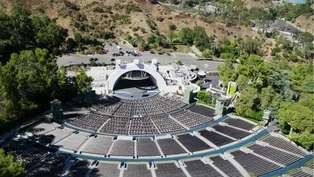
A Bowl, A Barn & A Tower: Birthplaces of the Entertainment Industry (Preview)
Preview: S9 Ep4 | 30s | From a barn to a bowl to a tower, the early history of Hollywood. (30s)
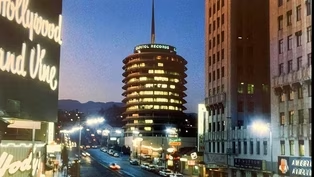
The Hollywood Landmark Where Music Legends Made History
Video has Closed Captions
Clip: S9 Ep4 | 9m 20s | Inside Capitol Records Tower, where music legends shaped Hollywood history. (9m 20s)
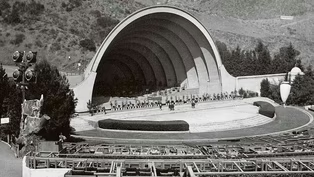
How a Canyon in the Hills Became the Hollywood Bowl
Video has Closed Captions
Clip: S9 Ep4 | 8m 36s | How a natural amphitheater in a Hollywood canyon became an iconic music venue. (8m 36s)
Providing Support for PBS.org
Learn Moreabout PBS online sponsorship












Support for PBS provided by:
Lost LA is a local public television program presented by PBS SoCal