
Behind the Scenes of Elie Wiesel: Soul on Fire
Clip: 1/28/2026 | 5m 38sVideo has Closed Captions
A behind-the-scenes look at the making of Elie Wiesel: Soul on Fire.
A behind-the-scenes look at the making of Elie Wiesel: Soul on Fire that delves into the creative process with key members of the filmmaking team, including animator Joel Orloff, producer Tal Mandil, director Oren Rudavsky and editor/producer Michael Chomet.
Problems playing video? | Closed Captioning Feedback
Problems playing video? | Closed Captioning Feedback
Support for American Masters is provided by the Corporation for Public Broadcasting, AARP, Rosalind P. Walter Foundation, Judith and Burton Resnick, Blanche and Hayward Cirker Charitable Lead Annuity Trust, Koo...
Support provided by:

Behind the Scenes of Elie Wiesel: Soul on Fire
Clip: 1/28/2026 | 5m 38sVideo has Closed Captions
A behind-the-scenes look at the making of Elie Wiesel: Soul on Fire that delves into the creative process with key members of the filmmaking team, including animator Joel Orloff, producer Tal Mandil, director Oren Rudavsky and editor/producer Michael Chomet.
Problems playing video? | Closed Captioning Feedback
How to Watch American Masters
American Masters is available to stream on pbs.org and the free PBS App, available on iPhone, Apple TV, Android TV, Android smartphones, Amazon Fire TV, Amazon Fire Tablet, Roku, Samsung Smart TV, and Vizio.
Buy Now

A front row seat to the creative process
How do today’s masters create their art? Each episode an artist reveals how they brought their creative work to life. Hear from artists across disciplines, like actor Joseph Gordon-Levitt, singer-songwriter Jewel, author Min Jin Lee, and more on our podcast "American Masters: Creative Spark."Providing Support for PBS.org
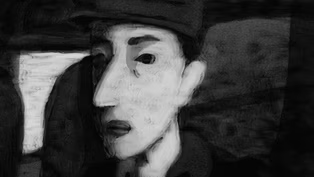
Learn Moreabout PBS online sponsorship(gentle music) - What we ended up using was actually the first thing we tried, right, which was paint on glass animation.
So you've got a camera pointing down at like a sheet of glass, or in the end, we ended up using plexiglass instead of glass.
I would paint using gouache on top of the glass, you know, of a given frame, and then erase, put the parts of that frame that are gonna move.
- There are 24 frames in one second.
Imagine making a painting that's eight and a half by 11, and that takes probably 30 minutes.
And then for some of the frames, you have to completely repaint it, so just two frames takes you a whole hour.
- But it also really reflected what we were trying to communicate through the animation, which was seeing these bits of what was there before that everything that we were looking at in Elie's life, there was always the memory of what came before of what he had experienced.
And the animation was really this moment in the film to look at internally what Elie was experiencing.
- We're not trying to tell all the facts about Elie Weisel's life.
We're trying to tell an emotional story about a man, you know, who, throughout his life, always was linked to his hometown and to those traumatic experiences that happened to him, but also the beauty of what he experienced as a child, which shapes him.
- In terms of the editing, the goal was to focus on him in a lyrical way.
His life and his story, it echoes today in terms of his message, but also echoes, you know, intergenerational.
So we were trying to show the connections between him as a young boy and then follow those connections and messaging all the way straight through to his son, his grandson.
- A university archive had about 10 years of conversations between Elie and Henry James Cargas on mini cassettes, and they'd never digitized them.
Very early on, I got in touch with them and they said, "We don't really know what it is.
I've got two names and a date."
The audio was so difficult to understand that the transcript would basically be illegible.
So you'd start reading it and go, "Okay, this is not useful."
And then I'd listen to the entire audio file, so maybe on one and a half or double speed to go through it.
And as I'm going through the material, you know, I have a sense of kind of what stories we're interested in or what maybe is a beautiful detail that I get from that recording that we hadn't heard elsewhere.
- The thing I'm most proud of is finding those kids in Newark who were just so remarkable.
I mean, I love everything we did in this film.
I love how we worked together.
I think it was a really great partnership, but it's always a partnership with other people who are just, who are not filmmakers.
And that includes these eighth graders and their teacher, Paris Murray, who just welcomed us into their classroom and gave us such gifts of their enthusiasm and their wisdom.
- This is dehumanization because one of the main things that makes a human human is them having the right and the ability to choose.
- I have to hand it to you, Oren, because I was against shooting there because I thought, "Well, what could 13-year-old kids have to say about this?"
And I was really, really wrong.
- [Narrator] One day, we saw three gallows rearing up in the assembly place.
- That day that we spent talking about the writing night sequence where it felt like we really just got on the same page and like came to this idea sort of, it felt like together, that was really lovely.
- [Oren] It was really just finding past and present so that that moment lived in multiple time periods where he's both imagining as he's going up to his apartment, this scene of the hanging, he's writing it, and we're seeing the thing itself happening, and him imagining it on the walls of his apartment.
- We took just this massive amount of material style information to bring together Newark animation archive all into one piece and to be able to flow from one into the next into the next over the course of decades of his life, but then also somehow be looking to the future.
I'm really proud of working with this team and for all of us to put together that story arc and to bring in so many different elements because, you know, we found our own challenges throughout all of that process, but I think by pushing each other, we were able to create this story that has been really successful and been wonderful to share with audiences.
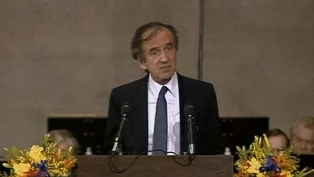
Elie Wiesel on Palestine, trauma and suffering
Video has Closed Captions
Elie Wiesel vowed to always speak up whenever people were enduring suffering and humiliation. (2m 21s)
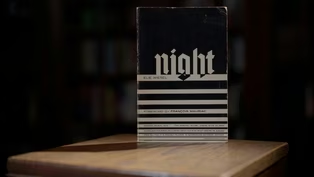
Elie Wiesel recounts the horrors of the Holocaust in "Night"
Video has Closed Captions
In "Night," Elie Wiesel recounts a memory of witnessing three victims being hung. (1m 56s)
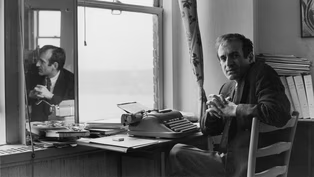
Video has Closed Captions
Learn about Elie Wiesel, Holocaust survivor and Nobel Peace Prize-winning author of Night. (2m 9s)
![Elie Wiesel: Soul on Fire [ASL]](https://image.pbs.org/video-assets/1HkDWrj-asset-mezzanine-16x9-k3i9SRf.jpg?format=avif&resize=316x177)
Elie Wiesel: Soul on Fire [ASL]
Video has Closed Captions
Learn about Elie Wiesel, Holocaust survivor and Nobel Peace Prize-winning author of Night. (2m 9s)
![Elie Wiesel: Soul on Fire [Extended Audio Description + OC]](https://image.pbs.org/video-assets/ybrtuZy-asset-mezzanine-16x9-QzrBo71.jpg?format=avif&resize=316x177)
Elie Wiesel: Soul on Fire [Extended Audio Description + OC]
Learn about Elie Wiesel, Holocaust survivor and Nobel Peace Prize-winning author of Night. (2m 43s)
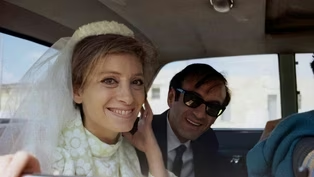
How Elie Wiesel's wife and son gave him a new lease on life
Video has Closed Captions
Before meeting his wife Marion, Elie Wiesel "shunned love" and didn't see himself having children. (2m 40s)
How Elie Wiesel was reunited with his sister
Video has Closed Captions
Elie Wiesel reunited with his sister in France. (1m 10s)
Providing Support for PBS.org
Learn Moreabout PBS online sponsorship












Support for PBS provided by:
Support for American Masters is provided by the Corporation for Public Broadcasting, AARP, Rosalind P. Walter Foundation, Judith and Burton Resnick, Blanche and Hayward Cirker Charitable Lead Annuity Trust, Koo...