Roots, Race & Culture
Being Biracial
Season 5 Episode 3 | 26m 45sVideo has Closed Captions
How does our racial identity shape how we view the world?
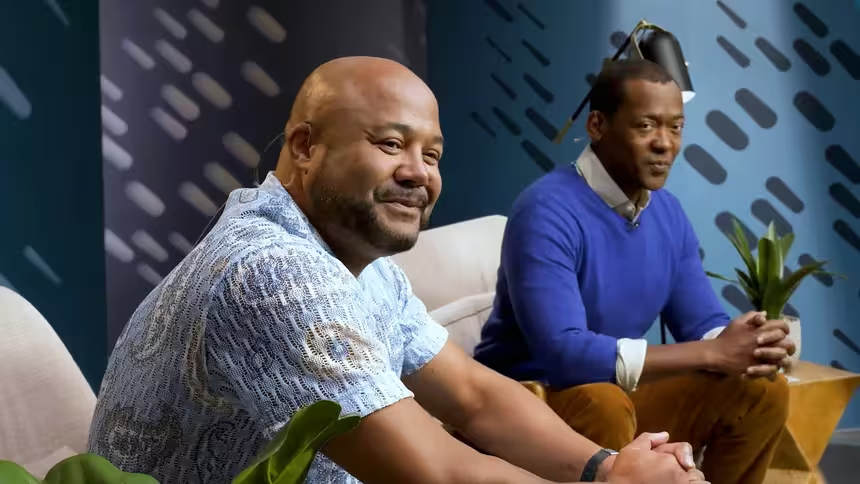
Chantelle Squires and Ebay Hamilton join this discussion to shed light on the experience of what it is like to grow up with parents from two different racial or ethnic backgrounds, and how that shapes their view of the world. Plus, dive into an exploration of the benefits of a multicultural upbringing. Is there such a thing as a “biracial advantage?”
Problems playing video? | Closed Captioning Feedback
Problems playing video? | Closed Captioning Feedback
Roots, Race & Culture is a local public television program presented by PBS Utah
Roots, Race & Culture
Being Biracial
Season 5 Episode 3 | 26m 45sVideo has Closed Captions
Chantelle Squires and Ebay Hamilton join this discussion to shed light on the experience of what it is like to grow up with parents from two different racial or ethnic backgrounds, and how that shapes their view of the world. Plus, dive into an exploration of the benefits of a multicultural upbringing. Is there such a thing as a “biracial advantage?”
Problems playing video? | Closed Captioning Feedback
How to Watch Roots, Race & Culture
Roots, Race & Culture is available to stream on pbs.org and the free PBS App, available on iPhone, Apple TV, Android TV, Android smartphones, Amazon Fire TV, Amazon Fire Tablet, Roku, Samsung Smart TV, and Vizio.
Welcome to Season 7
Bold and honest conversations tackled with humor, insight, and empathy.Providing Support for PBS.org
Learn Moreabout PBS online sponsorship(instrumental music) - [Commentator] Funding for "Roots Race & Culture" is provided in part by The Norman C. and Barbara L. Tanner Charitable Support Trust, and by donations to PBS Utah from viewers like you.
Thank you.
(upbeat music) - Hello my friends, and welcome to "Roots Race & Culture", where we bring you into candid conversations about shared cultural experiences.
I'm Danor Gerald.
- And I'm Lonzo Liggins.
What is it like to grow up with parents from two different racial or ethnic backgrounds?
How does that shape your view of the world?
How does it shape your view of love and identity, especially here in Utah?
- According to census.gov, the multiracial population is the fastest growing demographic in the United States, increasing by 276% between 2010 and 2020.
And in Utah alone, the multiracial population increased by 269% in that same period.
Now, unless y'all have been under a rock this past year, I'm sure you've heard about the well-publicized rap battle between Drake and Kendrick Lamar.
Drake was attacked for being half black and half Jewish.
This brought to light a lot of dirty laundry, particularly in the black community, about racial identity when one of your parents is not black.
So, joining us today, to help us unpack all of this, we have Chantel Squires and Ebay Hamilton.
- I'm Chantel Squires.
I was born and raised in Lehi, Utah, and my mother is Peruvian.
She was born in Lima, Peru and lived there up until she was 18.
And my dad is from Utah, Centerville, Utah.
- Ebay.
- So I was born in Long Beach, California.
My mother's from Orum, Utah, and my father is from Indianapolis, Indiana.
So I grew up with the black side of my family, which is my father's side and the white side, which is my mom.
- [Lonzo] Okay.
- How did being from two different races affect your experience in that regard?
- Yeah, growing up in Lehi, Utah, I mean, it was very, very white.
I, when I was little, I was in the sun all day, so I was really, I was a lot darker than I am right now, and I didn't ever see anyone that looked like me, and it was a weird experience because my mom, I'm even darker than my mother, so- - Wow.
- I, you know, and she was very self-conscious about being dark.
And so I just always felt like I was different and I, not being able to see myself in anyone around me, it was a weird experience.
I've had to unpack it for many years because it's a experience of not knowing where I belonged, you know?
It was like, who am I?
I'm not like anybody else, but what does that mean for me?
And I, so- - That's hard to figure out when you're that young also.
- Yeah, and also figuring out, like, you know, people would say things about people with dark skin and, you know, I, so what are you supposed to make of that?
So I actually hated my skin all the way up through even high school.
I just felt like I didn't, like, in terms of being around people, I just didn't even feel like I was one of them.
- Because here's the thing, I'm biracial.
So I mean, I really get this whole thing, and I'm really curious as to how you two viewed the world, specifically other people growing up.
- Looking around at people who were different races.
Like growing up in Lehi, I didn't actually see a lot of people- - The song "One Race", so it all looked the same to me.
(all laughing) - And when I would see somebody that looked more like me, like it was, it was really, it's really peaceful actually.
Like when I, I've recently, like the last three years, I went to Mexico for the first time, and there's just like, people from all over the world were in this like area that I was in, and I just sat there, I was like, this is the craziest experience I've ever had.
Because I just felt like I looked like people and it was just really calming.
But when I'd see, like I had all my cousins were white, and I don't know, I just felt, I did just feel like I didn't belong anywhere.
I mean, I don't know how else to say it.
It was just this weird, like, I, it was almost like I didn't really exist, you know, around people.
It was like, you know, people would be looking and they'd just skip over me.
- Let's hear your perspective on that.
- Well, I didn't really think about it much as a kid.
I grew up with my white mother and my white brother.
And while my dad was in my life, I was in a white family, and I just didn't think about it much until grade school and other people started asking me why I looked the way I did when my mom looked the way she did.
Folks started asking if I was adopted.
You know, and just thinking like, why would you, you know, why do you think that?
And then realizing over time that, oh, the world sees me very differently than than I see myself and my family sees me and my friends see me.
And like Chantel, I think there were comments about, oh, you've got really nice hair.
There's, you know, I would get comments about my complexion.
But things that maybe people thought were complimentary, but definitely made you feel like you were different.
You know?
Even if they were nice, whatever things to hear or to say or the intention was good, still it was, you're different than everybody else- - Right.
- Here.
- Yeah.
- And my father, when I was younger, used to always say, "You have the best of both worlds."
And I always thought that was just an interesting idea and concept because I didn't feel that way.
I felt like if somebody didn't like black people, they didn't like me.
And in the black community where so white folks didn't always know what I was, but they mostly thought I was black.
And quite often are surprised when they find out that I have any white in me, let alone that I'm half white.
- [Danor] Wow.
- But the black community, there's never been a black person I've met who didn't know right away (all laughing) that I was was biracial.
- Right.
Okay, okay.
- Wait a minute.
Now I feel like I'm like the odd man out here.
(all laughing) But I will say, I can relate to some of this because that feeling that you had, I had that same sort of experience like when you went to Mexico, when I went to Africa, right?
Because I was thinking I'm going to the Democratic Republic of Congo, Kinshasa, there was all this hype about it being the most dangerous, one of the most dangerous cities in the world, et cetera.
And I thought, man, they're gonna see me.
I'm gonna stick out like a sore thumb.
I'm gonna be like a target on my back.
Oh, get that dumb American, he is gonna give us some money or whatever.
And when I got there, after my nerves settled, it didn't take long.
I realized nobody was giving me a second glance.
I fit in, like you said, you fit in in Mexico.
People looked at me and they were just like going, oh, he's from this tribe.
Oh, he's from that tribe.
And I was like, wow, it is so nice to be around people who look exactly like me, even though they speak four or five languages, and I only speak one or two.
And it's like, there's something about the connection that you have when somebody looks like you.
And it's a powerful sort of feeling, you know what I mean?
Like, you don't have to say much to know that you understand each other because of that shared experience.
- Well, and you also have biracial kids.
- That's true.
My, that's true.
- And one of the things here, like in Utah is you'll see a lot of interracial relationships, in particular, especially between, you know, black and white.
And a lot of people have these really, you know, intense feelings about it.
And I know you've heard it, I know Ebay's definitely heard it growing up.
And a lot of it has to do not based on the fact that it's what somebody prefers, it's just the fact that it's the availability.
You know, when you have, you know, 100 to 1, you know, I challenge anyone to go into a grocery store and see how many black women or black men that they see and or anywhere really.
So I mean, it becomes about what's available in the dating pool, you know, at many times.
But it's not just something that, it's like, oh, this is just what they prefer here.
But you do see a lot of biracial people.
And I wanted to ask you guys something, because when I grew up biracial, I just didn't, I never viewed what was happening with my parents as wrong.
You know, people around me had kind of said, "Oh, you know, they're not supposed to do that."
You know, "Blacks aren't supposed to be white."
So I hear these things.
But in my brain, I never saw like what they were doing was evil or bad.
Did you both feel that same way?
- I definitely felt like, well, my parents were separated, and so there was always a sense of, you know, something didn't work, you know?
But I didn't think it was race related at all.
And my time with the LDS church, I learned about the Laymanites and this idea that there are people that have been cursed with darker skin.
And there were questions that came up for me that I wanted to present to my white family about how they viewed people of color, how they viewed my father, how they viewed this relationship.
And eventually, I just settled on, I love my family.
I'm not gonna dig into this.
But I would talk to other people and learn that this was, it was frowned upon.
It was illegal for, you know- - [Lonzo] Oh yeah.
- Interracial marriages in America.
You know, we would've been considered, you know, a crime even what, 20 years, you know, prior to when we were born.
So knowing that this was definitely something that was frowned upon, and I still hear it on occasion, which is surprising to me.
- I did have this really interesting thing from the conversation we had before the show.
And you were talking about some of the advantages, some of the people who have given some amazing contributions to art, music, society, politics, and there's a laundry list here of people that you came up with.
And these are people who are biracial, right?
I'm just gonna speed through this.
We got Bob Marley, Prince, Drake, J. Cole, Sade, Alicia Keys, Jimi Hendrix, Charlie Patton, who's the father of the Delta Blues, one of my favorites since I grew up in the Mississippi Delta.
Lenny Kravitz, Olivia Rodrigo, Slash... - [Ebay] Guns N Roses.
- I didn't even realize.
Slash from the Guns N Roses was biracial.
- [Danor] Biracial.
- I had no idea.
- Mama's Black.
Yep.
- So who we got?
Bruno Mars.
Frederick Douglas.
Frederick Douglas?
Barack Obama, Kamala Harris.
Colin Kaepernick or Colin Kaepernick?
It's Colin Powell, Colin Kaepernick.
(all laughing) Malcolm X, Key and Peele, and of course, Dwayne the Rock Johnson.
And this list goes on and on.
So I'm curious, why do you guys think that people from two different backgrounds who are biracial can be such contributors creatively or otherwise to society?
Let's throw it to you, Ebay.
- I think when you come from, whether you were involved with both sides of the family and these different cultures, I think because you early on are probably pretty aware that you're not completely one of these things, it makes it a little easier, earlier than most folks to start looking at yourself as an individual.
And because of that, you might start exploring some of your individual interests that aren't necessarily a cultural thing.
- Do you think that that does have a good impact on an artist or just, you know, a creative in general?
- Yeah, like as you were talking, Ebay, I was thinking, like, yeah, there's less expectation in some ways.
And I feel like that it, for me, kind of opened me up.
I mean, I was in a Bluegrass Band for five years and I played the banjo and sang.
And because I have on my dad's side of the family, I just came up with it myself.
Like one day I was like, I'm gonna learn how to do this, but I found out that I have a grandpa's uncle that played the banjo, right?
On my white side of the family.
And it's like, oh, well, maybe that's where that came from.
But then, like, I was just in a play, a musical, and I was dancing the salsa.
And like, I've always had that in me.
I have like- - It was so easy.
- It was so easy.
(Danor laughing) And maybe that's expansive thinking, probably.
And I just felt very free to explore who I was.
And there was just less, I think, less expectation of me, because I don't, yeah, I wasn't Peruvian and I wasn't white, so I had to decide what I was gonna be.
And it was like, well, I guess I'm a banjo playing salsa dancer (all laughing) that likes to make movies.
And I would say too, with filmmaking, I just love diverse stories.
And I think that makes me a unique filmmaker in the sense that like, I'm always searching for stories that are different and that like, I can relate to, even if I can't relate to it.
Like, I don't know what it's like to be black.
I have no idea.
But I know that I don't know what it's like well enough to like work really hard to try and tell a story that is true in some way and do the work and consult with people and like open up myself to like, bringing other voices in because I feel like I'm another voice.
And so I think that's been a good thing for my career for sure.
- So there's an image that we have here that we're gonna show you today.
It's an article by Psychology Today.
It's by this author named Jennifer Latson.
It's called a "Biracial Advantage".
And Duke University psychologist, Sarah Gaither, said, "More people in this group say that being multiracial is an advantage rather than a disadvantage, 19% versus 4%."
Gaither's research also found that those who identify as multiracial instead of just one race report higher self-esteem, greater wellbeing, and increased social engagement.
- My kids are biracial, as you mentioned.
And you know, in school, I feel like they are, they stand out in a positive way versus like the negative experience that you guys may have had.
You know, all the white kids want to be cool.
Like they're all listening to hip hop, they're all doing this.
And so if you've got that sort of built into your DNA culturally, it's, I could see how today's society, even particularly even in Utah, that might be considered an advantage because you're not just like every other, you know, white LDS Mormon person out there or something.
- And representation is important.
You know, nowadays you do see a lot more biracial folks.
We had a mixed president, you know?
Like if you're a younger person now growing up and seeing the world right now, and we're so much more connected with the internet and all of that.
So you see the world in a, definitely in a different way, - The way I felt about myself and the color of my skin when I was a child.
I mean, it was college that shifted, started shifting it for me.
When my friends were like, well, you're lucky you don't have to go to the tanning bed.
And I was like, whatcha talking about?
Like how, what is happening here?
And that, just like the beginning of that, and then having so many friends that were from other countries and from different places, and just the collection of the beautiful colors of skin of all my friends, like it started to evolve.
But there's been in the last 10, 15 years, the color of my skin, the background that I have being raised by a Peruvian mother and a white father, like that has kind of blended into my life in a really beautiful way that I'm like so, so grateful for.
So I think it's this real, it's a shift for me, right?
Like it's the healing that's happened inside of me to learn how to love myself and see myself.
Representation is huge.
So I feel like it's easy for me to make friends.
- Well, that's our kind of motto in the show is that we all have these shared cultural experiences.
You know, you might be, your father might be black, your mother may be from Peru, but you have such similar experiences.
And you know, there's also some downsides.
And so in that same article, I'm gonna read this quote here.
"Multiracial's face the highest rate of exclusion of any group", which kind of goes back to what you were saying, "They're never black enough, white enough, Asian enough, Latino enough."
So that's- - Let's get into that.
- Yeah.
(all laughing) - You know, I just wanna say before we start delving into that, that you know, you were talking about going to the Congo and sort of blending in and you know, feeling like, see that's one of the downsides, 'cause I've been to, like a lot of places I will go, I will all of a sudden look like those people.
It's a weird thing.
Like I'll go to Puerto Rico and you know, even though they're kind of on the African diaspora, they'll be like, "Oh, you're Puerto Rican."
I'll be like, "Okay."
(all laughing) I went to Morocco.
The people are like, "You look Moroccan with your beard."
And I'm like, "Okay."
I'll be Moroccan.
There's all these different races that we kind of pass as at times, I'm sure Ebay's gotten it.
I'm sure that you've gotten it multiple times.
And a lot of that comes from- - Australian.
I'm Australian.
Some people- - I see that.
Like New Zealand.
(all laughing) But what, let's talk about the downsides of it.
What do you think about that quote?
- Well, I've certainly, I relate to that.
- Yeah.
- You know, more often than not there is a, you're not black enough, you're not white enough, or this question about how authentic.
Do you really like the music you listen to?
Do you really like the things that you're doing?
There is always this question about, you know, are you real?
Who are you?
When I'm with white folks especially, there is this pushback, you know, that you hear it often about like, why do you always wanna make it about race, right?
Like this sort of comes up in conversations.
And what I like to remind the white folks in my life about is like, think about being the only white person in a space.
It's not an experience that you have.
And for those of us who are the only one or one of a few in these spaces, we have to think about navigating our days very differently.
It's not that we want to constantly think about race, it's not that we always want to talk about it or make something, race the central point of it.
It's that it's always something we have to always on think about.
- Yeah.
- It's always there.
And I think when you're biracial, there's, while you can navigate these spaces, you know, a little easier I think than some other folks, there's still a sense that, you know, am I really supposed to be here?
Am I really accepted here?
- I find that to be the case in black spaces too, you know?
- Yeah.
- Like, I'm being, just keeping it real.
Like people, if I go to a black space, there'll always be like, at least a mention at some point about my light skin.
What do you mix with?
You know?
What do you... You know?
You're not really one of us.
I was working with these three black dudes at a car dealership back in the day, and one of them just stood up and just said, "What is wrong with this picture?"
What, who doesn't fit in this picture right now?
And then, and they all just looked at me and he was, and I was like, "You got biracial kids."
(all laughing) Do you say this to your kids at the dinner table?
- Wow.
- But there was this, I get reminders too from the black side about not being black enough.
And when we were talking in the intro with Drake and Kendrick Lamar, is there pushback really from our own people at times?
Do you get pushback from Peruvian people about you not being enough, Chantel?
And I'm curious about that.
- Well, the only Peruvian person that is in my life is my mom and I think she loves me.
(Chantel chuckling) - Oh, good.
- The thing that I, for me, because it's, there's not a lot of half Peruvian, half white people.
My grandmother did come over and I knew her a little bit, but, so I just, I never had that community here, right?
And so I, trying to find that side of me, I think I've gravitated just toward every other ethnicity out there, right?
So like, I am, my last film was about a woman who was black.
And I, that was hard.
It was a really hard experience because it was like, well, you're not black.
How can you tell that story?
And it's like, so can I only tell stories about half Peruvian, half white people?
(all laughing) Because like, I don't see that anywhere, right?
Like, representation is just, it's hard to see it.
And so, but I'm like, but I want to tell those stories.
Like, who else is gonna tell that story if I don't?
- [Danor] Right.
- There's so many other stories, I've read lots of scripts of like, stories about a white man, and I'm like, I just, that story's been told so many times.
I feel really inclined to tell the story of someone else's experience because I can relate to that in some way, because it's, even though it's not mine nobody's gonna have the same experience and having the color of your skin, it's so visual, right?
So people ask like, "What are you mixed with?"
Right?
Like, that matters to them.
But it's like, there's so much more to us than that.
- When you see me, I don't necessarily, I couldn't pass.
And you know, people are always very aware of, you know, that there's a person of color in the room with me.
And so if you say something racist around me, you are intending, or at least that's my assumption.
And, you know, I will most likely just cut you off.
And there's certain, you know, you learn growing up, I think people of color, just across the board, we learn some of the hidden rules, like the things to keep us safe, right?
Like here's the places where I can go, here's where I can't go.
You know, if someone's dropping certain things, they're saying things in a certain way, maybe that's not a space that I'm gonna be okay in, you know?
- Right.
Yeah.
- Which makes your situation even more shocking.
(all laughing) Yeah.
- I walked, when I first moved to Florida, I didn't have my car, so I walked to the closest place to grab something to eat in the neighborhood.
And it was a restaurant, it was called Florida Crackers.
And I walked in and it was like, it was like the jukebox went (screeching sound) and I looked around, I just turned around and walked right back out.
(all laughing) - I wanted to add something here before we're gonna wrap up here.
But there are some benefits to society about being around multiracial people.
It's in the same article that I was reading.
So being around multiracial people can boost creativity and agile thinking for monoracial's.
Monoracial is a person who's like one race.
This is according to a Hawaiian psychologist, Kristen Pauker.
Humans are compartmentalized by nature and labeling others by social category is part of how we make sense of our interaction.
She says that race is just one category, and humans historically relied on it to decide who's the in in the out group, right?
So racially ambiguous faces however, foil this essential approach.
So that's a good thing.
So she found that just being exposed to more diverse populations, it can actually help people's not only ability to get along with other people, but ability to like improve their self racial attitudes and their own self-worth.
And she said to change it, it's not only about being in a diverse environment, but soaking up things that make difference.
Like you have to actually formulate relationships with people from other racial groups.
Now I know this personally, 'cause my wife, she's from Hawaii.
She lived in Oregon, grew up there, but then she moved out to Hawaii when she was 16.
And she said it's so multiracial out there that it changed her entire impact of her perspective of how she viewed other people.
So I think that that's a good thing to note for people who are, who may be in one racial group, who are white or who are black or who are Hispanic, whatever.
That if you do expand your circle and you're around people of more than one race, then it does kind of help your outlook and minimize that, you know, feeling of being- - [Danor] Isolated.
- This is my group and that's it.
I'm not moving.
I'm not dating anyone outside this group.
I'm not gonna be with anyone, but whoever's in this group.
So that's just something to keep in mind as we wrap up.
But thank you guys so much for being on the show, man.
- I would like to say, also thank you for- - Please do.
- Like there's a part of me that's like, am I biracial enough?
Do you know what I mean?
Like even coming here and it's like, I get to hang out with you guys with all the experiences that you've had, and it's just like, yeah.
Overcoming that feeling like we're, we are trying to do that.
Like figure out what the other person, who the other people are in our lives and how we're more similar than we are different.
And so I just, I've loved being here and being a part of this.
- Well, thank you.
Do you have any last little words for us before we go?
- I think that the most important thing a human can do is get outta your bubble, your comfort zone and travel, meet other people from different cultures and not just, you know, if you have the opportunity to really get to know someone who's has a different background than you, who looks different than you, that's one of the best things you can do for yourself.
And biracial folks, we have that experience from such a young age because so many people feel a little more comfortable letting us into those spaces, even if they're not, we're not fully accepted.
So it gives us a bit more perspective.
And I think the folks in my life who are close friends, they do like to talk about this sort of thing with me.
And it's, yeah.
It's just a really beautiful thing to get out there and explore the world and build your empathy for and create those human connections with folks that are from a different group.
- Yep.
I personally feel like being biracial was one of the best things that happened in my life, and I absolutely have, you know, love for everyone.
- Well, that's awesome.
- Thank you guys so much for being here.
- Thank you.
- Well, from all of us at PBS Utah, thank you for joining this conversation.
And as always, other episodes and extended conversations can be found on our website, pbsutah.org/roots or on the PBS Utah YouTube channel.
- Yes, indeed.
And if you have feedback or ideas for other episodes, be sure to give us a shout out on social media.
But until next time, from Roots Race & Culture, y'all, we are out!
(upbeat music) - [Commentator] Funding for Roots Race & Culture is provided in part by the Norman C. and Barbara L. Tanner Charitable Support Trust and by donations to PBS Utah from viewers like you.
Thank you.
(upbeat music continues)














Support for PBS provided by:
Roots, Race & Culture is a local public television program presented by PBS Utah