State of Affairs with Steve Adubato
Benjamin Dworkin; Sen. Declan O’Scanlon; Tony Vauss
Season 5 Episode 16 | 27m 21sVideo has Closed Captions
Benjamin Dworkin; Sen. Declan O’Scanlon; Tony Vauss
Dr. Ben Dworkin talks about policy issues affecting New Jersey and how voting has impacted citizenship; Sen. Declan O’Scanlon discusses Gov. Murphy’s leadership during the crisis and the impact of the pandemic on small businesses; Tony Vauss shares the challenges in vaccine hesitancy in minority communities and the relationship between police officials and minority communities.
Problems playing video? | Closed Captioning Feedback
Problems playing video? | Closed Captioning Feedback
State of Affairs with Steve Adubato is a local public television program presented by NJ PBS
State of Affairs with Steve Adubato
Benjamin Dworkin; Sen. Declan O’Scanlon; Tony Vauss
Season 5 Episode 16 | 27m 21sVideo has Closed Captions
Dr. Ben Dworkin talks about policy issues affecting New Jersey and how voting has impacted citizenship; Sen. Declan O’Scanlon discusses Gov. Murphy’s leadership during the crisis and the impact of the pandemic on small businesses; Tony Vauss shares the challenges in vaccine hesitancy in minority communities and the relationship between police officials and minority communities.
Problems playing video? | Closed Captioning Feedback
How to Watch State of Affairs with Steve Adubato
State of Affairs with Steve Adubato is available to stream on pbs.org and the free PBS App, available on iPhone, Apple TV, Android TV, Android smartphones, Amazon Fire TV, Amazon Fire Tablet, Roku, Samsung Smart TV, and Vizio.
Providing Support for PBS.org
Learn Moreabout PBS online sponsorship- [Narrator] Funding for this edition of State of Affairs with Steve Adubato has been provided by Hackensack Meridian Health.
Keep getting better.
NJM Insurance Group.
Serving New Jersey'’s drivers, homeowners and business owners for more than 100 years.
The New Jersey Economic Development Authority.
Johnson & Johnson.
Choose New Jersey.
Operating Engineers, local 825.
Eastern Atlantic States Regional Council of Carpenters.
Wells Fargo.
And by IBEW Local 102.
Lighting the path, leading the way.
Promotional support provided by NJ.Com, keeping communities informed and connected.
And by Jaffe Communications.
Supporting innovators and changemakers with public relations and creative services.
[INSPRATIONAL MUSIC] - Hi, I'm Steve Adubato.
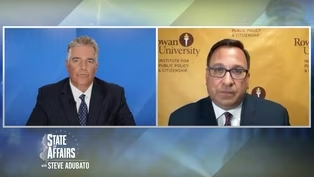
More importantly, we welcome back our good friend from Rowan University, Dr. Ben Dworkin, Director of the Rowan Institute for Public Policy and Citizenship at Rowan University.
Good to see you Ben.
- Good to see you, Steve.
Thanks so much for havin' me back.
- You got it.
Rowan is one of our higher ed partners, and Ben joins us to talk about public policy and citizenship and a whole range of things.
So Ben, we're taping on the 22nd of June, being seen later.
As New Jersey faces a decision as to who will lead the state as governor, either the incumbent, Phil Murphy, or Jack Ciattarelli, his Republican opponent, we don't do politics, we do policy.
What are the most significant policy issues facing the state of New Jersey, regardless of who gets elected governor?
- Well, I think it's gonna continue to be the traditional policy issues that usually come forth in a gubernatorial campaign.
That's the affordability question.
Taxes and affordability are gonna remain front and center for New Jersey, and it's a high cost state.
Democrats have embraced a certain outlook about how they're going to approach taxation.
We've seen the increase in the millionaire's tax, as an example, and Democrats are proudly running on that.
Republicans are gonna be challenging Phil Murphy and the Democrats on exactly those issues, and these are pretty standard for what we typically see in a gubernatorial election.
- Let me try this one.
This is gonna sound like a real pivot, but, as we tape this program, there are discussions going on all around the country, around the voting process, the electoral process.
Some argue, on the Republican side, you're making it too easy for people to vote.
On the other side, the argument has been there are too many impediments, and it's, in some cases, perceived to be racially motivated, who's a D, who's an R, et cetera, et cetera.
Here's the question.
These debates around the country, around the voting process, in person, by mail, voter ID, no voter ID, what does that have to do with citizenship?
- The fundamental aspect of citizenship in a representative democracy is the ability to choose your leaders, and the more restrictions we put, the more hurdles we put in front of our citizens to engage in that fundamental act of citizenship is perhaps a way we are making citizenship harder, when we should be making it easier.
And I think that's really, that's the link here.
- But, one more quick one on this.
Is proving that you are who you say you are, by having some sort of ID, is that a barrier?
Because, devil's advocate question.
I need that ID to do a lotta things, and yes, citizenship should be easier, but, you need to be who you say you are, no?
- Absolutely, nobody wants to see fraud.
I mean, I think what we're seeing are things that go far beyond voter ID, but, even the progressives, you know, people like Stacey Abrams, who's been a national leader out in Georgia, but now a national leader on this particular issue, hasn't got a problem with voter ID.
You know, it's a matter of, do you have it?
Not everybody has a driver's license, so what can you use as a voter ID?
If I can use my utility bill, then sure, everybody's okay with that, that is not the issue.
But what we are seeing around the country are issues, and new legislation being put forward, in some states being passed, that go far beyond just proving who you are.
- Ben, let me ask you.
You mentioned some of the issues in New Jersey that will have an impact on, not just who's elected governor, but what that governor will face, but COVID.
This pandemic, as we tape this program, 15, 16 months, going beyond that, right.
As a public policy question, what is the COVID policy question or what are they?
- You mean, for the gubernatorial campaign?
- Yeah take, okay, so from a public policy point of view, Republicans, including Jack Ciattarelli, the Republican nominee, will say, and by the way, we're gonna do an hour program, with two half hours with each candidate talking policy, but here's the question.
They'll argue that, from a policy point of view, that Governor Murphy's policies have been wrong and hurtful to business.
They've been too restrictive to date, regardless of where we are right now, but for too long, too restrictive.
Is that a policy or a political question?
- Oh, I think it's absolutely a policy question.
I mean, these, somebody had to make a decision.
One of the things we appreciate about politics in the aftermath of, in the continuing aftermath of the pandemic, is the role government does play in our lives and the importance of having strong leadership.
Republicans might've done things differently had they been in charge.
The voters gave Phil Murphy that position, and so he made the call.
Polls continue to show us that, generally, the public is giving Phil Murphy high marks for his decisions.
So, the fact is, sure it's part of a political process in that we debate, did Phil Murphy do the right thing or the wrong thing in June, in March, in the beginning?
But, first of all, I think politically, the public is gonna be less concerned as we head towards November with what happened six, seven months ago and decisions that were made by the Murphy administration then, than they will be with taxes and opening the economy.
But it is an absolutely a policy issue, and someone had to make the decision on what policy to do.
What was fascinating, fascinating, from a strictly academic perspective here, obviously, real lives were involved.
What was fascinating was that, unless you were an elected official in 1918, nobody really had a guidebook for how to do this.
Nobody knew, so.
- The last pandemic.
- The last pandemic, back in 1918, and so, you had a new generation of executives who had to figure out what to do.
And, some are exhausted by it, which is why you're seeing the retirement of a whole bunch of mayors and other kinds of executives.
- Sorry, Ben.
- I'm sorry.
- Jan, no, no, January 6th, the insurrection, US Capitol.
Some argue, particularly supporters of former President Trump and that wing, if you will, of the political, about the Republican party, that wing of the party, which may be the party, I'm not sure.
Here's the question.
Some say, "Come on, that's just citizenship, "people expressing themselves.
"That's what it was, stop makin' a big deal about it."
You say?
- Oh, I think that's ridiculous.
I'm sorry, I think, the insurrection doesn't need to be put in quotes.
It was what it was, we all saw it.
This is not a matter of interpretation, though some people continue try and spin it that way.
It wasn't citizenship either.
The constitution says you have a right to petition your government.
Doesn't say you have a right to storm the Capitol, break down doors, attack police officers, and seek out to.
- Threaten the Vice President and members of Congress.
- Exactly.
And threaten the lives.
- That's not citizenship, right, that's not citizenship.
- No, it's not.
And we wouldn't call it citizenship in any other country, and we certainly shouldn't call it citizenship here.
It is illegal, which is why a lot of these people who were involved in those activities are getting arrested.
- Does Jack Ciattarelli, as the Republican nominee for governor, and other prominent Republicans, do you believe they have a responsibility, from a citizenship perspective, to condemn what happened that day?
- Well, I'm sure we all have an obligation to call it what it is.
And Ciattarelli and anybody, you, me, citizens, and elected officials, and people who wanna be elected officials have an obligation to not ignore what happened.
And therefore, we all have to face up to that, and ignoring it, you know, so much in society today goes so quickly.
News cycles aren't even news cycles anymore, they're just quick moments, and three days later, you seem to have totally forgotten whatever was hot three days before.
We can't let that happen with what happened on January 6th.
That was a significant event in American history, and it needs to be understood and remembered and recalled and dealt with as such.
- Well said.
Dr. Ben Dworkin, Director of the Rowan Institute for Public Policy and Citizenship at Rowan University, one of our higher ed partners.
Thank you, Ben.
- Thank you, Steve.
- Stay with us, we'll be right back.
(grand music) - [Announcer] To watch more State of Affairs with Steve Adubato, find us online and follow us on social media.
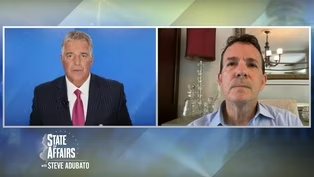
- We are now joined by someone who's now in the national news, he's State Senator Declan O'Scanlon, Republican from the 13th legislative district.
How you doing Senator?
- I'm doing really well Steve, how are you?
- I'm great.
We're taping on the 20th of July, it'll be seen later.
I'm not sure if you're gonna be national news then.
But I will say this, we'll talk about the state budget, we'll talk about the economy, can we talk about freedom of speech and Twitter?
You got taken off of Twitter, was it 12 hours, 24 hours?
- 12 hours.
- What did you do to get them to throw you off for 12 hours?
- Well nothing.
Nothing justifiable.
My tweet was perfectly reasonable.
It was an opinion.
It was an accurate opinion based on facts.
And- - What was it exactly?
About vaccines and COVID.
- Yeah look, I've been a big vaccine supporter.
I've encouraged people to get vaccines, I've organized clinics.
It was my office that helped get, I think we were the first county to make vaccines accessible to every senior and to every teacher in the state.
I'm a big backer.
But I am also a big believer that our government should not mandate things if it doesn't have to, if there's not a compelling safety reason, and here there's not.
We have had amazing voluntary uptake of the COVID vaccine.
Also, by the way, it's emergency use authorization as well.
So mandating such a medication when there's already great voluntary uptake is completely uncalled for.
- But Senator, even for children under than 12, as we speak on the 20th of July, with the Delta variant just sweeping across the nation.
Really?
No sense that children should be vaccinated?
- I will- - Because I believe the tweet said something about that, no?
- No, no, we didn't talk about child vaccinations.
I don't think you're gonna see child mandatory vaccinations or discussion of it until the vaccine is fully approved.
And I don't think that's gonna be 'til January.
The real discussion that was going on at the time was vaccine passports and mandating people get the vaccine before they're allowed to do certain things.
Adults.
- What do you think of that?
- So that was the discussion- - What do you think about the passports?
- I think it's uncalled for at this point.
Certainly in New Jersey.
We have one of the best vaccination rates in the nation, in the world.
We're over 70% vaccinated.
If you add in the people that have naturally acquired antibodies, people that had it, of that remaining 30%, we're probably approaching 85% of adults in New Jersey have some level of substantial immunity.
You don't have to mandate anything, you don't have to talk about vaccine passports.
It's gratuitously provocative to those people that have concerns that choose not to get vaccinated.
- By the way real quick, Twitter put you back on and you're waiting for an apology.
By the time this air you may have gotten it and you may not, I don't know.
But I wanna ask you this, real clear, and by the way, we love having you because you always speak your mind.
Quick question.
In the fall, September into October, should school-age children under 12 wear masks?
- At this point, no, because of our low transmission rate.
This isn't a great threat to children, they are proven not to be vectors.
Look, but we have to be fair.
It's possible that could change if our transmission rate goes, if there's a variant that starts hitting our kids.
So we have to be open to that.
But right now people shouldn't worry about their kids going back to school wearing masks.
- Shift gears.
By the way, if you're listening on the radio side, State Senator Declan O'Scanlon, 13th legislative district.
He knows a lot about the fiscal affairs in the state.
Give Governor Murphy a grade of his fiscal, regarding his fiscal management of state resources.
- F. Because, and here's why- - Come on!
Declan, seriously.
- Look.
Okay, I'll... F?
You know what?
Here's what I'll do.
I'll give him a D plus because he did do what Republicans requested.
The leadership in the legislature and the governor, at the end of the day, did pay down some debt, did do some things and make a full pension payment and then some.
And look, I think they partly did that kicking and screaming because Republicans were pushing and they knew we were breathing down their necks.
But, on the flip side, we borrowed $4.5 billion that our kids and grandkids are gonna have to repay that we didn't have to borrow, that Republicans warned at the time we didn't have to borrow.
We have done nothing to control our budget long-term.
There's billions of dollars in this budget that are one-shots, that are counting on us maintaining the level of revenue that we had this year, which could easily be an outlier because of the gyrations of the market.
So no, no more than a D plus.
We should have done better, we should have put more money away, we should be controlling our spending, and we should be reforming our long-term fiscal obligations so we can be sustainable.
- Talk about the governor's track record in terms of supporting small business.
- Been a disaster.
It's been dribs and drabs.
You talk to almost any small business person trying to gain access to the minimal amount of money.
Well, we should have done 300, and I had a bill to do 300 million 15 months ago.
We would have saved hundreds and hundreds more businesses.
We would have kept people employed.
So, it's been a disaster.
It's been dribs and drabs and the programs are oversubscribed in 10 minutes.
That's been a disaster, we could have done much- - Hold on, Senator, and sorry for interrupting.
And on one hand you talk about it's important to be fiscally conservative, it's important to manage the resources we have in the windfall from the federal government, from the COVID dollars, federal support, but then give more money to small businesses.
Is that a contradiction?
- Not at all.
That's exactly what the money was designed for.
You take the money that you get and you put it where it's supposed to go, and where it prime our fiscal pump.
We didn't do that.
We held onto it.
There's still money that that we're holding on to.
And the governor used it, rather than to help small businesses, we used it to pay salaries of people that were already budgeted for.
So no, it's not inconsistent at all if I'm calling to use money exactly as it was intended to save our economy.
- You know, I feel like for 20 years, I've been doing this for close to 30, it just makes you really old, but for 20 years we've been talking about, not you and me, we've been talking about school regionalization.
There's a school regionalization bill.
Real quick, what is it, why is it important, and why is it going nowhere fast?
- No, I think it's gonna move.
I think... We did the... Now what are you saying isn't gonna move quickly?
The regionalization itself, or... We passed the bill- - Let's just say they've been talking about regionalizing schools for at least two decades.
- We have a new bill.
- There are way too many school districts, they're way too expensive, it has a big impact on property taxes.
You tell me what's going on.
- We've been our own worst enemy.
In many instances, you've had districts that wanted to merge, but our own laws, our own restrictions, our own mandates about dealing with contracts and salaries got in the way.
So you'd have, you know, three districts trying to merge and two out of the three would be big winners, one would be a loser and they'd kill it.
You also would have other, um... Issues, which we're removing with our new bill.
And there's tons of districts that are looking at regionalizing.
So, hold tight on that.
- Okay, so you'd have one superintendent instead of three.
You'd have not as many administrators.
And we're not looking to have people lose their jobs, but it is very expensive.
A small school...
There are school districts that don't have a high school.
There are school districts that I'm not even sure how many schools they even have to have a superintendent, an assistant superintendent, a deputy.
It's expensive!
- Our bill will go a long way to solving that and it's paving the way for districts that want to merge and make it easier for them to do it and remove these hurdles to doing it.
- By the way, how do people follow you on Twitter?
- Declan O'Scanlon, @DeclanOScanlon.
Very easy.
- And by the way, as we speak right now, your account is active.
- It is, yes.
- Just checking.
- I'm gaining followers every day, it's wonderful.
(laughing) - Senator, my good friend, Declan O'Scanlon.
I don't know, are we supposed to say legislators are good friends?
I don't know, I don't know the rules anymore.
But- - It's okay, we're allowed.
- And we're always civil.
And you always are.
Thank you, Senator.
Appreciate it.
- Thanks Steve.
- We'll be right back.
(grand music) - [Announcer] To watch more State of Affairs with Steve Adubato, find us online and follow us on social media.
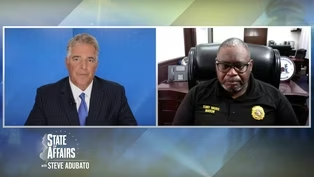
- We are honored to be joined by the Honorable Mayor of the Township of Irvington, Mayor Tony Vauss.
Great to have you with us Mayor.
- It's great to be here, great to be here.
- Mayor let's talk about this whole range of conversation about COVID resistance.
I want to get into this, because in your community, of, you said approximately 55,000, 54,000 residents, right?
- Yeah.
- But it's larger than that when you count, those who are undocumented.
Is that fair?
- That is very fair.
There's a few things that is involved - when you start talking about that.
The biggest thing is not the access to vaccines, it's more of the trust in government that people don't have.
- Sometimes rightfully.
Sometimes deserved, correct?
- Absolutely, absolutely.
You think about, you know, the history of African-American folks, brown and Latino folks in this country, and you think about what we've just went through the past four years with not being able to trust government.
Some people think that if they even fill out the census form, that they're gonna be deported or their family members are gonna be stripped away from them.
So they are very hesitant to give government any access into their lives, especially their information so they can even do things like, you know, get vaccinated, save their lives.
- And so, as we speak, I believe, you know, we're taping this at the end of June.
I'm hoping and praying these numbers are higher a month or two months from now, 35%.
Is that right, 35%?
- We're actually up about 43% now.
- 43, I'm sorry, my bad 43%.
What's your message to everybody else.
Not just in Irvington, but in other urban communities across the tri-state region, watching us right now.
- Well, my message is I hear you.
And I understand, and we have to look at this as a single incident.
Something that has happened not only to our urban communities, this state, this country and this planet.
This pandemic has ravished everyone from black, white, Latino.
And it doesn't really matter.
And when we look at ourselves, if you want to take the position that you don't want to get vaccinated for yourself, I can understand that.
But think about other people in your family that may not have that choice.
Think about your spouse or your children or your grandparents.
You know, that may fall prey to this because you've made a decision not to get vaccinated yourself.
I've been vaccinated, Steve.
It's safe.
I haven't turned into a zombie.
I'm still here in my community, letting people know that it's very important for them to get vaccinated.
And I want everyone to know that.
- Mayor, switch gears.
You've talked an awful lot, very eloquently and effectively in a very important way about relationship between police and the minority community.
And you have said it is extremely important that the police force in a community is reflective of the population in that community.
What is the case in Irvington in that regard?
- Yeah, I mean, our department is a little over 90% African American.
It definitely reflects the population here.
And, you know, in Irvington, we do things a little different.
We know that everyone's immediate idea is not to go to college.
So we go into the schools, we talk to the kids in high school about their options when they graduate high school, about becoming police officers, becoming firefighters, about investing in their own community.
So we have those conversations with folks and we've been doing that since 2014 and it's been very successful.
- But also the fact that homicides, violent crimes and we're not here to promote Irvington per se, but there are statistics.
There are facts that crime has been reduced by 80% over the last several years.
- That's correct.
- How?
- Well there's a there's a combination of things.
One it's taking on your own community.
Being responsible.
We try to talk to people and educate people about being responsible in your own community.
Because if you think the mayor has all the ideas or the police director or the police chief, it's sadly mistaken because it takes you, the people who live in the community, to want to make a difference.
And we have a friendly approach with our community.
I live in this community.
We want to talk to one another.
We want to have the type of relationships that they used to have years ago, where you can talk to your neighbor's kid, or you knew the officer that walked the beat on your block.
And we wanted to get back to some of those things that was the real foundation of community.
- You've also said, Mayor, that the only way to really engage in serious substantive economic development, which Irvington needs, a lot of urban communities need, is to deal with crime first.
Because if people don't feel safe, you could finish the sentence.
Go ahead, Mayor.
- Yeah, I mean, well, one of my slogans have been, we want to keep our community clean and safe.
Nothing else matters.
No development, no businesses coming in.
If your community is not clean, no one's going to want to come there and spend their money.
If it's not safe, no one's going to be there and risk their lives.
So, it's important to keep the community clean and safe.
And as long as you have those at the head of the line of the things that you want to accomplish, everything else will fall into place.
And that's the model that we've been speaking for the last eight years.
- Real quick, what's the Explorers Program?
- We started an Explorers Program here because we wanted to have a real face to face contact with our young people and our men and women in uniform.
We had a program here that was supervised by the Director of the Fire Department, John Brown, and also Captain Crews, where we teach the kids about not only responsibility and taking care of their own community, but what it is that they do as men and women in uniform, whether you're on a police or the firemen side.
Which consists of training and respect and standing at attention and marching and knowing exactly what it is that is expected of you as being a member of this community.
And it's been very great, very rewarding, successful program.
Of course, COVID put a damper on that, but we want to get that started up again, as soon as we can.
- Mr. Mayor, we thank you for joining us.
You honor us, and we wish you and the great community of Irvington, all good things.
And we'll continue this conversation.
We'll revisit this discussion in the future.
Thanks so much, Mayor.
- Thank you so much.
Take care.
- You got it.
I'm Steve Adubato.
We thank you so much for watching and we'll see you next time.
- [Narrator] State of Affairs with Steve Adubato Is a production of the Caucus Educational Corporation.
Funding has been provided by Hackensack Meridian Health.
NJM Insurance Group.
The New Jersey Economic Development Authority.
Johnson & Johnson.
Choose New Jersey.
Operating Engineers, local 825.
Eastern Atlantic States Regional Council of Carpenters.
Wells Fargo.
IBEW Local 102.
And by these public spirited organizations, individuals and associations committed to informing New Jersey citizens about the important issues facing the Garden State.
And by Employers Association of New Jersey.
Promotional support provided by NJ.Com, And by Jaffe Communications.
- Many of New Jersey'’s children have been affected by Covid-19, but now that there'’s a safe and effective vaccine available for children ages twelve and older you can help make COVID-19 history by getting yourself and your child vaccinated.
Let'’s end this pandemic together and help all children get back to being kids.
Visit HackensackMeridianHealth.org/ covid19 to learn more, or to schedule a vaccine appointment today.
Mayor Vauss Discusses the Public Safety Explorer Program
Video has Closed Captions
Clip: S5 Ep16 | 8m | Mayor Vauss Discusses the Public Safety Explorer Program (8m)
Sen. O'Scanlon Discusses Vaccine Distribution in New Jersey
Video has Closed Captions
Clip: S5 Ep16 | 9m 48s | Sen. O'Scanlon Discusses Vaccine Distribution in New Jersey (9m 48s)
Voting's Impact on Citizenship
Video has Closed Captions
Clip: S5 Ep16 | 10m 31s | Voting's Impact on Citizenship (10m 31s)
Providing Support for PBS.org
Learn Moreabout PBS online sponsorship
- News and Public Affairs

Top journalists deliver compelling original analysis of the hour's headlines.

- News and Public Affairs

FRONTLINE is investigative journalism that questions, explains and changes our world.












Support for PBS provided by:
State of Affairs with Steve Adubato is a local public television program presented by NJ PBS