
Benton Harbor's Lead Water Crisis/Gabriel Duran
Season 5 Episode 35 | 26m 46sVideo has Closed Captions
Benton Harbor's Lead Water Crisis/Gabriel Duran | Episode 535
The lead water crisis in Benton Harbor persists. This week, the EPA started testing water in homes to measure lead levels and lead pipe replacement is expected to start next week. While important issues were on the ballot during this month’s elections, many Detroiters didn't make their way to the polls. Christy talks with Mariam Noland, president of the Community Foundation for Southeast Michigan
Problems playing video? | Closed Captioning Feedback
Problems playing video? | Closed Captioning Feedback
One Detroit is a local public television program presented by Detroit PBS
Benton Harbor's Lead Water Crisis/Gabriel Duran
Season 5 Episode 35 | 26m 46sVideo has Closed Captions
The lead water crisis in Benton Harbor persists. This week, the EPA started testing water in homes to measure lead levels and lead pipe replacement is expected to start next week. While important issues were on the ballot during this month’s elections, many Detroiters didn't make their way to the polls. Christy talks with Mariam Noland, president of the Community Foundation for Southeast Michigan
Problems playing video? | Closed Captioning Feedback
How to Watch One Detroit
One Detroit is available to stream on pbs.org and the free PBS App, available on iPhone, Apple TV, Android TV, Android smartphones, Amazon Fire TV, Amazon Fire Tablet, Roku, Samsung Smart TV, and Vizio.
Providing Support for PBS.org
Learn Moreabout PBS online sponsorship- Hi, I'm Christy McDonald and here's whats coming up this week on "One Detroit."
We head to Benton Harbor, as the EPA tests more homes this week for lead in the water.
Plus, my conversation with Mariam Noland, and the impact of 36 years as the president of the Community Foundation for Southeast Michigan.
And then, a closer look at the reasons behind the low voter turnout this election cycle.
It's all ahead this week on "One Detroit."
- [Announcer] From Delta faucets to Behr paint, Masco Corporation is proud to deliver products that enhance the way consumers all over the world experience and enjoy their living spaces.
Masco, serving Michigan communities since 1929.
- [Announcer] Support for this program is provided by, the Cynthia and Edsel Ford Fund for journalism and Detroit Public TV.
The Kresge Foundation.
Community Foundation for Southeast Michigan.
- [Announcer] The DTE foundation is a proud sponsor of Detroit Public TV.
Among the state's largest foundations committed to Michigan focused giving, we support organizations that are doing exceptional work in our state.
Visit DTEFoundation.com to learn more.
- [Announcer] Business Leaders for Michigan.
Dedicated to making Michigan a top 10 state for jobs, personal income, and a healthy economy.
Also brought to you by, and viewers like you.
(upbeat music) - Hi there and welcome to "One Detroit," I'm Christy McDonald, so glad that you're with me this week.
We have a lot coming up on the show, including a look at the water crisis in Benton Harbor, how the state is handling pipe replacement, and what's next for residents.
Plus, my conversation with the president of the Community Foundation for Southeast Michigan, Mariam Noland.
She's retiring after 36 years.
She and I reflect on the work, investment in the region, and legacy.
Then, what's behind the low voter turnout last week?
We have a Bridge Detroit and American Black Journal special report with Bryce Huffman and Aja Walker.
And then we'll end up with a little bit of arts and culture and introduce you to R&B singer, Gabriel Duran, who uses his roots in Southwest Detroit as inspiration.
It is all coming up this week on the show.
We're starting off with the water crisis in Benton Harbor.
This week, the EPA is testing water in hundreds of homes looking for levels of lead.
And lead pipe replacement is expected to start next week.
What is happening in Benton Harbor underscores the importance of updating aging infrastructure and listening to its residents.
One Detroit's Bill Kubota has more.
- We were before Flint.
We were doing boil acts way back then.
- Boil advisories?
- For awhile.
For awhile.
I could go back to at least 2012.
- So why are we boiling water, why are we?
The water's undrinkable.
- [Bill] Boiling water might help, but it won't make lead go away.
In Benton Harbor and Southwest Michigan, Nathan Smith smelled trouble a decade ago.
- I started probably 2011, that's when I stopped drinking the water.
- [Bill] Okay, and why, what was it about it?
- It was a smell, it was an odor.
It was something wrong, the dangerous part, it was clear.
- [Bill] Now bottled water's a way of life.
High lead levels hiding in plain sight for three years.
Big headlines, the past two months.
- It's really unimaginable that you could live with, you know, not just the stress of the COVID-19 pandemic, but the stress of having unsafe drinking water in your home on top of that and not knowing when you're gonna get safe drinking water in your home.
- [Bill] With that in mind, in September, Nick Leonard's Great Lakes Environmental Law Center joined other groups to submit a petition demanding government action.
- The severity of it, we were seeing homes as high as, you know, nearly 900 parts per billion, which is nearly 60 times the lead action level.
We thought that residents weren't getting the response that they deserved and many were just completely unaware that there was any issue with their drinking water.
- [Bill] Our One Detroit partner, Great Lakes Now.
is working with MLive's Garrett Ellison.
- Since October 6th it's been a pretty high profile response.
It's been a lot of news crews in Benton Harbor, been a lot of questions being asked, and you know, that's a status that's gonna probably continue for quite a while.
- [Bill] Getting everyone on the same page has been a challenge.
- I didn't get an alert on my phone, I heard some people got an alert on their phones.
I never did get one, I don't know why.
- [Bill] when did you find out about the lead problem with the water.
- Listening to the TV.
- [Bill] Communication issues, that distrust of government, shades of Flint here in Benton Harbor, another majority black city that had been ruled by an emergency manager.
The water plant already had its troubles, then lead joined the mix, not a surprise to health officials.
- There was some water distribution, you know, in the past few years, but not at the levels that are happening now.
Now the governor has said, she's going to send 20 semi trucks full of 30,000 cases of water every week.
- Francis Kai-Hwa Wang's part of the PBS NewsHour team covering the crisis.
Or you see the sign when you drive to Chicago, but call me about Benton Harbor.
- Yeah, so Benton Harbor used to be a booming town with manufacturing, and there started to be more and more of a black community that came to work in the factories and work in manufacturing.
- [Bill] White flight shrank the tax space, then the downward spiral.
- The population of the city is half the size it was in 1960.
- Now less than 10,000, one more Rustbelt town like Flint, though much smaller.
How does this compare to Flint?
Is it a similar situation or facts are different here?
- I think there's some similarities and there's some differences.
There was a specific event that led to high levels of lead in Flint's drinking water, and it was the switching water source, and changing the corrosion control treatment to match the change of water chemistry that resulted from that switch.
In Benton Harbor we don't really have that.
There was no sort of discrete act that caused the high levels and Benton Harbor.
It's a community with a lot of lead service lines and it's a community that wasn't using corrosion control treatment, which was allowable under our regulations.
- [Bill] Benton Harbor would implement corrosion control, but that didn't solve the problem.
- It's more just a case of infrastructure that was deteriorating for decades of disinvestment and it eventually reached essentially a breaking point.
- [Bill] Lead testing showed Benton Harbor overall at 24 parts per billion.
- The thing is that when it hits 15 parts per billion of lead in the water, that's when they're legally required to do something, right.
Before that they're not required to do anything by law, but as a lot of the activists are saying, legal does not mean safe.
Because all the doctors, the medical community will say, no amount of lead is safe.
- [Bill] Benton Harbor's not alone.
Elevated levels found in Hamtramck, St. Clair Shores, a lot of other places too.
The feds have tossed in about five million of the $30 million needed for Benton Harbor.
- At the same time, the governor was able to get $10 million for Benton Harbor to replace the pipes.
She had applied for $20 million, but the legislature only approved 10 million.
So now Benton Harbor has about $15 million.
- [Bill] The rest, maybe federal infrastructure money.
- The state of Michigan is pledging to get all of Benton Harbor's lead service lines dug up, out of the ground and replaced by April, 2023.
That's essentially 18 months from now.
That's a tall order and, you know, it remains to be seen if that can actually be done.
- [Bill] Back on the waterline MLive's Garrett Ellison chats with resident Anthony Bell.
- I don't believe they gonna fix the water.
I'm just being honest, I really don't.
Only way they gonna fix the water if they get pressure.
- [Bill] Bell's thinking a mass protest in Lansing is in order.
- How did this happen in Michigan, in the place where we promised, where I think everybody promised it's not gonna happen again.
This isn't gonna be the last lead crisis that we see.
In the future we need to make sure that we're responding better and making sure that we're listening to residents and making sure that they have clean drinking water.
- For more on our coverage of water quality in Michigan just follow Great Lakes Now, and head to our website at OneDetroitPBS.org.
One of the things I like about my job here at One Detroit is the opportunity to talk with leaders around our state about the decisions they're making that impact all of our lives.
For the last 36 years, Mariam Noland has led the Community Foundation for Southeast Michigan.
It's among the 30 largest foundations in the country.
It has awarded $1.3 billion in grants for our area, and Mariam and her team were instrumental in working with other foundations to form the Grand Bargain during Detroit's bankruptcy, among many other crucial investments.
Well, Mariam is now retiring and I had an opportunity to speak with her up at the Mackinaw Policy Conference, as she reflected on impact, philanthropy, and leadership.
Let's take a look back on maybe more of a global view of how you have seen philanthropy change and the role of philanthropy in Detroit and in Southeast Michigan over the amount of time that you've been with Community Foundation.
- Philanthropy's changed just like every other sector, that's true.
When I came, Detroit was very much a pay as you go place.
Very large, generous givers, but pay it out and it went away, there were no endowments.
And so when I came to build a community endowment, I had no idea there wasn't that tradition.
It was elsewhere in the country, of putting money aside in a permanent way.
And since that time, yes, we've had success, but we also have some more private foundations that are helping build that permanent capital because the charitable sector needs permanent capital, just like the for-profit sector.
I see more organizations now building endowment.
We have 230 some building their endowments with the Community Foundation because you have to help people understand that they can do good while they're alive, but also in their estate plans.
I also think that you see a switch in some extent the corporate giving patterns.
- What about how foundations work with each other?
Some of the larger foundations and coming together and saying, how can we align some of our goals to be even more powerful?
- We've learned how to work together better.
It's not totally a new thing.
When I first came the Community Foundation had no money so we had to work together.
And I think we'd been successful in that over the years, but things like the Grand Bargain brings you together in a way where you have to cooperate.
And now we share some goals together around major activities.
I think we're gonna see more of that happening because the issues are large, they're complex.
They don't change overnight and even though philanthropy's money pales in terms of size in relation to the public sector, sometimes we can help make some things happen.
I see that recently now there's a conversation about how do you really help finish some of the things that have been started by philanthropy., whether it's the Riverfront Conservancy, Ed Joe Lewis Greenway, how do they work together?
How do we work with the public sector to try to make some private and public sector activity coming together?
- You mentioned some of the projects, working on the Greenway and the Riverfront Conservancy, and you also mentioned the Grand Bargain, which you were instrumental in helping have the conversations and work through and helping the city of Detroit emerging from bankruptcy.
Take me back to that time and what some of those conversations were like for you.
And when you look back at the career that you have had, and the things that you have been able to achieve with the foundation and help others do, would that stand out as one of the major things?
- Oh, sure.
It will be one, but not the only.
When I think about the fact that Community Foundation has had almost 30 years of helping build Greenways, we have had the new economy initiative, now $190 million of helping small businesses, all with the cooperation and collaboration and money from other philanthropy, as well as the public sector as well.
What I'm gonna remember are the people, and that's what I will miss, because it's leaders and people that make things happen.
Without people willing to compromise we don't get these things done, and that was truly the Grand Bargain.
From the pensioners collaborating and cooperating to the DIA, to the Ford Foundation.
It was an amazing coming together, but we all knew that we could make a difference.
So it's really about people saying to themselves, can I make a difference?
And then when they can, stepping up and doing it.
- Talk to me a little bit about leadership.
Being a powerful woman in the front of the room, being a decision maker and being able to influence other young female leaders in Southeast Michigan.
- Well, if I'm powerful, I like to be the powerful woman in the back of the room, because I think you can actually make a lot of things happen by not being the most visible.
And so maybe that's what I've been trying, trying to do over the years.
Look, for me, it's sort of a practical, no-brainer kind of thing.
What we need in Southeast Michigan and in Michigan is talent.
We need to nurture talent.
We need to retain talent, and I'll be darned if there aren't a lot of women and girls that given the opportunity will provide a lot of that talent going forward.
So I think it's smart for all of us to find some of that talent and work with it, mentor it, support it, and there's a lot more work to do there.
And we have issues of all kind of diversity, and we need to find that talent and recognize it and move it forward.
I look forward to continuing to help individuals that want to give back, want to be a part of leading, going forward, that have ideas.
- I want to ask you before I let you go a little bit about how the foundations are rallying together, to talk about some of the spending, some of the stimulus money that we're getting from Washington coming out of COVID.
What are some of the priorities here?
- Well, there's a lot of work to do there and not all of it needs to be done in the next six months because it's a couple years.
I don't think the Foundation Community has only coalesced around that, it's being done on a localized level and that's healthy.
The council of Michigan Foundations is very hard at work and helping us, particularly with the money's flowing through the state.
But I would encourage any municipality that would like some help to reach out to their local foundations, because I think there's a willingness and a readiness.
What we can help with is technical assistance, with data, all kinds of things to ready them to better compete and make their case.
- To honor Mariam's impact on our community.
The Mariam C. Noland fund for public spaces was announced just last week.
It's a two and a half million dollar endowment to invest in Greenways, parks, and playgrounds, places where people come together and make a community thrive.
My thanks to Mariam.
Turning now to election turnout from last week, specifically looking at the city of Detroit.
There was the mayor's race and city council along with several other important initiatives, but turnout was historically low.
Bridge Detroit reporter Bryce Huffman teamed up with American Black Journal producer, AJ Walker to take a closer look at why some Detroiters went to the polls while others chose not to vote.
- [Bryce] The city of Detroit struggles with low voter turnout.
Only 51% of eligible Detroit voters actually voted in last year's presidential election.
Despite the low number, that was the best turnout the city had seen in the last 20 years.
Less than 15% of eligible Detroiters voted in the August primary this year.
This number leaves some Detroiters scratching their heads.
Detroit resident Wilmore Allen says, the importance of voting should be obvious to black people.
- Well, it's a shame, because you know, through slavery and other things that black people have went through and fought through, just for the opportunity to vote and they won't take it.
- [Bryce] Sierra Davis is another Detroit voter who sees going to the polls as important.
- If you want to see a change in the community, then that's your time to make voice be heard and get out and vote.
- [Bryce] So why are so few Detroiters showing up to the polls?
Jerome Webber is a Detroiter who doesn't believe in voting.
- Because I believe our votes don't go nowhere.
And the only thing we voting for is the things that we think and hope for.
This is gonna come to pass which it's never gonna pass so this is why I don't believe in voting.
- [Bryce] Webber said, he believes no matter who he would vote for, nothing would actually change.
- What do it have to benefit me to vote in this next election?
- [Bryce] Detroiter Demetrius Knuckles strongly disagrees.
- The vote does count.
The only time a vote doesn't count is when you don't vote.
- [Bryce] Knuckles spent 28 years behind bars before getting out of prison in 2018.
He now works as a street team leader with Michigan Liberation, a grassroots organization focused on criminal justice reform.
He now spends his time talking to people like Jerome, hoping to inspire them to vote.
Knucles says often, one of the reasons people don't vote is simply because they don't know they can.
- People who are on parole, probation, they don't think that they could vote.
People who are awaiting trial, they don't think that they could vote.
You have people who have warrants out for their arrest, they don't think that they could vote.
- [Bryce] Knuckles spends a lot of time working in areas of Detroit with low voter turnout, particularly in the cities, 48205, 48215, and 48213 zip codes on the east side.
Some of the precincts in this area had less than 3% voter turnout during the August primary.
Knuckles says, given some of the hardships facing thousands of Detroiters, he understands why a lot of them don't care about voting.
- When you have been down like we have been down and impoverished, like we have been impoverished and indiscriminately against like we've been discriminated against, we automatically are against the system that is discriminating against us and keeping us impoverished.
So we don't want to vote for that system.
Therefore, we don't think that our vote really matters in the grand scheme of elections.
- [Bryce] According to census data, nearly a third of families in the 48213 zip code live in poverty.
Knuckle says Detroiters who lack resources have bigger things going on than an election.
- When people are down and hopeless, they have no money, he says I'm broke, I don't have anything, I'm homeless.
He do not care about an election.
- [Bryce] Knuckles believes educating citizens on the importance of voting is the only way to overcome these challenges.
But what about areas that have a different set of challenges like Southwest Detroit?
Gabriela Santiago Romero is running for city council in the sixth district, which includes Southwest Detroit.
She says one of the big hurdles in those precincts is so many people living there weren't born in the US.
- There's actually a lot of folks that can't vote right now, and those that can have not been engaged to do so.
- [Bryce] Santiago Romero says, immigrant populated communities in Detroit have to deal with the more problems than just the language barrier.
- So I think folks in general, we are not asked or really told about the importance of our vote for every election.
It's not something that we're practiced in doing.
And then since it's not something that is in practice, new immigrants as soon as they can vote often don't because it's not something that we practice here.
- [Bryce] Her opponent in this race is Hector Santiago.
He agrees that getting people to vote in municipal elections is important.
That's why he's been going door to door, not only trying to get people to vote for him, but just to get them to vote.
- As we've seen, there hasn't been no noise around the city council race or mayoral race, you know, and it should be a lot of noise about this because this is actually important as a presidential race, because we are running a budget, we are doing ordinances, you know, we're representing our districts.
You know, we are the public servant for our people.
- [Bryce] And he feels he's responsible for getting people informed.
- If it's my district it's my responsibility.
If I'm running for it, I got to educate my people, right.
And I'm not, you know, the clerk has her job or his job, right.
But at the end of the day, I got my job.
And if I want the people to know who I am and to come out and vote, I gotta do my work.
I gotta educate my people, why to vote, who to vote, why to vote, you know, I'm not saying who to vote for, but these are the pros cons, you know, because at the end of the day, education is key.
- [Bryce] The city saw less than 20% of eligible voters cast ballots this time around.
But that's about what city officials had expected, since it wasn't a presidential election.
That number could improve heading into next year's gubernatorial primaries in the spring.
On election day, we caught up with Leticia Johnson, a city council candidate in district four.
Here's what she had to say about the voting process.
- I went at seven o'clock this morning.
So it was nice, clean, easy, simple.
- [Bryce] Detroit or Huber Edwards was happy to be among the relative few who voted in this most recent election.
- The day to vote and I vote.
- Hi, how are you?
- I'm ready.
I voted!
- For more stories from our partners at Bridge Detroit and American Black Journal just head to our website at OneDetroitPBS.org.
And finally, we want you to join us on Monday night for One Detroit arts and culture.
We have interviews with national and local artists, performances, art exhibitions.
It's all devoted to our great arts and culture scene right here in Michigan.
So here's a look at our conversation with singer songwriter, Gabriel Duran.
He's from Southwest Detroit, and he helped create Southwest Fest to showcase artists from around the area.
♪ And I move in silence with my kinfolk ♪ ♪ I ain't stoppin' til I see my brothers on the payroll ♪ ♪ And they know that she wanna tell me somethin' ♪ ♪ Prolly best if I didn't say nothing ♪ ♪ Pull up deep to the next few functions ♪ ♪ Hate to see me - What was the moment for you where you were like, you know what, I can do this.
I want to take a real shot at music.
What was that moment for you?
- I think it came around, so I used to be a part of a hip hop collective that started in my neighborhood, we called ourselves Awkward Theory.
It was like a hip hop collective that wanted to focus on using live instrumentation.
And that was back when I was like 16, 17 and I think that was really the moment where I realized that this was not only what I really wanted to do, but something that was realistic even.
I put out our debut album and it did really well within the neighborhood.
It was cool 'cause like a lot of people like knew our songs.
Like they'd show up to the shows and like, they'd be singing our song, you know?
And not only that, but they were also like supporting too, which is the big thing because, like you said, like a lot of people think it's like, oh, you got a cool song, you hit somebody up, you do a show, and your life is just like this magical journey with you know, like being, not like the center of attention, but like being in the spotlight for that moment, right.
But what they don't see is like the, you know, the shows where people might not support.
♪ Stay up til the morning ♪ I can't stay focused ♪ This is all so much for me I'm too afraid ♪ ♪ 'Cause I don't wanna talk unless it's about me and you ♪ - What motivates you to continue to try and carve out this space for your self?
- What keeps me going, I guess at the end of the day is knowing that if I'm able to, like the further along I get on this journey, the more likely it is that I can open doors for others that might want to take the same path.
- Make sure to join us Mondays at 7:30 PM for One Detroit arts and culture.
That is going to do it for me, but we wanted to take just a moment and give our thanks and honor to all of those who served our country.
We celebrate you this Veterans Day.
I'll see you next time, take care.
You can find more at OneDetroitPBS.org or subscribe to our social media channels and sign up for our One Detroit newsletter.
- [Announcer] From Delta faucets to Behr paint, Masco Corporation is proud to deliver products that enhance the way consumers all over the world experience and enjoy their living spaces.
Masco, serving Michigan communities since 1929.
- [Announcer] Support for this program is provided by, the Cynthia and Edsel Ford Fund for journalism and Detroit Public TV.
The Kresge Foundation.
Community Foundation for Southeast Michigan.
- [Announcer] The DTE foundation is a proud sponsor of Detroit Public TV.
Among the state's largest foundations committed to Michigan focused giving, we support organizations that are doing exceptional work in our state.
Visit DTEFoundation.com to learn more.
- [Announcer] Business Leaders for Michigan.
Dedicated to making Michigan a top 10 state for jobs, personal income, and a healthy economy.
Also brought to you by, and viewers like you.
(calm music)
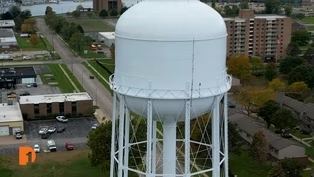
Benton Harbor's Lead Water Crisis
Video has Closed Captions
Clip: S5 Ep35 | 6m 20s | This week, the EPA started testing more homes for lead in the water. (6m 20s)
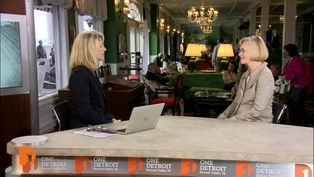
The Community Foundation's Mariam Noland
Video has Closed Captions
Clip: S5 Ep35 | 26m 39s | Mariam Noland has led the Community Foundation for Southeast Michigan for 36 years. (26m 39s)
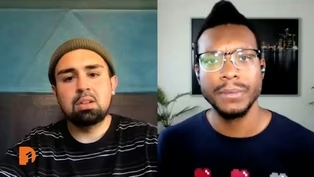
Video has Closed Captions
Clip: S5 Ep35 | 2m 1s | Duran helped create Southwest Fest to showcase artists from around the area. (2m 1s)
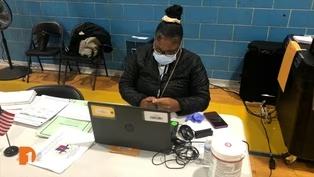
What's Behind Low Voter Turnout in Detroit?
Video has Closed Captions
Clip: S5 Ep35 | 6m 9s | A closer look at the reasons behind Detroit's low voter turnout this election cycle. (6m 9s)
Providing Support for PBS.org
Learn Moreabout PBS online sponsorship
- News and Public Affairs

Top journalists deliver compelling original analysis of the hour's headlines.

- News and Public Affairs

FRONTLINE is investigative journalism that questions, explains and changes our world.












Support for PBS provided by:
One Detroit is a local public television program presented by Detroit PBS