
Best Of: Detroit Creatives
Season 6 Episode 39 | 26m 46sVideo has Closed Captions
Best Of: Detroit Creatives
Author Aaron Foley on his debut novel, "Boys Come First," which follows three Black gay millennial men maneuvering through their 30s in Detroit. Then, artist Sterling Toles about a new spring 2022 exhibit focused on Black artists at the Museum of Contemporary Art and Design. Plus, a conversation with the 2021 Kresge Eminent Artist, Detroit artist and educator Shirley Woodson. Episode 639
Problems playing video? | Closed Captioning Feedback
Problems playing video? | Closed Captioning Feedback
One Detroit is a local public television program presented by Detroit PBS
Best Of: Detroit Creatives
Season 6 Episode 39 | 26m 46sVideo has Closed Captions
Author Aaron Foley on his debut novel, "Boys Come First," which follows three Black gay millennial men maneuvering through their 30s in Detroit. Then, artist Sterling Toles about a new spring 2022 exhibit focused on Black artists at the Museum of Contemporary Art and Design. Plus, a conversation with the 2021 Kresge Eminent Artist, Detroit artist and educator Shirley Woodson. Episode 639
Problems playing video? | Closed Captioning Feedback
How to Watch One Detroit
One Detroit is available to stream on pbs.org and the free PBS App, available on iPhone, Apple TV, Android TV, Android smartphones, Amazon Fire TV, Amazon Fire Tablet, Roku, Samsung Smart TV, and Vizio.
Providing Support for PBS.org
Learn Moreabout PBS online sponsorship- [Narrator] Just ahead on One Detroit, you'll meet some of the interesting and creative Detroiters we've highlighted on Detroit public television.
We'll hear from a journalist whose new work of fiction focuses on being black and gay in Detroit.
Also, a local artist lands his first solo exhibition at the Museum of Contemporary Art Detroit.
Plus, legendary artist, Shirley Woodson, talks about her career, which spans more than six decades.
And, a musical performance by Laura Rain and The Caesars.
It's all coming up next on One Detroit.
- [Male speaker] From Delta Faucet's to Behr Paint.
Masco corporation is proud to deliver products that enhance the way consumers all over the world experience and enjoy their living spaces.
Masco, serving Michigan Communities since 1929.
Support for this program is provided by the Cynthia & Edsel Ford Fund for Journalism at Detroit Public TV, the Kresge Foundation.
- [Female Speaker] The DTE Foundation is a proud sponsor of Detroit Public TV.
Among the States largest foundations committed to Michigan focused giving.
We support organizations that are doing exceptional work in our state.
Visit DTEFoundation.com to learn more.
- [Male Speaker] Nissan Foundation and viewers like you.
(intense low tempo music) - [Narrator] Just ahead on this week's One Detroit, we're placing the spotlight on Detroiters in the fields of art, music and literature.
Coming up, she's an artist, educator and the 2021 Kresge Eminent Artist.
Shirley Woodson sits down with American Black Journal's, Stephen Henderson to talk about her career, her art, and her protégés.
Also, Detroit native, Sterling Toles explains the creative process for his unique style of art, which earned him a solo exhibition at the Museum of Contemporary Art Detroit.
Plus, Laura Rain and The Caesars capture the soul of Detroit in their music.
We'll get a sample of their funky sound from Detroit Performs: Live from Marygrove.
But first up, journalist Aaron Foley has a new book out.
It's the first venture into fiction for the native Detroiter who lives in New York and works as a senior editor for PBS Newshour's Communities Initiative.
Foley's novel, "Boys Come First," is the story of three gay black friends in Detroit.
One Detroit contributor, AJ Walker, caught up with Foley at his recent book reading.
(low tempo music) - [Aaron Foley] A city like Detroit is a city full of character.
With writing about Detroit, you have an opportunity to talk, especially about black Detroiters, black westerners, types of characters you don't always see in literature all the time.
- [AJ Walker] Author Aaron Foley has penned his third book.
This one is his first novel and is particularly special to him.
- [Aaron Foley] I like to think of it as a love letter to Detroit.
I try to pour as much of the city, the east side, the west side, all of that, into it.
- [AJ Walker] Not only does Aaron Foley's book, Boys Come First, show the character of Detroit, it covers controversial topics.
- [Aaron Foley] I also really wanted to talk about sort of the intersectionality between blackness and queerness.
As I go to bookstores and look for stories and things like that, I read a lot but I don't read a lot about what is it like to be black and queer at the same time.
- [AJ Walker] How does it feel to be reading from your own book?
- [Aaron Foley] It's very weird.
I do not like it.
(Aaron laughs) I mean I do like it.
It's just very awkward because it's just like some times as a writer, you try to take yourself out of yourself.
And try to put yourself in the voice, in the shoes of a character.
And so I'm reading almost like someone else's words and it's just like, wait a minute, did I write this or not?
- [AJ Walker] He hopes his own identity as being black and gay can give a first hand perspective that can provide valuable insight and an authentic experience for readers.
- There's an idea that we might not be "as masculine" as the next man.
And how sometimes there's the expectation to cope with and not really live in our true selves.
- [AJ Walker] He writes from the perspective of a community that has been often ostracized, which is something he feels is important to achieving equality in marginalized communities.
- How important is it to have real authentic representation?
Because to me, I feel like for so long there has been a white male dominated industry in the media and these people select our representation but that's not really true representation if it's not coming from people within that culture.
- When we look at queer media, generally the face is a white male.
When we look at the face of movements like It Gets Better or who are some of the bigger power players, like on Broadway, on stage, on screen and what not, even love interests quite often, black characters or people of color period, are missing in those stories.
I felt it was really important to have three characters as in this book, who are fully formed, confident, gay black men, who love who they are, deserve to be loved out loud.
And represent themselves to the fullest.
- [AJ Walker] Foley makes it a point to note that his book is not all about the trials and tribulations of the black gay urban community.
- It's also important to recognize joy.
There is joy that comes with being black.
There is joy that comes from being gay, and from being confident and loving yourself and loving the people around you.
- [AJ Walker] He also makes it a point not to focus on Detroit's rocky past as some books and other media have previously done.
- [Aaron Foley] There are books about abandoned neighborhoods and crime being rampant and everything about the bankruptcy and things like that, we absolutely should be talking about that.
But I want people to also understand that people make their homes here.
There are people who stay, people who continue to love this place and extract love from Detroit, give love to Detroit.
- [AJ Walker] Foley says he's written a smart and in-depth book that will take readers on a journey into Detroit and into a world they may not have been comfortable to brave in real life or in fiction.
- [Narrator] The spring exhibition series at the Museum of Contemporary Art Detroit celebrated the city's diverse cultural history and black creativity.
The show included the works of Detroit native, Sterling Toles.
This was the first museum solo exhibition for Toles and featured his unconventional and creative style.
One Detroit contributor, Eden Sabolboro, has his story.
(intense low tempo music) - [Sterling Toles] My process is doing whatever I have to do in the creative process to fully return to a space of love.
I always tell people my work is not the work, but what the work does to my humanity is the true work.
My name is Sterling Toles.
I am a cross pollinating creative.
(Sterling laughs) So we are in the Mike Kelly mobile homestead at the Museum of Contemporary Art and I have an exhibition going on here called Shelves.
So I was brought into this project by Curator, Joe Vulin.
Joe is aware of the work that I've been doing in community for a long time which was kind of using are as a tool to create community and also collective healing.
This work was informed by many community conversations.
I was really fixated on this idea of the relationship between trauma and identity.
All of us have experienced pains and hurts and traumas and regrets and guilts and doubts.
And we try to evolve past those but how do you do so when the identity that you refuse to let go of was born out of those things.
This exhibition is an exploration of a lot of different materials and mediums.
I thought it would be interesting to use materials that have derived from industrial spaces and so a lot of those materials are used in the transference of energy.
Thinking about the true nature of our humanity, really we are not these static things, we are the constant transference of energy.
Having a solo exhibition for the first time has been very interesting because I never anticipated ever having one, never pursued having one.
My creative practice is always centered around intimacy.
It's interesting to be thrusted into positions where there is greater visibility because so much of what I'm doing is just about internal introspection.
I wanted to do a few portraits as a representation of identity.
But when I started to think about identity, I thought about the quandary of how identity doesn't allow us to see others fully.
Often times we can only see the parts of people that support the perspective that our identity holds.
So there's often a partition between us where we don't fully see people and we aren't seeing fully.
And so I just think it's an interesting relationship to each other as we see only bits and pieces when we make eyes, when we engage, when we make contact.
It means everything to me to have my first solo exhibition in Detroit because everything that I think I've done creatively in some way has something to do with Detroit.
What got me interested in being an artist was the realization at a very early age that I can transform how I felt inside by me making things.
I think Mocad's goal for me doing this exhibition was to have somebody that is really in the trenches in community.
Kind of create things that hopefully recharge and revitalize the people that really hold this city up.
I think the diversity of exhibitions and art in a particular space is so important because it allows people to see parts of themselves in an experience to where now they can engage in a way in which their internal power joins the collective force.
That hopefully is about change in justice and resolution, revolution.
(Sterling laughs) I think we're in a time now where we hopefully beginning to realize that we are a tree.
That sustenance that the tree needs involves the energy of everybody to participate, for it to be nourished adequately.
The works of Detroit artist and educator Shirley Woodson, are displayed in collections across america, including the studio museum in Harlem and the Detroit Institute of Arts.
Last year, Woodson was named Kresge Eminent Artist and a special exhibition at the Detroit Artists Market celebrated her work and that of her protégés.
American Black Journal's Stephen Henderson spoke with Woodson about her storied career.
(intense low tempo music) - I would love to start with you telling me about how you got started as an artist.
What was it that made you want to make this your life?
An honor like this kind of inspires that question.
How did this all begin for you?
- Well I guess as far back as I can remember.
Other than my dolls and other toys, the next sort of thing certainly was school.
My kindergarten experience I guess was probably my first actual realization that there was something wonderful out there that I wanted to do.
And it sort of just carried me right on through.
- [Stephen Henderson] And for you, is art a vehicle for certain kind of messages?
I think many artists are using the medium that they work in to say something.
- Art for me was always a key to something else.
I learned history, or I learned to understand more about history through the art that I saw.
I think really it just brought about so many connections.
When I was in school, I took French.
I was an art student by that time but when I first took French, I said, well if you take French, then you have to go where they speak French.
(Stephen and Shirley laugh) I didn't know anything about Toronto and all that but certainly the art source was Paris, was France.
And I could go to the museum and see those works and so that was always the - that was also the destination point for me.
To see work.
And anything that I studied, I could always make that connection to history, to China, the beautiful ceramic works of different periods of course.
- So you also have a new exhibit at the Detroit Artist Market which is one of my favorite institutions in Detroit.
Tell me about that exhibition and how you put it together.
- So I've been working, I work all the time, my practice is ongoing.
And so I had work that I was involved with at the time, so I thought I would show a lot of works that had not been seen before.
I concentrated on drawings that I had not shown in a group and went ahead with a real drawing exhibition.
And so I was able to include that work and other paintings related to one of my themes, which is water.
And I started another series and so I sort of gathered it together in that way and then I also was showing some work that was really adventurous for me.
I did four neon works that related to my writing.
And so that's sort of how it all got pulled together.
- There is also some work of your proteges in this exhibit.
- Oh yes, I've had wonderful students.
As an educator, I've had wonderful students.
And since as we've known each other for so many years, if I had, for example, my student (indistinct), we're of course colleagues at this point, and so when we talk together, I said, yeah we went to (indistinct) together.
(Stephen and Shirley laugh) We had a class together way at wherever I was teaching.
I had to refer to them in that way when they were students but they were colleagues as well.
- That's very exciting.
So you have six decades of work to share with the world at this point and it's in places all over the country.
Including here at the DIA.
A lot of the work is of course is telling the stories of African American life and I wonder if you can talk some about how important that dimension of your work is.
- Well that work is important.
African American artists have all kinds of stories, it's just one more story.
- [Stephen] Mhmm.
- Of the Jacob Lawrence definitely told the stories.
Romare Bearden, Elizabeth Cattle, they definitely told the stories wherever they were, whatever their life was about or whatever life that they were encountering was about.
And my story is the same.
My thoughts, my experiences.
I always wanted to be a totally abstract artists, like I said at one point I said I'll never paint any people, I just want to paint ideas and otherness quality.
Which I did but I eventually had to relate both of those so the viewer, the people, would be able to see themselves somehow in the work and see if that added to their experiences, to enlighten their own experiences.
And that was basically my approach.
- Yeah, I also wonder if you could talk a little about what the last year and a half has been like?
- The pandemic this past year and a half has just obliterated time.
I have no sense of time.
What is today?
Today's Thursday, no it's Tuesday.
I mean there's nothing that distinguishes really one day from another and you're in a constant state of waiting.
Waiting for it to go away, subside and all of the other events that have been a part of this.
It's made a difference in people.
I think my colors became even brighter during this period because you just wanted more joy out there in the world.
- [Narrator] That will do it for this weeks One Detroit.
To close tonight's episode, here's a special performance from Laura Rain and The Caesars.
Their music captures the energy and rhythm that made the motor city famous.
Here they are performing one of their original songs on Detroit Performs: Live from Marygrove.
(light soul music) ♪ How could you know ♪ ♪ If you never know me ♪ ♪ But my love is pure ♪ ♪ Just look and see ♪ ♪ How can I show you ♪ ♪ I've lost a lifetime of love ♪ ♪ If you don't need me ♪ ♪ I've already given up ♪ ♪ I'm chasing my past ♪ ♪ Where would I go ♪ ♪ I'm running too fast ♪ ♪ Where would you be ♪ ♪ My love is all I have ♪ ♪ If I can't have you ♪ ♪ I've found the only chance ♪ ♪ If I can't have you ♪ ♪ What would I do without you ♪ ♪ If I can't have you ♪ ♪ I only live and learn with you ♪ ♪ If I can't have you ♪ ♪ If I can't have you ♪ ♪ If I can't have you ♪ ♪ If I can't have you ♪ ♪ If I can't have ♪ ♪ How could you feel ♪ ♪ What I can't see ♪ ♪ When you let go ♪ ♪ You still have me ♪ ♪ Haven't I shown you ♪ ♪ I've lost a lifetime of love ♪ ♪ If you don't need me ♪ ♪ I've already given up ♪ ♪ I'm chasing my past ♪ ♪ If I can't have you ♪ ♪ Where would I go ♪ ♪ If I can't have you ♪ ♪ I'm running too fast ♪ ♪ If I can't have you ♪ ♪ Where would you be ♪ ♪ If I can't have you ♪ ♪ My love is all I have ♪ ♪ If I can't have you ♪ ♪ I've found the only chance ♪ ♪ If I can't have you ♪ ♪ What would I do without you ♪ ♪ If I can't have you ♪ ♪ I only live and learn with you ♪ ♪ If I can't have you ♪ ♪ If I can't have you ♪ ♪ If I can't have you ♪ ♪ If I can't have you ♪ ♪ If I can't have you ♪ ♪ Where would you go ♪ ♪ What would you do ♪ ♪ Who would you be ♪ ♪ If I can't have you ♪ ♪ If I can't have you ♪ ♪ I'm running too fast ♪ ♪ If I can't have you ♪ ♪ If I can't have you ♪ ♪ If I can't have you ♪ ♪ If I can't have you ♪ - [Male Speaker] From Delta Faucets to Behr Paint.
Masco corporation is proud to deliver products that enhance the way consumers all over the world experience and enjoy their living spaces.
Masco, serving Michigan communities since 1929.
Support for this program is provided by the Cynthia and Edsel Ford Fund for Journalism at Detroit Public TV.
The Kresge Foundation.
- [Female Speaker] The DTE Foundation is a proud sponsor of Detroit Public TV.
Among the States largest foundations committed to Michigan focused giving.
We support organizations that are doing exceptional work in our state.
Visit DTEFoundation.com to learn more.
- [Male Speaker] Nissan Foundation and viewers like you.
(light upbeat music)

Video has Closed Captions
Clip: S6 Ep39 | 4m 29s | ‘Boys Come First’: Aaron Foley’s Debut Novel Follows Three Millennial Gay Black Friends (4m 29s)
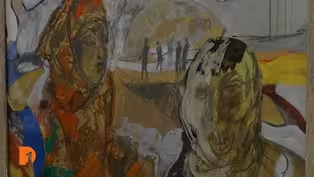
Detroit Artist Shirley Woodson Named 2021 Kresge Eminent Art
Video has Closed Captions
Clip: S6 Ep39 | 4m 48s | Detroit Artist Shirley Woodson Named 2021 Kresge Eminent Artist (4m 48s)
Video has Closed Captions
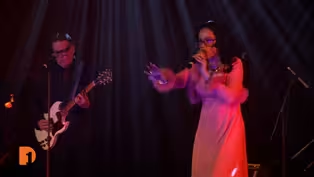
Clip: S6 Ep39 | 4m 48s | Laura Rain & The Caesars Bring R&B, Soul to the Detroit Performs Stage (4m 48s)

MOCAD Launches Spring Exhibit Celebrating Black Artistry
Video has Closed Captions
Clip: S6 Ep39 | 5m 6s | MOCAD Launches Spring Exhibit Series Celebrating Black Artistry in Detroit (5m 6s)
Providing Support for PBS.org
Learn Moreabout PBS online sponsorship
- News and Public Affairs

Top journalists deliver compelling original analysis of the hour's headlines.

- News and Public Affairs

FRONTLINE is investigative journalism that questions, explains and changes our world.












Support for PBS provided by:
One Detroit is a local public television program presented by Detroit PBS