
Lebanese skeptical of Israel agreement as violence continues
Clip: 7/21/2026 | 9m 20sVideo has Closed Captions
Southern Lebanese skeptical of Israel agreement as violence continues
When Lebanon's president met President Trump at the White House, it was the first such visit by a Lebanese head of state in nearly two decades. It comes after Lebanon and Israel resumed diplomatic relations under the auspices of the Trump administration, signing a deal meant to end a long history of wars. But as special correspondent Simona Foltyn reports, the deal is facing stiff opposition.
Problems playing video? | Closed Captioning Feedback
Problems playing video? | Closed Captioning Feedback
Major corporate funding for the PBS News Hour is provided by BDO, BNSF, Consumer Cellular, American Cruise Lines, and Raymond James. Funding for the PBS NewsHour Weekend is provided by...
Lebanese skeptical of Israel agreement as violence continues
Clip: 7/21/2026 | 9m 20sVideo has Closed Captions
When Lebanon's president met President Trump at the White House, it was the first such visit by a Lebanese head of state in nearly two decades. It comes after Lebanon and Israel resumed diplomatic relations under the auspices of the Trump administration, signing a deal meant to end a long history of wars. But as special correspondent Simona Foltyn reports, the deal is facing stiff opposition.
Problems playing video? | Closed Captioning Feedback
Where to Watch PBS News Hour
PBS News Hour is available to stream on pbs.org and the PBS app.
Providing Support for PBS.org
Learn Moreabout PBS online sponsorshipAMNA NAWAZ: When Lebanon's president, Joseph Aoun, met President Trump at the White House today, it was the first such visit by a Lebanese head of state in nearly two decades.
It comes after Lebanon and Israel resumed diplomatic relations under the auspices of the Trump administration, signing a trilateral agreement last month meant to end a long history of wars.
But, as special correspondent Simona Foltyn reports from Southern Lebanon, the deal is facing stiff opposition.
SIMONA FOLTYN: The Lebanese government has agreed to make peace with Israel, but there's little hope for that here among the ruins of a war that has yet to stop.
We're in Nabatieh, once a bustling commercial town, now devastated by Israel's punishing aerial campaign.
MOHAMMED AWADA, Nabatieh, Lebanon, Resident (through translator): The shops are all gone, and Nabatieh, as you see, is mostly destroyed.
With these strikes, they set us back 10, 15, 20 years for Nabatieh to return to what it once was.
SIMONA FOLTYN: Israeli troops have occupied the hills southeast of Nabatieh.
Even as talks with Israel continue, the fear of renewed escalation hangs in the air.
With shovels and bare hands, Mohammed, his son Hadi and a nephew are trying to salvage what's left of their shop in the old market.
Like much of the city, the Ottoman era buildings lie in ruins.
HADI MOHAMMED, Nabatieh, Lebanon, Resident (through translator): Israel are criminals who like to destroy.
They don't want us to have a good country.
SIMONA FOLTYN: Many here do still support Hezbollah, in spite of the group's decision to reenter the regional war last March in support of its ally Iran.
Mohammed is against Lebanon's deal with Israel, which he sees as a capitulation to Israeli and U.S.
demands.
MOHAMMED AWADA (through translator): This agreement protects them more than it protects us.
It's more in their than in our interests.
They are playing games.
Why haven't they withdrawn?
What is their intention?
Is their intention to take the south?
SIMONA FOLTYN: Israel currently occupies a six-mile strip all along its border with Lebanon demarcated by a Yellow Line similar to Gaza.
This area accounts for roughly 7 percent of Lebanon's territory.
As per the agreement signed on June 26, the Lebanese government must first disarm Hezbollah, and only then will there be a -- quote -- "progressive redeployment" of Israeli troops.
In Washington, the deal has been hailed as a success.
NADA HAMADEH MOAWAD, Lebanese Ambassador to the United States: The trilateral framework we signed today is a first step on the road to restoring Lebanese sovereignty and territorial integrity, securing a permanent and final cessation of hostilities, enabling our people to go back to their land.
SIMONA FOLTYN: But not much is left to return to.
Israel has continued to raze border villages to create a depopulated buffer zone.
Rights groups say such systematic demolitions could amount to war crimes.
Israeli attacks have killed dozens of people since the agreement was signed, according to Lebanon's Health Ministry.
Esperanza Ghandour, a beloved kindergarten principal, is one of them.
This is her when the kindergarten celebrated Lebanese Army Day, and here she is during last year's Christmas party.
She was killed on July 6 while on a quick trip to check on her house near Nabatieh.
Her husband, Wissam Kanso, explains what happened.
WISSAM KANSO, Husband of Israeli Strike Victim (through translator): Esperanza was driving.
Her mother was next to her.
The maid and the plumber were sitting in the back.
The strike came from here directly at my wife.
SIMONA FOLTYN: None of the car's four occupants survived.
Given Israel's advanced surveillance capabilities, Wissam finds it difficult to believe that a strike was a mistake.
WISSAM KANSO (through translator): The Israeli enemy knows every needle on the ground.
They know her car.
They know her plate number.
They have the phone numbers.
They have all the information.
SIMONA FOLTYN: Wissam feels that Lebanon's deal with Israel has come at the expense of justice for victims like his wife.
WISSAM KANSO (through translator): We haven't heard any condemnation for the killings, not from the president of the republic, not from the prime minister, nor from any official in this government.
SIMONA FOLTYN: To better understand why the school principal might have been targeted, we drove towards the strike location.
Only a few cars make the perilous journey this close to Israel's Yellow Line.
In describing the incident, the Israeli military said it had struck a vehicle that was approaching what it calls a security zone, posing a threat to its forces.
This is where Esperanza Ghandour was hit by an Israeli drone while on her way back from her village driving away from the front line.
So it's difficult to imagine how she would have been perceived as a threat to Israeli forces, who are stationed over there.
At the entrance to the village flanked by billboards of Hezbollah's past and present leaders, we met the mayor of Nabatieh al-Fawqa.
ZAIN GHANDOUR, Mayor of Nabatieh al-Fawqa, Lebanon (through translator): Her house is about 400 yards away from here on the main road.
SIMONA FOLTYN: Zain Ghandour believes Esperanza's killing was intentional.
ZAIN GHANDOUR (through translator): It's clear that this is a message to every civilian who wants to go to this area that they will target him.
She wasn't just a school principal.
She was a symbol of patriotism, a symbol of resisting the occupation, a symbol of dignity and steadfastness and clinging to the land.
SIMONA FOLTYN: The municipality has now erected a symbolic barrier to signal to civilians that it's not safe to go any further.
Inquisitive young men on motorcycles occasionally whiz by.
Hezbollah, like Israel, keeps a close eye on this area.
The village sits at the foot of the strategic Ali al-Taher Ridge, an embattled hilltop the Israeli military has yet to fully capture.
Why have the people of Nabatieh al-Fawqa not returned home until now despite the cease-fire?
ZAIN GHANDOUR (through translator): This is the crux of the matter.
There is no occupation here, and the people are supposed to go back.
But the Israeli enemy is occupying these areas through the media and through fire from the sky.
SIMONA FOLTYN: The villages adjacent to the occupation zone have become a no-man's land with no people and no state.
ZAIN GHANDOUR (through translator): The Lebanese state should take the political decision for the Lebanese army to deploy to the heart of the whole village to make people feel safe that the state is present.
SIMONA FOLTYN: We traveled further south to the village of Froun.
It lies in one of two areas designated as so-called pilot zones.
The Lebanese Army is building up a presence here.
This is one of the new Lebanese army positions that have been established to implement the Israel-Lebanon framework agreement and to ensure disarmament of Hezbollah in areas that the Israeli army is not occupying.
Once Israel is satisfied with this process, it should redeploy from Lebanese territory.
But the agreement doesn't mention the word withdrawal, nor does it stipulate a timeline for it, raising fears of an indefinite Israeli occupation.
To people here, it seems as though Israel wants the Lebanese army to finish its job and disarm Hezbollah in areas it could not seize.
The Israeli army is based on the other side of the valley, about 2.5 miles away.
HASSAN BAZZI, Mayor of Froun, Lebanon (through translator): They chose Froun as a pilot zone because of the stupidity of the Lebanese state.
SIMONA FOLTYN: Hassan Bazzi is the mayor here.
HASSAN BAZZI (through translator): Israel is inside the Yellow Line, but they chose areas adjacent to the Yellow Line, which Israel couldn't take during the war, so they're trying to take during the cease-fire.
SIMONA FOLTYN: The mayor says there's no Hezbollah military infrastructure left in the village.
But the group is deeply embedded in the social fabric of the south.
Hezbollah's yellow flags are firmly planted in the ruins, a message that it's here to stay with or without weapons.
Posters thank fighters for their sacrifice.
ZEINAB SHHADI, Froun, Lebanon, Resident (through translator): Those young men protected us.
If it weren't for them, Israel would have taken Froun and destroyed it like the other villages.
SIMONA FOLTYN: More than 200 homes in this village alone, including Zeinab's, were destroyed in Israeli strikes.
This house belongs to one of her relatives.
ZEINAB SHHADI (through translator): My house was destroyed.
During the 2006 war, it was also destroyed.
We then bought another piece of land and built another house.
We were so happy.
Then this war came, and it was destroyed again.
SIMONA FOLTYN: So little is left of the village this war around that it's difficult to imagine how people can rebuild again.
To many here, Lebanon's agreement with Israel feels not like a path to peace, but surrender.
For the "PBS News Hour," I'm Simona Foltyn in Southern Lebanon.
Anna Deavere Smith brings her family's history to the stage
Video has Closed Captions
Anna Deavere Smith brings her family's history to the stage in 'Basil Biggs' (7m 22s)
Epstein survivor calls Blanche meeting 'a performative move'
Video has Closed Captions
Epstein survivor criticizes Blanche, calls meeting 'a performative move' (7m 14s)
Hegseth says Iran war has cost $37.5B so far
Video has Closed Captions
Hegseth says Iran war has cost $37.5B so far and Pentagon needs $67B to restock arms (5m 20s)
Janesville becomes battleground in AI data center debate
Video has Closed Captions
Janesville, once a symbol of the Great Recession, becomes AI data center battleground (8m 45s)
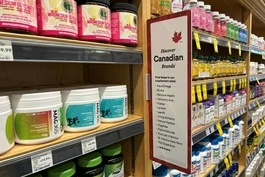
Trump raises tensions with Canada by announcing new tariffs
Video has Closed Captions
Trump raises tensions with Canada by announcing new 50% tariffs (6m 48s)
Providing Support for PBS.org
Learn Moreabout PBS online sponsorship New Episode
- News and Public Affairs

FRONTLINE is investigative journalism that questions, explains and changes our world.
 New Episode
- News and Public Affairs

Today's top journalists discuss Washington's current political events and public affairs.

 New Episode
 New Episode
 New Episode
 New Episode
 New Episode


 New Episode
Support for PBS provided by:
Major corporate funding for the PBS News Hour is provided by BDO, BNSF, Consumer Cellular, American Cruise Lines, and Raymond James. Funding for the PBS NewsHour Weekend is provided by...