
Beyond Beauty
Season 8 Episode 10 | 26m 47sVideo has Closed Captions
Host Angela Fitzgerald explores all there is to do at Yellowstone Lake State Park.
Good fishing, beautiful scenery and accessible hikes. Host Angela Fitzgerald explores all there is to do at Yellowstone Lake State Park. We also set out to show other amazing places and people found in our state.
Problems playing video? | Closed Captioning Feedback
Problems playing video? | Closed Captioning Feedback
Wisconsin Life is a local public television program presented by PBS Wisconsin
Funding for Wisconsin Life is provided by the Wooden Nickel Fund, Mary and Lowell Peterson, A.C.V. and Mary Elston Family, Leon Price & Lily Postel, Stanley J. Cottrill Fund, UW...
Beyond Beauty
Season 8 Episode 10 | 26m 47sVideo has Closed Captions
Good fishing, beautiful scenery and accessible hikes. Host Angela Fitzgerald explores all there is to do at Yellowstone Lake State Park. We also set out to show other amazing places and people found in our state.
Problems playing video? | Closed Captioning Feedback
How to Watch Wisconsin Life
Wisconsin Life is available to stream on pbs.org and the free PBS App, available on iPhone, Apple TV, Android TV, Android smartphones, Amazon Fire TV, Amazon Fire Tablet, Roku, Samsung Smart TV, and Vizio.
Providing Support for PBS.org
Learn Moreabout PBS online sponsorship- The following program is a PBS Wisconsin original production.
- Angela: Coming up on Wisconsin Life: Meet a mountain climber reaching new heights.
An artist painting with beeswax.
The go-to couple of a bustling state park.
And a drummaker preserving lessons from the past.
That's all ahead on Wisconsin Life.
[upbeat music] - Funding for Wisconsin Life is provided by Lowell and Mary Peterson, Alliant Energy, Stanley J. Cottrill Fund, American Transmission Company, Focus Fund for Wisconsin Programs, and Friends of PBS Wisconsin.
- Hi, I'm Angela Fitzgerald.
If you're looking for a sweet spot to hike, camp, or enjoy a beautiful lake in Southwestern Wisconsin, then welcome to Yellowstone Lake State Park.
No need to travel thousands of miles to see all that Wisconsin's Yellowstone has to offer.
This local park, with a famous name, sits in Lafayette County adjacent to more than 4,000 acres of state wildlife area.
As part of Wisconsin's Driftless area, this park offers delightful landscapes in every direction.
But being in the Driftless area means natural lakes can be hard to come by.
So in 1954, the gates of a new dam were closed, and this beautiful manmade lake was formed.
Now it offers respite for water recreation, swimming, and peaceful fishing.
[kids giggling] There's more here.
But before we get too caught in the brush, let's meet someone else embracing their love for the outdoors.
We meet a Bayfield mountain climber who's reached the world's highest peaks.
[lighthearted guitar music] [fast paced music] [snow crunching] - My name is Lori Schneider, and I'm a teacher, and a mountain climber, and a motivational speaker.
I spent the first 18 years of my life growing up in Janesville, Wisconsin.
Life in Wisconsin was very powerful for me.
It shaped me into a person who loved to get out into nature.
My first love of mountains came when I moved out to Colorado when I was in my early twenties and started to hike a lot of the trails and do a lot of skiing and cross country skiing.
But really, my first mountain climb happened many years later when I climbed with my father in Africa.
I remember our first trip.
- That was on my 61st birthday.
- I know it.
[laughs] - We climbed Kilimanjaro, and that's us at the summit.
- Yeah.
So, that was really the start of my mountaineering.
My father was the one who really inspired me to get out and try things that I probably wouldn't have normally done.
We rafted the grand canyon together.
We went to South America and climbed Mount Aconcagua.
So he's still very, very active at 87.
He's been really my mentor, my health mentor, and adventure mentor my whole life.
[somber music] I'll never forget the day.
It was January 4th, 1999.
And I woke up in the morning.
I realized that half of my body had gone numb overnight.
I called the doctor, and they had me come in for tests.
When I was told I had MS, I thought I was immediately going to be wheelchair-bound.
I was so afraid.
I thought it was the end of... of life as I knew it.
[rock music] That's when my climbing really accelerated because I wanted to do it all and prove to myself that I still had some control over my body.
Since being diagnosed with MS, I've climbed the Seven Summits, which refers to the highest peak on each of the seven continents.
Kilimanjaro in Africa, Mount Aconcagua in South America, Mount Elbrus in Europe, Denali, or "Mount McKinley" as it was called in North America, Mount Kosciuszko in Australia, the Vinson Massif in Antarctica, and Mount Everest in Asia.
After finishing the Seven Summits, I thought what I wanted to do was help other people with this disease realize that MS isn't a death sentence.
So, I started organizing trips where a helicopter would drop people on a high mountain peak.
They could hike for as long or as short as they wanted to, and then a helicopter would take them back.
I think the misconception is that someone with MS can't do anything.
And I hope that their employers, their friends, their families will look at them as strong people and not weak.
I don't want people to think that because I can be physically active that they're not trying hard enough because they aren't.
[treadmill running] I am very fortunate to still have my mobility intact.
And really, over the last decade, I've not had any symptoms.
Everyone's case of MS is very different.
And there are many people that are horribly disabled from this disease.
I often wonder what would have happened in my life had I not been diagnosed with MS.
When I got diagnosed, I thought, "I want to climb the Seven Summits."
And even though it took me 16 years to complete that final chapter, it was something that I felt determined to do.
So, in many ways, it was such a catalyst for me to live a more adventurous life than I would have without it.
And I think that that has been my goal: to live a better life with MS than I could have conceived without it.
- Next, we go to Stevens Point, where an artist is creating buzz with her vibrant paintings.
[orchestral music] - Encaustic art is beeswax paintings.
[laughs] I always hear, "Beeswax paintings?"
They just can't believe it.
It's considered one of the first forms of easel painting.
It's ancient, 2,000 years ago.
It's incredible.
My name is Jessie Fritsch.
I am an encaustic artist, and I have been painting with beeswax for 14 years.
I live in Stevens Point, Wisconsin.
♪ ♪ Encaustic is one of the most durable forms of painting.
Beeswax is a natural preservative.
It's a natural adhesive, resistant to moisture, resistant to insects.
So, these paintings will last for thousands and thousands of years.
I found that truly fascinating.
I was fascinated by the ancient history.
And then, once I actually used the medium and saw how vibrant the colors were, I was completely hooked.
The thing is, with encaustic, you don't have time to really ponder and think about where the wax is going to go once it leaves the heat source.
So a lot of times, I like to have somewhat of a detailed drawing in place, so I know exactly where the wax is going to go, so I don't have to think about it.
Then, I can start the fun part of applying the wax.
Beeswax just needs something rigid and porous to adhere to.
So, I primarily paint on wood.
[tap, tap] Beeswax paint is simply beeswax, powdered pigments, the same powder pigment that are in oils or watercolor, and then damar resin, which is a tree sap.
With encaustic, there is no drying time.
You have about five to eight seconds to put the paint down before it just begins to clump up and won't flow off your brush anymore, and you have to reheat it.
So, I'm constantly reheating my brush and my paint, applying the paint, then immediately going back, reheating my brush and my paint, applying it again.
The big issue with encaustic is the fumes, is the ventilation.
So, beeswax is actually toxic if you heat it over 250 degrees.
I heat it at around 180° to 200°.
And after 250°, it starts smoking and creates formaldehyde and another carcinogenic.
No respirator will save you from those fumes, so you can see in my art studio I have a very strong ventilation system.
[soft scraping sound] Wax is very forgiving in the sense that if you put it down and you didn't like it, you can just scrape it off and start over.
It's not like watercolor, like, you can't make a mistake.
However, the part that it's not forgiving in is the fusing part, which is absolutely essential to encaustic.
All right, I'm ready to fuse.
The word "encaustic" comes from the Greek work enkaustikos, which means "to burn in."
So each layer of beeswax must be fused or burned in to the layer of wax beneath it.
The overall goal with fusing is you're trying to make one cohesive sheet of wax.
I basically need to heat the paint up to 180 degrees on my surface.
So, it will adhere to the layer beneath.
The minute the wax cools, it is finished, and you can paint another layer of wax.
I'm not a patient person in life.
But somehow, with encaustic, I'm able to be patient because, as you can see, there's all these different steps to this process.
A piece will take me, like, a week or two weeks, depending on how big it is.
To really finally, like, sit back and look at it, you just see it differently, you know?
You invest all this time in something.
It's really just satisfying.
You know, when you talk to so many kids, right, v "What do you want to be when you grow up?"
Probably like a handful will be like, "Oh, I want to be an artist!"
you know?
Of course, I always said that 'cause I always was passionate about it; I always liked art.
And I was just, I was good at it.
But did I think that that would really end up being my career?
Well, it can, if you work at it.
And it is thrilling to just sit and watch people be like, "Oh, my God, that's beeswax?
Are you serious?
Like, what?"
And you just tell them the ancient history.
Then they're, like, completely blown away.
I just really enjoy teaching people about something that is a lost art.
- There's nothing more refreshing than a shaded hike on a hot day.
From hike-able hills to shimmering shorelines, Yellowstone Lake State Park is more than meets the eye.
[lighthearted guitar music] Wisconsin's Yellowstone Lake State Park is a year-round destination with a rich array of natural resources.
I sat down with park manager Mike Watt to learn about the scenic wonders and adventures to be found here.
So, we've been spending a lot of time in your park.
So, can you tell us a little bit about what people that are interested in visiting, what they could expect?
- Oh, well, there's lots of things to do in the park.
We've got the hiking.
You can mountain bike.
You can swim at the beach.
You can go out pleasure cruising on your boat or go fishing.
And that's just in the park, but we also have lots of things around here.
We have a big wildlife area.
Actually, the other side of the lake here is our wildlife management area, which is quite large.
It's over 4,000 acres or just over 4,000 acres.
Because we didn't have these giant heavy glaciers moving through here flattening everything out, you've got really nice ridges and hills and valleys and stuff.
- Which makes for nice hiking.
- Yes, exactly.
- Got it, okay.
- Beautiful vistas and lots of great hiking.
- Okay, wonderful.
And I understand there's dams in this park, as well.
- Yes, yes.
- Okay.
- So, actually, just over here, we have a dam that blocks off the lake.
It was put in in the early 1950s.
So, I think in 1955, they put the dam in.
And then, it filled up with water.
And then, it became what you see today.
[soft, gentle music] - There's something for everyone here, especially campers.
- So we have camping here.
We have 128 campsites.
- Wow.
Just in this park alone?
- Just in this park alone.
We have group sites, We have electric sites for those people that have campers, and then we have the primitive sites for tents.
So, it's a great time to camp out here.
I will say weekends are very busy this time of year.
We feel like we bring a lot to tourism in terms of bringing people in from other states as well as from other parts of Wisconsin to come visit our parks.
And it definitely benefits the local communities in a lot of ways.
- So you mentioned the wildlife management area across the lake.
- Oh, yes, yes.
- Can you tell us more about, like, that as well as conservation that exists in this area?
- Oh, sure.
So, the wildlife management area, again, I told you, is about 4,000 acres.
It's managed by, we have wildlife biologists that manages that property, that they're managing it for all kinds of different things-- everything from endangered species to game species, all those kinds of things.
One other unique thing about the park is we have a lot of bats in the park.
And so, we have at least on the, in the park side, we have a lot of bat houses, which you may have seen around the property.
And it used to be a very big draw, but, unfortunately, there's a disease called white-nose syndrome that's caused a lot of problems for bats in there.
So, the population's reduced, but we still have quite a few bats around, and for campers, they're great 'cause they help with the mosquitoes.
So, you don't see a lot of mosquitoes in the campground because of that.
They're a cool, unique species that we'd like to do what we can to help.
- Thank you so much for that, Mike.
[soft guitar music] A wild and gorgeous landscape that adds to the treasures found in Southwest Wisconsin.
After all that exploring, the lake is looking pretty refreshing right about now.
But before I get any wild ideas, let's jump into our next story as we head to Mirror Lake State Park in Baraboo to catch up with a couple who volunteers as campground hosts.
[lighthearted guitar music] While most people go camping to relax and leave their responsibilities behind, campground hosts at Wisconsin State Parks sign up to stay at the parks and work.
- Hi, I'm Gary Zarcone.
I'm a campground host here at Mirror Lake State Park.
- And I'm Elaine Zarcone.
[snapping firewood] - Gary: Well, we did camp when our children were young in a tent and did that for a few years, then stopped, and then started up again 12 years ago.
[UTV engine humming] - Angela: Retirement offered Elaine and Gary the opportunity to get back into camping with a three-fold goal.
- Oh, the idea of using our camper more often, getting out to the parks, and also providing service to the campers.
- Elaine: There were opportunities to camp host here, and so we took advantage of it.
[lighthearted guitar music] - Gary: As campers leave, we go in and clean up the fire rings, pick up trash.
- Angela: Making sure the sites are cleaned before the next group comes in can be quite a challenge.
The checkout time at state park campgrounds is at three o'clock.
Check-in for the next group of campers is... three o'clock.
[drums playing] - It doesn't leave a lot of time to sometimes do, you know, 20, 30 sites.
On Sundays, it's a big day.
Sundays, I'll be working from 8:30 / 9:00 till 5:00 or 6:00.
- Elaine: And if the weather's really nice, then they usually stay, hang around right until almost the three o'clock mark.
- Gary: And I don't blame them for staying.
[chuckling] - Elaine: No, I don't either.
We have also helped out by monitoring the sale of the firewood.
There you go.
Are you trying to get a couple more?
We have to check to make sure there's enough toilet paper, but we don't clean the bathrooms.
- If we see something along the roads or the paths or the trails, we'll pick it up and dispose of it.
And also, providing assistance.
So, I had the back up someone's trailer in for them once.
[flute playing] - Angela: Although it's hectic at times, Elaine and Gary take advantage of their stay to relax and enjoy traditional camping activities.
- Well, we brought our bicycles along, so we might go do some bike riding.
[playing flute] Elaine and I both play some music.
So we may take out our instruments and practice a little.
[playing guitar and flute] [fire crackling] We read.
- Elaine: And hike.
- Gary: And hike, yes.
The most often asked question is, "Where's a good trail for hiking?"
And then, Elaine takes over.
She knows the trails very well.
- My favorite part is being outdoors and meeting tons of people.
Very interesting people.
Just the opportunity to be sitting outdoors, having your coffee.
And I can do this at home, but there's something different about doing it right in the middle of the woods.
[UTV motor rumbling] Morning.
- Morning.
And I would agree exactly.
Our neighborhood changes every couple of days.
So, we get to meet new neighbors quite often.
[playful piano] - We now travel to Ashland County, where a drummaker is preserving a language and traditions passed down through generations.
[soft guitar music] [geese honking] [fire crackling] - Out in the woods and into nature, Dylan Jennings finds life and energy.
[thud] - It's a very powerful place.
- It's this sense of place that has grounded Dylan.
- This time of the year, we're finishing up sugar bush, our Iskigamizigewin.
- The maple syrup season marks the arrival of spring in Ashland County for the Bad River Band of Lake Superior Anishinaabe.
- It's a very humbling thing to think about when you realize that everything you need to survive and to live healthy and to live a really good life is right in our own backyard.
- As a twenty-something, Dylan is very aware of where his people have been.
It's the lessons of the past that carry him forward.
- Our reservation was established in the Treaty of 1854.
[geese honking] The majority of our reservation is on the south shore of Gichigami or Lake Superior, but we're predominantly located in wetlands all over the place.
My spirit itself gravitated towards this place because of the spiritual power that these homelands have for us as Anishinaabeg.
My name is Dylan Jennings, or Bizhikiins is the name that was given to me.
- Preserving and protecting the indigenous language is also important to his way of life.
- Aaniin nindinawemaaganidog, (Hello all of my relatives) niijii gakina.
(and friends) Niin sa Bizhikiins indizhinikaaz.
(I am known as Bizhikiins.)
Waabizheshi nindoodem.
(I am of the marten clan.)
Mashkiiziibi nindoonjibaa.
(I am from mashkiiziibi.)
Good evening, everybody, in our beautiful and descriptive Ojibwe language.
- It's a language the tribe is trying to resurrect.
- We try very hard to speak to my first-born daughter as much Ojibwe as we possibly can so that she grows up understanding and comprehending our language.
♪ ♪ - Passed down through the generations, language, culture, and ancient traditions go hand-in-hand.
- I've been making drums-- or trying to make drums-- since I was a little kid.
Every hide is different too.
This one is elk hide.
You don't want to pull 'em too tight.
And then, you don't want to make 'em too loose either.
The drum has taken me all over the world traveling, and that's one of our teachings.
You take care of the drum; the drum will take care of you.
That's a very real and true statement.
The drum then dries, kind of molds to that frame.
- Taking care of the drum is both sacred and ceremonial.
[drum reverberates deeply] [chanting with drumbeat] - People recognize the drum as being our heartbeat of Mother Earth and the power that it brings to our circles and our ceremonies and our communities.
I was very fortunate to be exposed to some of our ceremonies, and some of our language at a young age.
And I'm also very inquisitive about those things.
You know, my grandmother was a really big advocate for our way of life.
Cultural revitalization is a huge component of all the work that we do nowadays as tribal communities.
It's almost as if we are picking up the pieces of what's left.
♪ ♪ - Calendula is a powerful skin healer.
- Picking up the pieces and forging ahead also meant a foray into politics.
- I had a lot of our community members approach and ask me if I would consider it.
I think I was one of the youngest individuals to be elected into this capacity in our community.
- In addition to being a young tribal leader, Dylan also works for the Great Lakes Indian Fish and Wildlife Commission, educating young and old alike.
[students chattering] - I knew at a young age that teaching in some capacity was going to be a part of my life.
And outreach specifically and educating people on our way of life.
That's what I do for a living.
That's the portal, or that's the gateway or nexus to eliminating stereotypes, to eliminating misconceptions about indigenous people, and to help us all to move forward in a better and more productive society.
This drum here was created, and there was a lot of good blessings put into it when it was created.
- Moving forward with lessons from the past, Dylan is a role model for the next generation.
[chanting with drumbeat] - I stay drug- and alcohol free.
Stay close to our ceremonies, try to learn our language, and try to be a good example for our young people.
[striking drum in unison] If you're still waking up every day, you're healthy, you have relatives that care about you, and you feel good about yourself and who you are, I think that's what success is for Anishinaabe.
- It may be hot, and making my way through this extensive park is no easy feat, but well worth it.
If you'd like to learn more about Yellowstone Lake State Park or any of the people we met today, visit WisconsinLife.org.
As always, share your stories and favorite places with us by emailing Stories@WisconsinLife.org.
Until next time, I'm Angela Fitzgerald.
And this is our Wisconsin Life!
Bye!
[upbeat music] [birds chirping] [children laughing] - Funding for Wisconsin Life is provided by Lowell and Mary Peterson, Alliant Energy, Stanley J. Cottrill Fund, American Transmission Company, Focus Fund for Wisconsin Programs, and Friends of PBS Wisconsin.
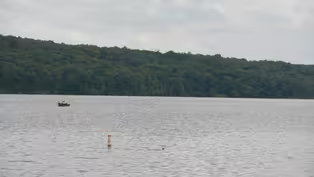
Angela Fitzgerald Explores Yellowstone Lake State Park
Clip: S8 Ep10 | 3m 9s | Host Angela Fitzgerald explores all there is to do at Yellowstone Lake State Park. (3m 9s)
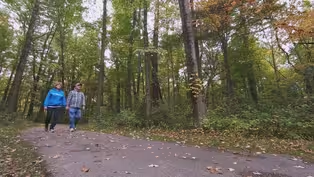
Clip: S8 Ep10 | 3m 40s | Elaine and Gary Zarcone enjoy assisting campers at Mirror Lake State Park. (3m 40s)
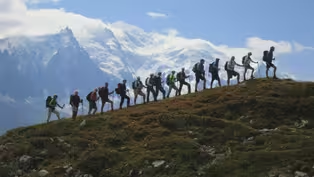
Clip: S8 Ep10 | 5m 7s | Lori Schneider has multiple sclerosis but that doesn't stop her from climbing mountains. (5m 7s)
Providing Support for PBS.org
Learn Moreabout PBS online sponsorship













Support for PBS provided by:
Wisconsin Life is a local public television program presented by PBS Wisconsin
Funding for Wisconsin Life is provided by the Wooden Nickel Fund, Mary and Lowell Peterson, A.C.V. and Mary Elston Family, Leon Price & Lily Postel, Stanley J. Cottrill Fund, UW...