Inside California Education
Beyond the Classroom
Season 4 Episode 3 | 26m 46sVideo has Closed Captions
Monterey Bay Aquarium, School Employees, Calaveras Big Trees State Park, My Masterpieces.
Discover how the Monterey Bay Aquarium is taking a deep dive into education, offering an immersive experience to these Placer County students. Meet school employees who are reimagining their jobs during the pandemic -- from a bus driver delivering laptops to a librarian keeping kids well-read. Join us as we visit Calaveras Big Trees State Park, where a park interpreter leads students from Los An
Problems playing video? | Closed Captioning Feedback
Problems playing video? | Closed Captioning Feedback
Inside California Education is a local public television program presented by KVIE
Funding for the Inside California Education series is made possible by the California Lottery, SchoolsFirst Federal Credit Union, Stuart Foundation, ScholarShare 529, and Foundation for the Los Angeles Community Colleges.
Inside California Education
Beyond the Classroom
Season 4 Episode 3 | 26m 46sVideo has Closed Captions
Discover how the Monterey Bay Aquarium is taking a deep dive into education, offering an immersive experience to these Placer County students. Meet school employees who are reimagining their jobs during the pandemic -- from a bus driver delivering laptops to a librarian keeping kids well-read. Join us as we visit Calaveras Big Trees State Park, where a park interpreter leads students from Los An
Problems playing video? | Closed Captioning Feedback
How to Watch Inside California Education
Inside California Education is available to stream on pbs.org and the free PBS App, available on iPhone, Apple TV, Android TV, Android smartphones, Amazon Fire TV, Amazon Fire Tablet, Roku, Samsung Smart TV, and Vizio.
Providing Support for PBS.org
Learn Moreabout PBS online sponsorshipChristina: Coming up on Inside California Education...
Discover how the Monterey Bay Aquarium is taking a deep dive into education... offering an immersive experience to these Placer County students Katy: Does anybody recognize any of the other three animals?
Does anybody know what they are?
Christina: We'’ll also meet school employees who are reimagining their jobs during the pandemic... from a bus driver delivering laptops... to a librarian keeping kids well -read.
Catherina: The kids are so sweet and it really makes my job worth it, because the whole point of me being in here is to get books to them.
Christina: Plus, join us as we visit Calaveras Big Trees State Park, where a park interpreter leads students from Los Angeles on a virtual field trip.
Jenny: What's a footless long, short animal that's dangerous?
Kids: Snake.
Kid Not a snake.
Christina: And explore an award-winning arts program in Pasadena that introduces every student in the district to a local museum or cultural institution.
Patrick: Each grade level, they're experiencing something truly magical.
Christina: It'’s all next...on Inside California Education!
Funding for inside California Education is made possible by: At the California lottery.
We're focused on our mission to provide supplemental essential funds to public schools, kinder through college, helping to keep teachers on staff or pay for new, school computers, band equipment, and other instructional materials and services.
Since 1985, we have raised more than $37 billion and more than 95% of our sales go back to the community.
Music, to all of our ears, California lottery, helping schools and communities across California.
The Stuart foundation, improving life outcomes for young people through education ScholarShare 529, California state sponsored tax advantage 529 college savings plan designed to help pay for the cost of higher education.
Additional funding for Inside California Education is made possible by these organizations supporting public education.
♪♪ ♪♪ TYLER: PERCHED ALONGSIDE THE RESTLESS PACIFIC OCEAN IS THE MONTEREY BAY AQUARIUM... ♪♪ BESIDES A MAJOR TOURIST ATTRACTION, IT'’S ALSO REGARDED AS A GLOBAL LEADER IN OCEAN RESEARCH AND CONSERVATION.
Child: Oh my gosh!
Katy: The Monterey Bay Aquarium from its founding has really valued education.
And so we have a really large education division.
Teacher: Yeah, we eat different foods alright.
TYLER: SINCE 1984, THE AQUARIUM HAS BEEN OFFERING EDUCATIONAL PROGRAMS FOR STUDENTS IN PRESCHOOL THROUGH 12TH GRADE... PROVIDING EVERYTHING FROM AFTER SCHOOL PROGRAMS TO GUIDED FIELD TRIPS Katy: They would get a facilitated experience that was about an hour long, where they get to interact with animals, do some really cool science, and then they'’d be able to explore the aquarium on their own.
[Girl laughs] Katy: All of our education programs are free because we don'’t want that to be a barrier for students accessing the aquarium.
TYLER: BUT ALL OF THAT CHANGED IN MARCH 2020 KION News Segment: We'’re back with a special news report.
The Monterey Bay Aquarium is one the most recognized tourist attractions in the country but even they are not immune to the pandemic and now hoping for a better tomorrow.
TYLER: THE AQUARIUM WAS FORCED TO CLOSE ITS DOORS TO VISITORS.
BUT THE STAFF CONTINUES TO CARRY ON THE INSTITUTE'’S MISSION Katy: What we knew was that we wanted to continue connecting with students and we wanted to continue engaging with students TYLER: KATY SCOTT HAS BEEN THE FORCE BEHIND BUILDING THE AQUARIUM'’S ROBUST ONLINE CURRICULUM - AND HAS MADE IT POSSIBLE FOR STUDENTS TO EXPERIENCE THE AQUARIUM FROM THEIR HOMES, BY PROVIDING ONLINE COURSES AND VIRTUAL TOURS Katy: Teachers can sign up for a field trip, via our website and their students and get a 45 minute zoom session live with an educator.
So my name is Katy and I'’m a teacher at Monterey Bay aquarium and I'’m so excited to have you here today.
TYLER: ON THIS DAY, FOURTH GRADERS FROM ROCKLIN UNIFIED SCHOOL DISTRICT ARE PARTICIPATING IN A VIRTUAL FIELD TRIP LED BY KATY, AND HER COLLEAGUE, CORINA... Corina: Zach would you like to share?
Zach: The hermit crab has a shell protecting it.
Zack: I liked all of it.
It was super cool and learning these new creatures that I had no idea that you could even find in tide pools.
Katy: If you touch a sea cucumber, it feels like playdough.
Those spikes are not hard at all.
They'’re squishy.
Student: That is going to gross my mom out.
Katy: (laughs) I bet, yes.
Katy: We'’ve also started to offer online courses for students from preschool to 12th grade.
Katy: They're also designed to get kids thinking about the outdoors and if possible going into the outdoors.
Instructor: Now that you'’ve practiced your sea otter observing skills, it'’s time to use them.
Have fun observing otter spotters.
Student: I see a dove!
Katy: Maybe they'’re going into their backyard or if they don't have a backyard, maybe they're taking a walk around our neighborhood and they're looking for animals in that space, whether they be birds or ants or anything.
And they're taking data on those animals that they find.
We'’re asking students to think like scientists and do the same types of things scientists do.
Katy: Can you hold up your illustrations so I can see what you drew there?
Oh!
Naomi'’s got two views.
Whoo!
Y'’all are some good scientific illustrators.
Rebecca: They really bring it down to a very cohesive level for the students to maybe be able to understand some pretty complex concepts about science and conservation.
Katy: Climate change is definitely a challenge.
That'’s a challenge for animals wherever they live, right?
Rebecca: Conservation is extremely important for I believe my students to learn because they'’re really our legacy.
TYLER: AND THAT MESSAGE IS GETTING ACROSS TO STUDENTS Zack: If you just like sit around and watching the ecosystem getting destroyed it just basically destroys earth.
Naomi: We were going to go on a field trip to the Monterey Bay aquarium and like stay overnight but since coronavirus came, we couldn'’t.
So I liked that I get to know how it is now.
Katy: Does anybody know the science name when we'’re talking about body parts and behaviors that help someone survive in the wild?
Student: Adaptations.
Katy: Adaptations!
Brilliant.
Yes.
Rebecca: I think the silver lining in all of this is that it is empowering for students to know that we can adapt and to be resilient, to be flexible.
You know children will learn that there'’s where there'’s a will, there'’s a way.
And don'’t we want our students to all have that idea that we don'’t give up?
And that'’s really what science is also also about.
That we never give up.
Katy: We're all going through a shared trauma right now.
This is really difficult times and what we know is connecting with animals and connecting with nature makes us feel better.
And so, especially at this time, if we can offer content that makes those students feel a little bit better, that this is going to be okay.
I think that'’s really important right now.
Katy: Well it was great meeting you all today.
I hope you had a fun time.
Hopefully we will be open again and soon and you will be able to come back and visit us.
Thank you so much.
Student: Bye!
Katy: Bye!
Zach: Bye.
Christina: The Monterey Bay Aquarium now offers 13 online courses to schools and students all over the world.
More than 40,000 people have enrolled in the courses from 93 different countries.
♪♪ Catherina: I've worked in different libraries, city and public, and working for a school is so fun because I get to see kids light up at these books that I'm falling in love with as an adult and they get to enjoy.
At this age, like it makes my heart very happy.
I just love it.
My name is Cat Horan.
I work for the Rowland Unified School District as a Library Assistant.
I've always been a library kiddo.
My parents brought me to the library since, before I was born.
They had their baby shower in a library because they work, they worked in the library at that time.
So I guess it's, it's in my blood (laughs).
So the cool thing about being a librarian is that I feel like we're always adjusting.
So when the pandemic hit, um, we were already kind of taking a look at, um, how to bring more digital and technological aspects into our library.
By August, I was trying to make like digital libraries and, um, so that they could click on it and kind of feel the feel of being in a library as much as possible.
And I'’ve also started doing... ...curbside pickup, ♪♪ When we have curbside pickup, the kids come with their parents and they drive up and I've got my book cart full of books and all of their stuff set up.
Um, they let me know what they're there for.
I recognize a bunch of the kids.
Um, I hand them their books and they're good to go.
I feel like the classified staff in the Rowland Unified School District, everything that they're doing really shows just how important our kiddos connection to their school and the people that work there are stopped by how important that connection is.
My name is Mayra Aguirre and I'm a school bus driver and I worked for Rowland Unified School District.
I like driving.
I like driving.
I like, you know, interacting with the kids.
I like special ed kids.
I like, yeah, I miss my work family and, um, driving (laughs) Since the pandemic, uh, it changed.
They send us to different schools to help up the schools, custodian job, uh, technology.
We used to disinfect the laptops, We we've been using our buses to transport, uh, technology, material.
Laptops, WiFi.
Sometimes when we get them, we disinfect them the laptops every day, or we turn them in.
And then at the school sites, whatever school sites we have, we pass them out.
I feel when this started, you're like, Oh, you know, like what's going to happen to us.
Are we going to lose our job?
And, you know, as they started offering our service, like, okay, you know, now, now they have something to do for us.
Last June, uh, all the seniors had a high school Grad and Go, we were there.
All the bus drivers were directing traffic.
It was so nice watching all the seniors, uh, their cars were all decorated is what their families.
And it was just so nice watching them because you know, of course their senior year was a challenged year for them.
I'm just happy that we have a job still.
All the staff has always been so nice to us ever since.
It feels like a, like another family here.
Breanna: So we're going to go over absolute value like something that we did in class this morning.
My name is Breanna Koehler, and I have been an Instructional Assistant II at Rowland Unified School District for eight years.
I work with kids all over special ed in Roland Unified School District.
And I support them in their classroom with their academics, their emotional support and their behavioral support.
So a year ago, we were just very shocked when the change came around and, uh, once we kind of settled the dust kind of settled and we realized, Oh, this is where we're going to be for a little while.
Um, my classroom and I got to work on prepping and changing our material that we tied into the classroom into a functional way for our students to do at home.
What' the absolute value of -8?
Aaron: +8 Breanna: Also +8 good job Aaron.
This thing is my lifesaver and all my kids know about it.
And it's my little touch screen pen that I use to, um, I have my interactive whiteboard and teach the kids math, mainly math lessons.
So in this pandemic, I've really just been, trying to stay positive and show that positivity to my students, that they will make it through all this.
Christina: Still ahead on Inside California Education.... a unique program in Pasadena takes advantage of the city'’s wealth of museums and public art installations... even during the pandemic.
But first....join us as we visit Calaveras Big Trees State Park in Northern California, where students get an up-close virtual tour of some of the world'’s largest trees.
♪♪ Jenny: Welcome first graders room 7 to Calaveras Big Trees State Park!
Michael: Park ranger Jenny Comperda loves talking with kids about the giant Sequoias and other flora and fauna at Calaveras Big Trees State Park.
In the past, these first-graders might have discovered these gentle giants on an actual field trip.
But here, the experience has gone virtual...thanks to an ambitious effort by California State Parks.
It'’s called PORTS...
Parks Online Resources for Teachers and Students.
Jenny: We'’re spending the next forty minutes or so learning all about these trees.
We'’re going to read a story.
We'’re going to take a short little nature walk, And we'’re going to have lots and lots of fun!
Jenny: It's very hard to come into the Sierra Nevada.
They don't have the ability to go anywhere right now, especially during pandemic.
So I'm planting that seed of these trees.
These trees are extremely rare.
They're California natives.
They don't grow everywhere.
So they get to have that in their hearts now.
Michael: The state parks'’ PORTS program actually started in 2004.
But with COVID closing hundreds of schools and forcing kids to learn from home, the need for, and use of, live remote learning skyrocketed.
Thankfully, advances in technology has made it much easier for teachers, parents, and kids to use... and fully participate in free learning opportunities like this one.
Jenny: So first graders, what would be the biggest animal we would find here at Calaveras Big Trees State park, and the mountains in the forest of California.
What would be the biggest?
It's like this big it's got big paws.
Really big paws.
(All kids:) "“BEAR!
"” Jenny: And you are correct, first graders.
The black bear.
A.J.
: I've only seen small trees and I've never seen big trees like that.
So it makes me want to see how tall that tree is in real life.
Amy: I was very proud of everybody for participating and asking and sharing their thoughts.
You know, that's a big deal for six and seven year olds to do that.
"” Michael: Amy Dedeaux is a first grade teacher at Short Avenue Elementary School.
She'’s such an enthusiastic supporter of the program, she'’s signed her students up for multiple sessions.
The first, at Hearst Castle, she described as "“magical and special"” .... while Big Trees gave her Los Angeles students a look at trees and snow they may have never experienced in person before.
Amy: This will defiantly be part of something moving forward.
You know, whether we're COVID or not, you know, virtual field trips will be a part of my curriculum and a part of our learning, because we have a lot of access in Los Angeles, but we could never visit Hearst castle.
We could never go to the Sequoias.
So now, you know, we can do that.
Jenny: What's a footless long, short animal that's dangerous?
Kids: Snake.
Kid Not a snake.
A.J.
: I thought today's field trip was two thumbs up.
Michael: As a Program Presenter, Jenny Comperda figures she'’s connected with classrooms in almost every state, even internationally.
Program manager Brad Krey estimates 200,000 students and teachers will use this free service over the 2021 school year...almost a four-fold yearly increase from before the pandemic.
Forty state parks offer a wide variety of live remote classroom experiences: Nature programs like the one at Anza Borrego Desert State Park, Bodie, Columbia and Sutter'’s Fort State Historic Parks; even unexpected experiences like stately Hearst Castle or underwater in Monterey Bay.
Brad: These content experts are park interpreters.
They are educators, the ones that know and love and care about it.
They're scientists, they're historians.
They're the storytellers of these resources.
They have access to them.
Ranger: Good morning everyone.
Brad: This has really kind of shaken out to be, I think, one of the best ways possible to use education technology, video communications, um, and put it in unique locations because that's people deserve: access to their California state parks.
Jenny: We'’re really lucky to live in California.
We have the best trees on Earth right in our state!
It means the world to me, this is why I do what I do.
It's like so important that these kids get to see more of California, beyond their backyard, beyond their neighborhood, beyond what they're used to expanding their world and showing them what is out there.
Thank you for coming, and I hope someday you can visit these trees in person!
(Kids) Thank you!
Christina: Teachers schedule virtual field trips by going to the California State Parks PORTS website.
Each experience is live, exclusive, and intimate... devoted to just your school or classroom.
There'’s also recorded experiences on the PORTS website and YouTube channel, The goal - provide access and experience to any student regardless of location, background, or social status.
Providing an online experience now... and perhaps inspiring a future journey to enjoy these parks in person.
♪♪ ♪♪ Rochelle: Pasadena is the city of arts and culture.
We have more arts and cultural organizations per capita than practically any place west of the Mississippi.
Michael: Pasadena is a major cultural hub in Southern California, with a number of museums... many in walking distance of one another.
So it made sense that the city'’s schools took advantage of their unique position.
Karen: Because we have such a rich cultural center here in Pasadena with so many world-class institutions...... we're able to provide a progressive curriculum where students can visit these cultural institutions each year in kindergarten through sixth grade to get a holistic picture of the incredible resources that are available in our community.
Michael: My Masterpieces is a partnership between the Pasadena Unified School District and the Pasadena Educational Foundation.
Every one of the district'’s 9,000-plus students goes on a field trip each year to a different museum or institution.
Lessons learned at the field trip are then brought back to the classroom.
Karen: In Kindergarten, our students visit the Kid-space Museum and study patterns, patterns in science, patterns in nature, ......and patterns in color in art.
In 1st Grade, our students visit The Huntington Museum and Gardens and look at the idea of portraiture versus landscape versus sculpture.
In 2nd Grade, our students have the opportunity to take a public walking tour of the City of Pasadena.
So, we start at City Hall and our partners from Side Street Projects, take our students on a tour of this public art with a guidebook that then they take home so that they can bring their parents on the same exact tour afterwards.
In 3rd Grade, we expand into our local history.
At The Gamble House our students look at architecture as an art form In 4th Grade, our students visit the Pasadena Museum of History and the Fenyes Mansion.
In 5th Grade, our students visit the Norton Simon Museum...... they also visit The Armory Center for the Arts to engage with a more contemporary art gallery experience.
In 6th Grade our students visit the Pacific Asia Museum to connect with their curriculum in ancient civilizations.
Patrick: What's beautiful about this program is that students in our public schools are getting a tour through the cultural resources of our community, the amazing cultural resources and each grade level, they're experiencing something truly magical.
Michael: Second grader Kyndel says My Masterpieces has changed her perspective on how she looks at art.
Kyndel: I see art in a different way.
Like I see art whenever it's, it'’s supposed to be this way.
I always look at, um, in different ways, like a diamond or like this way, and I look at it all different ways to see if it makes something different.
Karen: When the pandemic hit and we had to stop all of our field trips, it made it seem like "My Masterpieces" was going to be done.
The schools closed and the museums closed, um, and we had to re-visualize this program, uh, at first it seemed absolutely impossible.
Each cultural institution, after many meetings with us here at PUSD figured out a way that they could present their curriculum and their material in our virtual classrooms.
Docent: This is a map of the Silk Road and the first thing I think you'll notice, it isn't one Silk Road.
And you may have already studied that.
Michael: These sixth graders are on a virtual field trip with a docent from the Pacific Asia Museum ...where they'’re immersed in the Silk Road.
To keep "“My Masterpieces"” alive, partnering institutions quickly pivoted to either provide online courses for teachers to download and use in virtual classrooms, or schedule virtual field trips with docent-led tours and art experiences.
Docent: Oh you have to come to the museum so we can...
Teacher: Okay, thank you ... Docent: I'm sorry we didn't get into Buddhism, another time.
You are an exceptional class, and I really thank you so much.
Michael: Anderson says transitioning their traditional field trip program into a distance learning model has opened up more opportunities to provide an expanded curriculum for students.
Karen: It's been really interesting to go through that process of re -imagining it... um, through this context..... and we've built some really great content that we'll be able to use in the future.
Patrick: I'm a parent and I am the father of a student, and to see the program in action from that perspective has been a great joy.
To see the community come together and embrace the students in our public schools is a wonderfully satisfying thing to be a part of.
Karen: We believe in arts education and we believe that it is essential for our students to have this progressive experience in their earliest years and to understand what our city has to offer them.
Christina: That'’s it for this edition of Inside California Education.
If you'’d like more information about the program, log on to our website insidecaled.org.
We have videos from all of our shows, and you can connect with us on social media.
Thanks for joining us.
We'’ll see you next time on Inside California Education.
♪♪ ♪♪ Funding for inside California Education is made possible by: At the California lottery.
We're focused on our mission to provide supplemental essential funds to public schools, kinder through college, helping to keep teachers on staff or pay for new, school computers, band equipment, and other instructional materials and services.
Since 1985, we have raised more than $37 billion and more than 95% of our sales go back to the community.
Music, to all of our ears, California lottery, helping schools and communities across California.
The Stuart foundation, improving life outcomes for young people through education.
ScholarShare 529, California state sponsored tax advantage 529 college savings plan designed to help pay for the cost of higher education.
Additional funding for Inside California Education is made possible by these organizations supporting public education.
♪♪
California’s State Parks: Virtual Field Trips
Video has Closed Captions
Clip: S4 Ep3 | 5m 46s | Join us as we visit Calaveras Big Trees State Park. (5m 46s)
Monterey Bay Aquarium: A Deep Dive into Education
Video has Closed Captions
Clip: S4 Ep3 | 6m 6s | Discover how the Monterey Bay Aquarium is taking a deep dive into education. (6m 6s)
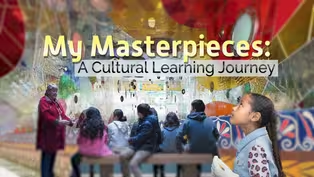
My Masterpieces: A Cultural Learning Journey
Video has Closed Captions
Clip: S4 Ep3 | 5m 51s | Explore an award-winning arts program in Pasadena. (5m 51s)
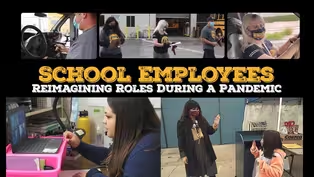
School Employees: Reimagining Roles During a Pandemic
Video has Closed Captions
Clip: S4 Ep3 | 4m 43s | Meet school employees who are reimagining their jobs during the pandemic. (4m 43s)
Providing Support for PBS.org
Learn Moreabout PBS online sponsorship
- News and Public Affairs

Top journalists deliver compelling original analysis of the hour's headlines.

- News and Public Affairs

FRONTLINE is investigative journalism that questions, explains and changes our world.












Support for PBS provided by:
Inside California Education is a local public television program presented by KVIE
Funding for the Inside California Education series is made possible by the California Lottery, SchoolsFirst Federal Credit Union, Stuart Foundation, ScholarShare 529, and Foundation for the Los Angeles Community Colleges.