
BGSU In The Round
Season 27 Episode 21 | 27m 15sVideo has Closed Captions
BGSU’s In The Round focuses on Native American creatives.
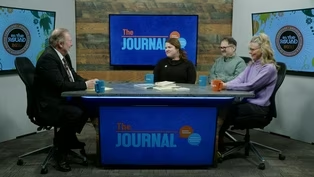
BGSU’s In The Round speaker series features Native American creatives to make more visible the creations of Native American artists.
Problems playing video? | Closed Captioning Feedback
Problems playing video? | Closed Captioning Feedback
The Journal is a local public television program presented by WBGU-PBS
BGSU In The Round
Season 27 Episode 21 | 27m 15sVideo has Closed Captions
BGSU’s In The Round speaker series features Native American creatives to make more visible the creations of Native American artists.
Problems playing video? | Closed Captioning Feedback
How to Watch The Journal
The Journal is available to stream on pbs.org and the free PBS App, available on iPhone, Apple TV, Android TV, Android smartphones, Amazon Fire TV, Amazon Fire Tablet, Roku, Samsung Smart TV, and Vizio.
Providing Support for PBS.org
Learn Moreabout PBS online sponsorship(upbeat music) (graphic pops) - Hello and welcome to "Journal."
I'm Steve Kendall.
Bowling Green State University's "In The Round" series talks about Native American creatives in an effort to make them more visible and remind people of our Native American heritage.
We're joined by Jenn Stucker, Heidi Nees, and Amilcar Challu.
Thank you all for being here, all professors at Bowling Green State University, all involved in the program, and we've had "In The Round" on before.
Jenn, for those who may not remember, maybe all the details, kind of talk about how "In The Round" came about, why it came about, and some of the things that we've done in the past, and some of the things you're gonna be doing we're gonna talk about today.
- [Jenn] Absolutely.
So I worked on a committee with Heidi as chair on a land acknowledgement statement for the university.
This was about in 2021.
After that statement was, you know, went through all the channels of the university for approval and usage, we really talked about how do we put these words into action?
You know, it's one thing to acknowledge the land, but how can we do more?
And so we started the "In The Round" series in 2022.
We started with six speakers in the calendar year of 2022, representing the aspects of the arts here at BGSU.
So creative writing, music, theater, film, art, and design.
And so we had speakers from each of those areas.
Halfway through the year we realized like, wow, that's just- - [Steve] A lot.
- It's not, it's a lot, but there was such a big list, you know, working with our colleagues and getting informed by who would be good people to bring in.
We had a huge list and we were like, "We should do more of this."
So the series has continued ever since.
We've had 13 different speakers.
Part of that's included book distributions in partnership with WBGU-PBS.
It's included all kinds of community events where we've been out having library talks.
So sometimes our speakers come here and then they'll also speak at the library, especially if there's books involved in that.
And then this year, we're just excited about our latest speaker, Dr.
Robin Wall Kimmerer.
- Yeah, now you mentioned the fact in your initial part of that the university looked at the land here, because obviously almost, well, all of Ohio was Native American land at one time or another.
And gradually things changed, but specifically where the university sits obviously has that cultural history as well.
And that's an effort to tie that into the university in the year 2026 or 2022, whatever say, we're reminded of the fact that yes, we weren't the first people that were here and they had culture, they had their own arts, they had their own history, that kind of thing as well.
And then to bring people in like this.
I know last time when you guys were on, we had a gentleman who was working with the Ohio Department of Natural Resources.
So as they did parks and land restoration, things like that.
Incorporating that into that as well to remember that, oh, there's Native American heritage here too,that dealt with the land before we got here to change it into a state park or whatever.
- [Heidi] Can I add to that?
- [Steve] Sure, jump on in, oh yeah, absolutely.
- [Heidi] That person's name is Talon Silverhorn.
And Talon is a member of the Eastern Shawnee tribe.
And he was instrumental in the development of the Great Council State Park that opened in Xenia, Ohio.
I think it was the fall of 2024.
It's been within the last couple of years.
So if folks are headed down south on 75, definitely go check out the Great Council State Park.
- [Steve] And they can see an example of this in work.
- Yeah, and there's a lot of Shawnee input in the creation of that park from members of all three federally recognized Shawnee tribes.
So definitely check it out.
- [Steve] Yeah, and I guess too, you know, and obviously you have lots of partners outside of the university as well that work with you on this too, because we're gonna talk eventually about some of the things you have set up between in the spring and into the summer, basically, you had a lot of activities in the fall.
So talk a little about who else you collaborate with, because they're an important part of this as well.
- [Heidi] Yeah, so we have continued this year our partnership with the Wood County District Public Library.
They've been wonderful partners from day one of the series.
Also partnering with, we've continued to partner with BG City Schools.
There are high schoolers who are going to get copies of "Braiding Sweetgrass for Young Adults," which is an adaptation of Dr.
Robin Wall Kimmerer's work.
We also partner with the Wood County Park District.
In fact, and maybe Amilcar can talk a little bit more about some of our partnerships there.
But we just worked with them this past Saturday on a seed cleaning, which was amazing and a wonderful gathering of folks from around the area.
And then also the BG Parks and Rec have been wonderful partners with all of this as well.
There are other organizations that have opened up space.
The Wood County Committee on Aging opened up the senior center, so we could have one of our community reads there.
So there's just been, it's been wonderful to see how the- - [Amilcar] 577 too , right?
- [Heidi] Five, oh my gosh.
Thank you so much.
Another really important vital partner in this, the 577 Foundation.
- [Steve] Oh, okay, up in Perrysburg.
- [Heidi] Yes, and we'll be having a community reads there in March, but also they're gonna do a story walk in March of "Bud Finds her Gift," which is Robin Wall Kimmerer's first children's book that came out this past fall.
So we we're just really excited about how the community has come together.
- [Steve] Yeah, and Amilcar, will talk about like your participation, your role in this, and how you got involved in it.
- Yeah.
So I'm in the Department of history.
We've been talking a little bit when the land acknowledgement came about.
And the department has been involved in a secondary role with supporting the series.
But so they invited me to be there and I said yes, and I'm very grateful.
But yeah, I mean, it's a different program than the previous years in that we have one big event and we build up to that event.
And as Heidi was saying, I mean, we have partners all over the region that have put this in, I mean, have transformed this into something different than what maybe we originally were thinking.
I mean, it's not that you had like a specific plan, but the beauty of this is how it's evolving, like a child in a way.
But yeah, so the Wood County Parks and Parks and Rec here, they have been partnering with university in other events as well.
And it's very nice to bring them to this.
So basically the books are about, I mean, love for nature and how nature loves you back and forth.
So it's a reciprocal relationship.
And county parks, city parks, I mean, the stewardship, the care they have for the land truly expresses that reciprocal feeling, but also how the community loves the parks, how the community loves this event.
And that's what we have been seeing as well.
It's like every time we have an event, it's like different people that are coming in and they are like word of mouth.
And so it's beautiful I think to bring this entirely to the community so that we can see this in action, right?
- [Steve] When we come back, we can talk more about it because obviously as you go through these past several years, as you said, Amilcar, things evolve.
You say, "Oh, well this is something we hadn't thought about, let's incorporate that."
That brings in a different group of people.
Brings in other people that have expertise in these areas.
Whether it's arts, culture, whatever it is, land usage, botanical work, that kind of thing.
So yeah, It covers so many different pieces when it comes together.
We'll be back in just a moment with Amilcar Challu, Heidi Nees, and Jenn Stucker here on "The Journal."
We're talking about Bowling Green State University's "In the Round" presentation and program.
Back in just a moment.
You're with us on "The Journal," our guests are Amilcar Challu, Heidi Nees, and Jenn Stucker.
Thank you all for being here from "In The Round."
Amilcar, obviously we've talked about the fact that we're looking at all the Native American indigenous people that were here in Ohio as part of this, but this year, one of the things that you've brought in especially are the connections you had with the Wyandot Nation, which is a very important part of the Native Americans that were here.
So talk a little about that and how that evolved.
- [Amilcar] Yeah, so I mean, it actually started with the book because Kimmerer, the beauty of the book is how he brings storytelling and how storytelling is not just like, you know, like cute, right?
It's not that we are around the table listening.
Well, it is, but also develops a connection with the place and reinforces the connection with the place.
And so storytelling is part of loving the place others.
And so we talk about storytelling, right?
But the idea is taking a step back and saying, what if one of these community gatherings is storytelling itself, right?
Now the issue is, I mean, we could tell stories, anyone can tell stories that others made, but it doesn't really have the strength.
And the Wyandot were the last removed indigenous group from Ohio.
So it was pretty significant to have their input on this.
And so we contacted them, we had like a nice Zoom talk, and basically we want to tell our stories, right?
And so it's been like a beautiful coordination so far.
Well, let's hope it's February 21st, 2:00 PM, hopefully the polar vortex will give us like a warm spell there like a little bit.
It's going to be in the nature garden.
It's in the, sorry, in the nature center and Wintergarden Reserve, which is like an intimate like setting.
I mean, it probably, we can accommodate what, 30, 50 people, but it's by the woods.
And the interesting thing is that the Wyandots, I mean, have like a very strong storytelling tradition like all other groups as well.
But they are pretty distinct.
They are very funny, the stories.
And they are all about animals and vegetation that we can recognize.
So there's hickory bark, there's oak, there's maple, like horror stories of maple groves.
- [Steve] Horror stories of maple groves.
- [Amilcar] I hope they tell that one, that's a great one.
And actually, I mean, this area that we are in, by the Portage River, we have maple groves.
So actually the, not the Wyandot, but the Ottawa have what they call the winter camp.
And so where they did a lot of maple tapping and got it also around the area of the Wood County Historical Center.
So those were all surrounded by, I mean, those creeks were surrounded by maples, Ottawa the Wyandot came to do maple tapping there.
Anyway, so they are, yeah, so they are driving from Oklahoma to Ohio to tell their stories basically.
- [Steve] Because that's where, as the country moved Native Americans to the west, that's where they eventually ended up.
- [Jenn] Well, and these stories are only told in the winter also.
- [Steve] Oh really?
Now why is that?
Because you couldn't endorse anything else to do, right?
- [Jenn] I mean, part of it is related to that.
- [Steve] Everybody got one place to stay warm.
So when you talk about their storytelling, is this all oral?
I mean is any of it committed in any kind of symbols or writing or anything like that?
- [Amilcar] That's the always the contradictory legacy of I would say colonialism in many ways, right?
So yes, it's oral tradition.
And it's always changing.
So one thing that you notice in the collections we have now written down is that you have lots of elements from European folkloric traditions as well.
So it's mixing them back and forth, but it's still a very unique combination.
But that's one... They were written down in the late 19th century, early 20th century by ethnographers that went to Oklahoma, some to Kansas, and took testimonies.
Actually, Chris Houk, one of the storytellers who is coming, told us about the story of the most significant of these ethnographers who went to, I mean, to where he was sitting actually, he was sitting right off this window and had people tell the stories, and there was also like a monetary compensation attached to it.
So that's why I say it's a very contradictory legacy, because on the one hand, this is an act of power and taking the stories.
- On the other hand, for Wyandot and many other indigenous groups as well, these are practically the only testimonies that have remained in writing from the late 19th century.
So that's part of the contradiction I think of, I mean, you could say the conflict, but also the beauty of people evolving and changing as well that we grapple with our past.
- One question too, as these people are recording this, how much gets lost in their interpretation of what they're being told or how they interpret how it should be written?
- [Amilcar] That's why we want to have them here to tell the story.
- [Steve] So you get first as firsthand as you can get versus filtered through European culture saying, "Oh, well this is what they kind of met."
Or this is how we wanna position it versus what they're telling me sometimes.
- [Amilcar] Even for me, when I read them, they remind me a lot of cartoons.
It's like I feel like this is like "Tom and Jerry" kind of rivalry between different animals, but that's my own filter.
Because I've been raised on cartoons, right?
So that's why I think it's going to be particularly beautiful to- - [Steve] To hear someone from that culture as unfilled as it can be.
Now you mentioned the fact too that the Wyandot, I don't know what the maple groves are like in Oklahoma, but I'm guessing hardwood's not a big thing in Oklahoma.
So that had to change their culture dramatically, which we know that it did for all of the Native Americans that were moved either from Florida to wherever and the trail of tears and all of that.
So I don't know with their background, how did that change their culture?
Because obviously this is wooded swamp land, totally different land out there.
It's the plains, it's drier, it's whatever.
How are they able to adapt to that?
They just did what they did.
- [Amilcar] No, that's a great point.
And it's been, yeah, over 150 years of learning how to deal with the different environment in a way.
A lot of the lessons change, I mean.
But I think that when you listen to how storytellers and tradition bearers talk about the indigenous culture and how it has evolved, changed, the key term that they use is survivants.
And it's this idea of keeping the cultural core adapting.
And that's, to me, something, but I mean, I know Heidi knows much better.
- [Heidi] And I would say survival and then also we have survivants, which Amilcar just mentioned.
- [Steve] We can come back and touch it, we'll start there because obviously it is a matter of you do what you need to do to, as you said, survive, but at the same time try to hold onto as much of that original culture as you can.
So yeah, interesting.
Back in just a moment.
We're talking about "In The Round" with the folks from Bowling Green State University, Amilcar Challu, Heidi Nees, and Jenn Stucker, back in just a moment.
Thank you for staying with us on "The Journal."
We're talking about Bowling Green State Univeristy's "In the Round" program, and our guests are Amilcar Challu, Heidi Nees, and Jenn Stucker.
Heidi, we left that last segment.
And Amilcar was talking about the Native Americans moving out of Ohio to, in this case, Oklahoma, the Wyandots.
And their first goal was to survive.
So you kind of touched on that as we were leaving.
Talk about that and what you were gonna follow that up with.
- Yeah, I was just gonna offer that, you know, the adapting to a completely new region ecosystem, right?
That was a matter of survival for tribal nations.
And Amilcar mentioned survivants, which is a term that is often discussed.
And the idea is the combination of survival and resistance.
And that is something that Gerald Vizenor, who is a native scholar, has talked a lot about in his work.
And along the same subject, WYSO in Southwestern Ohio recently produced a podcast series called "The Ohio Country" and it's wonderful.
And it's about the forcible removal of all the different tribal nations that were here in Ohio and those tribal nations who still consider Ohio homelands, the stories still connect them to this land.
Their culture still connects them to this land.
And so I think that anybody who wants to learn more, it's a great series.
I think it's 12 episodes, but I highly recommend it.
You can find it on your podcaster of choice.
But I also think that Dr.
Kimmerer, Dr.
Wall Kimmerer talks about these ideas in her book "Braiding Sweetgrass" as well.
So I'm just gonna hold that up for a moment.
And all of our community programming this year has been designed and geared towards "Braiding Sweetgrass."
But she talks about very early in the book, I think that the chapter is essay, I'm sorry, the essay is called "Council of Pecans."
And she talks about her, I think it's her great-great-grandfather and what it was like for him and his family when they were removed out west and the changes in ecology and what that meant for everything from diet to culture to seasons to everything, right?
- [Steve] And probably even the clothes they wore, the things because they were used to using what was here versus what was that available out there.
- [Heidi] Yeah, so I do wanna say "Braiding Sweetgrass," one of the things we love about this book is it's divided into essays.
And so you can sit and read at your own pace, how we designed the programming this year, the community reads sessions that we've had throughout the fall and that continue throughout the spring, each one focuses on one essay in the book.
So no one has to feel like I have to read the whole book before it comes to the community reads, right?
And all the outdoor gatherings that we've planned are designed to again, connect with community partners and to get people involved with the land.
And so back in September, Cindy Stutzman led a wonderful guided hike through Wintergarden, St.
John's Preserve, and talked about the work they're doing to try to restore native plant life there.
There was a, with the Wood County Parks District, we had an owl hike, a guided owl hike in December.
It was kind of snowy, but- - [Jenn] We did hear owls.
- [Heidi] Owls were heard.
As I said, we just had a seed cleaning.
We have coming up, Marcelle Dupay, who is part of the School of Art, is leading an art making and collaging event in March.
We have community garden planting here on BGSU'S campus in May.
So we have a lot more coming up.
I don't know if you all wanna add- - As you were saying, yeah, you're linking not just these stories about their culture, but how the interaction was with the land as they found it when they were here.
And then the efforts now to bring that back, some of that back to restore that environment that was here.
You can see pieces of it in places if you like ride the slippery trail.
You go through what looked like a Great Black Swamp back then, but that's a small piece of everything.
And this is an effort to restore native plants and the things that they use to cook, eat, live, whatever, build, that kind of thing to restore that kind of situation.
- [Heidi] And how can we all learn how to establish reciprocal relationality with the area we call home, right?
- [Steve] Because it constantly is evolving, you know, someone a hundred years from now, look at what we were doing and go, "They didn't understand why we were doing what we were doing."
But as you said, Amilcar, things will evolve and that's how people then adapt and survive and that sort of thing.
When you look at these events, I know you've got community reads coming up in February, March, and April.
The outdoor gatherings go on and the same thing, March, April, into May.
When you start to lay all of that out, I mean, that's a pretty big undertaking.
So do you find people more than eager to help, or is it sometimes it's a little trickier than maybe you anticipated with a typical thing?
- [Jenn] I think it's been rather easy.
I mean, it doesn't mean it's not work.
It's definitely work.
But the partners have all been very enthusiastic.
I think there's even the reciprocity of, you know, our enthusiasm about what we're doing, their enthusiasm about sharing the work that they're doing has just made a nice mix.
One of Robin's quotes in her book is "All flourishing is mutual."
And so I think that relates to person to person and person to earth.
And so the earth is doing well, we're doing well, and vice versa.
So these community events have, yeah, come together really fluidly and easily.
We're so excited about the partners, we've been all connected.
- And I think the nice thing about this is too, one of the many things that's nice about it is that it allows a more in-depth examination of Native American culture in Ohio because it gets, at least, and I haven't been in high school for a while, but I remember that it wasn't a big part of Ohio history, and there was an Ohio History course, but this was a very small part of what it was Native Americans.
It was more about the progression, Manifest Destiny, that sort of thing, versus what it was like before the push west began out of the 13 colonies in Connecticut and the Firelands and all of that sort of thing.
So it's good that this kind of reconnects that and the storytelling that you talked about, Amilcar, and then relates it to the land and what was here and what it can be again.
So it brings it kind of full circle and starts to fill in a lot of those gaps.
- [Jenn] Yeah, well one of the things about learning standards.
Across the nation, 87% don't address native cultures past 1900.
So there's a lot of perception by people that, you know, native indigenous cultures are in the past.
And so that's why a big part of our focus, and the language that you use "In The Round" is presence.
You know, not just here in the space, but present.
- [Steve] We're not studying Egyptian culture, we're studying a live viable going on today kind of culture.
- And Robin is Potawatomi, which is part of the homelands for the Potawatomi people.
And also her book is, she was on our list from the very beginning when we started this series.
And for us it was like, "Oh, that's such a big, big ask."
So we're so excited that we've been able to get into a position where we were able to ask her to come.
"Braiding Sweetgrass" has sold over 3 million copies.
She's been noted as a top 100 writer in the 21st century.
So we're expecting a pretty good audience to come in March and hear her speak.
And we're just excited to have her here.
She also has a series she's doing on her own called "Plant Baby Plant."
And so really asking all kinds of individuals to get involved with, you know, if we wanna really preserve the earth, we need to get connected with planting and giving love back to the earth.
- [Steve] And obviously the easiest thing to do is very simple.
I just, you can Google BGSU "In The Round" and it lays all out in that first event.
Well, her event is on the 27th of March at 5:30pm.
That's the big premiere piece or the big keynote part of it.
And it scrolls from there.
- [Jenn] And the second big talk also at the Veterans Memorial building through the Wood County District Public Library, so two opportunities.
And that'll be at, yeah, ours is at 5:30 Friday evening, there's today and Saturday morning.
- [Steve] Well thank you so much guys.
Appreciate you coming on, because it's always, we always learn, you know, we learn obviously about all of this, but we always get deeper into something that talks more about Ohio and the culture.
So it's always a great thing.
Appreciate you being here and thanks for doing this.
It's a good thing, it's a really good thing.
You can check us out at wbgu.org.
You can watch us every Thursday night at 8:00 on WBGU-P We'll see you again next time.
Good night, and good luck.
(upbeat music)
Preview: S27 Ep21 | 30s | BGSU’s In The Round focuses on Native American creatives. (30s)
Providing Support for PBS.org
Learn Moreabout PBS online sponsorship
- News and Public Affairs

Top journalists deliver compelling original analysis of the hour's headlines.

- News and Public Affairs

FRONTLINE is investigative journalism that questions, explains and changes our world.












Support for PBS provided by:
The Journal is a local public television program presented by WBGU-PBS