
Bike Clubs and Carolyne Naomi
Season 17 Episode 11 | 28m 45sVideo has Closed Captions
We Bike Rochester & Pata de Perro provide bikes and Carolyne Naomi creates Nigerian heritage music.
In Rochester, We Bike Rochester and Pata de Perro provide bikes and maintenance resources to the community, while in the Twin Cities, musician Carolyne Naomi creates music inspired by her Nigerian heritage.
Problems playing video? | Closed Captioning Feedback
Problems playing video? | Closed Captioning Feedback
Postcards is a local public television program presented by Pioneer PBS
Production sponsorship is provided by contributions from the voters of Minnesota through a legislative appropriation from the Arts and Cultural Heritage Fund, Explore Alexandria Tourism, Shalom Hill Farm, West Central...
Support provided by:


Bike Clubs and Carolyne Naomi
Season 17 Episode 11 | 28m 45sVideo has Closed Captions
In Rochester, We Bike Rochester and Pata de Perro provide bikes and maintenance resources to the community, while in the Twin Cities, musician Carolyne Naomi creates music inspired by her Nigerian heritage.
Problems playing video? | Closed Captioning Feedback
Where to Watch Postcards
Postcards is available to stream on pbs.org and the PBS app.
Providing Support for PBS.org
Learn Moreabout PBS online sponsorship(bright music) - [Host] On this episode of "Postcards."
(gentle music) - [Bill] So we just got this bike in, and what we do is we look over the bikes and make them safe to ride.
- [Carolyne] The events that I play at are music venues like Ice House Minneapolis.
I played at Dakota Jazz Club.
We played at Afrofest.
So it's just a lot of music festivals, outdoor festivals.
I just love performing, I love being out there.
(bright music) - [Host] "Postcards" is made possible by the Minnesota Arts and Cultural Heritage Fund and the citizens of Minnesota.
Additional support provided by Margaret A. Cargill Philanthropies, Mark and Margaret Yakel-Julene on behalf of Shalom Hill Farms, a retreat and conference center in a prairie setting near Windom, Minnesota.
On the web at shalomhillfarm.org.
A better future starts now.
West Central Initiative empowers communities with resources, funding, and support for a thriving region.
More at wcif.org.
(bright music) - So I'm involved in the Rochester Community Bike Club, Pata De Perro, that started back in 2010.
- Pedal-It-Forward is the name of our program we operate under We Bike Rochester.
- I worked with a couple other people, and we came up with this curriculum that we call the Safe Riders Club.
- Pata De Perro is a nonprofit program.
We offer the tools, the parts, and the knowledge so individuals can come and learn how to fix their bike.
- And the way we pedal it forward is that we take in donated bikes, we identify people through a network of social service providers, probation officers, school counselors that are in contact with individuals that need some form of reliable transportation.
- I noticed as an educator in the Rochester Public Schools a need for students finding their way on bicycles.
The afterschool Safe Riders Club program is an opportunity for middle schoolers to learn the ins and outs of riding a bike safely.
- After these kids go through a six week program or so, it's sort of like graduation day, they come and get a bike, and that's probably the best thing that I've experienced volunteering with this group.
- [Enrique] So we work under the same roof out of the fire station that we're in today.
So the front portion is where you see our bikes and all of our tools.
And then the back portion is the Pedal-It-Forward with a shared facility in the middle where we can both use the workspace to promote learning for new mechanics, kind of stuff like that.
- This is a kickstand right here.
- All right, yeah I see, All right.
I'm Doug by the way.
- Hi Doug, I'm Bill.
- So Minnesota over the last 20, 30 years has really developed its infrastructure for bicycling.
Rochester was ahead of most communities because of a flood control project back in the mid-70's where the river through town flooded, destroyed a bunch of things.
And so when the Corps of Engineers came in and redid the all the concrete work to rechannel the river, they put in a bike trail on either side of the river.
That was the kernel that started our biking infrastructure here in Rochester.
(film reel whirring) - Pata De Perro is a slang in Latin America when you're a kid, they always tell you, oh, when you're backpacking across the continent, you're a Pata De Perro because you're just roaming everywhere.
Anywhere in Latin America, you say Pata De Perro, they know the concept.
(upbeat music) - So the way the program works at Pata De Perro is people will come in here and they'll use the QR code to sign in, and that way we can get a clear count of how many people we're helping.
And so part of it is we have these toolboxes here that individuals can utilize to work on bikes, and then we bring the tables and the toolboxes outside so that they can learn how to fix their bicycle and utilize that as well as the bike stands that we see here.
And then over here, we have kind of the lubes, all the liquids that people can utilize.
We have more of a workbench.
So when somebody donates a bicycle, this is kind of a coloring system.
When we get a bike in, somebody donates it, we put it on this side and it's marked as yellow, which means it meets our standards to be fixed.
And so these bicycles then get chosen by a volunteer and they'll fix the bicycles, and once they're fixed, they'll come over here and they'll either be labeled green or they'll put a price tag.
When they're labeled green and put a price tag on, the funds will go back to the program to make the program sustainable.
That's kind of our big goal for this year is to be more sustainable and be able to just generate our own funding.
When a bike is not deemed safe, we strip the bike down and we put it into these bins.
So you can see like we got all these screws, bolts, nuts, that can be used to repair bikes and to be able to put a new life to a bike.
So last year, we had over 200 people visit.
So that's between getting help with learning how to fix their bicycle, purchasing a bike.
Those are kind of the main ones that we track.
Pata De Perro was started by ACHLA, a Latino-led organization in Rochester.
And while the program has morphed, the goal of ACHLA has always been to support and help Latino immigrants in the community.
Pata De Perro is a little different because we just help everybody.
- The reason we have the name is kind of to make it, you know, that people can see something that they recognize and feel welcoming, but also we are open to everybody.
- You don't have to be Latino, you don't have to speak Spanish, you don't need to pronounce the name correctly.
You just have to come in and have a positive attitude and we'll help you fix your bike, we'll teach you how to fix the bike.
- It'll be a little tricky to do, but if you get one that's, we call it potato chip, so it looks like a potato chip.
That would be okay.
- I'll give it a shot.
(film reel whirring) (upbeat music) - So Paul reached out to us regarding our clientele.
So we work a lot of times with low income or people who are homeless.
And so he reached out to us for the program Pedal-It-Forward.
- Rochester's a large community, and you know, there are a lot of different options for transportation, but it's not always accessible.
You see a lot of people that maybe don't have money to even pay for a bus pass or even have access to a car.
Having a bike creates some access and removes some of those barriers to employment, to going to the grocery store, to getting to their housing that may be across town, to go downtown to get to the clinic.
So there's a large number of things that are beneficial.
- There are people here that a bicycle makes a difference in their life.
These are adults, and there's a nice referral system.
So we're able to get these bikes hopefully to people that need them and will appreciate them.
We depend on people that donate their bicycles, and some bikes are better than others.
We don't really like the bikes that have been sitting around in your backyard for a hundred years, the wheels don't work and they, you know, the tire does not spin anymore.
So we just got this bike in, and what we do is we look over the bikes and make them safe to ride.
And we use a simple formula, because some of us are simple, myself in particular, called the ABCs.
A is for air, this one fails miserably, it needs air in the tires.
Brakes, that's for B, or B is for brakes.
Pretty much spin the wheel.
You should do this when you get on a bike first thing in the morning, right?
And it stops, it's a good thing, we can adjust this a little further to make it a little bit safer.
And then finally C for chain, which really doesn't exclusively mean chain, it's everything associated with getting the power to the bike.
You know, starting with the pedals.
And that's pretty simple, so ABC.
- A lot of the bikes that we're getting now are baby boomers that are transitioning to electric bikes.
And so you can imagine this was one that was probably bought five, 10 years ago with the intent to go riding and was seldom ridden.
And now that same person of means has bought a four or $5,000 electric bike and they're wondering what to do with this.
So we tell them that we'll find a new rider.
Taking a bike that would otherwise be discarded and returning it to service, that's, I see that as important.
I think it's a metaphor for how you conduct your life.
And our mission is to get bikes to adults and youth that are adult-size for transportation.
So when we get some of these toddler bikes, I can show you in the back, they're collected for the end of the year and they're given out during a Christmas anonymous distribution day.
Mid-summer, we've got maybe half a dozen, but by November, December, we'll have 25, 30 bikes, and they'll go out for Christmas anonymous.
Yeah.
- They're just fun.
(film reel whirring) - The reason I love the afterschool Safe Riders Club program is because it affords these middle school students an opportunity to really imagine possibilities.
- What?
Favorite kid?
- Favorite kid, favorite student.
There had to be one that sticks out or two.
- From the club?
- Yeah.
- Ben was yours?
Oh my gosh, I tried so hard not to have favorites.
I really liked Lily just because of the fact that she was really nervous in the beginning, and then by the end, I feel like when she got to pick her bike, she was like stoked, you know?
- You're asking all the really like heavy hitter questions that are probably gonna make me cry.
(laughs) I'm sorry, I probably actually will in just a minute.
(Lucy sniffling) So, um... Apologies.
That's gonna be my 30 second clip, right?
You're just gonna have me crying probably.
(laughs) Yeah, so the afterschool, the afterschool bike club, you know, we said, "Who are the students who are really gonna benefit from this program the most?"
You know, who has asked, "I need help getting from school," to home, or to work, or riding home with a family member.
And so we kind of work together to make sure that those 15 students each session would truly take the bike and go anywhere with it.
- This is the stockpile of bikes that go out to like the students that Lucy was talking about.
- You put out like a cool beefy tire mountain bike and then something that has a rack and then something that has drop handlebars and they definitely, you know, have a quick reaction and a feeling about which one they want.
I always loved, I loved watching the students pick the bike they wanted and they're just like rolling out feeling so proud, and so cool, yeah.
Seeing those students now have that sense of independence is really an on-ramp to anywhere they go for the rest of their lives.
They have this skill now, no matter what community they live in, they can pick up a bike and roll anywhere and figure out how to get from point A to point B with confidence.
- My biggest accomplishment is we took 15 kids out several miles on bikes that we repaired, and they all got back.
- What you mean is that they didn't break, yeah.
(traffic zooming) (bright music) - Well I got involved in bicycles because I love bikes and I watched the movie "ET" and the movie "ET" had all bikes BMX.
So at that age, I was like, "Oh my god, I wanna BMX."
And then once I got my bike, you know, it's like getting freedom at that age and always put a smile on your face.
So I always like bikes.
- My favorite part of biking is simply the freedom of movement, being out in the elements.
- They allow us to connect with nature in a different way.
- You know, you can be friendly to the environment, you know, eco-friendly, not ride a car.
- Yeah, having a bike, actually, it's not only good, you know, physically, it's also good for mental health.
- [Bill] Anything on two wheels is like flying, flying very low and very fast.
- [Enrique] It also hits the community portion where you can ride with others and become friends.
- [Paul] Just the sheer beauty of it as a machine, it's the most efficient machine for transferring human power to movement.
(group chatting) Got the new tube.
- One, two, three, four.
(light rock music) ♪ Na so your matter be oh ♪ ♪ All the things wey you promise me ♪ Ase!
Na lie oh ♪ I gave you all of me oh ♪ Na so your mouth take sweet ♪ Tiff my heart oh!
♪ Just when I started ♪ Opening up to you ♪ So this is kind of like my little space.
It's still bare bones, it's not what it should be yet, but it does the work for now, you know, getting my vocals recorded and sending that to my music producer.
I'm able to create kind of like a demo of my song using my guitar, send that demo to him to tell him this is a new song I'm thinking about.
He goes ahead and then adds more instrumental to it, sends it back to me to then record clean, clear vocals.
Then we send those to the mixing engineer who's in Nigeria.
His name is Santi, Dr.
Santi.
♪ Ah ♪ Then you started acting like a clown ♪ ♪ But it's over now, it's over now ♪ ♪ I no be your mumu again, be your mumu again ♪ ♪ Moti japa, japa, japa ♪ The earliest memory I have of how I started off with music as a kid was when I was about eight or nine years old, and one of the first songs that I wrote was when I was in primary school, I had a math assignment that I had that I didn't like and I didn't want to do.
I wrote about that.
When I was about 12 years old, I joined the choir, kind of like an extracurricular activity to do outside of school.
And then at church, I also joined the choir right around the same time.
And so that was kind of how I developed more of the stage presence, singing in front of people.
♪ But by [indistinct] ♪ And finally I found myself on a West African music reality TV show and competition similar to "The Voice" or "American Idol," but also similar to "Big Brother Africa," "Big Brother America," where you have people living in a house like an academy and performing music every weekend.
15 contestants from different parts of Africa.
It was hosted in my country, which is Nigeria.
I'm on the magazine covers, you know, and I'm just saying hi to all of my friends.
(group laughs) That's it.
- Lovely, very nice, very nice.
- Being on "MTN Project Fame West Africa" kind of opened a door of opportunities for me to perform, to write music, to meet people that made me see that it was possible to in fact be a performer and not be too shy about it, you know?
And so after that, I had the desire to want to teach music and want to perform more.
I had taught a group of kids who were visually impaired.
So it was a school in a place called Surulere in Lagos, Nigeria, where majority of the kids were born blind or a few of them lost their sight as a result of maybe accidents or something else.
And I taught them how to play the guitar, which is very difficult.
Imagine picking up a guitar and trying to show a few kids who have never seen an instrument or seen anything in their lives before and showing them how to play.
And then when I came to Minnesota in 2014, I went to McNally Smith College of Music because I wanted to develop my skills in guitar and singing.
And that's what I did.
And afterwards I started performing here.
And the rest, as they say, is history.
(gentle guitar music) ♪ Who's got it down like ♪ Down like you ♪ Oh, who's in control like ♪ Control like you ♪ You handle everything like a boss ♪ ♪ 'Cos you're the boss ♪ I'm left in awe ♪ You handle everything like a boss ♪ ♪ You have the sauce ♪ Na you be the one ♪ My Oga at the Top ♪ When you speak a word, mic drop!
♪ ♪ Na you be... - A lot of times, the ideas behind the music videos come from the videographer and myself and also the producer that I work with who, when we're writing the song and recording together, we kind of say to ourselves, "Oh, this melody gives us a sense of XYZ, maybe XYZ, you know?"
So like when you're writing, you have this idea of what you want it to look like and then you work that thought process.
♪ Actions speak louder than words ♪ ♪ Deeper than make-believe ♪ ♪ Jowo my sistah ♪ ♪ Toju re e daada ♪ ♪ Ni ife re Pari ja pelu e ♪ ♪ Se gbo gbo eyi ti owo re lese ♪ ♪ Aah And so growing up and listening to Michael Jackson and listening to Brandy, it was like an influence on my style.
And my music producer, whose name is Tolu by the way, shout out to Tolu.
♪ I know that I messed up ♪ But I know that you're ♪ I no be your mumu again And he had initially created a beat already and said, "I have this beat, I think we can work with it."
And then he created like the hook of the song, the japa japa, which means like to run away, to leave a situation sort of.
The theme of the song is being in a relationship or a situationship that is just not beneficial because you realize that the person is wasting your time.
And then you just want to get your things, get yourself, and just run and leave the situation because it's unhealthy.
And so like even the first line of my verse is in Nigerian Pidgin English.
“Na so your matter be” “All the things wey you promise me” “Ase!
Na lie oh” It means, "Oh, so this is how you are.
All the promises you made to me, all the love, all the this and that, everything was completely untrue?"
♪ ...be your mumu again ♪ ♪ Moti japa, japa, japa, mi o lo rara ♪ ♪ I no dey do again oh ♪ (Music fades out) (Music fades in) ♪ A promise ♪ A promise, ooh (soft upbeat music) When I moved in 2014, I definitely experienced culture shock, obviously, but I think the main culture shock for me was the weather.
It was incredibly cold.
So my brother and his family have lived here, I think since 2000, so about 25 years now.
And when I was thinking about moving to Minnesota, the first thing he said was, "Leave all your summer clothes in Nigeria.
Don't bring anything here with you."
I was coming from a weather that's 80 degrees, 90, 100 degrees sometimes, even 100-plus degrees to Minnesota where it was about 40 degrees, and I was freezing in 40 degrees, you know?
And then winter came and it became even worse and I thought I was gonna die literally because I was going to music college and I didn't have a car, so I would have to catch the bus.
I still don't like the winters, but I love Minnesota now.
All right now, I need more people here, come on.
♪ When all us were against you ♪ When it looked like things would fall through ♪ Finding community here in music, dance, cultural activities, connecting with friends and other people who know other people who are either Nigerians or Africans, it started to help me know that I'm far away from home, but in a way, I can make home here as well too in Minnesota.
(audience cheering) Oh my goodness, you guys are amazing.
Thank you, thank you, thank you, thank you so much.
I always dreamed about having my own EP, like a small album of about six songs.
♪ Everybody say (Carolyne singing in foreign language) ♪ One more time, let me hear you say ♪ The events that I play at are music venues like Ice House Minneapolis, I played at Dakota Jazz Club, we played at Afrofest.
So it's just a lot of music festivals, outdoor festivals.
I just love performing, I love being out there.
♪ Ay (group singing in foreign language) - Everything that I experienced inspired the music that I write.
I've written a song about my brother hurting me.
I've written a song about a relationship going bad.
I've written a song about my faith in God, you know, being a Christian and growing up in church and all of that.
So I feel that music speaks to a place in my heart that sometimes words just isn't able to articulate.
When I listen to a song and hear a melody that just strikes something inside of me, I'm like, I don't know, I smile, I respond.
Even at my job, my nine to five, everyone at the company that I work with, they know that I'm a musician, and sometimes they see me working with headphones on and I'm listening to music and my boss would pass by and is like, "Okay, I see you nodding your head.
What are you listening to?"
You know?
So music is just everywhere with me.
There was a time that I would even not go to bed unless I was listening to something to help me sleep at night.
♪ ...grace and mercy ♪ ♪ There is no controversy ♪ ♪ No be me ♪ ♪ Abi na you ♪ ♪ Wey dey give you love Wey dey lift you up ♪ ♪ No be me ♪ ♪ Abi na you ♪ ♪ Wey get your back Through the good and the bad ♪ ♪ No be me ♪ ♪ Abi na you ♪ ♪ Wey stand by your side ♪ When people talk about the Nigerian culture, it's almost as if they assume that it is just one culture, and it is not with that many people, over 200 and something million people.
We have, I believe, over 500 languages if I'm not mistaken.
And those languages are tied to different cultures.
(gentle guitar music) (Carolyne singing in foreign language) I don't have a lot of songs in my own language just because English is the official language in my country.
And in my family, the majority of the times that we conversed, it was mostly in English.
And so I'm not as fluent in my own language, which is terrible.
But I have the song that my mom taught me that I want to sing because I love it.
It just helps me stay connected to my roots.
And I love that a lot.
(Carolyne continues singing in foreign language) (Carolyne continues singing in foreign language) (bright music) - [Host] "Postcards" is made possible by the Minnesota Arts and Cultural Heritage Fund and the citizens of Minnesota.
Additional support provided by Margaret A. Cargill Philanthropies, Mark and Margaret Yakel-Julene on behalf of Shalom Hill Farms, a retreat and conference center in a prairie setting near Windom, Minnesota.
On the web at shalomhillfarm.org.
A better future starts now.
West Central Initiative empowers communities with resources, funding, and support for a thriving region.
More at wcif.org.
(bright music)
Video has Closed Captions
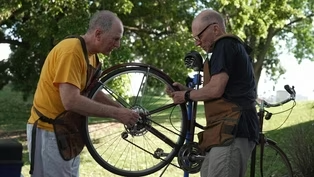
Clip: S17 Ep11 | 14m 23s | We Bike Rochester and Pata de Perro in Rochester with the community to provide bikes for the city. (14m 23s)
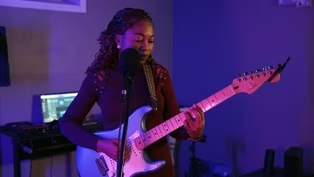
Preview: S17 Ep11 | 40s | We Bike Rochester & Pata de Perro provide bikes and Carolyne Naomi creates Nigerian heritage music. (40s)
Video has Closed Captions
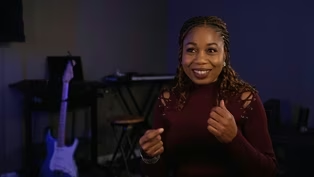
Clip: S17 Ep11 | 13m 44s | Carolyne Naomi writes and performs music inspired by her Nigerian heritage. (13m 44s)
Providing Support for PBS.org
Learn Moreabout PBS online sponsorship
- Arts and Music

Innovative musicians from every genre perform live in the longest-running music series.





 New Episode



Support for PBS provided by:
Postcards is a local public television program presented by Pioneer PBS
Production sponsorship is provided by contributions from the voters of Minnesota through a legislative appropriation from the Arts and Cultural Heritage Fund, Explore Alexandria Tourism, Shalom Hill Farm, West Central...