State of Affairs with Steve Adubato
Bill Spadea (R); Steve Sweeney (D)
Season 8 Episode 18 | 27m 8sVideo has Closed Captions
Bill Spadea (R); Steve Sweeney (D)
Steve Adubato sits down individually with two candidates for New Jersey’s next Governor: Republican Candidate, Bill Spadea, discusses the school funding formula, his views on the migrant crisis, and ensuring voter integrity in New Jersey, and Democratic Candidate, Steve Sweeney, shares his views on the fiscal health of the state, reproductive rights, and education.
Problems playing video? | Closed Captioning Feedback
Problems playing video? | Closed Captioning Feedback
State of Affairs with Steve Adubato is a local public television program presented by NJ PBS
State of Affairs with Steve Adubato
Bill Spadea (R); Steve Sweeney (D)
Season 8 Episode 18 | 27m 8sVideo has Closed Captions
Steve Adubato sits down individually with two candidates for New Jersey’s next Governor: Republican Candidate, Bill Spadea, discusses the school funding formula, his views on the migrant crisis, and ensuring voter integrity in New Jersey, and Democratic Candidate, Steve Sweeney, shares his views on the fiscal health of the state, reproductive rights, and education.
Problems playing video? | Closed Captioning Feedback
How to Watch State of Affairs with Steve Adubato
State of Affairs with Steve Adubato is available to stream on pbs.org and the free PBS App, available on iPhone, Apple TV, Android TV, Android smartphones, Amazon Fire TV, Amazon Fire Tablet, Roku, Samsung Smart TV, and Vizio.
Providing Support for PBS.org
Learn Moreabout PBS online sponsorship- [Narrator] Funding for this edition of State of Affairs with Steve Adubato has been provided by Hackensack Meridian Health.
Keep getting better.
The Turrell Fund, a foundation serving children.
Operating Engineers, Local 825.
Eastern Atlantic States Regional Council of Carpenters.
New Brunswick Development Corporation.
IBEW Local 102.
Lighting the path, leading the way.
PSE&G, powering progress.
And by Rowan University.
Proudly serving New Jersey for 100 years.
Promotional support provided by NJ.Com.
Keeping communities informed and connected.
And by New Jersey Globe.
[INSPRATIONAL MUSIC] - Hi everyone, Steve Adubato, welcome to another edition of New Jersey's Next Governor, Decision 2025.
We kick off the program with Bill Spadea, Republican candidate for governor of the great state of New Jersey.
Bill, good to see you.
- Great to see you, Steve.
Thanks for having me on.
- You got it.
Hey, 30 seconds on your background.
People know you from 101.5, but you've been doing a whole range of things.
30 seconds on your background leading up to your candidacy.
- Yeah, you know, I've been married, I've been married 30 years this November.
I've got two great kids and I was in the Marine Corps, graduated from Boston University.
I started a filmmaking company.
We actually have sold movies to Lifetime, so just kind of a pretty cool side.
And I spent a long career as a business leader in real estate, working for my good friend Jim Weichert, turning departments around, you know, managing budgets, managing people, and helping the company achieve success.
- Good stuff, hey Bill, let's prioritize the issues, affordability in the state of New Jersey.
If governor, what is the most significant action you would take outta the box to make New Jersey more affordable?
- First thing we've gotta do is we have to change how we fund our schools.
You know, we are throwing money down this rat hole where we are not getting any return on the investment.
You know, $33 billion are collected in property taxes.
We've got the highest property taxes in the country, average tax bills nearing 10,000 per household, and 69 cents on the dollar goes to fund our schools.
And I look at that and say, well, it's broken.
How do you fix it?
First thing you gotta do is we have to encourage an opportunity for school choice, specifically charter schools.
You look at the Newark school system, $1.1 billion goes into Newark.
Nine outta 10 kids in Newark can't do grade level math.
So the kids can't read, they can't write, you know, we're spending our time on pronouns instead of practical knowledge for these kids.
But if you look at Newark as an example, 4,000 kids want to be in a charter school that has been blocked.
They have not brought in the investment for that.
That would be a day one priority, because once you shrink the size of those classrooms and reduce the burden on the public schools, you can start to reduce the amount of money you need from real estate taxes.
Two, we've gotta restructure our pensions.
They did it successfully, and I'm talking about teacher pensions with the NJEA.
They did it successfully in Wisconsin, in 2010, took a $3.6 billion deficit, turned it into a $900 million surplus.
It's called Act 10, we need it in New Jersey.
- So, interesting, you mentioned choice Bill, I'm gonna ask you about this because the candidate you support for president, as we're doing this program, this will be seen later, this is about 2025 and it's policy oriented, but former President Trump has said that the Supreme Court as currently constitute the change with the Dobbs decision, pushing abortion back to the states, that's what he says most Americans want, whether he gets elected or not, that's not the issue, again, this will be seen, later.
Bill, let me ask you, if governor, what would you attempt to do to change, if at all, new Jersey's current statute, which protects a woman's right to choose?
- Well, as you know, Steve, that is gonna be up to the legislature.
You know, the hypotheticals are always asked, would you sign this?
Would you sign that?
- As governor, what would you lead?
If you were governor, I'm sorry for interrupting, Bill, would you say, you know what?
I would like to ban and if the legislature went along, that's what I'd want.
But I would like to lead as governor to ban abortion in the state.
- No, first of all, nobody is going to take seriously any broad ban on abortion.
However, when you look at the numbers, most reasonable people do not agree with abortion up to birth.
I think the challenge in our country, and the challenge of literally in every state, red state, blue state, is that we tend to govern on the fringes.
We tend to talk about the radicals on one side or the other.
The reality is, when you ask most Americans, do they think that we should have a late term abortion, abortion up to birth?
81% of Americans say, no way.
That's all in New Jersey.
It's almost seven outta 10 voters.
So here's how I look at it.
I think that we need to stop looking at the, you know, one black or white issue ban or not ban.
The Supreme Court smartly, got rid of Roe v. Wade, put it back to the States, and now in New Jersey, people have their choice.
So number one, I don't see any foreseeable change in the future of taking away a woman's right to choose.
Number two, I think reasonable people can come together and say, you know what, maybe we ought to ban this barbaric practice of late term abortions and that's a bill I'll certainly sign.
- Hold on, if late term, one second Bill, I'm sorry for interrupting again, but I'm wanna be clear, if late term abortions are due to the health of the mother, the life of the mother, you're okay with that, right?
- Well, I agree with President Trump.
And this goes back, I mean, honestly, Steve, this goes back to the Republican platform all the way into the eighties when you talk about life of the mother, rape and incest.
So I have no issue with that, but that's not what we're talking about.
As a matter of fact, you ask any of the research out there, and you read any of these papers, some 97 to 99% of abortions are not due to those circumstances.
So most of the abortions in the late term, you're not talking about that.
And again, this is not an issue that any candidate is going to lead on.
And let me tell you why it is not on the forefront of any New Jersey voter's mind.
You know, we were talking a second ago about affordability.
People wanna know that they can pay the bills, raise their kids, start their business, get to work in a free and safe environment, has nothing to do with abortion policy.
- Bill, I'll get off this in a second, but you don't think women disproportionately, men as well, but more women are concerned about reproductive rights?
You don't believe that's an issue that matters to most women or even a significant number of them?
It's issue the media, no, it's an issue that the media and the radical Democrats wanna lead with.
The reason that the Democrats consistently talk about abortion is they have nowhere to go when it comes to crime, public safety, infrastructure investment, quality of education, and affordability.
The Democrats have caused a major spike in the cost of living across the country and in particular in New Jersey.
They have, by their policy and by their ignorance and by their actions, and in many cases inaction, caused our streets to be less safe.
So, of course, they want to talk about abortion because it's not an issue in New Jersey, but they make it an issue.
And quite honestly, Steve, the media is complicit.
The media does not want to talk about the real issues.
Again, energy infrastructure, transportation infrastructure, highest in the country property taxes, highest corporate business taxes.
We've got seven outta 10 people leaving the state of New Jersey when it comes to that United Van Line survey, five years running, We have the highest out migration of any state in the country, three to $4 billion a year leaving our state.
So, of course, naturally, the Democrats have been in charge since 2001.
They'd rather talk about abortion, I want to talk about affordability.
- Well, I appreciate that, bill, but let me ask you this.
We do a series called Democracy in Danger, and I believe you believe our democracy, our representative democracy, our republic, is in danger.
You don't have to to have the same point of view as that I do or anyone else, but we're in trouble.
Question, in terms of the peaceful transition of power and the trust in elections.
This isn't a major issue.
You can be concerned about property taxes and still be concerned about democracy.
Question, do you believe that in the 2020 election, Joe Biden legitimately won that election and Donald Trump lost?
And that there should have been a more peaceful transfer of power, and if it was the other way around, the same thing should have happened for Donald Trump?
- Well, first of all, there was a peaceful transfer of power.
I mean, President Trump-- - January 6th was, January 6th, was a peaceful transfer of power?
- Steve, you know, as well as I do that, that did not even mark a dent in the actual transfer of power.
There was no interruption in the government, - But there was an effort.
- But a million people on the Capitol, on the mall, and you have a few that got into the Capitol, and look, we've all seen the videos for some reason the Capitol police opened the door.
And I don't know what the story is behind that, but let me get to your original question.
- Sure.
- A lot of people ask, was the election stolen?
I will say this to you, Joe Biden is the President of the United States.
There's no discussion about whether he is or isn't, he is.
But there is a legitimate question that should have been raised and is being raised now that most Americans don't feel like their vote counts.
I mean, you had like seven outta 10 Republicans saying the election was stolen.
You had a fair number of Democrats worried about the election and why.
Let's just talk about the optics.
Look what happened in Philadelphia when they papered over the windows, when they expelled poll watchers out, when reams of paper were showing up at three o'clock in the morning.
Look, we can solve the election integrity issue with voter identification.
We have to look forward, not backward.
You can't undo anything.
I don't know how much fraud was there, but is there any American that doesn't believe there's some fraud in every election?
Of course, there is.
So I'd like to see the Democrats in a bipartisan way, join me in this conversation where I believe all 21 county clerks, if we got them together and said, look, let's make sure we safeguard the integrity of the legitimate legal votes out there.
We need to have voter ID.
We need to absolutely make sure that we understand the chain of custody of those mail-in ballots.
We should be the business of making people feel safe and secure that their vote counts.
- The other issue that you've been outspoken on and someone says, well this is, someone might say, well that's a federal issue.
It's not a state issue, this is immigration.
The immigration crisis is real.
Democrat, Republican, it's real.
If you were elected governor, what if anything, could and would you do to deal with the migrant crisis?
Even though it's federal legislation and law that is the primary factor here, please Bill.
- Several things that I would do on day one.
Number one, we'll begin enforcing federal detainer orders.
There are thousands of criminal aliens that are being accused of some heinous, heinous crimes.
New Jersey does not enforce those orders, that would be a day one issue, that's the first thing.
The second thing is we have to end, and I would end on day one by executive order the 2018 executive order that made us a sanctuary state, that's out the window.
The third thing is the 2019 Immigrant Trust Directive that has handcuffed law enforcement and made things very, very difficult and blurred the lines that will go away on day one as well.
But beyond that, I believe we have an emergency in New Jersey, and part of it is caused by the fact that-- - An immigration emergency, Bill?
- On immigration, absolutely.
There is an estimate, you look at the report that my friend Paul Kenitra did when he got back from the border with a lot of smart people.
Nearly 900,000 people are in New Jersey illegally.
Now, if you look at that, even if that number were half- - Where's that number come from, Bill?
- What's that?
- Where's that number come from?
- From Paul Kenitra's report.
Paul Kenitra, member the assembly, did a comprehensive report on illegal immigration, estimated between I think it was 820 to 850,000 illegals here in New Jersey.
Right now, our budget is being overtaxed on this.
We're providing housing, medical care, education, and legal representation.
The state of New Jersey and the 9 million residents, Should not be bearing that burden.
- We're gonna end bail reform.
We're gonna enforce federal detainer orders.
We are gonna reopen those five prisons that have closed in the past five months, and we're gonna get control of law enforcement and the sanctuary state and return New Jersey to a state that protects legal citizens.
- Bill Spadea, Republican candidate for governor, in the great state.
let's hope we stay great, the great state of New Jersey.
Thank you, Bill for joining us.
We appreciate it.
- Thanks, Steve, great to see you - Right after this, sorry for interrupting, Bill, right after this, the former Senate President Steve Sweeney, will join us talking policy.
Thank you, Bill, stay with us, we'll be right back.
(grand music) - [Announcer] To see more State of Affairs with Steve Adubato programs, find us online and follow us on social media.
- We continue in our series, "New Jersey's Next Governor: Decision 2025" with an in-depth interview with the former president of the New Jersey Senate, a Democratic candidate for Governor Steve Sweeney.
Good to see you, Senator - Steve, it's great to see you again.
- You got it.
Question right out of the box.
Top two issues if you were governor in January of 2026, top two priorities for you would be?
- Transit, obviously.
Huge problem that, you know, I called for a constitutional dedication of funding in 2020.
Now they gave it a billion dollars but they didn't constitutionally dedicate it.
So, you know, that means it could be spent other places.
And honestly reforming the budget process, Steve, what we do, the way we do it's wrong.
And it would take giving up some authority to the legislature, but it would be worth doing it to come up with a better process so that, you know, we have multiyear budgeting and we do consensus forecasting.
So we don't have these crazy swings in numbers.
'Cause the budget is what drives everything.
So I would say there two of the top.
But there's, look, there's a lot of issues here in New Jersey.
- And I wanna talk about affordability too, but go back to the budget.
Talk to us about your view of state funding of public schools.
The school funding formula.
What's screwed up about it?
'Cause everyone argues, it is screwed up.
A and B, more importantly, what would you do to change it?
- Steve, it's not screwed up.
It might need to be updated.
It's not screwed up.
It's not?
- No, no.
What happened- - We've had so many Republican legislators come on saying, "My district got the shaft.
We didn't get enough money, they had to let go of teachers."
Go ahead Senator.
- I'm glad you brought it up.
It's BS.
They were overfunded for 15 years, these districts.
Overfunded, when I say overfunded, they were getting funding for children that weren't in the school.
So instead of right-sizing the school district, Steve, like if a school district had 1000 less kids, they got paid as they had those thousand kids.
- Why?
- So if you don't have the kids, because, 'cause the legislature screwed it up, it took me eight years to fix it.
Seriously, it took me eight years to fix it with S2, which is what they complained about.
- Senate bill number two.
Go ahead.
- Which means money follows the child.
Now, so if you have an extra 1000 kids in your school, before you didn't get any funding for them.
Now you do.
And if you have less students, you lose that funding because you don't have the students.
And I honestly, a lot of these school districts knew this was coming for years, Steve, and I don't wanna lay people off.
I think that's not the way to go about this.
But you attrition, you right-size the district.
So, but here's the thing, we should be doing every five years, at least five years, a look back, to make sure the formula is performing the way it's expected to and intended to.
The school funding formula was the first formula that the courts approved that met all the needs in the state.
So, but you know, that was done back during the Corzine administration.
And when I was still in the legislature, I was talking about we need to revisit the funding formula to see if something's wrong with it to make corrections.
But the principle, the argument with these school districts and it's, you know, look, they're Democrat districts that lose funding too.
- Both, yeah.
Democrats and Republicans, yeah.
- You lose students.
I'll pay you for your thousand students.
I'm not gonna pay you for 2000 when you only have 1000.
- It's important conversation.
And we'll continue with legislators on both sides of the aisle.
But let me, affordability, New Jersey, and again, you're in the southern part of the state, you look to represent the entire state.
Senator, why, A, is New Jersey so unaffordable for so many, and B, what would you do as governor to change that?
- Well Steve, you know, I put on a 2% property tax cap, if you remember.
- As Senate president.
- As Senate president, when taxes were going up seven to 9% a year.
We need to do government differently.
And it's easy to say, and it's very hard to do.
But I'll give you an example.
In my home county, Gloucester County, we have more shared services than any county in the state.
And...
Which means you're bringing the service, you're bringing the service, but you're providing it cheaper.
Now, Gloucester County is the only county in the state that doesn't have any jails.
If they close their juvenile, they're female, they're male.
We have prisoners.
We send them to places that have empty jail cells.
And we're saving, I think $20 million a year now.
So it's looking at government and the way you're doing it and doing it differently.
I'm thrilled.
We had three school districts, you know, I was working on consolidation, you know, we really working on school consolidation and was able to negotiate with the NJEA a bill, that they agreed to.
Three school districts in Monmouth County voted, the towns voted to merge their school districts.
- What happened?
- Nothing, it worked.
You know what I mean?
- But that's the exception.
Sorry for interrupting, Senator.
The merging or consolidating of school districts is rare in the state, is it not?
- It's rare, but it's starting to happen more often.
There's I think 70 or 80 school districts in the state of New Jersey right now studying consolidation.
And Steve, what I'm getting to is, all our school districts should be K to 12, pre-K to 12.
You know, you have the K to two, the K-4, K-6, you know, they all need to be K-12 districts.
Because one of the other problems is, especially when you have the regional high schools, if you have five schools sending to a regional high school, they're not teaching the same curriculum.
They're not reading out the same books.
I mean, the vast majority of that.
So details matter.
Details matter a great deal.
Now, when we did the school consolidation bill, we worked with the NJEA and they agreed to this bill because, you know, they care about their membership.
You know what I mean?
I get it.
I don't wanna let- - You have a union background.
You have a union background, you get it.
Yep.
- I don't wanna see people laid off unnecessarily.
But the frustration with the school funding was they knew it was coming and they just never did anything about it.
You know, and like at some point you say, "Well, okay, musical chairs, we pulled the last chair."
- Senator, I'm gonna bring up another issue.
Just real quick, I hate to say real quick because it's such a complex issue.
The issue of abortion.
The Supreme Court has done what it has done, the United States Supreme Court, back in the states, New Jersey law is what it is.
If you were governor, would you do anything to change the existing law in the state of New Jersey that codifies Roe v Wade?
- Look, we codified, you know, the Supreme Court's decision, I was in the legislation, we codified it, passed the bill.
But we need to do a constitutional amendment, Steve, because what happens is with legislation, you will know this, what you legislate, you can un-legislate.
We need to protect a woman's right to choose.
And what we need to do is make sure it's in the Constitution so it can't change.
- On the issue of immigration, New Jersey, I'm not gonna say like other states, because places like Arizona and California and other places, Texas, they're impacted differently.
But there's still an impact here in New Jersey.
What, if anything, would you do if you were governor?
Again, federal policy is, you know, that's what it has to change.
But what, if anything, could, and would you do as governor in January of 2026 regarding the immigration crisis?
- I would get our federal legislators in a room and start talking about how we fix this.
You know, Steve, we can't have an open border.
We just can't have everyone pouring in.
But there should be a pathway to coming here legitimately and legally.
And it really is our federal delegations, and every governor in every state in this country should basically get their federal legislators together and say, "Knock this off."
You know, unfortunately, Donald Trump, they actually came up with a bill.
You know this, they came up with a bill that was the strongest border bill in history.
- In Congress.
- Yeah.
And Trump said, "I'd rather have the issue.
I don't want you to solve it."
Well, we gotta stop that stuff, you know, I can work bipartisan.
I've worked bipartisan my whole career.
And the only way you fix big things like this is by working with both sides.
We need to recognize that we're never gonna get anything done if we're doing what they're doing in Washington.
People are frustrated and angry because they're not thinking about us.
They're thinking about them.
And that's what's wrong.
- Senator, I wanna ask you, and not everyone knows this, your background real quick, your background in the labor movement, describe it, and in your connection then to public life, please.
- Well, my background is I'm a union iron worker.
I didn't go to college.
I went right to work.
It was, you know, right have to work when I was a young guy.
I was an ironworker.
I worked on buildings, walked the structural steel, worked on bridges, and then I had a daughter born, two pounds with Down syndrome, Steve.
And it really sobered me up.
And I became more mature.
You know what I mean?
I think that's actually when I actually physically really became a man.
When I realized that I had a responsibility.
And I'm a believer that everyone has a purpose in life.
Some people find it, some people don't.
My purpose is advocating for people like my daughter Lauren, to make sure that she can have the fullest life possible without just what happens now, which is people look at people with disabilities and they just don't think they can do things, and they can.
- Lauren, you've talked about Lauren for years now.
Lauren, and how old is she right now?
- 31.
- I remember the first time I, when, in a conversation with you, in an interview, you started talking about her.
It has had a profound impact on your public and personal life, has it not?
She has.
- Yeah, oh yeah.
She changed me as a person.
But for better, Steve, you know, you don't miss anything.
Like we go by, like when my son was supposed to sit up, he sat up, when he was supposed to walk, he walked, talk, he talked.
My daughter had to learn all those things.
We taught my daughter how to do those things.
So what happens, it makes you a better person 'cause you don't take anything for granted.
- Former Senate President Steve Sweeney.
Thank you so much for joining us as part of our series, "New Jersey's Next Governor: Decision 2025."
Thank you, Senator.
- Thank you, Steve.
- You got it.
I would be remiss as a broadcaster and as someone who greatly admired Michael Aron, who was a mentor to all of us.
He was the dean of the State House Press Corps.
Everybody knows that.
He made a difference.
He did it the right way.
He interviewed every governor for decades in the state and asked the right questions and followed up when he didn't get a straight answer.
He was a great journalist.
He was a giant in the world of broadcasting and media.
And we need to continue Michael Aron's legacy.
Michael, my friend, my colleague, job well done.
- Sentimantal music - [Narrator] State of Affairs with Steve Adubato is a production of the Caucus Educational Corporation.
Celebrating 30 years in public broadcasting.
Funding has been provided by Hackensack Meridian Health.
The Turrell Fund, a foundation serving children.
Operating Engineers, Local 825.
Eastern Atlantic States Regional Council of Carpenters.
New Brunswick Development Corporation.
IBEW Local 102.
PSE&G, Rowan University.
And by these public spirited organizations, individuals and associations committed to informing New Jersey citizens about the important issues facing the Garden State.
Promotional support provided by NJ.Com.
And by New Jersey Globe.
- (Narrator) Life is full of changes.
At Hackensack Meridian Medical Group, we're ready for them.
If you have a cold or chronic illness, our five star doctors can treat any ailment.
Whether you're starting recess or retiring, we're prepared with pediatric and adult specialists.
And if you just moved here, we are in your neighborhood.
You now have access to a health team thousand strong.
So no matter what or when, we're ready.
Bill Spadea's campaign goals for New Jersey Governor
Video has Closed Captions
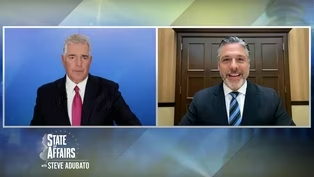
Clip: S8 Ep18 | 13m 39s | Bill Spadea's campaign goals for New Jersey Governor (13m 39s)

Steve Sweeney discusses issues that matter to NJ voters
Video has Closed Captions
Clip: S8 Ep18 | 13m 23s | Steve Sweeney discusses issues that matter to NJ voters (13m 23s)
Providing Support for PBS.org
Learn Moreabout PBS online sponsorship
- News and Public Affairs

Top journalists deliver compelling original analysis of the hour's headlines.

- News and Public Affairs

FRONTLINE is investigative journalism that questions, explains and changes our world.












Support for PBS provided by:
State of Affairs with Steve Adubato is a local public television program presented by NJ PBS