
Bills on Fluoride, Pedestrian, and Chickens Clear Full House
Clip: Season 4 Episode 317 | 4m 24sVideo has Closed Captions
This is the tenth time lawmakers have considered a similar water fluoridation bill.
A bill that would give authority to local water boards to decide if fluoride should be added to drinking water clears the full House, but not without some debate.
Problems playing video? | Closed Captioning Feedback
Problems playing video? | Closed Captioning Feedback
Kentucky Edition is a local public television program presented by KET
Bills on Fluoride, Pedestrian, and Chickens Clear Full House
Clip: Season 4 Episode 317 | 4m 24sVideo has Closed Captions
A bill that would give authority to local water boards to decide if fluoride should be added to drinking water clears the full House, but not without some debate.
Problems playing video? | Closed Captioning Feedback
How to Watch Kentucky Edition
Kentucky Edition is available to stream on pbs.org and the free PBS App, available on iPhone, Apple TV, Android TV, Android smartphones, Amazon Fire TV, Amazon Fire Tablet, Roku, Samsung Smart TV, and Vizio.
Providing Support for PBS.org
Learn Moreabout PBS online sponsorshipFluoride and water.
Should it be removed or kept in?
Well, that's a question that lawmakers have been pondering for a few years now.
A bill to give authority to local water boards made its way out of the House yesterday.
And you might soon have some new neighbors.
We're not talking about people, but chickens.
As another house Bill looks to allow backyard chickens in Kentucky.
Our Emily Sisk continues our legislative update.
PostScript.
Out of 50 states, there's only one other state that has worse oral health than we do.
Northern Kentucky State Representative Mark Hart says that data shows the state's water fluoridation system is not working, and it's why he sponsored House Bill 103 to give local water districts the decision making authority to keep or remove fluoride.
House Bill 103 removes the statewide mandate, but water will continue to have fluoride until a local governing body votes otherwise.
The legislation also provides legal immunity for public water employees, meaning they can't be held liable based on their decision.
House Bill 103 does not say that you have to take fluoride out, so I would encourage those that would be opposed to this bill.
Go and make your pitch to the individual local governments, as they're deciding whether or not to put it in their local water supply.
Many Democratic lawmakers strongly oppose the bill, pointing to positive health outcomes linked to water fluoridation and the potential increased cost of health care if fluoride is removed.
The CDC has identified community water fluoridation as one of the top ten great public health achievements of the 20th century, due to its widespread and equitable reduction in tooth decay.
This is a preventative health treatment.
This has significant fiscal impact to our state with the Department of Medicaid.
The Medicaid program would spend an additional $250 per child in a county that ceases to floor its water for every 10% of Kentucky's child population that no longer has fluoridated water.
The Medicaid program will spend an additional $17 million annually.
The bill's sponsor argued there are studies that show too much fluoride can cause decreased brain development in children.
Ultimately, Representative Hart said he wants the authority to be at the local level.
House Bill 103 passed the House with a vote of 67 to 29, with some Republicans joining Democrats in opposition.
Another bill passed in the lower chambers would prevent pedestrians from hanging out in areas not meant for foot traffic, like medians and exit ramps.
This only applies to state maintained roads, and the bill's sponsor, Representative Kevin Jackson, said it doesn't impact designated pedestrian areas like crosswalks.
The Bowling Green Republican gave his rationale for the bill.
When pedestrians are present and those travel corridors, it creates dangerous and unprecedented situations that risk the public safety of both drivers and pedestrians.
A Northern Kentucky Democrat shared his grievances with the legislation.
I'm worried that this is a tool that could be used, to unfairly target people who are either homeless or protesting.
The bill heard no other opposition and was approved on an 8211 vote.
Another noteworthy measure that cleared the House this week Representative Steve Jones backyard chickens bill.
It allows residents to keep six or fewer domesticated hens on their property.
The chickens may only be kept for personal use.
The sale of eggs is prohibited.
One House minority representative expressed her criticism of the bill.
What I am most concerned about is why this body is so concerned about housing for chickens and not housing for our people.
So I hope we can address that in the backyard.
Chickens legislation advanced out of the house with a 72 to 22 confirmation.
These bills now head to the Senate for consideration.
For Kentucky edition, I'm Emily Sisk.
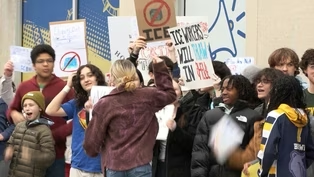
JCPS Students Walk Out to Protest ICE
Video has Closed Captions
Clip: S4 Ep317 | 1m 54s | Students shared with KET why they felt the need to speak out. (1m 54s)

Lexington Mayor: City Didn't Deny State Help to Clear Roads
Video has Closed Captions
Clip: S4 Ep317 | 55s | The comment came a day after Gov. Beshear said he was disppointed in the city's response. (55s)
New Poll Show Barr, Cameron in Tight Senate Race
Video has Closed Captions
Clip: S4 Ep317 | 3m 45s | It's the second poll to come out this week showing Barr with a slight lead. (3m 45s)
Reporter's Notebook: Jess Clark
Video has Closed Captions
Clip: S4 Ep317 | 6m 52s | Discussion of Kentucky Senate GOP and public education policies. (6m 52s)
Providing Support for PBS.org
Learn Moreabout PBS online sponsorship
- News and Public Affairs

Top journalists deliver compelling original analysis of the hour's headlines.

- News and Public Affairs

FRONTLINE is investigative journalism that questions, explains and changes our world.












Support for PBS provided by:
Kentucky Edition is a local public television program presented by KET