
Bistro
Season 5 Episode 9 | 23m 16sVideo has Closed Captions
Ludo Lefebvre brings us to see some of the people and bistros that first inspired him.
A bistro is typically defined by its modesty - they are relatively small, affordable and humble. With Petit Trois, Ludo’s has brought the spirit of the bistro to Los Angeles. In this episode, Ludo brings us back to Paris to introduce us to some of the people and places that first inspired him to begin a culinary career.
Problems playing video? | Closed Captioning Feedback
Problems playing video? | Closed Captioning Feedback
Bistro
Season 5 Episode 9 | 23m 16sVideo has Closed Captions
A bistro is typically defined by its modesty - they are relatively small, affordable and humble. With Petit Trois, Ludo’s has brought the spirit of the bistro to Los Angeles. In this episode, Ludo brings us back to Paris to introduce us to some of the people and places that first inspired him to begin a culinary career.
Problems playing video? | Closed Captioning Feedback
How to Watch The Mind of a Chef
The Mind of a Chef is available to stream on pbs.org and the free PBS App, available on iPhone, Apple TV, Android TV, Android smartphones, Amazon Fire TV, Amazon Fire Tablet, Roku, Samsung Smart TV, and Vizio.
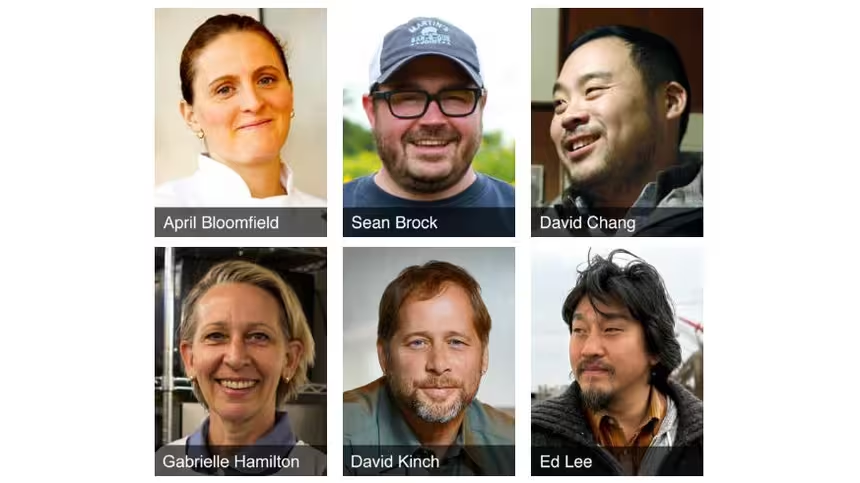
Meet the Chefs
Meet the culinary figures behind The Mind of a Chef! The Mind of a Chef combines cooking, travel, history, humor, art and science into a cinematic journey, each episode focusing on what it truly means to cook, think, create and live in the food-obsessed world that is The Mind of a Chef.Providing Support for PBS.org
Learn Moreabout PBS online sponsorshipViewers like you make this program possible.
Support your local PBS station.
>> BOURDAIN: A bistro is, in many ways, defined by its modesty.
Most are relatively small and affordable.
They've long provided the French with honest home-cooked food, and plenty of red wine.
The bistro's rather ubiquitous these days, but despite its many incarnations, its spirit remains the same.
It is a place where every man can eat and eat well.
Recently, a new cadre of bistros has swept through Paris and beyond-- small restaurants that retain the feel of a neighborhood cafe, while turning out some of the best food in all of France.
Enter the Mind of a Chef.
>> LEFEBVRE: Cooking is not just a recipe.
It's instinct.
Don't need to use caviar, fried chicken is cool, too.
My mom would be proud of me.
(sniffs) >> LEFEBVRE: You recognize a bistro by the menu.
Very, very classic French food.
You recognize a bistro by the bar with the zinc.
And the most important thing, it's a neighborhood restaurant where there's no pressure, and people have a good time.
(laughter, indistinct chatter) You go to a bistro for good food, of course, but also the lifestyle inside the restaurant.
You know you're going to meet some people, you know you're going to talk with people.
You know, I say hi to everybody.
We exchange eye contact.
"Hey, how are you?"
"Hey, good to see you."
"Oh you order the same thing, you're getting the omelette?"
"Yeah, I come for the omelette all the time."
The people make the bistro.
(speaking French) I just love this ambience, I love this ambience.
And I want to create that with Petit Trois.
Petit Trois is my second restaurant I open in Los Angeles.
It's next to Trois Mec in the strip mall.
It's a very tiny restaurant, 800 square feet.
Right away I know what to do over there.
Create a bar a la carte with good classic French food.
A place where people meet each other, and where you know the host.
I grew up with that.
When I was a kid, I go to bistro with my dad on Saturday for lunch.
All the time I go over there, the owner is there.
Serving Chablis to the guest, talking with the guest, cooking, serving food.
The same guy's at the bar drinking his little Ricard or white wine.
(gulping) Jean-Pierre is coming, Maurice is coming, too.
Hey, how are you, ca va?
Philippe, hey, have a drink, come here!
Everybody meet at the bistro.
I remember eating a lot very, very old school dishes.
Nothing really creative.
Just simple, good food.
Andouiliette, steak frites, escargot, beef bourguignon, pot-au-feu.
And my banana split.
Not very French, I don't know why it was in the bistro, but love my banana split, love banana split.
The food I'm missing, the food I'm craving from France.
That's what I do at Petit Trois.
One of my favorite dishes, it's escargot, snail from Burgundy.
Trust me, when I'm depressed, when I'm sad, when I miss my country, a glass of Chablis, and escargot.
And that I'm a happy man.
♪ ♪ We eat a lot of escargot in Burgundy.
But escargot is also really for a celebration.
Mix the butter slowly until it becomes soft.
Voila.
Going to add our garlic.
Some shallots.
Of course we use white wine from Burgundy.
Chopped parsley.
This butter, we call that snail butter.
It's really like a mother butter in Burgundy in cooking.
We put snail butter on everything.
That's a memory from my childhood, you know.
It's exactly for that I decide to open Petit Trois in L.A.
I was missing the food, but also the energy of the bistro.
Here when it's packed, it's magical.
I don't go nowhere.
It's the best restaurant I create for me.
Trois Mec is great, Trois Familia is good, LudoBird, too.
But that, that's my baby.
That's where I feel at home.
So our butter is ready now.
Most people the mistake they do, they put escargot right away, and the butter.
That's good, no.
A little key for detail to be better, you put a little butter first.
A little pea of butter.
Then after you put your escargot, push it.
Then after, you put some more butter-- and be generous.
And again, more butter.
That's it, that's a beauty, a piece of art.
Make sure when you put them in the oven, the shell is straight.
You want the escargot to swim in the butter.
(sizzling) I know this escargot are cooked when you can hear the sizzling of the butter.
We say the butter is singing.
(imitating sizzling) Baguette.
When I was a kid, you can ask my mom, I was eating like ten dozen of escargot.
It was like a competition.
Like I was a machine, a machine.
(slurps) I like the sound... (imitates slurp) The sound of the butter... (loudly slurps) Wait ten seconds.
(imitating slurping) I take the last one, sorry.
Mm... so good.
My mom would be proud of me.
Do you have an escargot in the oven?
>> Chef.
>> LEFEBVRE: Okay, so one niçoise, one cappuccino now.
>> Yes, chef.
♪ ♪ >> LEFEBVRE: A bistro, it's really about the owner.
His personality dictates the ambience of the restaurant, the owner.
At Petit Trois I joke a lot.
I love to joke.
I put all my classic French disco.
Sometimes I dance.
I just love to please people.
And Petit Trois bistro is great for that.
(indistinct chatter) A great, great inspiration for me is Yves Camdeborde in Paris.
He have this little restaurant called L'Avant Comptoir.
It's a neighborhood restaurant, and everybody know Yves.
He have a big heart, you know, like he's so generous.
He really make the place.
(speaking French) >> LEFEBVRE: L'Avant Comptoir, it's a restaurant with no seats-- no seats, you stand up.
To just eat like this at the bar, you meet people.
Sharing butter, the cornichon, the bread.
I can go alone over there and make ten new friends.
(speaking French) >> LEFEBVRE: Yves have a classic French training in high end restaurants.
But Yves decided to open a restaurant with less luxury ingredients, but still the same quality, the same freshness as a three-star Michelin restaurant.
Yves create this new movement: bistronomy.
It was in the middle of three-star Michelin restaurant and classic bistro.
(speaking French) >> LEFEBVRE: When I open Petit Trois, the omelette came on the menu almost the last minute.
I remember that very well that day, you know, it was my partner, Jonny.
He loved to challenge me all the time, and that day he challenged me about omelette.
Well here, actually.
Myself, Jonny, do omelette.
(puttering) My omelette, Jonny omelette, all the staff here try the omelette.
They all vote, and they all vote for my omelette.
All the cooks say, "Wow, I never have an omelette like this.
Chef, how you do that?"
You know, so that's why we decide to have an omelette on the menu.
Good quality of eggs, okay, farm eggs.
Per person I put three eggs.
Put a little bit of salt.
White pepper.
In France we always have eggs and cheese in our fridge.
So I remember my mom, you know, doing a lot of eggs, especially in the night.
Here in the United States it's more the morning or brunch, but in France it's something we eat in the night, too, at the restaurant.
So beat very well your egg.
You don't want to see any piece of egg white in your omelette.
So take your time.
Take an extra one minute and beat this egg.
Voila.
Touch of butter.
Yes, it's a touch of butter.
It's not that much, guys, okay, come on.
So as you can see, the eggs are not boiling in the pan.
No like... (imitating sizzle) No.
And then after you cook your omelette, like if you are doing scrambled eggs, you shake it, and you turn it.
All about to control your heat.
'Cause an omelette need to be like a custard.
Almost like a crème brulee.
Eggs-- it's technique, huh?
You got to be patient.
Cooking, I always say, it's a lot about patience.
Make sure you're in a good mood, not in a bad mood.
I cook better when I'm in a good mood.
Bad mood, I don't know, I don't do good, guys, you know.
So don't piss me off when you come to my restaurant.
See that, start to coagulate, here we go.
Now it's game on, guys!
Now we shake it.
That's the tricky part, don't want to overcook the eggs now.
You need to move it, and move it, and move it.
Middle, and you go all around here.
Make sure the heat is even everywhere.
And after I'm going to reform the omelette.
Voila.
The eggs are cooked underneath, but here you know, they're still a little bit raw.
That's how you want to stop the omelette.
So now, boursin cheese, I grew up with that.
It's not like the fancy cheese you buy in Paris in the fromagerie.
I mean I call that the French Velveeta cheese.
A little different flavor, but I use the black pepper.
It's good, a little, little kick.
♪ ♪ Salad.
With a Dijon vinaigrette.
Chives, fleur de sel, and after we just put a little bit just like this.
It's the perfect meal-- morning, lunch, night.
I challenge everybody to see if they can do an omelette like this.
♪ ♪ Next to the Le Cirque d'Hiver in Paris is this very, very old bar called Clown Bar.
Sven Chartier, the chef from Saturne decide to do bistro over there, don't change the design, just leave it the way it is, I love it.
(speaking French) Sota Atsumi, an amazing Japanese chef.
Who learn how to cook in France and takes the classic French and twist it sometimes with Japanese flavors.
Work very well together.
(speaking French) >> LEFEBVRE: Merci.
Wow.
Wow.
(speaking French) Wow.
I think this is the top dish I eat since I'm here.
(speaking French) When I decide to open Petit Trois, I want to bring back this classic French dish, but I don't find good sole here in California.
To find the best sole, sorry guys, not because I'm French, but the best sole is from Brittany-- France.
So, sole, white pepper, and flour.
Just regular flour.
Shake it.
Voila.
So a little touch of clarified butter, medium heat.
So now we are to give a nice coloration to the fish.
When the clarified butter starts sizzling, you add a little bit of beurre baratte.
Beurre baratte, it's a butter from Brittany.
The flavor is just amazing.
So now I'm going to put my potato here because the fish is not the same thickness everywhere.
So I don't want to overcook my tail.
I can hear the sizzling, so I'm going to check the coloration.
I can just cook like this.
Blind.
Just with the sound.
I'm going to put my sole to rest, ten minutes.
Put a little bit of butter, warm it up in the oven.
Voila, our sole is ready now.
The way it's built, the sole, you have two filets, and the bone is here.
Go under the meat and just pull it gently.
You can see the sole is cooked perfectly because the bone is still a little bit pink.
Pick it up straight like this.
Okay?
I'm going to put my fish together here.
And now the last minute I'm going to show you how to do the brown butter.
I don't know how many times I say butter today.
(sizzling) The milk start to caramelize here.
That's what gives it this hazelnut flavor.
Voila.
Salt.
A little bit of lemon juice.
And we go on the sole.
Parsley.
And that's it.
This dish is very special.
You don't find that in L.A. A real sole meunière like this, with a real French fish, and a real French butter, and a real hand of the chef, too.
I'm French.
Things change in Paris now.
You don't see young chefs opening up classic bistro.
They're opening bistro, the same concept, the same philosophy, but the food is more creative.
It's not classic classic at Petit Trois.
Petit Trois really help me to follow this line about my French heritage.
Sometimes you get lost because you're in L.A., there's so many great food, I love it.
I want to cook Mexican, I want to cook Japanese, cook Chinese, I want to cook Korean because I love that food.
But you know what, I want to bring more of my culture in L.A. And I don't want to forget where I come from.
I'm French, so I want to really stay French.
(sniffs)
- Food
Christopher Kimball’s Milk Street Television
Transform home cooking with the editors of Christopher Kimball’s Milk Street Magazine.





Support for PBS provided by: