
Black Church/Hartford/Greater Grace
Season 49 Episode 17 | 26m 46sVideo has Closed Captions
Black Church/Hartford/Greater Grace | Episode 4917
We’re continuing our year-long series on “The Black Church in Detroit” with a look at how the church meets more than just the spiritual needs of the community. We’ll hear from three prominent Detroit ministers about their faith-based work in the neighborhoods Episode 4917
Problems playing video? | Closed Captioning Feedback
Problems playing video? | Closed Captioning Feedback
American Black Journal is a local public television program presented by Detroit PBS
Black Church/Hartford/Greater Grace
Season 49 Episode 17 | 26m 46sVideo has Closed Captions
We’re continuing our year-long series on “The Black Church in Detroit” with a look at how the church meets more than just the spiritual needs of the community. We’ll hear from three prominent Detroit ministers about their faith-based work in the neighborhoods Episode 4917
Problems playing video? | Closed Captioning Feedback
How to Watch American Black Journal
American Black Journal is available to stream on pbs.org and the free PBS App, available on iPhone, Apple TV, Android TV, Android smartphones, Amazon Fire TV, Amazon Fire Tablet, Roku, Samsung Smart TV, and Vizio.
Providing Support for PBS.org
Learn Moreabout PBS online sponsorshipJust ahead on American Black Journal, the ministry beyond the church walls for continuing our year long series on the black church in Detroit with a look at how the church meets more than just the spiritual needs of the community.
We're gonna hear from three prominent Detroit ministers about their faith-based work in neighborhoods French Detroit, Orlando Bailey is gonna join me with a special edition of American Black Journal.
Announcer 1: From Delta faucets to Behr paint.
Masco Corporation is proud to deliver products that enhance the way consumers all over the world experience and enjoy their living spaces.
Masco serving Michigan communities since 1929.
Announcer 2: Support also provided by the Cynthia and Edsel Ford fund for journalism at Detroit public TV.
Announcer 1: The DTE Foundation proudly supports 50 years of American Black Journal, in covering African-American history, culture and politics, the DTE foundation and American Black Journal partners in presenting African-American perspectives about our communities and in our world Announcer 1: Also brought to you by AAA, Nissan Foundation, Ally, Impact at Home, UAW Solidarity Forever, and viewers like you.
Thank you.
♪♪ Welcome to American Black Journal.
I'm Stephen Henderson, and I'm glad you've joined us.
We are continuing our year-long series on the black church in Detroit, produced in partnership with the ecumenical theological seminary and the Charles H. Wright Museum of African-American history.
Today, we're looking at the important role of the black church in the community.
Historically, churches have served as a foundation for African Americans by meeting their religious economic social and cultural needs.
We're teaming up with BridgeDetroit for today's show.
And joining me now is BridgeDetroit's, Engagement Director, Orlando Bailey.
Orlando all thanks.
Hey, Stephen things are good, Things are good considering everything that's going on in the world.
How are you?
Yeah, I know, I know.
I think that's the question you got to ask everybody right now is how are things, how are you doing?
'Cause the world is a confusing, a really confusing place.
So for this episode of American Black Journal, we're looking at churches and community, and you got a chance to talk to one of my favorite people, Bishop Edgar Vann.
So, you know, he's a phenomenal minister here in Detroit, and his church is an icon really in the city.
But I also think of him as a phenomenal Detroiter.
And I think that really kind of captures the bridging between the ministry of the church, and the ministry of Detroiters, and the kind of shepherding of the city and its people through things that aren't just religious.
Yeah, you know, he said to me off camera that my first name isn't Bishop, it's Edgar and it speaks to his humanity, speaks to the live experience that he has to live as a Detroiter.
And as a person who leads one of the largest congregations in the city of Detroit Bishop Vann.
And, you know, I called them, you know, Detroit's pastor, because so many people feel that way.
We really got a chance to, you know, dive deep into you know, some of the trends that we've been seeing as of late, especially with the research that has come out of the Pew Center with millennials making a mass exodus from the church and talk a little bit about why he thinks that is, it's gotta be a really, it's an interesting conversation we had to have.
Yeah, and of course, you're talking with one minister in this piece, but this is the story all over Detroit.
There are ministers in nearly every community who are bedrock parts of that community and hugely important to the community work that goes on in these neighborhoods.
Yes, but there's also a sense of that, the church has virtually been silent on issues of social economic and racial justice as of late especially in the blackest city in America.
And, you know, we talked with Bishop Vann about that as well, around, you know, the call for churches to return to the center.
At one point it was the black church who was the center of racial movements and civil rights movements, especially in the 1950s and '60s, where do we stand on that in 2021?
And so while many churches are still epicenters in their community, a lot of folks feel like and research is saying this that they are no longer, that go-to place.
And we got to talk about that.
Yeah, yeah, I mean, it's a real challenge for Bishop Vann and all the other ministers here in Detroit.
All right, so Orlando, do you wanna introduce your piece?
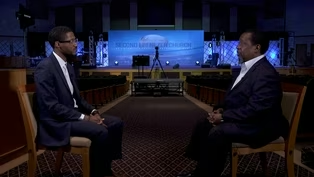
Yeah, I'm super excited producer Marcus Green and I had the opportunity to go to second up and these are onsite in interview, Bishop Edgar Vann.
Here's what he had to say.
Bishop Vann welcome back to American Black Journal.
Well, it's my pleasure and my privilege, Orlando, thank you for inviting me.
We're happy to have you, as we embark this series around, the black church in the city of Detroit we'll get into all of that, but first I just wanna do a human check-in.
How are you doing, sir?
I am doing quite well.
And I give, you know, God the praise and the glory for it.
But this has been a season that he's given me some special skills to navigate.
And I'm very grateful for.
45 years in pastoring.
And you've seen the city of Detroit in its heyday.
You've seen it decline.
And now we're seeing it on the up and up.
How do you feel the black church has been showing up on the pavements of neighborhoods in the city of Detroit in 2021?
I think there's been a remarkable level of resilience for the black church.
The fact that we're still here in spite of the circumstances, we've done over a $40 million worth of housing in commercial development and community development, in the North end neighborhood in those years but also here at the church where we are really considered a community hub.
We now for the last 10 weeks done COVID vaccinations right here at the church.
We've really, really been on the vanguard of what needs to happen in our communities, just during COVID.
I think we've, I think our last numbers we had fed about 70,000 families in the 14 months during COVID each week.
You talked about innovation, and I wanna talk a little bit about all of the research that has been coming out around church and millennials and a mass exit is making mass exodus from the church.
I'm a millennial.
I happen to still be in the church, citing, you know a lot of things, a lack of progressivism a lack of physical representation in neighborhoods.
Some still have that critique and the service just not fitting what they, how they wanna serve, how they want the service to go.
How are you being innovative and retaining and attracting young people to the church in 2021?
I think it's a challenging thing for any church.
I think that this is a generation who possibly one of the first generations who their primary influencers are not necessarily their parents.
Yeah.
Not necessarily institutions, not necessarily anything conventional, churches are not cookie cutter.
All of them are not called to do everything.
Other people want them to do.
They need to find a church and leadership that works for them.
And I think the church is not monolithic.
The church is the black church is not monolithic, right?
And so it's important for us to understand what the black church represents even in this day in time.
I do know that there are people who have given up on God because of some of the social ills and the unconscionable situations that they have seen happening to African-Americans.
But this is exactly the power that we need in times like these, because it will take the church.
It will take the power of God, and it will also take our stands for social justice and our voices to be heard.
But still one of the most potent voices can be heard today from the black community is the black church.
Bishop Vann, thank you so much for joining me.
Thank you, it's been a pleasure.
Second Ebenezer is just one of several black churches here in Detroit.
That's investing in the city and in its residents.
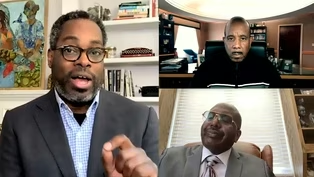
I talk with two pastors whose churches have been leaders in economic development projects, Bishop Charles Ellis the third of greater grace temple and Reverend Charles Christian Adams, from Hartford Memorial Baptist church.
What we're talking about today is the work that you guys do beyond the church walls the roles you play in our community and in trying to keep the community together, lift the community up and develop the community.
That's a role that black pastors of course have played for a really long time.
But I wanna give both of you a chance upfront to just talk about what that role looks like in Detroit in 2021 We are in pandemic, all of the other things that pushed us down on our lives, what role are you called to play these days?
Bishop Ellis, I'll start with you.
Well, you know, I'm carrying on 25 years now, legacy from my father who passed it for 34 years.
He was the first to move beyond the walls of the church.
And in terms of a daycare center monitor, sorry daycare center, and then a Christian school that went from kindergarten to the eighth grade and then a apartment.
So duplexes that allow people to live in affordable housing and then the credit union, federal credit union federally chartered credit union.
And that was like, wow, we're bank now, you know?
And so, you know, he was the one to see beyond the church and to see that people have more than spiritual needs but they had natural needs.
And it kind of was a transition because before he passed I was one that wrote the grant.
They received $5.3 million from HUD to Ellis matter that here on the new site.
So it was kind of like a transition in the two years after we moved the first residents in '94 my father passed me this transition.
And of course, five years later in 2002 we moved into this facility six years later, I should say.
So I'm just curious on that legacy.
And I used to brag here in a good way that we did more ministry here.
I had our presence site outside of the church during the summer months, then we did inside of the church and now we're pretty much doing almost everything outside of the church.
So, you know, we've gotten a head start, you know making sure that we ministered outside the church.
You know, we didn't wanna have a great party inside, and nobody even knew we existed except for the members of the congregation.
So we've tried to specialize for years, you know going beyond the walls and ministering to people outside of these confines of Gregory's temple.
Yeah, Reverend Adams.
Yes, and it's really divine providence that we would be on the show together, Bishop Ellis and myself because his father and my father were contemporaries and colleagues and very good friends.
And they did a lot of the same work, housing, developed, bishop papa's was a forerunner to that in a lot of housing development for black church.
And we also continued that tradition and we just completed a Senior Village.
Right, almost Parkwest at its center $15.5 million project cooperatively with the (inaudible) villages of Michigan, providing apartment style housing and cottage style housing right there for those who did not want to live in the suburb.
But again, have quality housing in the city of Detroit.
Also, we, have tried to ignite employment opportunities through economic development.
So on the church property, there is a, development, adjacent development corporation entity in the church but it's church property basically where we have a Kentucky Fried Chicken, Long John Silver Subway, McDonald's.
Also we developed the land that Home Depot now sits upon.
It originally was a Super Kmart.
And also the Checkers Hamburgers we developed that is presently on church land as well, as well as the Davis Brothers who are institution within the city of Detroit.
As African-American a black businessmen, they were pioneers and they are second generation entrepreneurs.
Actually, I think I've talked with Benson Davis.
I think he might be third generation pioneers but they own the shell station.
And then the auto body shop, the auto body shop is on our land as well because there is an ethos that we walk into that our four runners walked into as well.
And that was the church being a part of the revitalization of the community.
Second Baptist Church, at one point was the main Baptist church in the city.
And his pastor, Reverend Bradley was considered to be a employment agency in and of himself in her book, "Faith in the City," Dr. Preston the dealer talks about how for dependent upon second Baptist leadership and their pastor particularly to recommend people for jobs at Ford, during the great migration and then also to settle disputes we didn't have unionization.
So he sent to the West side of Detroit, a pastor who pastored Hartford Memorial Baptist Church, Harford Avenue at that time for two years, Charles Andrew Hill came after him pastor for 48 years and started UAW Local 600 was started in the sanctuary of the church.
He also fought for fair housing had WEB to boys to lecture at the third fall Robeson saying then my father was was his successor and he fought for the same types of issues, but he walked in the ethos.
The Bishop was able to do the work that he's able to do because the congregation understood that even before he ascended it was a part of the theology of the church.
My father had that same advantage, and now I am able to be aggressive in community development as well as we continue to reach beyond the walls because of our forerunners, they laid the foundation.
It's an ethos that we are walking in almost like the scripture that says we live, move, and have our being in God.
We live, move and have our being in this idea that church goes beyond Sunday morning.
Yeah, so you both referenced economic development there.
And I wanna talk just a little.
You gotta have, that is, you know a lot of people would say, that's not the church's job.
That's government's job, or that's not the church's job.
That's a, the Chamber's job or business group.
It's their responsibility to grow, its other social organization, and talk about why, especially for the black community the church is this incredible engine of economic development and opportunity, Bishop Ellis.
Well, I would say that it's always been, you know, when you think about the church coming out of slavery the church was that gathering place.
Even on the plantation, down by the Riverside.
I think about the schools that you're saying those spiritual songs and hymns I'm gonna lay down my burdens down by the Riverside.
Those were gathering places.
And many times those songs that they saying were messages that they were sharing one with another, that the slave masters did not understand and could not comprehend.
So the church was always that place of trust for black people.
It was always a place of integrity for black people.
It was always that place where you knew that you could get a fair deal.
You knew that you can get somebody who would be sensitive to your plight into your situation and with not just, you know, lay hands on you and pray for you, you know, and give you a spiritual high and then, you know release you and say, hey, make it for yourself.
It was always that institution that wrapped his arms around you.
And I would say, that we've always been family here in the black church.
You know, that that's why this pandemic is really affecting us emotionally, probably in a greater way.
There may be some Caucasian or other congregations because you know, African-Americans man, you know, we touchy feely people, you know.
I mean, when black people shake hands, man, it's like five minutes, you know, you got all this and then a snap at the hand, two minutes later, you know, other folks and keep moving on because we like touching one another, and we're that touchy feely kind of, we hug and we embraced.
And, you know, we care about our brother and our sister, because again we know the burden, and we know the plight of not having enough and just barely making it.
And that's why we've always been, you know, an economic engine as well.
We want to see our people educated, we want to see them be able to apply for jobs and enlistment.
I give credit to the UAW and to a lot of institutions, and thank God that we have people like you, and others in places of influence that when opportunities come you bring it to the church and say, you know, Bishop, I need 20 good people, you know, and I'm gonna give them a break on your integrity and on your word, you know, and that's what we've been blessed to have probably in the last 30 or 40 years.
And that's made a tremendous difference in people in our congregations which is our community getting a fair shake on the American Dream.
Yeah, Rev.
Adams.
Yeah, absolutely.
That is a powerful question because this is across the Baptist Church that this has been compelled to bed.
We have to be so many people, counselors, preachers, pastors, economic developer.
We have to employment agencies.
We have to have so many roles and so many hats because of the necessity of access to it.
Now, if somebody has emotional crisis and, you know, wealthy neighborhood, they hire a psychoanalyst at two or $300 an hour or more.
And they make an appointment.
These are, a lot of those appointments.
We feel ourselves and we walk people through changes and challenges in life, because we have to, if people can afford that.
And, but it's a wall that we gladly fleck.
We start the engine for economic development because corporations are skiddish about coming into the community and paying the black tax.
We have to make the case that you can make money in the African-American community.
And when they can't get the small business loans they have to come to Michigan Credit Union because they can't get the money elsewhere.
And we have to create the opportunities that are in other communities, just because of the demographic differences.
But we have to play that role.
Now, the question is for me Stephen, when do we start making sure that we compel the government to do their job, 'cause we shouldn't have to play all these roles.
It's the government's job to make sure everybody has access to fair housing.
It's the government's job.
We're paying taxes, just like everybody else.
This myth that African-Americans are just somehow living off the fat of the land, and we're not paying any taxes, says a lot.
And the economics of many of the economic development entities that we're talking about ain't engines, pay tax.
And look the government has to provide equal access to healthcare.
The government has to provide equal access to education.
The government has to provide equal access to opportunity and we have to continue to pressure them to do it.
We have to do much.
We have to continue to fight.
We have to continue to advocate and ultimately it will help everybody, injustice anywhere is injustice everywhere.
And now folks shoulders getting a little taste of the system that he allowed to run on over African-Americans, right?
I hope they give him mercy at his sentencing because I wanna make the same case for African Americans who are overcharged and over sentenced.
we have to say, look, why are we dealing with COVID-19 pandemic?
So that's part of life communicable diseases, that's part of life.
It's the medical delivery system that has forgotten poor.
So we can't be satisfied with the union in America and then no unionization in coordinations because the companies just go to work for, nations aren't exploit down.
We can't be satisfied with healthcare in America and then no health care delivery and other nations.
'Cause if they get sick there, with transportation being the way it is we're gonna get sick here.
And even within our country, we have third world living conditions right here in America.
Now we wanna talk about, we are involved with the Africa and help them.
We got kids that need our help in Detroit, in Watts, in Cabrini-Green.
And if they still have Cabrini-Green I think there's the bigger projects kids got but where we've got kids that need help right here.
But we have to force the government to fulfill their role.
Okay, Bishop Ellis, and Pastor Adams, great here on this show that we have two such huge religious, not just in the religious community but in Detroit generally, I'm really glad you joined us for this conversation.
That's gonna do it for us this week.
Thanks as always for watching, we look forward to bringing you monthly reports on the black church in Detroit, and you can view past shows, at americanblackjournal.org And BridgeDetroit looks forward to partnering with American Black Journal on the stories that matter to African-Americans check out our reports at bridgedetroit.com.
We wanna hear what's on your mind.
Connect with us on Facebook and on Twitter.
See you next time.
♪♪ Announcer 1: From Delta faucets to Behr paint Masco Corporation is proud to deliver products that enhance the way consumers all over the world experience and enjoy their living spaces.
Masco serving Michigan communities since 1929.
Announcer 2: Support also provided by the Cynthia and Edsel Ford Fund for journalism at Detroit public TV.
Announcer 1: The DTE foundation proudly supports 50 years of American Black Journal in covering African-American history, culture and politics the DTE Foundation and American Black Journal partners in presenting African-American perspectives about our communities and in our world.
Announcer 2: Also brought to you by AAA, Nissan Foundation, Ally, Impact at Home, UAW Solidarity Forever, and viewers like you.
Thank you.
(upbeat music)
Video has Closed Captions
Clip: S49 Ep17 | 4m 9s | Black Church | Episode 4917/Segment 1 (4m 9s)
Video has Closed Captions
Clip: S49 Ep17 | 14m 47s | Hartford/Greater Grace | Episode 4917/Segment 2 (14m 47s)
Providing Support for PBS.org
Learn Moreabout PBS online sponsorship
- News and Public Affairs

Top journalists deliver compelling original analysis of the hour's headlines.

- News and Public Affairs

FRONTLINE is investigative journalism that questions, explains and changes our world.












Support for PBS provided by:
American Black Journal is a local public television program presented by Detroit PBS