
Black Church’s Role Reducing Gun Violence, Hastings Street
Season 50 Episode 30 | 26m 46sVideo has Closed Captions
Black Church’s role reducing gun violence, Plowshares Theatre “Hastings Street” musical
"American Black Journal" continues its Black Church in Detroit series with a look at the church's role in helping to curb gun violence in the community. Then, producer Marcus Green takes us backstage for a look at the new musical "Hastings Street," set in Detroit's historic Black Bottom neighborhood in 1949. Episode 5030
Problems playing video? | Closed Captioning Feedback
Problems playing video? | Closed Captioning Feedback
American Black Journal is a local public television program presented by Detroit PBS
Black Church’s Role Reducing Gun Violence, Hastings Street
Season 50 Episode 30 | 26m 46sVideo has Closed Captions
"American Black Journal" continues its Black Church in Detroit series with a look at the church's role in helping to curb gun violence in the community. Then, producer Marcus Green takes us backstage for a look at the new musical "Hastings Street," set in Detroit's historic Black Bottom neighborhood in 1949. Episode 5030
Problems playing video? | Closed Captioning Feedback
How to Watch American Black Journal
American Black Journal is available to stream on pbs.org and the free PBS App, available on iPhone, Apple TV, Android TV, Android smartphones, Amazon Fire TV, Amazon Fire Tablet, Roku, Samsung Smart TV, and Vizio.
Providing Support for PBS.org
Learn Moreabout PBS online sponsorship- Coming up on "American Black Journal", our black church in Detroit series is gonna examine the gun violence crisis and the church's role in helping to stop the shootings in our city.
I'm gonna talk with two Detroit pastors about their efforts to curb violence in the community.
Also coming up, a new musical about Detroit's historic Black Bottom neighborhood.
Don't go away.
"American Black Journal" starts right now.
- [Advertiser] From Delta faucets to Behr Paint, Masco Corporation is proud to deliver products that enhance the way consumers all over the world experience and enjoy their living spaces.
Masco, serving Michigan communities since 1929.
Support also provided by the Cynthia & Edsel Ford Fund for Journalism at Detroit Public TV.
- [Narrator] The DTE Foundation proudly supports 50 years of "American Black Journal" in covering African American history, culture, and politics.
The DTE Foundation and "American Black Journal" partners in presenting African American perspectives about our communities and in our world.
Also brought to you by Nissan Foundation and Viewers Like You.
Thank you.
(upbeat music) - Welcome to "American Black Journal".
I'm Stephen Henderson.
Today, we're continuing our series on the black church in Detroit, which is produced in partnership with the Ecumenical Theological Seminary and The Charles H. Wright Museum of African American history.
In the wake of the increase in gun violence here and across the country, we wanna talk about the role of the black church in helping to combat the shootings.
There are a lot of ministers who are talking about the violence in their sermons on Sunday mornings.
Here's Reverend Cindy Rudolph of Oak Grove AME.
- Here we are dressed in our orange, remembering those who have died senselessly to gun violence.
And instead of coming together to combat this culture of senseless bloodshed, we are more divided than we ever were all because there are those who could in fact make a change and make a difference, but instead they allow laws to remain in place that protect gun manufacturers from being sued and refuse to pass laws to protect our children from being shot in school.
(congregation applauds) This is not who God created us to be.
This is who we are not.
All week long, some of us saw on television, family members and survivors, and even frontline workers who have testified before Congress about just how horrific it was when those babies, and those teachers, and defenseless victims were slaughtered in cold blood.
And yet there are those who insist that their right to own a military style assault rifle is more important than the right for innocent victims not to be murdered in cold blood.
(audience applauding) This is not who God created us to be.
This is what we are not.
- Now some churches like Detroit's Church of the Messiah on the east side are taking their efforts to the streets.
That church recently held its annual Silence the Violence march and rally.
And later this month, it'll kick off a series of summits called State of the Hood.
The first meeting will focus on the church's role in stopping gun violence.
I sat down with Church of the Messiah's pastor, Barry Randolph and Reverend QuanTez Pressley, who is lead pastor at Third New Hope Baptist Church and a member of the Detroit Board of Police Commissioners.
Pastor Barry I'm gonna start with you, the march that you have each year to highlight violence, to highlight the opportunity I think, to intervene in the cycle of violence.
Tell us about that.
Tell us why you do it and what it means in the community where your church is located.
- Thank you so much, Stephen, for the question.
June the 4th, we had our 15th annual Silence to Violence march and rally.
The march actually honors the innocent victims of gun violence.
That's the reason why we do that.
The rally gathers the community groups together that work on violence interruption.
So the groups come out, they give people an opportunity to be able to join them, find out what's going on in community.
And it gathers everybody from not just Islandview but we had people from all over the state come.
And there were well over a thousand people who showed up, which just kind of let me know everybody is sick and tired and they want to work together.
So this is all about the people from Detroit and across the state coming together to eradicate gun violence.
- And Reverend Pressley talk about the church.
And again, it's opportunity to interrupt this cycle of violence.
I mean, we live in a city where there has been too much violence for years and years.
And of course, the last few years I think have gotten much more intense in terms of the number of incidents, the kinds of incidents that we're seeing.
The church plays such an important role in people's lives, in Detroit.
Where does it fit in this particular issue and where is that chance to interrupt it?
- Yeah, great question.
I think that first and foremost, Chief White at the funeral services for fallen officer Loren Courts mentioned that he needs everybody to do their part, that everyone in the community has a part to play.
And I believe that the church has an essential part in that fight and combating against the violence that we see in our communities.
And I think it first starts with the moral message that God stands on the side of life.
All that we know about the scriptures is an affirmation of life.
And so we as the church should do everything that we can to secure and to protect a full and flourishing life.
But I think there's two areas in which we can have more specific input.
You know, there are lot of violent crimes occur as a result of poverty.
And so a number of our programs are aimed at helping people to alleviate the poverty that they experience so that they don't have to engage in crimes that often leads to violence.
And then we also have been hearing the conversation about how important mental health is, again, and being able to mitigate violent responses in our community.
And likewise, I think the church can play a very important role.
Here at Third New Hope, we have a Seasons Of Grace Ministry that provides mental health services to those who are in need.
And so I think that if we address poverty and mental health, particularly from a spiritual and moral point of view, that we can begin to disrupt the kind of violence that we're seeing in our community.
- Yeah, pastor Barry, young people are such an important part of your church and your community down in Islandview.
And you already do so many things to try to give them opportunities, to make the right choices, to build productive lives for themselves.
Talk about in that work, how violence comes up, the role it plays in these young people's lives already.
And again, what role you see the church playing in trying to disrupt that.
- The church do play a role in disrupting violence.
One of the ways that we do that is we do work on the issues of poverty and bringing people out of poverty, but also too, it's about changing the mindset, changing the mindset to let people know, that greater is He that is in you than he that is in the world.
And being able to give you the resources to be able to do that.
The church is the resource.
So a lot of times in disadvantaged communities, there's a lot of poverty, because there's not a lot of economic opportunity.
There's not a lot of educational opportunity.
There's not a lot of entrepreneurship opportunity.
The church fills in that gap by being able to become the hope through which you can get back in school, that you can go to college, that you can get a job and where you can start a business.
And at the same time, you can actually work on your spirituality and your relationship with God.
So the church fill in the gaps, knowing that there is an issue of violence in our community or neighborhood, and most young people, they don't wanna choose the violence, but it's the thing of there's so few options in the community and neighborhood that a lot of 'em feel like they have to take that choice.
- Reverend Pressley.
I want to give both of you a chance to talk about the ways in which this, particularly this recent increase in violence affects your church community.
I think for all of us on a certain level, this becomes very personal.
This becomes about people we know.
This becomes about people we care about.
And I know that churches of course are not immune for that.
So talk just a little bit about how this is affecting your congregation and your community right now.
- Yeah, thank you for the question.
Again, I think that it's very important to remember that often we talk about the preventative measures, but a place that the church plays a huge role is usually in the after effects.
When families have become victims of violence, it is the church that steps in and provides comfort and support for these families.
And so when we see funeral services, particularly from my advantage point with people who are younger than I am, it really does tug on my heart to recognize that there is some young person with great potential whose life was stuffed out from them way before their time.
And so when you're looking in the faces of grandmothers and mothers, sisters, and brothers, and having to comfort them as a result of senseless violence, it really does begin to weigh heavily upon the faith community.
And it is that weight that compels us to act because we cannot sit idly by and allow it to continue to perpetuate, but we must do our part to see what we can do to pause, if not completely eliminate the level of violence that we're seeing in our community.
Not only just gun violence, but violence in total.
- Pastor Barry, what's this look like in your church and in Islandview?
- Well, the conversation that I had with the young people a few weeks ago, we were talking about something seemed to have changed.
There's something that's changed over this last year, last couple of years.
We know COVID have a lot to do with that, with isolation, things of that nature.
But one of the things that I told them that 50, 60 years ago, this was not an issue the way it is now.
And I explained to them how the church has always stood up during the time of everywhere from slavery, civil rights, Jim Crow, that the church has always been the voice of reason.
It's always been the place where you can come, where people got together and they stood up against immorality that was in our communities and neighborhoods.
And somethings changed because I told them when I grew up, there was no such thing as a drive-by.
There was no such thing as carjacking.
And now this is becoming normal.
In the same way that system is put in place, we can change that system.
We changed the system during the civil rights movement, we can change the system now.
We have to agree that we're going to do this.
Best place to do it is the church.
We have a moral obligation and responsibility to do it.
And ours come from the book.
- Yeah.
Reverend Pressley, as you pointed out, you're closer in age to some of the young people who struggle with this issue than I am, or pastor Barry.
This idea of it being different, this idea of not being the way things used to be.
I wonder what you make of why that's true, whether that's true in your experience and why, what has changed, what is either missing or present that makes the city feel so different?
I think especially for young people.
I think they feel like they live in a different place than I might have when I was growing up here in the 70s and 80s.
- Yeah, it's interesting that you would say that because according to data, I sit on the board of police commissions and each week we receive the data from the city of Detroit and violent crimes are actually down this year than it was in the year before.
And so I don't know whether it's anecdotally that we're feeling more violence.
Maybe it's a matter of social media being able to show these images over and over again, that makes it seem more frequent than it might be.
But I do think that one of the issues is that there's a failure on all parts of institutions in the eyes of young people.
Every institution that let's say in the 60s and 70s that will look to for some level of guidance, a standard barrier has all changed.
Whether that's the criminal justice system, whether that's churches, schools, even families, broken families.
All of these institutions have crumbled before young people's eyes.
And I think that there is a lack of a sense of a real future.
And when you don't have a sense of real future, you will really make some very risky decisions with your present.
And I think that that's the case with a lot of the young people, not having real goals about seeing themselves 40, 50 years old.
They make decisions that oftentimes end their lives before they have truly lived.
And so one of the things that I always try to do is to encourage them to think beyond the present, I ask them questions, like, "What do you think your grandchildren "will think about that?"
So multiple generations from where they are now forcing them to have a more long term view, which might mitigate some of the risk that they're willing to take in the present.
- And as you mentioned, you're a police commissioner here in Detroit as well.
And part of the system that tries to hold the police department accountable for the job it does and for its behavior, let's talk about from that perspective, this violence that we're dealing with and I guess what's needed, right?
What are the levers we should be pulling in that arena that would have an effect on this?
- Yeah, violence has been with us always.
I mean, I think the Bible, even as early as Genesis, we realized that human beings have this predilection towards violence, but I think guns have entered a new wrinkle because of how quick and how fatal it can be and even as we're seeing now, these mass shootings where numbers of people are losing their lives in one setting has really made it a challenge.
And so the thing that I'm struggling with is that there's limitations to every institution, there's limitations to what churches can do to eliminate violence.
There are even limitations to what law enforcement can do to prevent it.
Often they're responding to incidences after they've already occurred, but there aren't many resources or tools to prevent it.
And so I kind of land on when are we gonna have the conversation about the amount and the accessibility of guns in our community at large, because if we can eliminate guns from the conversation, then it gives us a little bit more space to begin to talk about how we can eliminate violence in totality.
But while we have guns in our community where just on the whim, an individual... Let me mention this.
At the border police commissioners meeting, numbers of the gun incidences that we were hearing about were teenagers.
And they were accidental gun shootings where a child would pick up a gun and either injured themselves or someone else.
These things can be prevented with the right level of education, but more importantly, with the lower access of guns in our community.
And I think that's a conversation that most people don't wanna have, but I think it's crucial to really changing the nature and condition of gun violence in our community.
- And that's one thing that is absolutely different today than it was 40 or 50 years ago is the number of guns that are available.
I mean, there are more guns in America than there are Americans.
That wasn't true in the 1970s and 80s.
And there are no question that the access, the easy access to those is one of the drivers here.
Pastor Barry, I wonder if you can talk just a little about what you hear from young people who are living through this time and have to manage, the violence that does exist, have to kind of keep their focus on the future and opportunity is Reverend Pressley was talking about.
What do they say to you about all of this and what they wanna see be different?
- Well, I have to comment on something that Reverend Pressley had mentioned when he said that young people, they're losing hope in established institutions.
And that is the part that is so true that they're losing hope.
And they kind of feel like they can't believe that adults can't figure this out.
They cannot believe that adults with common sense cannot figure this out.
They cannot believe that whether it's government officials, whatever leadership ability you're in, they cannot believe that this cannot be figured out by adults.
And they believe that they're gonna have to do something about it.
A lot of them are trying to figure out different ways of being able to build out community, neighborhood, have conversations among themselves and see what it is that they could possibly do.
They want a different future.
And they want people who have not sold their soul out to any type of entity to be able to stand up and stand up for them.
We had a conversation where we were talking about there's 400 million guns in this country and about 330 million people.
And that just kind of blew their mind.
And they just talked about how easy it is.
It's easier to get a gun than a driver's license, and they wanna be able to change the system and they wanna see it, whereas it's a lot harder, but they also wanna be able to see opportunities.
They know they gotta work on issues of racism and not just gun violence.
They have to work on gender equality, all these different things.
They know that these are issues that's gotta take place.
They're just disappointed in adults when they come down to it.
- We wanna turn now to the world premiere of a musical about Detroit's historic Black Bottom community.
The Plowshares Theater Company is presenting "Hastings Street" at the Detroit Music Hall through July 31st.
"American Black Journal" producer, Marcus Green stopped in during rehearsal and spoke with the shows creators and the theaters artistic director.
(classical music) - For "Hastings street" we knew that it was gonna be set very specifically in 49, 50 in Detroit, in Black Bottom and Paradise Valley.
And so what does that do then to the music that is inherent to that time period?
If somebody's walking into a bar in Black Bottom in 1950, what are they gonna be hearing, right?
And so there's that aspect to it.
Then there's also, I think some music that isn't necessarily anachronistic to the time period, but that draws a similar contrast that is really speaking to well, where is a person, one of the main characters, Ranita has a song called "Towers."
Like what is going through her head?
What is she feeling at this moment?
And how do we express that through music?
- I think right now we have this opportunity to be at a major stage and what I consider to be a very important city from an artistic and historic standpoint, and to be able to be working with Plowshares Theater and the history that they've really carved out for themselves here in the city of Detroit is really significant.
Gary Anderson has been a long time collaborator of mine, and I'm really proud to be working with him, really proud of what he's put together in both commissioning us to put this piece together, as well as this production that we're about to see.
- We were all working on another project that was supposed to be Detroit related that wasn't really Detroit related and it fell apart.
And I think it fell apart for a legitimate reason.
It wasn't gonna focus the attention on something that was gonna celebrate Detroit.
And so I decided that working with them has shown me that they had some talent and the best thing to do is to seek some funding so that we could get them commissioned to create a work that was gonna focus on a really untold story in Detroit.
And that is the conditions that occurred during the razing of the Black Bottom.
- For me, having family constantly talking about Black Bottom.
My grandmother used to tell stories about how they would take pennies and coins and like put them on, or attach them to the bottom of their shoes and go out and dance in the streets, standing outside, listening to music.
And that neighborhood doesn't exist anymore.
Like the city that we grew up in was very different from the city that our grandparents, and aunts, and uncles and family grew up in.
And there's a difference, I think between hearing your family talk about a story and then actually doing research and like investigating that story more thoroughly.
And for me, I think it was the idea that this street that could have had however many businesses, stores, shops, homes, families is now a couple of blocks.
You know what I'm saying?
Like that to me was a great microcosm in understanding what happened to a whole community.
- And I think even being in a room like this where we're able to see so much history and so much detail that has been preserved, but then we're talking about an area where it's really the lack of having access to that resource, having access to that even visual reference of what this would've looked like and what this would've been had it still existed now is a large part of what has informed this piece.
Because now we're really thinking about what could have this legacy have been if this had continued.
How it would've shaped the music, how it would've shaped the culture, the infrastructure of business, how would it have really have changed the black community in the city of Detroit had those neighborhoods not been destroyed.
- Hastings Street was a cultural entertainment hub for black folks.
Everything that you think about when you talk about Broadway, or you talk about Woodward Avenue here, that was Hastings Street.
- The stories that happened in Detroit are just as valid as the stories that happened in New York.
The people that live in this city that have lived in this community are just as influential, if not, if I dare say so myself, more so sometimes when you start talking about the history of manufacturing sectors and like the birth of the middle class and everything that came out of this city and this geography, and this people.
And that their stories deserve to be told, but their stories deserve to be cherished.
- I want people to walk away feeling proud of the history of our city and also feeling proud of the musical influence that African Americans have had on the world of music.
'Cause we have everything represented here.
Every piece you could ask for, whether we're talking about jazz, whether we're talking about blues, or you can talk about the influence that we've had on the music referred to as classical music or even the influence that was had on the history of musical theater.
If you really think about it, black American music has shaped the face of what popular music is across the world.
- We also need to look at that one of the elements that this play talks about is coming together, the importance of people, of a community unifying to work on large challenges.
I get choked up about that.
'Cause it means a lot.
We Plowshares has instituted this policy of what we call Harambee, it's a Kenyan principle.
In Swahili, Harambee means all pulled together, which shows you the importance of nobody does anything alone.
(classical music) And others have to be invested and see the benefit of being engaged.
And one of the messages of this story is that, even though this community was fractured and displaced, the key to us moving things forward in Detroit is by coming together, having a common interest and a common goal.
And I think that's the main thing that I could get across.
The idea of this story being used to convey that message to the people who see it, hopefully, hopefully might spark some people to see that as a solution for our current situation.
(upbeat music) - That is gonna do it for us this week.
You can find out more about our guests at americanblackjournal.org.
And as always, you can connect with us on Facebook and on Twitter.
Take care, and we'll see you next time.
(upbeat music) - [Advertiser] From Delta Faucets to Behr Paint, Masco Corporation is proud to deliver products that enhance the way consumers all over the world experience and enjoy their living spaces.
Masco, serving Michigan communities since 1929.
Support also provided by the Cynthia & Edsel Ford Fund for Journalism at Detroit Public TV.
- [Narrator] The DTE Foundation proudly supports 50 years of "American Black Journal" in covering African American history, culture and politics.
The DTE Foundation and "American Black Journal" partners in presenting African American perspectives about our communities and in our world.
- [Advertiser] Also brought to you by Nissan Foundation and Viewers Like You.
Thank you.
(upbeat music)
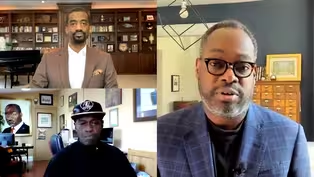
The Black Church's Role in Reducing Gun Violence
Video has Closed Captions
Clip: S50 Ep30 | 17m 14s | Stephen Henderson examines the Black church’s role in reducing gun violence. (17m 14s)
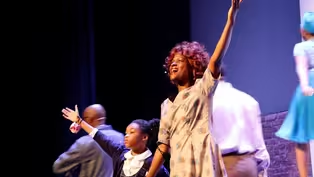
Plowshares Theatre Premieres New ‘Hastings Street’ Musical
Video has Closed Captions
Clip: S50 Ep30 | 6m 5s | The Plowshares Theatre premieres its new “Hastings Street” musical, set in 1949 Detroit. (6m 5s)
Providing Support for PBS.org
Learn Moreabout PBS online sponsorship
- News and Public Affairs

Top journalists deliver compelling original analysis of the hour's headlines.

- News and Public Affairs

FRONTLINE is investigative journalism that questions, explains and changes our world.












Support for PBS provided by:
American Black Journal is a local public television program presented by Detroit PBS