
Black Film Festival, Black Reading Month, Aaron Pori Pitts
Season 50 Episode 38 | 26m 46sVideo has Closed Captions
Detroit Black Film Festival, September is Black Reading Month | Episode 5038
The 3rd annual Detroit Black Film Festival returns Sept. 21, featuring 86 films by Black independent filmmakers. September is Black Reading Month encourages people to read books, magazines and journals by Black writers. Plus, a tribute to renowned Detroit artist Aaron Ibn Pori Pitts, who passed away at age 80. Episode 5038
Problems playing video? | Closed Captioning Feedback
Problems playing video? | Closed Captioning Feedback
American Black Journal is a local public television program presented by Detroit PBS
Black Film Festival, Black Reading Month, Aaron Pori Pitts
Season 50 Episode 38 | 26m 46sVideo has Closed Captions
The 3rd annual Detroit Black Film Festival returns Sept. 21, featuring 86 films by Black independent filmmakers. September is Black Reading Month encourages people to read books, magazines and journals by Black writers. Plus, a tribute to renowned Detroit artist Aaron Ibn Pori Pitts, who passed away at age 80. Episode 5038
Problems playing video? | Closed Captioning Feedback
How to Watch American Black Journal
American Black Journal is available to stream on pbs.org and the free PBS App, available on iPhone, Apple TV, Android TV, Android smartphones, Amazon Fire TV, Amazon Fire Tablet, Roku, Samsung Smart TV, and Vizio.
Providing Support for PBS.org
Learn Moreabout PBS online sponsorship- Just ahead on "American Black Journal," this year's Detroit Black Film Festival is kicking off with a special screening of an iconic movie that opened in theaters 50 years ago.
Plus, September is Black Reading Month, and we're gonna talk about the importance of families reading books by African American authors, and we will remember a renowned Detroit artist.
Stay right where you are.
"American Black Journal" starts right now.
- [Announcer] From Delta faucets to Behr paint, Masco Corporation is proud to deliver products that enhance the way consumers all over the world experience and enjoy their living spaces.
Masco, serving Michigan communities since 1929.
Support also provided by the Cynthia & Edsel Ford Fund for Journalism at Detroit Public TV.
- [Announcer] The DTE Foundation proudly supports 50 years of "American Black Journal" in covering African American history, culture, and politics.
The DTE Foundation and "American Black Journal," partners in presenting African American perspectives about our communities and in our world.
- [Announcer] Also brought to you by Nissan Foundation and viewers like you, thank you.
(upbeat music) - Welcome to "American Black Journal."
I'm Stephen Henderson.
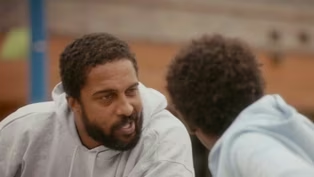
The third annual Detroit Black Film Festival gets underway on September 21st, and the organizers have partnered with the Motown Museum for this year's opening event.
The movie "Lady Sings the Blues," which was produced by Motown, is gonna be shown in celebration of its 50th anniversary.
Then over the course of the five-day festival, a total of 86 films by Black independent filmmakers will be screened.
Here's a peek at a couple of the films, followed by my conversation with the festival's co-founders, Marshalle and Lazar Favors.
(bright music) (bird tweeting) - [Narrator] One of the things that's so amazing about locs is that they're all so unique because our hair is so unique.
It's almost like a fingerprint.
I learned how lucky we are to have that kind of opportunity to express ourselves.
(calm music) (bird tweeting) - The most beautiful things in life are always the hardest to accomplish.
But if you put your mind to a it, King, you can achieve anything.
(somber music) And when it really matters, do whatever you gotta do to conquer the bum.
(intense music) (singer vocalizing) ♪ Whoever you are ♪ Whatever you're faced with ♪ Stand up tall, give it your all ♪ ♪ Give to the nation - You put everything on the line to do what's right.
(dramatic music) - Marshalle and Lazar Favors, two of my favorite Detroiters, welcome back to "American Black Journal."
- Thank you, Stephen.
How you been, man?
- I'm good.
- Appreciate being back.
Thank you very much.
- So Lazar, I'm gonna start with you.
Congratulations on the third annual Detroit Black Film Festival, but also bigger congratulations on the opening-night film, which you're partnering with the Motown Museum to show, "Lady Sings the Blues" on its 50th anniversary.
- Yes!
- That is a big event.
- That is a huge deal, man.
Shout-out to Robin over at the museum.
We were discussing this over a year ago, and we just thought it would be great.
It was just timing.
It was the 50th anniversary.
It was our festival.
We was like, "Hey, let's just mesh those two things together and let's see what we get out of it."
So our opening night ceremony is the "Lady Sings the Blues" film, for anybody who knows, anybody from Detroit should know who's in that film, and that's Diana Ross.
- (laughs) Yes, yes.
- It's one of the films produced by Motown Records and Berry Gordy.
So we're excited about it, man.
We super excited about it.
And it's at the Charles H. Wright Museum.
You can't ask for much more than that.
- (laughs) Yeah, right, right.
So I feel like it's a perfect sort of coming together of all the things that make the Detroit Black Film Festival special, this idea of- - Absolutely.
- The voice and the culture and the arts- - Right, absolutely.
- That come out of Detroit into the film industry.
- Absolutely man, you know, we're very intentional about our experiences, our narratives, and our culture, and that's our tagline for Detroit Black Film Festival.
We're very serious about that, and this just helped, this just helps build that awareness, and it marries very well for us.
So we were excited when we did, when me and Robin talked about it, we were just super excited.
Like, wow, this is like a big deal overall, and for it to be our third year, and it's like, this is how you show up, you know?
And I feel like this is how you show up.
This is how you, partnerships are great.
This is how you show up.
So it was, then Ford Foundation came on with us also and helped push that narrative.
So it's just a great thing happening this year.
- Yeah, and I won't say how old that makes me, if this film is 50 years old.
(laughing) - I won't talk about it, either, Stephen.
(Stephen and Lazar laughing) The film came out a year after I was born.
- (laughing) That's right.
Marshalle, talk about the other films that we'll be celebrating this year.
- Well, we have 86 films from 14 different countries, and I'm just really, really excited because the genres are all over the board.
We have documentaries, action drama.
We have a lot of short films for folks to enjoy.
And what's really exciting about it also is the fact that we have, we have to always represent our own.
So we have 14 films from Metro Detroiters as well.
And so it's gonna be an exciting time.
- So when you talk about films from folks here in Detroit, for a lot of them, this is a big break.
I mean, this is their chance for, you know, other people to see their films.
They may not get other chances.
I know that is, Marshalle, one of the things that you guys are really focused on here is lifting up folks who otherwise wouldn't see that lift.
- I think that's like the number-one reason that we have the film festival really is to give a voice to filmmakers and artists and to just really connect audiences with artists so that they have not only a chance to experience their film but have a dialogue, really.
and to have people come together and to talk about the films.
That's my favorite part.
My favorite part is connecting with audiences and connecting with the directors.
- Yeah, I wanna have you, Marshalle, also talk just a little about what's gone on in the last three years and what effect you see, not just in the film industry, but of course, with African Americans in the film industry.
We know that when things get set back, they get set back further for us.
Talk about the pandemic and coming out of it, what we can expect.
- Well, I think that the pandemic really gave us a chance to shift, right?
And we were able to virtually connect with audiences even that we wouldn't have been able to connect with before and have a different type of experience.
One thing that the pandemic did also was just, I think because of the uprisings, because of George Floyd and everything that was going on socially and politically, it gave artists a chance to really think about their art and the type of narratives that they wanted to put out there.
And as I mentioned before about dialogues, it really helped us to connect in a way that we really needed to connect during the pandemic.
And oh, my goodness, so much has changed even in terms of audiences and eyes and broadening audiences for African American stories.
And so I think that, like, there's no limit.
Like, now we we've seen like achievements from, that we haven't seen like in the past years.
And so that's opened up opportunities and doors for artists to just expand their work and have even more eyes and ears on it, and I think going forward, you're just gonna see more great content.
- I wanna before we end give you a chance to talk about what your favorite film is that's showing.
And I know that's asking somebody to choose among their children, but talk about some that you think people have to see.
- I'll say this, "Sons of Toledo" is an amazing short film an amazing short film.
That's a must-see film.
"If These Locs Could Talk," a must-see film.
"The Woodstock of House," must-see film.
And there's several other ones.
You know, it's a lot, like I said, it's a lot.
Oh, "Black Daddy" is a must-see film documentary.
I'm suggesting all fathers, grandfathers, uncles, cousins, sons see this film.
- See that one.
- It's a great film.
- Yeah, well, I know it's an unfair question, but I'm gonna ask it of you, too.
Tell me which films people have to get out and see this year.
- Oh, you're not gonna put me in that box.
He'll go ahead and tell you his opinions, but I say across the board, you know, I'm not gonna play any favorites.
Come see the movies.
Come see all of them, But I will say this, that we were really, really excited to have a film by Sir Steve McQueen.
It's a short film, and it's opening the festival, one of the films that are opening the festival, and it's about prostate cancer and dialogues in the African American community around that subject.
So I'm gonna be neutral ground here.
I'm gonna say, come see the films!
(laughs) - (laughing) Come see 'em all, right?
All right, Marshalle and Lazar Favors, congratulations again on the festival, and thanks so much for joining us here on "American Black Journal."
- Thank you, Stephen.
Thank you.
- Thank you for having us.
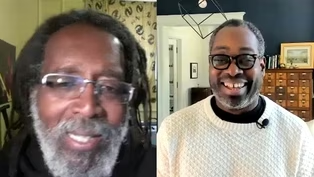
- 40 Years ago, Detroiters Malik Yakini and David Rambeau came together to designate September as Black Reading Month.
Their goal was to encourage the African American community to read books, magazines, and journals that are written by Black authors.
They also use the month to promote the support of Black-owned bookstores.
I spoke with Yakini about the Black Reading Month observance.
So let's talk about the origins of September being Black Reading Month.
Of course, you know, we all know that it is still difficult 40 years after you founded this for Black authors to find publishers, for them to get audience, for them to get opportunities, and for Black bookstores who sell Black authors to survive.
Talk about how you came up with this idea 40 years ago.
- Okay, I'll just give a very brief history.
In 1969, I was involved in an organization called New Directions Information Institute.
And one of the things that we did is we distributed Black books and magazines to various stores throughout Detroit.
So we noticed, for example, that in the supermarkets, where they always have kind of magazines near the checkout counter, that none of those magazines were magazines that explored any aspect of the Black experience, in a city that was overwhelmingly Black, and so something was wrong with that picture to us.
And not only were we selling magazines, we were also selling various books, primarily from the Third World Press, which is headed by Haki Madhubuti.
But what we noticed is at the end of the month, we were able to make inroads and develop relationships with many of these stores where we could get the magazines in the stores on consignment, but when we came back at the end of the month, either one or two had sold or none had sold.
And so we saw, it was more than a question of access, but we needed a campaign within the Black community in Detroit in particular to emphasize the importance of reading Black books as a way of becoming familiar with our own cultural and historical experience.
And our idea, then as well as now, is it this profound sense of being informed about our own culture and history is necessary for us to move forward in a sane and balanced way.
And so we started Black Reading Month as a way of having a large-scale public campaign to support and emphasize the importance of both reading Black books, magazines, journals, and newspapers but also of supporting Black writers, supporting Black publishers, and supporting Black bookstores.
- Yeah, yeah, so I'm really curious what you make of the landscape and the world 40 years later.
Has anything changed?
Is it better?
Is it easier?
- I'm not sure that it's, I'm not sure that it's better, and you know, questions like that are always a mixed answer because nothing is all either this or that.
And you know, certainly there have been some changes.
We didn't have the internet at all, you know, 43 years ago when we created Black Reading Month, and so certainly the internet has exposed many Black writers and Black publishers to a wider audience.
And also I think it has opened up the world of self-publishing, and so we see a lot of independent writers producing their own works, probably on a larger level than we saw 43 years ago.
On the other hand, we've seen a tremendous decline of Black bookstores in the last 40 years or so, and frankly, we've seen a decline in bookstores generally.
So in fact, I'm sure you can attest this, we've seen a decline in the viability of print media in general.
- Yes.
- And so we've seen many national newspapers fold.
We've seen many magazines fold.
We've seen many large syndicated national bookstores fold.
And so there's disturbing trend in American society in general, and of course, because Black people in America are impacted by the larger cultural trends, we're also impacted by that.
And so we've seen a decline in bookstores in general, but a tremendous decline in bookstores in the Black community.
- Yeah, so talk about how this connects to Black literacy, and that's a subject that I feel like a lot of people get wrong an awful lot of the time.
We hear this statistic all the time about literacy in the city of Detroit, people saying that, well, you know, "40% of the people who live here are illiterate."
That's not true, A, but this idea of Black Reading Month really is, I feel like, targeted toward celebrating the reading that Black people do do and wanna do and are craving in cities like Detroit.
- Yeah, well, I don't wanna deny that there's a literacy problem in Detroit.
I don't wanna get into specific statistics.
I don't know what the accuracy is.
But certainly we need to improve the level of literacy in Detroit and other communities throughout the United States.
Let me say this, though.
Again, I wanna situate the Black experience in America with inside of this larger context, because the reality is, though, it is that although most people in America might be literate, the majority of people haven't read a book in the last five years.
Many people have not read a book since graduating from high school or graduating from college.
Literacy is not really a fundamental part of American culture in the time period that we live in now.
And that's distressing because I think Americans in general have little knowledge about history, have little knowledge about geography, have little knowledge about global affairs, and thus don't know how to situate ourself within that context.
So Black Reading Month is both concerned about literacy, about people actually knowing how to read, and we think that, you know, from our experience of peoples who have struggled for their liberation, such as in Cuba, such as in Guinea-Bissau, where Paulo Freire, in fact, worked with the leader of the revolution in Guinea-Bissau, Amilcar Cabral, to create a literacy campaign.
So we know that campaigns that encourage people to learn how to read and to read better and to make that a fundamental part of their lives is an essential tool for people who are striving to be more self-reliant, who are striving to be more self-actualized.
And so on that level, reading anything, learning how to read and reading anything is important.
But in the case of Black people in America, where we still live in a society which has dominated the cultural, well, let's say the, although Black people create much of the culture in America, the mechanisms that control that culture are still largely outside of our hands.
- Sure.
- And of course the culture and history of people of European descent is the main narrative in American society.
And so in a situation like that, it's doubly important that Black people read because we have to almost read ourselves out of the brainwashing, I'll use that term for lack of a better term, that's happened by this steady inundation of information about the cultures related to people of Western European descent.
- Yeah, I wanna talk specifically about Black bookstores and Black bookstores here in the city of Detroit.
Two of the ones that come to mind for me all the time are of course Source Booksellers in Midtown, but the Shrine of the Black Madonna bookstore, I think, is, you know, it's a cultural touchpoint, right, for people in this city.
I think most people who've been there can remember the first time they walk in there and see all of the things that are available, and it's like this, it's like this step into a different world.
Those are two good examples of Black bookstores, and I assume that they're doing okay, although I know the pandemic was hard on a lot of bookstores.
But talk about how we're doing with just being able to get people access to books through the bookstores that sell them.
- Well, I'll start with Source Booksellers, and I'll just say that I admire tremendously the fortitude of sister Janet Jones.
She has hung in there for many years, and she started really as a vendor before she had a physical location, and she was able to build a clientele during that, and she, doing that, and she has a very specific focus in terms of the types of books that she sells, and so she's been able to really hone in on a particular niche that she's been able to fill, and I think that has led to her success where many small independent Black stores have failed.
So she continues to operate, and you know, I don't know what their profits are looking like, but from the outside, they seem to be viable and seem to be an important community institution.
And again, I have the utmost admiration and praise for Janet Jones and her daughter, Alyson Jones.
In terms of the Shrine of the Black Madonna bookstore, to the best of my knowledge, it's been closed altogether for two or three years.
I've heard rumors that it's supposed to open on some limited basis, but I have not seen evidence of that.
And that's extremely distressing, because I heard from many people around the country when I was in the books business.
I don't know if you know, I used to own a bookstore also.
From 2000 to 2009, I was the owner of Black Star Community Bookstore, and so I dealt with lots of writers and vendors and distributors, and from what I heard, the Shrine of the Black Madonna bookstore was the best Black bookstore in the country.
And they had the kind of mother shrine bookstore in Detroit and another bookstore in Atlanta.
I think the Atlanta bookstore is still open.
I'm not positive.
But it's extremely distressing that what many people consider to be the best Black bookstore in the United States has been closed for two or three years, and I don't see any concrete signs that's gonna open.
- It's not just about the words and ideas on the pages.
It's about the connection to the wider culture and the understanding of the wider culture.
So here's hoping that they can get that going again.
- Yeah, you know, institutions are only as strong as the community of people who support them.
- That's absolutely right.
- And so most of the Black bookstores that developed in this country, many of them developed in the late 1960s, the '70s, and they kind of came out of that era when Black power was being stressed and familiarity with Black culture and Black history was really being stressed as part of our movement towards liberation.
And so as that movement was suppressed in many cases through COINTELPRO and through various other methods, and as, you know, our own internal contradictions weakened that movement, then we see a corresponding weakening of the desire of Black folks to read Black books and whatever.
So those two things kind of go hand in hand.
Our movement for social equity mirrors the movement for Black literacy.
- Yeah, okay, Malik Yakini, congratulations on- - Thank you.
- 40 years of Black Reading Month.
- Actually, 43 years.
- 43 years, right.
(laughs) - And can I just mention very quickly- - Sure.
- that we have author talks that we're doing, and we're doing this for the third year.
Because of the pandemic, we can't really do large in-person events.
And so we have these author talks every Wednesday during September featuring prominent Black writers, and we wanna encourage people to tune in to the September's Black Reading Month Facebook page for the entire listing of those Black authors.
Even after September, the videos are still available for viewing.
- Thanks for being here.
- Thank you, Stephen.
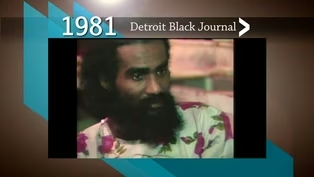
- And finally today, we are remembering the legacy of renowned Detroit artist Aaron Ibn Pori Pitts who passed away at the age of 80.
He served as artist-in-residence at the Charles H. Wright Museum of African American History and was voted "Metro Times" Artist of the Year.
Pitts was a guest on "Detroit Black Journal" in 1981.
- What motivated you or activated you in creating the art that you do?
- I guess when you reach a certain age of being in particular, if you're an oppressed and exploited person, and being a Black person in the United States, you are exploited and you are oppressed, and you reach a certain stage of development whereas you want to speak about that and you wish to change it and you wish to do it with your life.
So my art began to take on that character as I began to master this craft and as I began to educate myself, I began to try and give it back to my people, so to say.
- [Interviewer] Do you think that's what art should be, or is that what it's always been about?
- I would say- - How do you perceive art?
What function or non-function, for that matter, does art have?
- It's supposed to have the function of being able to put people at ease, to make them enjoy life.
But since art is not put at a, it's a price tag that's put on it that it puts at a premium that you had to have money in order to draw paper, have paper.
And coming from a working-class background, that was a frivolous idea to draw and paint.
But if you pushed at it, then you could get it.
So to make it at ease of people, you would have to make it available to them, and that's a contradiction to the society we exist in.
So to put people at ease, but it's something that is used every day.
The power of art, for example, is tremendous.
- Pitts has been described as one of America's greatest revolutionary artist-activists.
He also was a poet and videographer.
Our condolences go to his friends and his family, one of whom, Ollie Pitts, his son, is a former classmate of mine from high school and a friend.
Well, that's gonna do for us this week.
You can find out more about today's guests at americanblackjournal.org, and you can always connect with us on Facebook and on Twitter.
Take care, and we'll see you next time.
(upbeat music) - [Announcer] From Delta faucets to Behr paint, Masco Corporation is proud to deliver products that enhance the way consumers all over the world experience and enjoy their living spaces.
Masco, serving Michigan communities since 1929.
Support also provided by the Cynthia & Edsel Ford Fund for Journalism at Detroit Public TV.
- [Announcer] The DTE Foundation proudly supports 50 years of "American Black Journal" in covering African American history, culture, and politics.
The DTE Foundation and "American Black Journal," partners in presenting African American perspectives about our communities and in our world.
- [Announcer] Also brought to you by Nissan Foundation and viewers like you, thank you.
(calm music)
3rd Annual Detroit Black Film Festival
Video has Closed Captions
Clip: S50 Ep38 | 8m 53s | The 3rd annual Detroit Black Film Festival returns September 21-25, 2022. (8m 53s)
Detroit Artist Aaron Ibn Pori Pitts Passes Away
Video has Closed Captions
Clip: S50 Ep38 | 1m 53s | Renowned Detroit artist Aaron Ibn Pori Pitts passed away at the age of 80 years old. (1m 53s)
September is Black Reading Month
Video has Closed Captions
Clip: S50 Ep38 | 11m 47s | September is Black Reading Month encourages African Americans to read Black literature. (11m 47s)
Providing Support for PBS.org
Learn Moreabout PBS online sponsorship
- News and Public Affairs

Top journalists deliver compelling original analysis of the hour's headlines.

- News and Public Affairs

FRONTLINE is investigative journalism that questions, explains and changes our world.












Support for PBS provided by:
American Black Journal is a local public television program presented by Detroit PBS