
Black Madonna/Women in Church
Season 49 Episode 13 | 26m 46sVideo has Closed Captions
Black Madonna/Women in Church | Episode 4913
The role of women in the Black church. We’ve assembled a roundtable of women ministers to talk about leadership in the church and the importance of faith and religion in their daily lives. Plus, a special report on the iconic Black Madonna painting that brought national attention to a Detroit church. Episode 4913
Problems playing video? | Closed Captioning Feedback
Problems playing video? | Closed Captioning Feedback
American Black Journal is a local public television program presented by Detroit PBS
Black Madonna/Women in Church
Season 49 Episode 13 | 26m 46sVideo has Closed Captions
The role of women in the Black church. We’ve assembled a roundtable of women ministers to talk about leadership in the church and the importance of faith and religion in their daily lives. Plus, a special report on the iconic Black Madonna painting that brought national attention to a Detroit church. Episode 4913
Problems playing video? | Closed Captioning Feedback
How to Watch American Black Journal
American Black Journal is available to stream on pbs.org and the free PBS App, available on iPhone, Apple TV, Android TV, Android smartphones, Amazon Fire TV, Amazon Fire Tablet, Roku, Samsung Smart TV, and Vizio.
Providing Support for PBS.org
Learn Moreabout PBS online sponsorshipComing up on "American Black Journal," we will continue our look at the black church in Detroit with a round table of female ministers, who will talk about the historic and present role of women in the black church.
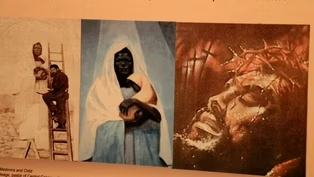
We'll also take a look at a piece about the iconic "Black Madonna" painting that brought national attention to a Detroit church.
Stay where you are, "American Black Journal" starts right now.
Announcer 1: From Delta faucets to Behr paint, Masco Corporation is proud to deliver products that enhance the way consumers all over the world experience and enjoy their living spaces.
Masco, serving Michigan communities since 1929.
Announcer 2: Support also provided by the Cynthia & Edsel Ford Fund for Journalism at Detroit Public TV.
Announcer 1: The DTE foundation proudly supports 50 years of "American Black Journal" in covering African-American history, culture, and politics.
The DTE foundation and "American Black Journal," partners in presenting African-American perspectives about our communities and in our world.
Announcer 2: Also brought to you by AAA, Nissan Foundation, Ally, Impact at Home, UAW, solidarity forever, and viewers like you.
Thank you.
♪♪ Welcome to "American Black Journal," I'm Stephen Henderson, and as always, I'm glad you've joined us.
Today, we're continuing our year-long look at the black church in Detroit, which is produced in partnership with the Ecumenical Theological Seminary, and the Charles H. Wright Museum of African-American History.
In honor of Women's History Month, we're taking a look at the role of women in the black church.
Here in Detroit, their influence was depicted in a painting that shocked the nation when it was unveiled more than 50 years ago, at the Shrine of the Black Madonna.
A portrait of a Black Madonna and baby Jesus was not only a symbol of black liberation and power, it also represented the strength of the black woman in the fight for freedom and equality.
Producer Marcus Green has this story.
I call upon my brothers, I call upon my sisters.
Together, we can overcome evil and injustice in this world if we choose to act with courage and conviction.
Women in the church have always been the backbone of the church, but the backbone in the background.
And that's not where we are here.
The church started in 1953, after our founder Rev.
Albert B. Cleage Jr. left the Presbyterian Church, St. Mark's Presbyterian, because he felt like he didn't have the latitude to do the kind of social ministry that he wanted to do.
And in 1962, they purchased this building, and it became the Central United Church of Christ.
In '67, with the unveiling of the portrait of the "Black Madonna," also came the launch of black Christian nationalism, that was the movement that gave birth to black liberation theology, and everything we know about that struggle.
I heard all sorts of pushback.
I heard, that's ridiculous.
I heard, did you see?
She's so dark, she's ugly.
I heard, well, what's that light-skinned man doing with that dark baby and child up in his church?
Everybody knows, blah, blah, blah.
There was a lot of pushback.
But from then to now, it is amazing to see how many brown angels, brown Madonnas, brown Jesus are in churches from the storefront to the big cathedrals.
Some churches, the Baptist churches, some what you call holiness or sanctified churches didn't allow women in the pulpit.
If a black woman was permitted to give the announcements for the church, she had to stand in front of the pulpit, not on the pulpit, and you didn't hear of black women preachers.
It inspired a whole revolution of iconography, black iconography, not just religious, but also cultural and social iconography.
So it had a tremendous impact on the culture, and the social force of black communities, white communities, all across the world.
And also, he wanted to pay tribute to the role of black women in our historical struggle for freedom and justice and equality, and who better to represent that than the mother of Jesus, Mary?
You know how they first started to talk about, we as a community said, well, we needed representation, right?
And so, we wanted to see ourselves in various careers.
Well, what better to see yourself as?
The mother of Jesus represents motherhood, and the important role that women play in the family, in the community.
But also, I think as she's an example of our willingness to serve God.
So she represents that highest level of servanthood, to be used as an instrument to do the work of God here on Earth, every single day.
Amilcar Cabral said, you can judge a people by how they value their elders and their women.
And people often think about that as, you know, value, put her up on a pedestal.
Isn't she pretty?
Let's buy her something cute to wear.
Isn't she lovely?
I'll open the door.
I want a door opened, okay?
And I love it when my husband buys me something pretty, but respect and making use of the talents.
If you don't fully make use of the talents of women, the community is forever robbed.
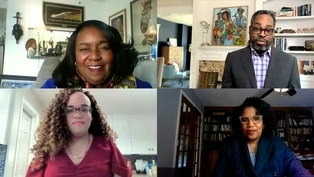
We put together a round table of women leaders in the black church to talk about faith, religion, and gender equality in the ministry.
Here's my conversation with Rev.
Dr. JoAnn Watson of West Side Unity Church, Rev.
Cindy Rudolph from Oak Grove AME, and Rev.
Kenita Harris of Detroit Bible Tabernacle.
So Rev.
Watson, I'm gonna start with you.
It seems to me that when you talk about the idea of the role of black women, and black women leadership in the church, you're by definition talking about change, you're by definition talking about transition, that this is a role that has changed a number of times across history and is changing even now.
How does that look from your chair?
Oh, absolutely, it's a transforming ministry with women, particularly black women, who are in ministry.
My observation has been that most black women in ministry have been mentored by other black women in ministry.
My mother was a minister in the AME church, really, in AME, fifth generation AME.
My mentor in the Unity Church was Rev.
Dr. Ruth-Ann Moseley, who founded the West Side Unity, the church I pastor, more than 56 years ago.
And she also founded the Unity Urban Ministerial School, the theological seminary I graduated from.
So women, you know, Rev.
Irma Henderson, many people don't know she was not only a political leader, she was also an ordained minister, who was a great mentor to me, as was Martha Jean McLean, who was not only a broadcaster, she was also an ordained minister.
So I've been very blessed to have been surrounded by women of faith who have, Mother Bills of Christ called me one of her daughters, she was a life member of the AME Church, and the Missionary Society.
So I believe women, black women in particular in the black church have been transforming our movements throughout the period that there's been a black church in this country.
And Rev.
Watson, the leadership role that we see also changing, and emerging for black women.
Talk about what's driving that change right now.
I believe that certainly black women in ministry, but spiritually rooted women are the reason that there's such political change in the air right now nationally.
There would not be a president Joe Biden, help me somebody, if there were not the black women- That's right.
Black women.
Yes.
All over Atlanta, one of my mentors was in Atlanta, and she told me directly how she ushered 60 black women, you know, church women into the rural areas of Georgia, who were assigned to get people in rural areas of Georgia to the polls to vote.
And that has transformed this country, and the reason we're all receiving a stimulus right now is because of those black church women.
Yeah, Rev.
Harris, I'm curious, because you're a young minister, a black minister, a female minister, you know, historically, there's a tension between the sort of patriarchy in the black church, and the need and the desire for women to be in leadership.
But I wonder, as somebody who's younger, and is experiencing that tension now, what it looks like, what it looks like for you.
Well, yeah, I mean, that definitely is the case, unfortunately, the tension of being a woman, and what we say in the church being called to ministry, when a call has been placed on your life.
And I think for me, personally, one of the things that I have been really blessed to have is to be in a church that I grew up in, and I left away to do ministry in other parts of the country.
But when I came back, I came back to the home church, the church that was started out of my home, that I was raised in by my father and my mother, Kenneth Harris and Ruthie Harris.
And when I went to my parents and told them, I said, I have a call for ministry, I'm called into the ministry.
And you know, and to be able to have a father who was in a ministry for a number of years, and actually was one of the first, I wanna say, Baptist pastors in the area who had ordained a woman to be associate minister at my church.
And so I grew up sort of within a fellowship where I heard the spirit speak through the black female voice.
That wasn't something that, you know, sort of was suppressed, or was looked down upon in any kind of way.
And so, I was used to that, but then I quickly found out, as we would go in fellowship at other churches in the area, that that was not the same value.
That same value of women being in ministry was not really upheld in the same way.
And so, I had sort of the gift of having parents who were really affirming of the call that was on my life.
Now, as that sort of, as that, after I left home, and went out to do ministry in the world, then I ran into, you know, those challenges.
And I think one of the things that I, that we as black women in ministry, is that we, every time, defy the stereotypes, we defy sort of the limitations, I think, that may be projected upon us, in terms of saying that we're not called.
That she is called, but there is always this narrative, and has been this narrative of she is not called.
And so, what we see in our history is that black women have contributed to the life of the church, and that there would not even be a church, a black church, if it was not for the presence of women, in terms of our ministry, and the special way in which we show up, in terms of nurturing in, within the walls of the church, but also that extending out into the community.
And so, for me, it makes me think about, actually, a woman historically in the AME Church that I had just learned about through the "Black Church" series, and just hearing about her story, and how she was demanding to be, you know, recognized as a person in ministry, and saying that I too am called to be a laborer in the gospel.
And so, that is what we have always said throughout history.
Our testimony has been, I too am called, and we have been able to demonstrate that the spirit does speak through us, and show up through us in the work of our hands, in our voices being used prophetically and politically, I think to speak truth to power, and to understand how that affects and shapes our communities.
Pastor Rudolph, I wonder if you can talk about the difference between, and Rev.
Harris got at this a little bit, the difference between the internal challenge of being a female leader in a black church.
In other words, the challenge you might face with your congregation, or your church, and the external challenges that you face kind of representing your church in a broader community that still has that strong patriarchy, that resists the idea of female leadership.
So I have been in ministry for 21 years now.
and in that 21 years, I've seen a lot, and experienced a lot.
I have been discriminated against.
I have been outright dismissed because of my gender.
I've been told to my face that women should not be pastors, or should not preach.
And so, I've certainly experienced it both within the church, and externally as well.
I've had members who would not open up to a female leader, but I must say, it has not all been bad.
I have been mentored by both men and women.
I'm someone who grew up in a family of men.
I have five brothers, and both of my parents raised us, so it was my mother and I with six men in the household.
And what I did not realize until about a year ago, when I was being interviewed, is that that really helped prepare me for the leadership in a male-dominated society.
And so, I had no issue with being supervised by a man, because I was accustomed to that with my father.
I had no issue seeing men as my peers, because I was accustomed to that with my brothers.
And because I had both younger and older brothers, I did what older siblings do, I bossed around my younger brothers, so I had no issues supervising men, either.
It was, and I wasn't intimidated by or anything like that.
But so, I've had the challenges, but I've also had really good experiences.
I'm the first female pastor of a church that is a hundred years old.
And my bishop, in the AME Church, we are governed by an Episcopal seat, which means that we are not necessarily brought in by a congregation, or a congregationally led church, but we are appointed by bishops.
And my bishop, who is a forward thinking bishop, was bold enough to be pioneering enough to send a female pastor to a flagship church, which, you know, is uncommon sometimes.
And so, I thank God for forward thinkers like him.
I thank God for forward thinkers like my father in ministry, Rev.
William Watley.
And also the women who have mentored me, and the women upon whose shoulders we stand.
Rev.
Harris earlier mentioned Adrena Lee, who was licensed to preach in the AME Church back in 1819.
Yeah.
And was not ordained, she was refused ordination though, was not ordained until 2016 when we posthumously ordained.
Wow.
And she preached and preached, and did ministry all over, but we thank God that we finally did affirm her gifts, and her calling, and her ordination posthumously.
Amen.
So for me, it's been a mixed experience.
I have suffered discrimination, but I've also been affirmed very publicly, as well as privately.
And I thank God for the ways in which my upbringing prepared me to excel in a male-dominated field.
And I wasn't- Yeah.
You're such a political icon in our city.
I wonder if you can talk about the difference between the struggle against patriarchy in politics, and the struggle against patriarchy in the church.
Which one was easier to navigate than the other?
And were there things that you could bring from the church to fight against patriarchy in politics?
But it's interesting though that you mention that, because I've had a practice, just because of my own personal intent of bringing the Bible to the council table every day, and Lord knows, some sessions, we needed prayer, but.
(laughs) That was just what I was, part of who I was.
And I brought even before my ordination.
And I actually had the, someone suggested that maybe I wasn't separating church and state enough, and put it on an agenda for the discussion, because I was bringing my, somehow my Bible was offensive to them.
As it happened, as the Lord planned it, by the time that issue came up on the city council agenda, we happened to have had been in an evening service at a church.
Come on, somebody, you know, nothing but God.
Only God could have ordained that, so you know what the pastor in the fellowship hall, you know nobody's gonna raise any issues with my Bible at the council table, as we conduct a business meeting for the city in a church fellowship hall.
So that went away without my saying a word, I didn't have to say one word.
(laughs) The persons who were opposed didn't open their mouths.
But I have had, I was invited to be a Women's Day speaker at a church once, a very friendly invitation.
I said, yes, and went.
And the pastor said to me, now, we don't allow women to speak from the pulpit, but you can speak from the lectern on the floor.
Wow.
Said that, said that, we know you a minister, but you a woman, so you can speak from the lectern on the floor.
I said, well, you know, you can give the message from any space.
I can give it from the pew, if you like, wherever you designate, I will do that.
And I've also had another minister who read my bio, and saw I was a preacher's kid, and started playing at his arms and saying, oh, she's the daughter of a preacher man!
She's the daughter of a preacher, so when I took that to pulpit, I had to say, I'm the daughter of a preacher mama.
My mother was an AME minister.
So, I have, I understand the issues that sometimes address women who are ministers in our church, because it's a male-dominated field.
And I think it's all a part of the cultural assumption about who ought to be in charge of a church, and it's but, the people just need to remember, it was women who never left Jesus at the cross.
It was women who went to the truth.
Right, right.
That's right.
It was a woman who said, come see it, man.
That's right.
Come see it, man.
So clear, it was Jesus who ushered women into ministry.
So for persons who happen to be Christian, they just need to read the word.
Yeah, Rev.
Harris, what do you think the future is for women in the black church?
Where are we headed?
I kinda think of just my own sort of experience.
I think that because of where we are in the place that we find ourselves in, in history, in human history, the look of the church is different.
And in every, across the church, the American church, people are thinking about what is it, asking the question, what does it mean to be the church, right?
And how does that look in terms of the ways in which we do mission, and how do we address the needs of those that are in our communities?
And so, I think for me, being a millennial, if you will, that even with ministry, my ministry looks different.
You know, I started off as denominational staff of a very old, the oldest denomination, Protestant denomination in the country in the Reform Church in America.
And started off as denominational staff, working in multi-racial initiatives and social justice.
So I was outside of the local church, but was empowering other churches across the U.S. and Canada to meet needs through community-based development sort of work.
And so, that was ministry in that context.
And then I found myself migrating to the local church.
And I did work there for a few years.
Now, I'm still doing that work here in the city of Detroit, but then I got called to actually go out, and to do work in the community development arena.
So, part of my ministry is being a chief operating officer for a neighborhood place-based organization called Jefferson East, Inc. on the east side of Detroit, servicing five neighborhoods, and doing work around housing, and economic development, and keeping the community clean and safe.
And that's part of my ministry too.
So I have one foot in the local church, and one foot in the community.
And so, really, the bridge of church and community, and this intersection of faith and justice, it really does meet up in someone like me, and in a lot of other women who are in ministry.
So, to answer your question, what does ministry look like?
It looks like one foot in the church, and maybe one foot out in the community.
It means opening up coffee shops, and holding services in those arenas.
It looks like, in so many different ways, how we as black women are embodying our call.
Pastor Rudolph, are you seeing something similar in AME?
Which is, again, one of the oldest churches, and one of the first to recognize female leadership.
Absolutely, I think that the church is very progressive.
We're moving in a very progressive direction.
We still have a long way to go.
There's still a lot that we need to do, but I do think that more and more women are taking their place.
I have seen, for many years now, more and more women coming into the ministry in the AME Church.
And that's across the board, because I've served several districts in several states.
And you often see more women than men now coming into the church.
Yeah.
So, I think we are absolutely being progressive.
As I said, we still have a long way to go, because not everyone is a progressive thinker, and you really need those kinds of progressive thinkers at the helm of the church.
We do have some, but we certainly have a ways to go.
But I thank God that we are not where we once were, where we were denying people opportunities and not recognizing their gifts.
You know, we've had four female bishops elected out of the AME church.
That in and of itself speaks volumes.
And we have many female presiding elders and you know, pastors.
And as we continue on, we'll see more and more of that.
That's gonna do it for us this week.
Thanks so much for watching.
We're looking forward to bringing you more important conversations each month about the black church in Detroit.
You can find out more about our guests at Americanblackjournal.org.
And you can always keep up with us on Facebook, and on Twitter.
We'll see you next time.
♪♪ Announcer 1: Delta faucets to Behr paint, Masco Corporation is proud to deliver products that enhance the way consumers all over the world experience and enjoy their living spaces.
Masco, serving Michigan communities since 1929.
Announcer 2: Support also provided by the Cynthia & Edsel Ford Fund for Journalism at Detroit Public TV.
Announcer 1: The DTE Foundation proudly supports 50 years of "American Black Journal" in covering African-American history, culture, and politics.
The DTE Foundation and "American Black Journal," partners in presenting African-American perspectives about our communities, and in our world.
Announcer 2: Also brought to you by AAA, Nissan Foundation, Ally, Impact at Home, UAW, solidarity forever, and viewers like you.
Thank you.
♪♪
Video has Closed Captions
Clip: S49 Ep13 | 4m 8s | Black Madonna | Episode 4913/Segment 1 (4m 8s)
Video has Closed Captions
Clip: S49 Ep13 | 18m 13s | Women in Church | Episode 4913/Segment 2 (18m 13s)
Providing Support for PBS.org
Learn Moreabout PBS online sponsorship
- News and Public Affairs

Top journalists deliver compelling original analysis of the hour's headlines.

- News and Public Affairs

FRONTLINE is investigative journalism that questions, explains and changes our world.












Support for PBS provided by:
American Black Journal is a local public television program presented by Detroit PBS