
Black-owned law firm Lewis & Munday marks 50th anniversary
Clip: Season 50 Episode 45 | 10m 18sVideo has Closed Captions
Lewis & Munday, P.C., located in Detroit, marks its 50th anniversary in the Motor City.
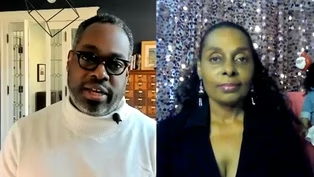
One of the nation's oldest and largest Black-owned law firms is celebrating a major milestone this year. Lewis & Munday, P.C., located in Detroit, marks its 50th anniversary in the Motor City. "American Black Journal" host Stephen Henderson learns about the major impact the law firm has had in Detroit, the launch of a scholarship fund, and the importance of diversity in the legal profession.
Problems playing video? | Closed Captioning Feedback
Problems playing video? | Closed Captioning Feedback
American Black Journal is a local public television program presented by Detroit PBS
Black-owned law firm Lewis & Munday marks 50th anniversary
Clip: Season 50 Episode 45 | 10m 18sVideo has Closed Captions
One of the nation's oldest and largest Black-owned law firms is celebrating a major milestone this year. Lewis & Munday, P.C., located in Detroit, marks its 50th anniversary in the Motor City. "American Black Journal" host Stephen Henderson learns about the major impact the law firm has had in Detroit, the launch of a scholarship fund, and the importance of diversity in the legal profession.
Problems playing video? | Closed Captioning Feedback
Where to Watch American Black Journal
American Black Journal is available to stream on pbs.org and the PBS app.
Providing Support for PBS.org
Learn Moreabout PBS online sponsorshipI don't think anybody can look at the skyline of Detroit and not see something that traces back to this firm and its involvement in this city and its development.
At the same time, I'm not sure lots of people know about Lewis & Munday.
So Reginald, take us back to the beginning where all this started and how it became such a big part of the way the city's Downtown in particular developed.
- Well, Lewis & Munday is celebrating its 50th anniversary this year.
And when it started, I think it was the year before Coleman Young was elected mayor of the City of Detroit.
After he was elected, a big part of his agenda was to make sure that people who lived here were included in things that were going on here.
So what he did was he saw to it that a lot of the larger law firms partnered with Lewis, then Lewis, White & Clay, to allow Lewis, White & Clay to become involved with a lot of the deals that were going on.
And to that end, Lewis, White & Clay became involved in deals with for purchase and for the erection of many of the things.
As you said Downtown, there's almost not a building in the last 45, 50 years that has been placed in Downtown that Lewis & Munday wasn't a part of.
Been involved in the many refinancings of the, is the Huntington Place now, but back in that time Cobo were involved in the, actually, which is in Downtown, the General Motors Poletown plant involved in actually the arena, the Ford Field Comerica Park, and even more recently the Little Caesars Arena projects.
So we've been involved from the real estate perspective in almost every deal that has gone on in Downtown Detroit.
- Take us back to that time, I mean, this is the time in the city when African Americans were getting in many cases our first chance really to participate fully in not just the city's governance, but its development.
And of course Coleman Young is instrumental in that and he brings lots of people along with him.
But there are barriers that exist even at that point to black participation, to black equity in the city.
Talk about those early years and whether there were real challenges to the idea of a black law firm doing all of the things that this one did.
- Okay, well let me start off by saying, let me throw this out there.
I wasn't back there.
- You weren't there, I know.
(all laughing) I wasn't meaning to say you're that old (laughs).
- I know I'm old (chuckles), but from what I've gleaned from being told by the founders and what I've seen by being a member of the legal community here, initially when Lewis & Munday started off, the attorneys at Lewis & Munday were doing criminal assignments and doing probate work and criminal work and those things that most African-American attorneys of that day and age were able to do.
But they had a vision to do more than that.
And it really primarily is because of the efforts of the mayor saying to law firms, Yeah, you might not wanna work with them, but if you wanna work with the city, you're gonna have to work with them.
So even though there were the barriers, this particular law firm had a champion that helped it overcome a lot of those hurdles that were in the way of many other African American attorneys at the time.
- Yeah, yeah.
And Ronda, that tradition of leaning into diversity, of celebrating diversity, of struggling to make sure diversity is respected, that continues today with the work in the firm.
- Absolutely, and I was talking with Regi earlier today.
We discussed the fact that this is actually a time period in our history where you have more women owners of Lewis & Munday than we have male owners at this time.
So it shows that the needle has been pushed, not just with respect to minority attorneys, black attorneys specifically, but black female attorneys.
And as you may have seen in the reports that have come out over the years about black equity partners in the major law firms across the country, that percentage is so very small when it comes to black women.
It's less than 1% that are equity partners.
And so that's something that I never set out to become myself that was not necessarily my goal.
But I'm so very proud to be a member of that small cohort primarily because it allows for other young women who are coming after me to see that this is something that can be attained.
It's a goal that is possible and for me to be able to be involved in the development of the next generation, to ensure that we see wider representation in those ranks and not just within African American owned law firms like ourselves, but we need to see that within the majority law firms as well.
That there's greater outreach, greater training, development, the things that I received that were so integral to my career at Lewis & Munday where I was poured into and given mentorship and support by individuals like Mr.
Dozier, that we need to see that for other young minority attorneys so that they can grow and succeed and reap the benefits of the hard work that they are putting into their careers each and every day.
- Yeah.
And are we doing better with that overall?
I mean, is there better opportunity for, especially in Detroit where, I mean you do have a lot more I think, opportunity for African Americans here than in some cities, but are there still barriers, I guess is the question.
- Well, I think that we have moved the needle some, but there are still some barriers.
I am very proud of the fact that here in Detroit though there are a lot of our major law firms that participate in pipeline programming that is hosted through organizations such as the Wolverine Bar Association.
I previously served as president of that organization, which is the largest black bar association here in Michigan and the oldest.
And while I was serving as president, I created a pipeline committee specifically designed to ensure that we were able to tap into students at younger ages than just the law student level.
If you're already in law school, you kind of have your path and you're ready to move forward, but it's important that we get to the kids a bit younger.
And so we do have a lot of the law firms that participate in programs such as our Summer Clerkship Program where students are placed into the major law firms for the summer and then oftentimes they may be extended job positions to come on board permanently.
And there are other programs that we place students, our Judicial Externship Program into internships with federal judges so that they are able to gain the type of experience that can springboard them into positions at other firms or perhaps full-time federal clerkships in the future.
So there are programs in Detroit, I think that there are opportunities in Detroit, but there are still barriers across the country and the numbers just have not really moved.
If you look at just even the past 10 years, actually, the percentage of African American lawyers slightly dipped by a 0.1%.
We still only make up 4.7% of attorneys in this country, whereas we're 13% of the population.
And it's important to have diverse voices that are at the table to bring different perspectives and ensure that we are enforcing a fair and efficient and equitable administration of justice.
- Quickly before we have to end, I want to give you guys a chance to talk about this scholarship fund that is part of the 50th anniversary.
What's that about?
- Well, as we, again, we've celebrated the entire year, our 50th anniversary because it's a milestone that not many small businesses make and not many small African American businesses like let alone law firm.
We have prided ourselves in being a place where African American and other attorneys can grow and go out and flourish.
But what we're trying to do with this scholarship, we are in the process of forming it and it will be rolled out at our gala celebration to celebrate our 50th.
The scholarship is out of the newly established Lewis & Munday Foundation and we'll have several scholarships over time, but we're starting off with two scholarships, which we intend to award during this next scholarship season.
And there'll be one scholarship for high school seniors who are going to and have been accepted into a college or university.
And there'll be another scholarship for those who are being accepted into law school.
It's not the traditional scholarship where you look necessarily for the person with the A+ grade point average.
We're gearing this toward those middle of the pack people who a lot of times are overlooked with scholarships.
And we're also gearing this toward graduates of Detroit Public School or of Detroit Schools, shall I say.
Well, all of them are most of them even charter schools, our public schools, so of Detroit Public Schools.
2022 Detroit Doll Show returns after two-year COVID hiatus
Video has Closed Captions
Clip: S50 Ep45 | 7m 48s | Visit the 2022 Detroit Doll Show at Marygrove Conservancy from 11 a.m. - 6 p.m. Nov. 12. (7m 48s)

Low U.S. Army Recruitment Leads to Soldier Shortage
Video has Closed Captions
Clip: S50 Ep45 | 4m 28s | The army's low recruitment of youth has caused a soldier shortage. Bill Kubota reports. (4m 28s)
Providing Support for PBS.org
Learn Moreabout PBS online sponsorship New Episode
- News and Public Affairs

Top journalists deliver compelling original analysis of the hour's headlines.

- News and Public Affairs

FRONTLINE is investigative journalism that questions, explains and changes our world.
 New Episode
 New Episode
 New Episode
 New Episode
 New Episode
 New Episode
 New Episode
 New Episode

 New Episode
Support for PBS provided by:
American Black Journal is a local public television program presented by Detroit PBS