
Black women entrepreneurs face unique business challenges
Clip: Season 50 Episode 46 | 11m 26sVideo has Closed Captions
Black women entrepreneurs face unique business challenges | Episode 5046/Segment 1
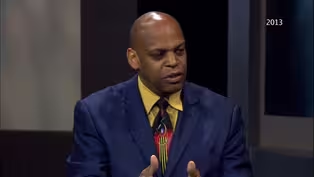
Venturing into the world of entrepreneurship comes with challenges, but for Black women entrepreneurs, the hurdles can be much higher and different. “American Black Journal" host Stephen Henderson talks with Linda Hendricks, co-founder of the Detroit Dance Center, and Chinonye Akunne, the owner of ILERA Apothecary, about the unique challenges they face as African American women entrepreneurs.
Problems playing video? | Closed Captioning Feedback
Problems playing video? | Closed Captioning Feedback
American Black Journal is a local public television program presented by Detroit PBS
Black women entrepreneurs face unique business challenges
Clip: Season 50 Episode 46 | 11m 26sVideo has Closed Captions
Venturing into the world of entrepreneurship comes with challenges, but for Black women entrepreneurs, the hurdles can be much higher and different. “American Black Journal" host Stephen Henderson talks with Linda Hendricks, co-founder of the Detroit Dance Center, and Chinonye Akunne, the owner of ILERA Apothecary, about the unique challenges they face as African American women entrepreneurs.
Problems playing video? | Closed Captioning Feedback
How to Watch American Black Journal
American Black Journal is available to stream on pbs.org and the free PBS App, available on iPhone, Apple TV, Android TV, Android smartphones, Amazon Fire TV, Amazon Fire Tablet, Roku, Samsung Smart TV, LG TV, and Vizio.
Providing Support for PBS.org
Learn Moreabout PBS online sponsorshipLinda and Chinonye, welcome to American Black Journal.
- Hi.
- Yes, thank you.
- Thanks for having us.
- Glad to be here.
- So, I always think that, you know, one of the most daring things you can ever do in life is to go out on your own and start a business.
Decide that you're gonna fare for yourself out in the market economy.
Of course, that looks really different for people of color than it does for the majority population, and it looks really different for women than it does for men.
So, you both face both of those challenges.
I wanna start with both of you just, kind of, telling your story, how you came to decide that this was for you, and what you ended up creating.
Linda, I'll start with you.
- Okay, sure.
So, I'm one of the co-owners of Detroit Dance Center.
We are located in Midtown Detroit.
And myself and my two other partners, Dominique and Jasmine, we all used to teach together.
We taught dance together at a dance studio in Detroit, and we've taught together as I was a teacher, they were students and then we all became teachers, and then the pandemic happened.
And so we were, kind of, on a hiatus.
Everybody was sitting at home and zoom classes, and everything like that.
And it started off as just like a little playful banter, like, you know, oh, if I had a studio I would do this.
If I had a studio, I would do that.
And the discussions became a little serious, and moving forward.
Next thing you know, about a year later, we opened up our studio in September of 2021, and it was kind of weird trying to figure it out during the pandemic, but that's how we all got started.
- Yeah, yeah.
And, and what were some of the risks, I guess, that you felt, or some of the challenges that you faced in making that decision?
- Oh, definitely, yeah, the pandemic.
That's really what it was.
- Let's start there, right?
- Yeah.
It was really that.
We were thinking, you know, would, parents want their kids to be around other kids so close?
And, you know, if we had classes, how many kids can we put in a classroom, and, you know, work on social distancing.
So, it was really unknown how the public would react or would we have students, you know, starting in 2021, that would want to be in person, and not have to do virtual dance classes.
- Yeah, yeah.
Chinonye, tell us how you came to decide to be an entrepreneur.
- Yeah, so I always tell people entrepreneurship found me.
And I say that because about eight years ago, my brother came to me needing a natural deodorant.
He was changing his lifestyle, changing his diet, and was going vegan.
So, he wanted something that was vegan, and that actually worked.
At the time, I studied chemistry in college.
I also got my master's in public health.
And so I was always been like tinkering with, like, formulas and things like that.
So, I was able to make it for him.
And on this journey of making this natural deodorant, I realized that some of the chemicals in my workplace, I was working at a global automotive company at the time, I was making sure we were evaluating the chemicals that were coming into our plants, and some of, I saw a lot of crossing.
And so I said, if I'm banning this from coming into a plant because it's unsafe for people to work in, in a large manufacturing environment, then why are we putting it on our skin.
Even though it's at smaller doses?
But we're still doing that every single day, and that's just compounding onto us.
And so I was, like, I just started doing more research.
I started talking to friends and family.
And when I learned about how many people were suffering with different skin elements from eczema to psoriasis, dry skin, being allergic, I was very shocked 'cause I had never experienced any of that.
And so I realized that my brother came to me for a reason, and I was gonna create the solution.
So, that's when I created Ilera Apothecary, and the goal of Ilera is to make people feel confident in their skin.
Ilera literally translates to health.
And in the Yoruba language in Nigeria, I'm a first generation American.
And so really tying my roots, tying my education, tying who I am into a product that helps people.
And so essentially that's how Ilera Apothecary came to be and that's what we're about.
Growing competence through skincare.
- Yeah, yeah.
So, I do wanna talk in a little bit about the program that has helped you guys with some financial assistance, and other things, but before we get there, I wanna talk about what some of the day to day reminders, I guess, that you get about the challenges that exist because of who you are.
The things that might be easier for other people who start and own businesses than they are for you.
Chinonye, I'll start with you this time.
- You know, it's interesting because in business, you don't know what you don't know until you come across that hurdle.
And then you have to start figuring it out.
And I don't have just, like, a dedicated group of people that I can go and say, like, this is what I'm dealing with.
How can you help me, or where do I go?
It's, like, I talk to one person, they introduce me to another person.
And so it's like the time to resolve issues, the more that I'm, like, learning about business and getting familiar with it, it decreases, but you have to be intentionally in those spaces to even get that access.
And I know, like, when I was applying for the Comcast grant for marketing, it was like, I don't need the money right now, but what I need is for people to know about my business, because essentially the money will come back from there.
And so really just, like, understanding what you need in business, and how you can make it work for you, even if it is something as a tangible dollar.
- Yeah, yeah.
I mean this idea that you need the support of other people, who own businesses, other people who know what it's like to start a business.
Linda, talk about how that challenge looks if you're an African American woman and trying to make a business work.
- Yep, absolutely.
Well, you know, one good thing about me and my business partners is that we are career professionals first and dancers second.
We have that passion for dance.
We love to dance, but we do other things.
Myself, I am an internal auditor, been so for over 20 years.
My partner, Jasmine, is a chemistry teacher, so she works on all the curriculum development, and then Dominique is a project manager.
So, with those things we're able to, you know, work the business, put out, you know, processes and procedures and operations and know about customer service.
However, we struggled a lot with that marketing.
So, being able to use that Comcast grant to, you know, join other groups that are similar with, you know, doing dance studios and how do you get students in, and, you know, bring in the babies so you could help them grow up within your studio, and everything like that.
So, you know, that has been a struggle, and then on a personal level, because we are minority women, we're also mothers.
So, our husbands have had to take on the role of Mr.
Mom, if you wanna say.
'Cause we teach classes in the evening.
So, my husband is, you know, running around, picking up the kids from school, dropping 'em off, and he comes home late at night saying, "Oh, I'm pooped."
I'm like, "Oh really, isn't that so interesting?"
So, that's a challenge of just being able to definitely have that support system of, you know, being able to operate in the evenings when, you know, most family or even women are at home, be it taking care of family, or running errands, or, you know, being the family Uber, so.
- Yeah, so, I want both of you to talk just a little about the grant, the Comcast Rise grant.
But also I wanna have you give some advice to people out there who might be thinking about starting their own business and may be apprehensive about the idea, maybe don't think that it will work, or that they'll have the support.
Talk about both of those things, and how they kind of work together.
Linda, I'll start with you this time.
- Okay, yeah, definitely.
With the Comcast grant, definitely the application process, I think, prepares a person, an entrepreneur, to be able to make sure that they have all their ducks in a row before they're hitting market.
So, it asks a lot of questions about, you know, what is your budget, how do you foresee yourself, you know, after 12 months, what are some of your obstacles, what are some of your risks, what are the markets looking like?
So, just those questions alone, if you don't have those answers to those questions, you know, you might not be in that position quite yet to hit market, but it's not a, you know, it's done for, and you can't do anything about it.
It's really, like, this is what it's gonna take as an entrepreneur.
You're always gonna plan, you'll always have to forecast, you're always gonna have to figure out how can you shift, or, you know, change with the market or the environment of what's going on.
So, you know, my tips are, you know, really thoroughly look at those questions on the application, you know, answer them to the best of your ability, and be real, what am I trying to say, realistic, with those answers.
And if you can do those things, you know, I think you would have, hopefully, a good shot at that.
- Yeah, Chinonye, what would your advice be?
- Yeah, absolutely.
Understand your why.
Why are you going into business.
Often I found that people have said they're going into business, because they don't wanna work for another person.
But what they don't realize is that when you go into business, you get a lot more managers.
You're answering to your customers, you're answering to your employees, your vendors, everyone.
And so really, like, understand what value are you bringing.
Why you, and what difference are you trying to make with your business?
Also, just like Linda said, understand your business.
Know your numbers.
Know the value that you bring and really, like, make sure that you're organized, you have your ducks in a row, but also don't think that you have to know everything.
Don't wait for perfection to get to where you wanna be.
People fail so many times, but as long as you get up after every single one of those failures, you've learned something new where you can then go, and take it to the next thing that you do.
But don't think that you need to have all the answers, make sure that the answers that you do have, you have them organized.
Ask a lot of questions and understand your why.
- That advice about understanding failure.
There is no such thing as a business owner who's never failed, right?
But you learn from those failures.
You don't just give up.
Wonderful advice from both of you.
Okay, Linda and Chinonye, thank you very much for being here.
- Thank you, thank for having us.
- Yes, thanks for having us.
- A onetime symbol of racism and housing segregation here in Detroit, now represents the city's hope

Detroit Bass Day celebrates with The Temptations tribute
Video has Closed Captions
Clip: S50 Ep46 | 6m 18s | The 9th annual celebration features spoken word poetry from the "Papa Was Project." (6m 18s)

Detroit's Birwood Wall receives Michigan Historical Marker
Video has Closed Captions
Clip: S50 Ep46 | 2m 50s | The wall was installed to separate housing for whites from African American neighborhoods. (2m 50s)
Remembering Detroit education advocate Tyrone Winfrey
Video has Closed Captions
Clip: S50 Ep46 | 52s | Detroit Public Schools Executive Director of Community Affairs Tyrone Winfrey passes away. (52s)
Providing Support for PBS.org
Learn Moreabout PBS online sponsorship New Episode
- News and Public Affairs

Top journalists deliver compelling original analysis of the hour's headlines.

- News and Public Affairs

FRONTLINE is investigative journalism that questions, explains and changes our world.

 New Episode
 New Episode
 New Episode

 New Episode
 New Episode
 New Episode
 New Episode
Support for PBS provided by:
American Black Journal is a local public television program presented by Detroit PBS