Washington Grown
Bloom and Bounty
Season 13 Episode 1303 | 26m 46sVideo has Closed Captions
Visit the Yakima Valley to celebrate the vibrant stories and flavors that define this iconic region.
We celebrate the vibrant stories and flavors that define the Yakima Valley. At Domex Superfresh, innovation keeps local apples crisp and world-ready. We explore the spirit of Yakima Tourism, cook up a salmon and cherry dish at Waterfire, and enjoy comfort food at Chick’n Fix. Finally, we uncover how Yakima’s apple history helped shape Washington’s agricultural legacy.
Problems playing video? | Closed Captioning Feedback
Problems playing video? | Closed Captioning Feedback
Washington Grown is a local public television program presented by KSPS PBS
Washington Grown
Bloom and Bounty
Season 13 Episode 1303 | 26m 46sVideo has Closed Captions
We celebrate the vibrant stories and flavors that define the Yakima Valley. At Domex Superfresh, innovation keeps local apples crisp and world-ready. We explore the spirit of Yakima Tourism, cook up a salmon and cherry dish at Waterfire, and enjoy comfort food at Chick’n Fix. Finally, we uncover how Yakima’s apple history helped shape Washington’s agricultural legacy.
Problems playing video? | Closed Captioning Feedback
How to Watch Washington Grown
Washington Grown is available to stream on pbs.org and the free PBS App, available on iPhone, Apple TV, Android TV, Android smartphones, Amazon Fire TV, Amazon Fire Tablet, Roku, Samsung Smart TV, and Vizio.
Providing Support for PBS.org
Learn Moreabout PBS online sponsorship- "Washington Grown" is made possible by funding from the Washington State Department of Agriculture and the USDA Specialty Crop Block Grant program, and by the Potato Farmers of Washington.
Learn why Washington is home to the world's most productive potato fields and farmers by visiting potatoes.com.
- Hi everyone I'm Kristi Gorenson and welcome to "Washington Grown."
Known for its long growing season, which starts early and ends late, the Yakima Valley produces some high quality, beautiful fruits and vegetables of almost any kind.
In this episode, we're going to explore this region that's known as the source of Washington's food scene.
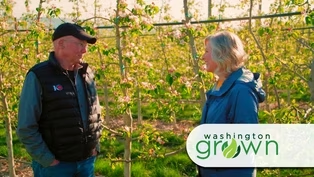
I'm talking with an apple expert in a blooming orchard.
- When I was six months old, my parents were picking apples on the family farm and I was in an apple box under the tree.
My learning started early.
- And I'm making salmon with cherry compote at WaterFire restaurant in Yakima.
- Kind of depends on how much cheese you want.
There you go.
That's what I thought.
[laughing] - More.
[laughing] - There we go.
- Then Tomás and I are learning what makes Yakima so great.
Here's to Yakima.
- Here's to Yakima.
- Here's to Yakima!
- Thank you guys.
- All this and more today on "Washington Grown."
[bright music] Cooking with Kristi.
Sweet meat.
- Jiminy gee willickers.
- Watch my bangs.
Go big or go home.
- [exclaiming] Right in my eye.
You made me a believer.
Oh, I am making a mess.
- Oh, Val, I love you.
- Heaven on a plate.
That's yummy.
- We're gonna need a to-go cup for these.
[laughing] - [laughing] Yeah.
- You keep talking.
I'll keep eating.
[bright music] Here in Yakima, fresh produce is abundant, so it's no surprise you can find some great food.
WaterFire Restaurant & Bar's serving up some incredible dishes that highlight the variety of flavors in the region.
From asparagus in the ground to fish from the rivers, they're making sure every dish is as fresh as can be.
- The food here is so much better because it is fresh.
- We have tried, I would say, half of the menu and never disappointed.
- It's like you have your own little garden.
- We want people to come in and feel at home.
We want you to feel welcome.
- Sous Chef Savannah Elliot and her team in the kitchen, wanna make sure that the customers feel important.
That's why they come out and talk with customers whenever they can.
- We have lots of customers that come through, sometimes several times a week, they pop up in the window.
They tell us, you guys did a great job.
They love talking to the cooks.
- They mingle.
They wanna know how things are going.
They wanna know what they can improve on.
They wanna know what your thoughts are.
- Our guests know that we're going to go that extra step for 'em.
We're willing to do what we need to make them happy.
- Don't miss later in the show when Savannah and I make salmon with Washington Cherry compote.
Learn from my mistakes.
- We could try it sometime.
The best mistakes make good recipes though.
You'd be surprised how many times we mess up and then we're like, "Oh, that works out.
Let's try this."
- That turned out pretty good.
[bright music] Although there are many beautiful places in Washington state, there aren't many that are quite as picturesque as an apple orchard in the springtime.
That makes today the perfect day to walk through the trees with horticulturalist, Dave Gleason.
For Dave apple orchards have been an essential part of his life from the very beginning.
- When I was six months old, my parents were picking apples on the family farm and I was in an apple box under the tree.
My learning started early.
- And his education has taken him far.
Today you might call Dave something of an apple expert, and he's sharing that knowledge with his clients.
- When you plant trees, it's three to five years before you really start producing.
At this point in my career, I'm working with outside growers, giving them advice, looking at what they're growing, how they can maximize it, and help them make decisions and operations, just in whatever way I can help.
- I think orchardists are very lucky to have you.
[laughing] Although this orchard doesn't appear to have any fruit on the trees, we can already see the beginnings of some amazing apples.
- This is a cosmic crisp block.
They're looking beautiful at the moment.
We're in the, what they call the first bloom stage.
So some of the first king blooms are starting to open up.
It's a little chilly at the moment.
There's bees in the orchard too that'll start getting busy in the next hour or so.
A tree, of course, in the spring, before it starts doing anything, it looks dead.
So it's pretty amazing that they come alive again and wake up.
And one of the first things they do is flower, and that's the beginning of the apple.
There's male and female parts in the inside of the flower, inside the center are ovaries, and you can see eggs or actually seeds that become the core of the fruit.
Most apple varieties are not self-fruitful, so though there's pollen and male and female parts, the male parts won't pollinize in that individual variety.
So, we've actually planted other types of apples inside the block to have a diversity of pollen.
And then we need the insects, the bees in particular, to move that pollen from flower to flower so that then the apple begins to develop.
There's somewhere between five to seven flowers in one bud.
And each of those flowers can become an apple.
There's one in the center that is the first one to bloom.
And it's head and shoulders above the others.
And that's the king bloom.
Generally in most varieties, that would be the best apple.
Washington has a wonderful climate.
It's a very special place in that regard.
Growing some of the best apples in the world, probably the best.
What a beautiful day to be out here.
- I know, right?
It's warm, sunny, apple blossoms.
It's a good day.
[bright music] - Here in Seattle, one truck is serving up some hot and delicious food with a special twist.
Chick 'n Fix creates its menu with a simple philosophy, make great dishes, using great ingredients.
Combining their backgrounds, Marry and her husband, John Rudd, have created a menu that's both simple and diverse with bold and incredible flavors.
- My husband, his family does the American style of fried chicken.
And then I wanted to introduce the Filipino food, like the lumpia and the adobo, because we wanted people to really try American and Filipino dishes.
Yes.
Yes.
- See, that sounds fun.
And just the way that you're incorporating your different cultures and styles.
Today's special, a macaroni salad, but with the Filipino twist, using pineapple, green peppers, and Washington grown Fuji apples.
But before I get to try it, let's see what those here in Seattle think of it.
[bright music continues] - Yeah, that's pretty tasty.
- Heavenly divine.
It's very good.
- Nice and creamy.
A little mild.
And you got a little bit of veggies.
- I taste the apples.
- You taste the apples?
- I taste the cheese.
- Okay.
- Oh, I just got a chunk of apple.
- Never had any macaroni with apple.
- And so this is Filipino macaroni salad.
Tried and true.
- Yes, it is.
- There you go.
There's all the proof you need.
- Yeah, it's fruity, it's fresh.
That's really nice.
Yeah.
- I'm gonna finish this.
- Well, even though you got another one coming?
Well, you can always save the other one for later.
[Tomás laughing] - Pretty tasty can I keep this?
- [laughing] Yes.
You can keep that.
That's yours.
Yeah.
- Sounds good.
Thanks, Tomás.
- Thank you.
This is the macaroni salad that everybody is raving about.
Now, hey, I'm gonna be honest with you.
I've never been a fan of macaroni salad.
- Well, I'm hoping you like this one.
- So I'm excited.
- This a little bit of everything.
- All right, ready?
Here we go.
You made me a believer and I love that sweetness of the pineapple.
But then you get that bite of the green pepper.
And there's this fun little like teeter totter effect.
If I'm ever gonna make macaroni salad, I gotta do it like this.
- Yeah?
[laughing] [Tomás laughing] Alright, well if you need the recipe, call me.
[bright music continues] - I'm sure you would all like to know what's the largest apple growing area in Washington State.
Well, we'll have that answer for you right after the break.
- Coming up, I'm making salmon with cherry compote at WaterFire restaurant in Yakima.
- Kind of depends on how much cheese you want.
There you go.
That's what I thought.
- More.
[laughing] - There we go.
- Then I'm learning how one project is helping both Yakima farmers as well as fish populations.
- The benefit is intuitive to the state of Washington.
[bright music] - The largest apple growing region in Washington state is the Yakima Valley, and it stretches from Naches all the way down to the Tri-Cities following the Yakima River from its headway to where it exits into the Columbia River.
- We're back in Yakima at WaterFire Restaurant & Bar.
Unique and incredible flavors are displayed perfectly on the plate, giving guests more than a meal.
They're getting the full Washington state experience.
- Oh my gosh.
You've gotta come check out the food.
It is amazing.
- I think people come here because they find their favorites and they come back for more.
- You can't go wrong when you come here.
It's amazing.
- So a lot of our produce we can actually get locally.
So like our vegetables, asparagus, cherries, apples, peaches.
- Sous Chef Savannah Elliot knows that it's a combination of skill and incredible local ingredients that make their food so great.
And this valley is the perfect spot to get everything fresh.
- Yakima is centered in such a spot in Washington that we have all the mountains around us.
It gives us such a diverse climate throughout the year that we have the ability to grow so many different products.
So we can get hops for beers and we get tons of wine from the grapes and then we can access all of our fresh produce for the kitchen as well.
- It's always a surprise as to what the seasonal menu's gonna be and what the options are.
- Good farm-to-table type food.
- Our menu's constantly changing.
We have access to some of the best ingredients in the Pacific Northwest.
We want you to come and be able to try something new every time.
- So you and I get to cook today.
- We do.
- So what are we gonna make?
- We're gonna work on a beautiful salmon today.
It's gonna come with a Parmesan risotto.
We have a local asparagus we're gonna grill off that we get from here in the valley.
We're gonna make a beautiful cherry compote with Washington cherries.
And then we have a beautiful Atlantic salmon that we're gonna grill off for you.
- Quintessential Pacific Northwest.
- Always a good light lunch.
- Yeah.
Very good.
[laughing] - We're gonna start with the cherry compote.
That one's pretty easy.
- Okay.
And these are dried cherries.
- Yeah, so with the dried cherries, they lose a little bit of the sweetness and they become almost tart.
So they're better when it comes to savory dishes.
- I love that.
- Versus desserts.
- Yeah, these are one of my favorite things to just munch on like as a snack.
We start by cooking some shallots and dried cherries.
- That's a red wine that we use.
You can add all of that.
- I almost took a sip.
So all of this?
- Yep, go ahead.
Basically we're gonna cook out all the alcohol in it, which that's the fun part, unfortunately.
We're gonna cook it all out, make it nice and sticky.
- We add some sugar and let it cook down for 20 minutes.
Then it's onto the risotto.
I don't think I've ever purposely made risotto, but like accidentally made risotto.
Cooking with Kristi, yeah.
[laughing] - I'd be down.
- We can try sometime.
- Learn from my mistakes.
- We can try sometime.
The best mistakes make good recipes though.
You'd be surprised how many times we mess up and then we're like, "Oh, that works out.
Let's try this.
Yeah."
- That turned out pretty good.
We cook down some onion, garlic and butter.
Then add the rice and slowly add chicken stock.
- Honestly, you're gonna find me in a kitchen outside of work.
I'm almost always in the kitchen.
- Does your family have a favorite thing that you make?
- Cheesecakes, lately.
- The cheesecakes?
- Yeah.
- We wanna be part of your family.
[laughing] - Just lemme know when you're in town.
I'll make you a cheesecake, I promise.
I got you.
- That's your love language.
- It is.
- It's food.
Yeah.
- Constantly feeding people.
- We finished the risotto with salt, pepper, and Parmesan cheese.
- Kind of depends on how much cheese you want.
So how much cheese do you want in your... There you go.
That's what I thought.
[laughing] - More.
[laughing] - Okay.
Here we go.
- These are like the star right here.
- Yes, because of the way the Yakima's situated, we get all four seasons.
So it like allows us to grow such great produce.
So our asparagus almost all year round comes in great.
It's thick, it's healthy.
Some of the best asparagus I've ever had.
- We grill the salmon and asparagus, then it's time to plate.
[bright music] That's so good.
It's like a bunch of different layers.
The cherries are lovely.
- Salmon's one of those fish, it takes a lot of flavors into it.
When you add in the tartness of the cherries, it brings out the lightness of the fish.
That's what we aim for with a lot of our dishes.
We don't want you to just get one flavor pop.
We want you to have an experience.
You eat a little this, this.
Then when you eat it all together, it's something else.
You enjoy a couple glasses of wine, you eat your fish.
And like it's a good night.
- So delicious.
Thank you so much.
For this and more chef-inspired recipes, visit us at wagrown.com.
In the Yakima Valley, water is an important resource, especially during summers when temperatures soar.
Here in the Wenas Valley, farmers were using an above-ground irrigation system to water their crops, which caused a lot of issues.
As a director for the Purdin Ditch Association, as well as for the Wenas Irrigation Board, Steve Johnson knows all too well how many problems the system caused.
- In the open ditch, we lost anywhere from one to two CFS worth of water, which is a significant amount of water.
The ditch would be full of weeds and it was just constant maintenance, water shutoffs.
It never ended.
It was all summer long.
- We've been at this out here for about 10 years on this specific project.
- Michael Tobin is the district manager for the North Yakima Conservation District.
He and his team worked with the farmers to create something called a ditch headgate diversion.
Changing the above-ground irrigation canals to underground irrigation pipes and adding the structure helped save water and protect local fish.
- This is a typical fish screen setup that you would find anywhere in the Yakima River Basin.
You'll notice that it's running at a very specific rate.
- Yeah.
Very slow.
- And it has perforated holes in it 'cause we're dealing with fish that are only this big.
If they swim up against it, they instinctively wanna burst away from it.
When fish come against the fish screen, they need to be able to escape.
And you notice they're in at an angle.
So this helps encourage 'em to go down there.
And that is a bypass structure.
So that bypass structure is a pipe that goes underground and way over there in the heavily vegetated area where it's nice and cool and safe, that's where we're returning fish back to the stream.
- Nice.
- The benefit is intuitive to the state of Washington.
Without fish, what are we?
- What this does, it provides much cleaner water than what we're used to seeing.
Number two, more water.
I think at my pump, I've gained 10 pounds of pressure.
I think some of the irrigators at the lower end are upwards of 20 to 25 pounds, which in some instances is enough to irrigate without an electric pump.
That's a big deal.
That water savings, it's not just for Purdin Ditch Association, but it's for the entire district.
There's more water in the lake for longer periods of time and everybody benefits.
- What would you say is the experience working with the conservation district on this project?
- Easy.
There's no other way to describe it.
- That is a big project that is well worth it and time well spent by the conservation district.
- Coming up, Tomás and I are learning why Yakima is so great.
Here's to Yakima.
- Here's to Yakima.
- Here's to Yakima!
- Yeah.
- Thank you, guys.
[bright music] [bright music] Hey everybody.
Tomás here with my daughter Anna Lucia, and we're actually on our way to the ice caves located at the base of Mount Adams.
Now the ice caves is a place that my parents used to take me to all the time, and so it got me thinking a lot about my parents and my dad.
And my dad makes this fruit salad that has been a staple of family dinners.
It's something that you've enjoyed.
- Yeah.
- I mean, you're always asking for a grandpa's fruit salad.
So that's what we're gonna be making for you today.
Today we're using Cool Whip, cream cheese, gelatin, a variety of Washington fruits and a few canned fruits.
We would begin with a large tub of Cool Whip.
Yep.
There it goes.
All of it.
- Oh, that looks so good.
Then goes the cream cheese.
- Boom.
We're gonna go ahead and put in some strawberry jello to give it some color.
- That looks so good.
And super pink.
- Yep.
- Already.
Now it's time for our apples followed by our Washington berries.
- There we go.
Fantastic.
Go ahead and add that as much as you'd like.
- Then we add our crushed pineapple.
- There we go.
And then put all those mandarin oranges in there.
- So colorful.
- Yes.
All right.
Let's go ahead and dish this up.
Oh, look at that.
Cheers.
[bright music] Mmm.
- Mmm.
That is good.
- Mm-hmm - It's like the exact same.
- Made it just like dad did.
That is great.
To learn how to make this recipe and many others, head on over to wagrown.com.
- Tomás, here we are in historic downtown Yakima.
- Yes, we are.
- I'm excited to be here because it is kind of the epicenter of this area of agriculture, and I'm excited to learn about that.
But also someone's hometown.
- That's right.
That's right.
- So we're gonna hook up with a couple of Yakima experts and they're gonna tell us more about the history and this beautiful city.
- Right.
Let's go check it out.
- In order to learn the history of Yakima, you have to talk about the beginning of the craft brewing industry.
CEO of the Greater Yakima Chamber of Commerce, Kristi Foster, took me to a special place to learn about just that.
- This is Front street.
This is the second oldest building here in Yakima.
- It was at this building that Bert Grant opened one of the first pub breweries in America, all to celebrate fabulous Yakima hops.
- Right behind us was the pub.
He also brought the first pelletizer to the United States.
What is that?
- It's a hop... It turns the hops into pellets.
- Well, and we need that to happen, right?
- That's right.
Yes.
- Next, we walked over to the old train depot where Bert Grant's story continued.
- This is where Bert Grant moved after he left the location over here and he opened the brewery on this side of the street.
- So one time though there was beer here.
- There was beer.
[both laughing] - With hops comes beer.
- Yakima's history is tied closely to agriculture and early agriculture couldn't succeed without the railroad.
I'm talking with John Baule, the director emeritus of the Yakima Valley Museum.
- We're actually walking on railroad tracks.
There used to be railroad tracks.
And these buildings, to my right, were used in the food processing industry.
All the fruit would be brought in from all the orchards out in the surrounding area, and then it would be packaged and transshipped onto rail cars.
But this is where it all started.
This was really the hub of it.
- We wanna keep that history here in Yakima because it is so important for our community.
- While Kristi's learning about Yakima's past, I'm learning about its future.
Curt Wilson, the director of the Downtown Association of Yakima, is working to revitalize Yakima, making it an even better place to live.
- I'm the executive director of Main Street, and so as part of a Main Street community, we are basically trying to do economic development.
We're doing design projects that basically just show that we have life down here.
- Yeah.
- And that yakima's moving forward, we're not looking back, - But still, they never forget our farmers and their importance to Yakima's past, present, and future.
- This is our farmer's market.
We have anywhere from 50 to 75 vendors that take over the space.
You know, obviously we're in farm country here.
So we have a lot of small farmers.
So it's a party down here every Sunday.
- After a great time in Yakima.
There's only one way to end the day, a toast at Schab's Bier Den to the town that some call America's fruit basket and I call home.
- And this is kind of your local cheers bar, serving all those great local Yakima beers.
- Well, thank you so much for the great tour.
Here's to Yakima.
- Here's to Yakima.
- Here's to Yakima!
- Yeah.
- Thank you, guys.
[gentle music] - For 200 years, Washington has been growing apples, and for nearly a century, we've been the leading producer in the nation.
But the heart of that story beats in the Yakima Valley.
It's here where mountains meet rivers and orchards stretch for miles that apples found their perfect home.
Let's step back in time and discover how this valley became fruit famous.
Apples arrived in the Pacific Northwest via the Hudson Bay Company at Fort Vancouver.
By 1836, several apple trees were already bearing fruit at the fort and seeds were shared throughout the Northwest.
Missionaries and settlers considered apples a staple for homesteading.
They kept well and pioneers loved hard apple cider.
Over the next few decades, small apple orchards began dotting the landscape from the misty fields of western Washington to the warm valleys of Walla Walla.
As settlers moved north into the foothills of the cascades, they learned that apples thrived in the long summers and cold winters.
Eastern Washington's rich volcanic soils under the dry grasslands proved especially fertile and great for the trees.
The Yakima Valley was exceptionally prime because of the Yakima River and its tributaries.
In 1852, Catholic missionaries and the Yakima people dug the first irrigation ditch in the Yakima Valley.
- Chief Owhi, chief of the Yakimas, was a resident out here.
And as the story goes, he learned from the priest Ahtanum mission one winter, while he was overwintering there, European irrigation techniques.
And just a stone's throw away from us here is where he implemented those at a place called Owhi Gardens.
And in establishing the gardens, he needed to continue to perpetuate.
So he traded with the Hudson Bay Company for seeds for more traditional European crops, potatoes, et cetera.
And he had a well-established garden and pastures there.
He was grazing animals in this, what would've been the desert.
- By the 1890s in the Yakima and Wenatchee Valleys, new irrigation projects promised to turn sun baked hills into thriving orchards.
The arid climate also meant fewer insect and disease problems.
Hopeful growers planted their first apple trees waiting years to see if their gamble would pay off.
And when those trees finally bore fruit, the land spoke for itself.
These valleys were destined to grow something extraordinary.
As the orchards grew, so did the realization that apple farming was no simple task.
It demanded real expertise.
Washington growers couldn't compete with the eastern orchards on cost, so they set their sights on quality instead.
Farmers and scientists work side by side to perfect the art of the Washington apple.
Railroads made far away markets accessible.
And by the early 1900s, Yakima apple growers were shipping more than a million dollars worth of apples each year.
But growing great apples wasn't enough.
They had to look the part while eastern growers packed theirs in a barrel that left fruit bruised and broken.
Washington farmers wrapped each apple with care, nestled in wooden boxes lined with paper.
Vibrant labels showcased Washington's mountains, rivers, and imagination, turning simple fruit into a symbol of pride.
By the 1920s, Washington had done it, we'd surpassed New York to become the nation's top apple producer.
A title we've held ever since.
Competition among growers led to high quality standards and the best fruit for consumers.
Research conducted by Washington State College also led to improvements in the orchards.
Farmers improved how they fertilized and managed pests and new varieties made their way to the orchards.
Washington Apple standards are the most rigorous in the country.
Today, the Yakima Valley stands at the heart of America's apple country, the nation's leading region for Apple growing, stretching from Naches all the way down to the Tri-Cities.
Known throughout the world for being the best, Washington Apples are more than a legacy for our state, they are a treat.
- If you're someone who likes history, amazing apples and other great food, then the Yakima Valley is definitely a place you should visit.
That's it for this episode of "Washington Grown."
We'll see you next time.
Video has Closed Captions
Preview: S13 Ep1303 | 30s | Visit the Yakima Valley to celebrate the vibrant stories and flavors that define this iconic region. (30s)
Providing Support for PBS.org
Learn Moreabout PBS online sponsorship

- Food
Christopher Kimball’s Milk Street Television
Transform home cooking with the editors of Christopher Kimball’s Milk Street Magazine.








Support for PBS provided by:
Washington Grown is a local public television program presented by KSPS PBS