If You Lived Here
Bloomingdale/LeDroit Park
Season 2 Episode 11 | 28m 49sVideo has Closed Captions
The history, homes – and turrets – of D.C.'s Bloomingdale & LeDroit Park neighborhoods.
The influences of Howard University run deep in D.C.'s Bloomingdale & LeDroit Park. With the help of realtor Suzanne DesMarais, John and Christine guess listing prices of three homes across both areas and gain a new appreciation of exposed brick and turrets. Local residents also share their history and perspective on these two fascinating adjacent neighborhoods.
Problems playing video? | Closed Captioning Feedback
Problems playing video? | Closed Captioning Feedback
If You Lived Here is a local public television program presented by WETA
If You Lived Here
Bloomingdale/LeDroit Park
Season 2 Episode 11 | 28m 49sVideo has Closed Captions
The influences of Howard University run deep in D.C.'s Bloomingdale & LeDroit Park. With the help of realtor Suzanne DesMarais, John and Christine guess listing prices of three homes across both areas and gain a new appreciation of exposed brick and turrets. Local residents also share their history and perspective on these two fascinating adjacent neighborhoods.
Problems playing video? | Closed Captioning Feedback
How to Watch If You Lived Here
If You Lived Here is available to stream on pbs.org and the free PBS App, available on iPhone, Apple TV, Android TV, Android smartphones, Amazon Fire TV, Amazon Fire Tablet, Roku, Samsung Smart TV, and Vizio.
Providing Support for PBS.org
Learn Moreabout PBS online sponsorshipWOMAN: Support for If You Lived Here comes from... MAN: The Yuen Foundation.
Committed to bridging cultural differences within the greater Washington D.C. community.
WOMAN: And now, If You Lived Here.
A WETA original series.
JOHN: Hi, I'm John Begeny.
CHRISTINE: I'm Christine Louise.
We're coworkers at WETA, and longtime friends.
JOHN: We love living in the D.C. area.
Finding a place to live here can be exciting, and sometimes challenging.
CHRISTINE: Join us as we tour three homes, at three price points.
JOHN: And try to guess the listing price without going over.
And find out what it would be like...
BOTH: If you lived here.
(theme music playing) SUZANNE: Hey.
JOHN: Good morning.
CHRISTINE: Hi, Suzanne.
SUZANNE: Hey, John and Christine.
Welcome to Bloomingdale.
CHRISTINE: This was a great place to meet.
What a hidden treasure.
SUZANNE: It's totally hidden.
This is Crispus Attucks Park.
It is very central to Bloomingdale.
We're in the Bloomingdale neighborhood.
And what's really cool about this park is that it's completely a community effort.
JOHN: And there seems to be, like, really nice personal touches.
Like this bench right here.
It says, "Open spaces, sacred places."
CHRISTINE: And it sounds like you take pride in this area as well.
SUZANNE: You know, when I saw the neighborhood, I just fell in love with it.
So over the years, you know, people have put a lot of energy and, and time, and money into these homes, and, and the neighborhood's been restored significantly.
JOHN: I mean, the University must play a big part.
SUZANNE: Howard University is a really significant entity in this area.
And decades ago, they began renovating houses so that their faculty members had places to live close to the university.
And that encouraged other people to invest in the neighborhood.
JOHN: So what is the range today?
SUZANNE: In Bloomingdale currently, you can buy a condo in the $300,000 range.
JOHN: Okay.
SUZANNE: That would be a smaller property.
JOHN: Yup.
SUZANNE: LeDroit Park, uh, some of those big detached homes can go well over $2 million.
JOHN: Wow.
SUZANNE: You guys ready to go see some stuff?
JOHN: We're ready.
CHRISTINE: I think so.
SUZANNE: All right, let's do it.
(doorbell rings) JOHN: Wow, this looks fabulous.
CHRISTINE: Ooh.
SUZANNE: Yeah, this our first property in the Bloomingdale Historic District.
This is actually four separate units, and we are going to see one of the unit sets available for sale today.
CHRISTINE: Well, I like this idea because if you can't afford the whole home, you can at least experience a portion of it.
JOHN: That's right.
SUZANNE: So one thing that really cool, about this having been a really nice big house back in the day, is that you have the original architectural features on the outside.
And then you also have the architectural elements, like the, the big windows in the front with the bay.
Take a look, enjoy, and I will meet you up at the front.
JOHN: All right.
CHRISTINE: Sounds good.
JOHN: Sounds perfect.
Oh, this is nice.
I see lots of possibilities here.
CHRISTINE: So do I. JOHN: Yeah, okay well let's start in the front with some of these beautiful historic details.
I love this brick.
So rustic.
And what really cool is looking at this view down the hallway.
CHRISTINE: Yeah.
JOHN: It's really dramatic.
CHRISTINE: You know what I see when I look down that hallway?
JOHN: What's that?
CHRISTINE: All the work that it took to expose that brick.
That's a lot of plaster, and it looks great.
JOHN: Speaking of other original features, how about this window?
CHRISTINE: Oh, this bay window.
JOHN: Yeah, Bloomingdale must of been named for, like, the lush landscaping on the streets.
It's really pretty out there.
CHRISTINE: Well, Blooming... JOHN: Dale.
CHRISTINE: Blooming... Yeah, blooming flowers, maybe.
JOHN: Got it.
Into the kitchen.
CHRISTINE: Much wider that I thought the space was gonna be.
JOHN: You know, we haven't talked about these floors yet.
CHRISTINE: Mm-hmm.
JOHN: These are newish floors.
CHRISTINE: Right.
JOHN: You can tell.
But I love this color.
CHRISTINE: Mm-hmm, mm-hmm.
JOHN: It's almost like a honey colored.
CHRISTINE: Look at all the cabinet space.
And you've got great counter space.
JOHN: Mm-hmm, lots.
CHRISTINE: So, you know, really, this kitchen is just move in ready.
JOHN: Okay, good start to this place.
CHRISTINE: Okay, now I know it's not the yellow brick road...
But how about... JOHN: The red brick hallway?
How about that?
(laughs) JOHN: Off we go.
CHRISTINE: Okay.
JOHN: Closet.
CHRISTINE: Closets.
JOHN: Okay, there's a closet to park your coats.
CHRISTINE: Nice washer-dryer.
JOHN: Must-have.
CHRISTINE: Mm-hmm.
Full bath.
JOHN: Yeah.
CHRISTINE: You know what's interesting?
When they were renovating, they ended up with what would be...
I would call it, like, a half tray ceiling.
But it looks great.
Gives it a little pop.
JOHN: Yeah, nice detail.
CHRISTINE: Mm-hmm.
So now we head down to bedroom number one.
JOHN: Ooh, bedroom.
This is a good size, Tina.
CHRISTINE: Ample space for additional furniture.
JOHN: Okay.
CHRISTINE: All right.
JOHN: On way.
CHRISTINE: Let's move on.
JOHN: All right, well, it's kind of like we're walking into en suite here with this door.
CHRISTINE: It is a full bath.
JOHN: Hey, so two full baths in this unit.
CHRISTINE: This makes me think, if you wanted a roommate... JOHN: Mm-hmm.
CHRISTINE: This is a great set up.
JOHN: Oh, yeah.
CHRISTINE: And into the bedroom.
JOHN: Yeah, here it is.
Bedroom number two.
This room actually has a separate entrance, which is great for a roommate.
CHRISTINE: Yeah that is nice.
Ooh.
JOHN: Oh, do you think this place comes with a parking space?
I guess you have to fight over that parking space.
CHRISTINE: See if it goes with this unit, though.
JOHN: One parking space, right.
(laughter) Come one.
All right, Suzanne.
SUZANNE: What did you guys think?
CHRISTINE: You never know, when you hear of these beautiful homes, there gonna be cut up into apartments or condos; what there gonna look like, but they did a really nice job on this one.
JOHN: And this brick is stunning.
Such a highlight.
CHRISTINE: So just saying, how much does a parking space add to the value?
JOHN: You cannot answer that question.
CHRISTINE: It's a legitimate question.
JOHN: It's legitimate, but it's also called cheating.
SUZANNE: So there are two parking spaces with the building.
And as we talked about before, there are four units, and one of the spaces comes with this unit.
JOHN: Ah.
SUZANNE: Yes.
CHRISTINE: Ah, okay.
SUZANNE: Yes, now that's a plus.
JOHN: That's good news.
CHRISTINE: A condo fee?
SUZANNE: So it is $225 a month, but the four owners maintain the property together.
So there are two bedrooms... CHRISTINE: Mm-hmm.
SUZANNE: Two full bathrooms; it is 838 square feet.
The property was originally built in 1901, and then it was condo'd in 2007.
And there have been some updates since then.
JOHN: I'm gonna give you a guess of $545,000.
CHRISTINE: Well, as John always says, "Oh, that was a good guess."
I don't think it was.
(laughter) CHRISTINE: I'm gonna go a little higher at $625,000.
SUZANNE: Those were both really excellent guesses.
The list price is $575,000.
JOHN: $575,000.
CHRISTINE: Oh my gosh, we're like... SUZANNE: Go with whoever was not over.
JOHN: We're like split in the middle.
CHRISTINE: We're split right in the middle.
SUZANNE: This unit might be worth a bit more if it were a, a very recent renovation, but that makes it more affordable for somebody.
JOHN: All right.
CHRISTINE: That's great.
I mean, it makes me feel better.
JOHN: Yeah.
And that was a great first house to see in this neighborhood, but we have house number two coming up.
SUZANNE: Yes, we have a house very close by in LeDroit Park, just a few blocks over.
JOHN: All right.
CHRISTINE: Sounds good.
SUZANNE: Great.
JOHN: On our way.
YUSEF: Well, we on the historical Anna Cooper Circle area.
This was a demarcation between the Black section of this area, and the White section of this area.
Bloomingdale is known more of the White section, and LeDroit Park is known for the Black section.
So soon as you cross this park, you cross over, you into Bloomingdale.
And that has its own vibe.
You have a lot of pubs over there now.
You have a lot of, uh, outdoor restaurants.
LeDroit Park has more like a neighborhood feel, where it's more settled, more established, deep roots, family oriented.
MECHELLE: I've lived at LeDroit Park since, um, 1952.
My grandfather bought our house in 1929, and it's been passed down, through my parents, on to me, on to my son.
But it was always a good block, with a bunch of kids, families.
It was just lawyers, doctors, teachers...
It was prominent people with good jobs.
The neighborhood was fun.
We just played.
And when the street lights came on, everybody disappeared because it was time to go in.
The neighborhood changed a lot.
The changes were, like, back in the mid ‘80s, when we went through a drug problem.
And we still never moved.
YAYO: I moved to LeDroit Park in 1989.
I ended up, uh, uh, looking at this house and I loved it immediately.
I just loved the fact that the, the street had this gentle curve that takes you into the circle.
There are very few, uh, streets like that in Washington, so I thought it was, I, I, I knew that it was special.
That it was very, very different.
Most of the homes were boarded up, and there were at least three drug houses.
And the, the neighborhood was very scared of what is, what's going on.
People were mostly staying inside their homes.
And it took about, like five years, before they actually came in and cleared the neighborhood.
To be surrounded by the history, the architecture, the fact that it's a historic place.
And therefore, everything is respected and is taken care of.
And it makes people proud of living here.
YUSEF: This neighborhood, it's very expensive now, and it's going to get even more expensive.
This area is known for a lot of intellectual... Black intellectuals, historians, Howard University professors.
They were political activists, social activists, gender related activists.
A lot of the pioneers and old neighbors, who made this neighborhood what it is, they're dying out, and new people are coming in.
This area is going through a lot of shift turns, and contours, and nuances.
And many different things because of the gentrification process.
(doorbell rings) SUZANNE: We are now in LeDroit Park.
We are very close to Howard University, and Howard University Hospital's right behind us.
And that use to be where the old Griffith Stadium was.
CHRISTINE: Oh.
JOHN: So cool.
CHRISTINE: We've heard so many stories about Griffith Stadium.
JOHN: Yeah.
CHRISTINE: But I don't think I ever really knew exactly where it was located.
JOHN: Me neither.
So that is really cool.
Washington History right there, yeah.
SUZANNE: And then the other cool thing, about this particular block, is that a few doors down, in the same style of house, young Duke Ellington lived on this block.
CHRISTINE: Wow.
JOHN: Wow, so that makes this block even cooler.
CHRISTINE: It does.
SUZANNE: So this is a little bit older than Bloomingdale.
There is a very large park just a block away.
It, it does have a playground.
It has a dog park.
This house, according to the building records, was built in 1892... JOHN: Mm-hmm.
SUZANNE: And something that's unusual, about this block of houses, is that there are no basements.
Why don't you guys take a look?
And, uh, I will meet you in the back, in the patio.
JOHN: Sounds great.
CHRISTINE: Sounds great.
Let's go.
CHRISTINE: Oh.
JOHN: Ah.
CHRISTINE: Does something look familiar?
JOHN: Looks like we have a theme here.
CHRISTINE: I think so.
JOHN: Okay, first in Bloomingdale, now in LeDroit Park, they love their exposed brick walls.
CHRISTINE: Yes, I do, too.
JOHN: There's a lot of character, color.
CHRISTINE: It does, the color.
JOHN: It's a little mustardy mixed in there.
CHRISTINE: It is.
But just looking at this room over all... JOHN: Mm-hmm.
CHRISTINE: You know, you just wanna walk in.
You can see yourself just siting, and just having a nice conversation with friends.
JOHN: Hey, listen, I think this is charming so far.
I love these floors with all these knots in 'em.
CHRISTINE: You know, I don't know if those are original to the house.
JOHN: But I love the character of it.
CHRISTINE: I do, too.
JOHN: I think it looks great.
And that banister, too.
You feel that sense of age, in this house, in a great way.
CHRISTINE: Yes.
JOHN: Yeah.
CHRISTINE: So shall we continue?
JOHN: We shall.
CHRISTINE: All right.
JOHN: And into this much more updated kitchen.
CHRISTINE: Right.
So obviously this has been renovated over the years... JOHN: Yeah.
CHRISTINE: And we have a galley kitchen, nice granite countertops.
JOHN: Mm-hmm.
CHRISTINE: I don't think this kitchen feels that small.
JOHN: It doesn't.
CHRISTINE: Especially when you look out this window... JOHN: Mm-hmm.
CHRISTINE: Because you have a whole other extension into that courtyard.
JOHN: Like... CHRISTINE: And the natural light makes the space feel bigger.
JOHN: It definitely extends it.
CHRISTINE: Mm-hmm, yeah.
JOHN: For this little dining room, too.
CHRISTINE: Yeah.
JOHN: It really makes this whole thing open up.
Let's go check out those two bedroom levels.
CHRISTINE: Okay.
JOHN: Even these stairs have that age in them.
CHRISTINE: Mm-hmm.
JOHN: That's very cool.
CHRISTINE: So let's go to bedroom number one.
JOHN: Ooh, this is a big bedroom.
CHRISTINE: It's big, but it's really inviting.
JOHN: Yeah.
CHRISTINE: I mean, when you look at these windows, which are newer windows, it just brightens the space.
And this is the original flooring because this is heart of pine.
JOHN: Heart of pine.
CHRISTINE: Mm-hmm, and you don't see this very often, because these have to come from very, very old trees.
JOHN: Ah.
CHRISTINE: And you just don't have that age anymore to get that heart of pine out of, and... Notice the transom.
JOHN: Ah, look at that.
I love a good transom.
Hey, washer-dryer.
CHRISTINE: Nice.
JOHN: And bedroom number two.
CHRISTINE: Okay.
JOHN: This is a cozy little nest here.
CHRISTINE: It just makes for a nice space.
JOHN: It's a cute little bedroom.
You have these built-in bookshelves.
CHRISTINE: Mm-hmm.
JOHN: Nice for a guest room.
CHRISTINE: Yeah, and right around the corner, we have a full bath.
JOHN: There probably was a tub in this room at some point.
CHRISTINE: Right, but I have to say I do like the shower.
JOHN: I do, too.
CHRISTINE: Mm-hmm.
JOHN: Yeah, very nice.
These old stairs again.
(laughs) JOHN: Ah, oh.
Is it... Don't you feel like you've been here before?
CHRISTINE: Uh, I feel a little déjà vu.
JOHN: Like... CHRISTINE: Exactly... JOHN: Speaking of double vision...
So this room is almost exactly like the room down stairs.
CHRISTINE: Right, both really spacious rooms.
JOHN: And what I love about this bedroom is you can see Founders Library at Howard U... CHRISTINE: Oh, nice.
JOHN: And the tower of the cupola.
Okay, I have a feeling there's another bedroom, and another bathroom.
CHRISTINE: Hmm, I think you're right.
And... JOHN: And how did I know?
CHRISTINE: Well this one is still cozy, but it does seem just a little bigger.
JOHN: Well, downstairs, you know, you had that washer and dryer here... CHRISTINE: Mm-hmm.
JOHN: Right?
So maybe they took up a little bit of that... CHRISTINE: Okay.
JOHN: Into... CHRISTINE: I think you, I think you're right, because here's the sink.
JOHN: So this is where the washer and dryer... CHRISTINE: Mm-hmm.
JOHN: Was on the first floor.
CHRISTINE: Ah, and look.
JOHN: Uh, more exposed brick.
CHRISTINE: Exposed brick.
JOHN: All right, well... CHRISTINE: More brick.
JOHN: It's like more cowbell.
We just need a little bit more exposed brick.
CHRISTINE: You can never have enough cowbell.
Hey.
SUZANNE: Hey, how'd it go?
CHRISTINE: Great.
Okay, so I'm just gonna say it.
The minute you walk in, that brick wall hits you like a brick wall.
JOHN: It sure does.
SUZANNE: You guys like those brick walls, yeah.
JOHN: We like 'em?
I think, uh, LeDroit Park and Bloomingdale like, yeah.
SUZANNE: People like to show the quality of the... CHRISTINE: Mm-hmm.
SUZANNE: Original homes... JOHN: Sure.
SUZANNE: So you see the, the craftsmanship of the original brickwork.
JOHN: Yeah, it's very handsome.
SUZANNE: Yeah.
CHRISTINE: Which is from a design element.
It really adds such a great touch to a home.
And when you walk into this one, I mean, the flow, you come into a renovated kitchen and, you know, this window.
The light.
It just carries you through this courtyard.
SUZANNE: Yeah, it's really nice to have the courtyard right off the kitchen.
Something that's interesting, about this house, is it's one of the smaller homes in the neighborhood.
But it does have those really large front bedrooms, and it has two of them... JOHN: Yeah.
SUZANNE: In addition to the, the two smaller ones.
Even though this is, it's a smaller house in the neighborhood, we're surrounded by a lot of the original single family detached homes.
So there are a lot of much larger homes around us that were designed by the architect James McGill.
And that gives a little bit different character to the LeDroit Park side... JOHN: Mm-hmm.
SUZANNE: Versus the Bloomingdale side, which tends to be more row homes.
CHRISTINE: Can you rundown the stats of the home one more time?
SUZANNE: Yes.
This a single family home.
It is not a condo, so there's no condo fee.
There are four bedrooms... JOHN: Mm-hmm.
SUZANNE: Two full bathrooms; it is 1620 square feet.
The building permit says it was built in 1892.
It has obviously been renovated since... JOHN: Yeah.
SUZANNE: But it is part of the original Historic District.
CHRISTINE: Mm-hmm.
This is a tough one, okay.
SUZANNE: It is a tough one.
JOHN: Are you still thinking there?
CHRISTINE: I'm thinking.
Don't rush.
JOHN: Yeah, blame you.
CHRISTINE: Don't rush.
JOHN: I'm, I'm not rushing you, I... CHRISTINE: Pressure.
All right.
JOHN: I'm relying on you, because whatever, she guesses, I'm gonna dance around that number.
CHRISTINE: Okay, I'm going to come in at $835,000.
SUZANNE: Okay.
JOHN: I really don't know.
I'm gonna go for $800 on the nose.
SUZANNE: So you are both a tad low.
CHRISTINE: Oh.
JOHN: Okay.
SUZANNE: We're priced at $875.
JOHN: Wow.
CHRISTINE: I win!
JOHN: You win.
CHRISTINE: I win.
JOHN: All right, house number two down.
House number three coming up.
SUZANNE: Awesome, let's go.
Let's go do it.
JOHN: Let's go.
Let's do it.
LeDroit Park was built as one of the first suburbs of Washington D.C.
It was built to be marketed as a romantic neighborhood, with tree-line streets and flower beds, to attract high profile professionals from the city.
Amzi L. Barber was the developer of LeDroit Park.
And even though LeDroit Park was built in the middle of a historically Black neighborhood, it was developed as and exclusively White residential area.
TONY: They put gates around it, uh, with guards, uh, with guns, saying to make it safe but essentially, it's to keep the...
The neighboring Black people out of that place.
LeDroit Park acted as a barrier.
So that if you wanted to go to work, as opposed to walking straight across, you then had to walk all the way around LeDroit Park and catch the bus, or whatever was getting you to your work.
And that was just inconvenient.
So the Howard student stepped up, and said no.
Made 'em take that gate down.
Once the gate came down, then Black people began to move into LeDroit Park.
CHRISTINE: The connection between LeDroit Park and Howard University has existed since the beginning.
Amzi L. Barber was also one of the founders of Howard University.
TONY: Howard was founded in 1867, and it's been the flagship of, uh, Black universities in the United States ever since.
One, one of the problems with, with Howard is that it had problems relating to the community that was right at their front door.
And so, the university began to develop a reputation of being bourgeois.
That there was this upper-class group of Black people who could afford to come here, can get in here, and were setting themselves apart from the immediate community.
Then in the community outside of, of Howard, especially young African Americans, became more militant.
And throughout the community was a cry for Black power.
Stokely Carmichael, who voiced that probably louder than anyone else, he had been a student at Howard University as well.
At Howard, there was, um, always a group of intelligencia and, and radical students.
And I came in, uh in '65, and it wou...
Didn't take me long to find people who were of like mind with me, um, that things had to change.
We wanted to have Black power.
We wanted to relate and we have a community right there, uh, that needs relating to.
Neighborhoods go through, uh, stages.
Uh, the stage now is one of gentrification.
Now who are these new people that are moving into LeDroit Park?
They are the sons and the daughters, and the grandchildren of people who left in 1968 to get out of the city.
They wanna come back.
Why?
The, the suburbs are boring.
They wanna get where it's cool and hip, and some action.
And they're moving back.
What it's doing is pushing people out of homes, where they raise their families for decades, because they can't afford to be there anymore, they leave.
They leave.
So the neighborhoods are changing.
SHILPI: So LeDroit Park, Bloomingdale, and Shaw they're all in this two triple zero one zip code, which five years ago now was the second most gentrified zip code in the whole country.
I've lived here since 2011, and I just spent the past three years working on an oral history of this area.
I think people think a lot of things, when they think of the word gentrification.
They think about, like, coffee shops full of hipsters.
They think about dog parks.
They think about people feeling disrespected; people who have lived here for a long time.
But I don't think gentrifiers can be lumped into one group.
When people move to a new place, they're not going to know all the history of that place.
But all of the history that they don't know, about the community activism that existed in this neighborhood for so many decades... And it's kind of humbling 'cause your assumptions are questioned a little bit.
I think everybody, everybody just wants to feel respected.
People who are trying to get to know their neighbors, and maybe they get involved with the Civic Association, they're invested in making the whole neighborhood work for everybody.
I think everybody enjoys having neighbors like that.
(doorbell rings) SUZANNE: House number three.
We are back in Bloomingdale.
JOHN: Good to be back.
SUZANNE: We just made a little circle.
This is a very classic Victorian style home.
Very typical of the Bloomingdale style home with the bay front.
And something that we love in Bloomingdale are our turrets.
CHRISTINE: Oh, okay.
JOHN: Mm-hmm.
SUZANNE: Are you guys ready to take a look?
CHRISTINE: Yes.
JOHN: Ready.
SUZANNE: I will see you upstairs.
JOHN: Okay.
CHRISTINE: Okay, let's go.
Okay.
JOHN: Oh this is new.
CHRISTINE: This has been completely renovated.
It's a whole theme.
I, I feel like I'm back on the farm in Pennsylvania.
JOHN: Oh, bringing the farm into the city.
CHRISTINE: I, uh...
Exactly.
And I'm looking at these floors.
And it does.
It feels like I'm in the hayloft.
JOHN: Yeah, I love the color of it.
CHRISTINE: But, you know, talking about the renovation of this home...
So you go from this beautiful bay window, and it's open all the way to the back.
JOHN: So obviously all the walls were broken down in here.
CHRISTINE: Mm-hmm.
Mm-hmm.
JOHN: You know, this is all reimagined... CHRISTINE: Right.
JOHN: And opened up.
I think I spy our exposed brick through the windows.
CHRISTINE: Well, our tour wouldn't be complete without an exposed brick wall.
JOHN: You gotta have it in this neighborhood.
CHRISTINE: Even though it's the neighbors.
JOHN: That's right.
It's the kitchen.
CHRISTINE: Okay.
JOHN: Oh, pretty.
Quartz countertops... CHRISTINE: Right.
JOHN: Nice cabinetry.
CHRISTINE: Okay, you're not gonna believe this.
I just bought these knobs, like, a couple of weeks ago.
And I was on the fence about them, 'cause I didn't know if I would like them.
Now I like 'em.
JOHN: I think this contractor and you could be best friends.
CHRISTINE: I think so.
JOHN: All right, pretty kitchen... CHRISTINE: Yeah.
JOHN: Has a huge stove... CHRISTINE: Mm-hmm.
JOHN: Beautiful back splash of marble, and take a look at this hood.
CHRISTINE: I know.
I don't think I've seen a design like this before.
JOHN: I thought you were gonna say, "Oh, that's funny because I just put this into my house."
(laughs) JOHN: All right, into a breakfast area.
CHRISTINE: And, you know, it just leads right out to this patio space.
JOHN: You've got the great deck, and then I think there's a garage.
CHRISTINE: Uh, I think you're right.
JOHN: Yeah.
Oh, but did you see there's more wood back here?
This is like, "Find the wood.
There it is."
All right, we have... CHRISTINE: Oh, half bath.
JOHN: Half bath.
CHRISTINE: So they didn't go with wood on the wall.
They went ceramic tile.
JOHN: Yep, they sure did.
CHRISTINE: Gives it a little different look.
JOHN: Another texture in this house.
CHRISTINE: Mm-hmm.
JOHN: All right.
All right, lower level.
JOHN: Okay.
CHRISTINE: Wow.
JOHN: Downstairs family room.
CHRISTINE: This is just a big ol' bonus room.
JOHN: Sure is.
CHRISTINE: Because... Yeah, you're right.
It would make a great family room, rec room, living area.
JOHN: Yeah, and you've got a little kitchen over here complete with a fridge... CHRISTINE: Oh yeah.
JOHN: And a stove.
Okay, nice tile floors.
CHRISTINE: Okay.
JOHN: More wood.
CHRISTINE: And a full bath.
JOHN: Okay, so we have one and a half baths so far.
CHRISTINE: Ah.
JOHN: Okay, so we have a bedroom.
CHRISTINE: Bedroom.
JOHN: I love this wall.
CHRISTINE: Yeah, you know, and this is so easy to do.
It's just strips of wood nailed to the wall, but look at how cool it looks.
JOHN: Looks great.
CHRISTINE: Mm-hmm.
JOHN: Oh.
CHRISTINE: Oh.
JOHN: Out to a patio.
CHRISTINE: I know.
JOHN: Your own patio with a fan out there.
It's beautiful.
This would be a great in-law suite.
CHRISTINE: It would.
JOHN: Yep.
CHRISTINE: Mm-hmm.
JOHN: What do you say we head upstairs and check out the bedrooms upstairs?
CHRISTINE: Sounds good.
All right.
Okay.
Oh, so here's a full bath.
JOHN: Okay, two full baths.
One half.
CHRISTINE: And this one has a soaking tub.
JOHN: Yep, and again, same tiles, same vanities.
CHRISTINE: Mm-hmm.
JOHN: I like it.
CHRISTINE: I do, too.
JOHN: Maybe, choice is simple.
Into bedroom number two with a view.
CHRISTINE: Whoa.
Talk about a view.
I call this the turret room.
JOHN: Well, Suzanne said turrets are a bit part of the neighborhood... CHRISTINE: Mm-hmm, mm-hmm.
JOHN: And this really show it.
It's like looking at a painting through this giant window.
CHRISTINE: And on top of that, this is a nice bedroom.
JOHN: It's not a huge bedroom, but I love it.
CHRISTINE: Yeah.
JOHN: It's perfect.
CHRISTINE: All right, here we have... JOHN: Bedroom number three.
CHRISTINE: Oh, I always lose track.
I'm glad you remember.
(laughter) JOHN: All right, cute little bedroom.
CHRISTINE: Right, it's a little on the smaller side.
JOHN: Yeah, but that's fine.
It could be and office as well.
CHRISTINE: That's perfect, yeah.
JOHN: Love these railings.
CHRISTINE: Mm-hmm.
JOHN: Okay so... CHRISTINE: Uh... JOHN: I guess this is the primary bedroom.
CHRISTINE: I would say so.
And you know what they carried through?
The design from the bedroom in the basement.
JOHN: And, you know, I like it.
CHRISTINE: Mm-hmm.
The only thing I would say in this room, especially being the owner's suite... JOHN: Yeah.
CHRISTINE: There's no room for a dresser.
JOHN: Yeah.
CHRISTINE: But over all, I think the bay window would make up for it.
JOHN: It sure does.
All that beautiful light.
CHRISTINE: Okay.
JOHN: Oh wait, and then.
CHRISTINE: Our full bath.
JOHN: Okay, well, I think we've seen this before.
CHRISTINE: Right, again the same design elements.
JOHN: You know?
CHRISTINE: And not a huge bathroom.
JOHN: No, nor do you need one really.
All righty, Tina, top floor.
CHRISTINE: Look at what's up here.
JOHN: A wet bar, great TV room, and then you have this.
CHRISTINE: It's a great way to get up close and personal with your turret.
JOHN: Okay.
(laughter) You know, 'cause everybody's very proud of their turrets here.
CHRISTINE: Obviously.
JOHN: And then you have this other space... CHRISTINE: Mm-hmm.
JOHN: Rooftop.
CHRISTINE: Ah, this is pretty amazing.
JOHN: Yeah.
CHRISTINE: Wow.
JOHN: Hey.
SUZANNE: Hey, guys.
JOHN: Hey.
CHRISTINE: Hey.
JOHN: You're back.
SUZANNE: I'm back.
Did you see all the turrets?
JOHN: Oh, my gosh.
This view is incredible.
SUZANNE: And the monument?
JOHN: And the monument.
CHRISTINE: Yeah, yeah.
SUZANNE: So I always tell my folks that when you buy in Bloomingdale, and you can see the monument like that... JOHN: Yep.
SUZANNE: You're gonna get a great view of the Washington D.C. July 4th firework show.
CHRISTINE: Oh.
JOHN: Ah, you sure can.
SUZANNE: Yeah, that's awesome.
CHRISTINE: So this would be a very, very popular place during that time.
JOHN: This is where you close the sale, Suzanne.
SUZANNE: So this is a very classic Victorian row home, in the Bloomingdale Historic District.
JOHN: Mm-hmm.
SUZANNE: There are four bedrooms... JOHN: Mm-hmm.
SUZANNE: Three and a half bathrooms... JOHN: Mm-hmm.
SUZANNE: This one is about 3,000 square feet.
JOHN: Okay.
SUZANNE: It has a full basement, a roof deck, and another deck, and a full yard... JOHN: Yep.
SUZANNE: Plus the garage.
JOHN: I'm gonna make this very simple.
Very flat number.
It is $1.5 million.
CHRISTINE: Hmm.
SUZANNE: Okay, that's a great guess.
JOHN: Okay.
SUZANNE: I see.
CHRISTINE: Okay.
SUZANNE: Christine?
CHRISTINE: Um, I just have one other question.
How great of a guess... CHRISTINE: Was that?
JOHN: Was it like great?
Or like, "That's great."
Or?
CHRISTINE: Was it like really great?
Or?
SUZANNE: You're definitely, solidly, in the seven figures.
CHRISTINE: I agree.
That, that is a good guess, but I'm actually gonna go a little higher.
JOHN: All right.
CHRISTINE: Okay, I'm going to go in at a listing price of $1.7.
JOHN: Wow.
SUZANNE: Okay.
CHRISTINE: Yeah.
JOHN: You are bold.
SUZANNE: And the list price is $1,550,000.
CHRISTINE: You were... SUZANNE: So you were $50,000 off.
JOHN: I'll take it, yeah.
CHRISTINE: Yeah.
So Suzanne thank you for not showing us just one great neighborhood, but two today.
JOHN: Yeah, that's right.
It was great to learn more about Bloomingdale and LeDroit Park.
SUZANNE: So glad we could do this.
JOHN: Yeah.
SUZANNE: I have one more surprise for you.
JOHN: Oh.
SUZANNE: Should we go get a cold drink at Big Bear?
CHRISTINE: Oh, that sounds good.
JOHN: Yes, please.
SUZANNE: All right, let's, let's go.
(laughter) CHRISTINE: I'll even toast you for your win.
IRENE: If you lived here, you would know the, the neighborhood and the neighbors; how nice and, uh, pleasant they are.
RENEE: If you lived here, you would know about our secret park, Crispus Attucks.
Um, which has become not this... Not as much of a secret anymore.
MECHELLE: If you lived here, you would know about the half a house.
It's just half a house.
The other half burnt up.
YAYO: If you lived here, you would understand the real sense of neighborhood, and neighborly love.
NAUTAU: And who I love about this neighborhood is my grandmother.
WOMAN: To find out more about living in the Washington metro area, visit weta.org/ifyoulivedhere.
Support for If You Lived Here comes from... MAN: The Yuen Foundation.
Committed to bridging cultural differences within the greater Washington D.C. Community.
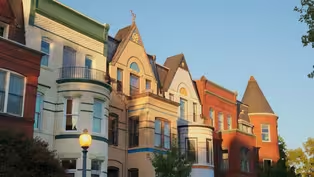
Changes in LeDroit Park Through the Years
Video has Closed Captions
Clip: S2 Ep11 | 3m 19s | Residents of LeDroit Park discuss the changes they have witnessed in their neighborhood. (3m 19s)
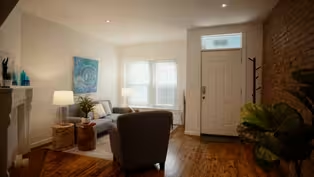
A LeDroit Park Rowhome That Blends History and Modernity
Video has Closed Captions
Clip: S2 Ep11 | 6m 53s | "You feel that sense of age in this house, in the great way." (6m 53s)
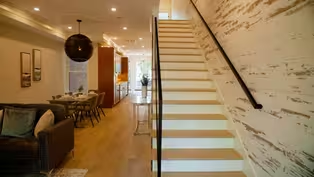
Open Concept on the Inside with City Views Looking Out
Video has Closed Captions
Clip: S2 Ep11 | 6m 59s | From top to bottom, consistent design elements tie this Bloomingdale rowhome together. (6m 59s)
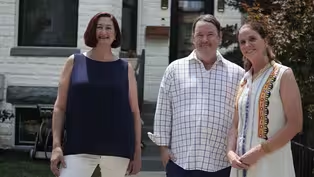
Preview: Bloomindale/LeDroit Park
Preview: S2 Ep11 | 30s | The history, homes – and turrets – of D.C.'s Bloomingdale & LeDroit Park neighborhoods. (30s)
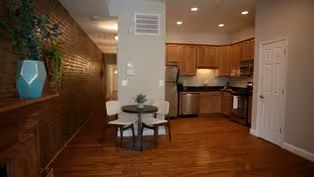
This Converted Bloomingdale Row Home is Perfect for Two
Video has Closed Captions
Clip: S2 Ep11 | 4m 36s | With good sized bedrooms and a move in ready kitchen, this rowhouse is perfect for two. (4m 36s)
Providing Support for PBS.org
Learn Moreabout PBS online sponsorship













Support for PBS provided by:
If You Lived Here is a local public television program presented by WETA