
Blue Bird Inn, World Mental Health Day, Teens’ mental health
Season 51 Episode 41 | 26m 46sVideo has Closed Captions
Blue Bird Inn jazz club, World Mental Health Day, social media and teens' mental health.
A historic jazz club in Detroit is getting a massive renovation, thanks to the nonprofit Detroit Sound Conservancy. In recognition of World Mental Health Day on Oct. 10, experts from CNS Healthcare and Judson Center address mental health issues in the African American community. And, we examine the impact of social media on teenagers' mental health and how social media can be used positively.
Problems playing video? | Closed Captioning Feedback
Problems playing video? | Closed Captioning Feedback
American Black Journal is a local public television program presented by Detroit PBS
Blue Bird Inn, World Mental Health Day, Teens’ mental health
Season 51 Episode 41 | 26m 46sVideo has Closed Captions
A historic jazz club in Detroit is getting a massive renovation, thanks to the nonprofit Detroit Sound Conservancy. In recognition of World Mental Health Day on Oct. 10, experts from CNS Healthcare and Judson Center address mental health issues in the African American community. And, we examine the impact of social media on teenagers' mental health and how social media can be used positively.
Problems playing video? | Closed Captioning Feedback
How to Watch American Black Journal
American Black Journal is available to stream on pbs.org and the free PBS App, available on iPhone, Apple TV, Android TV, Android smartphones, Amazon Fire TV, Amazon Fire Tablet, Roku, Samsung Smart TV, and Vizio.
Providing Support for PBS.org
Learn Moreabout PBS online sponsorship- Got a really great show coming up for you on American Black Journal.
An iconic Detroit music venue is getting a pretty big makeover.
We will take you to the groundbreaking.
Plus, in recognition of World Mental Health Day, we'll talk about the importance of self-care in the African American community, and we'll have a special report on the impact of social media on young people's mental health.
You don't wanna miss today's show.
Stay where you are.
American Black Journal starts right now.
- [Announcer 1] From Delta faucets to Behr paint, Masco Corporation is proud to deliver products that enhance the way consumers all over the world experience and enjoy their living spaces.
Masco, serving Michigan communities since 1929.
Support also provided by the Cynthia and Edsel Ford Fund for Journalism at Detroit Public TV.
- [Announcer 2] The DTE Foundation proudly supports 50 years of American Black Journal in covering African American history, culture, and politics.
The DTE Foundation and American Black Journal partners in presenting African American perspectives about our communities and in our world.
- [Announcer 1] Also brought to you by Nissan Foundation and viewers like you.
Thank you.
(funky upbeat music) (funky upbeat music) (funky upbeat music) - Welcome to American Black Journal.
I'm your host Stephen Henderson.
A major piece of Detroit's musical history is undergoing a massive restoration.
The Bluebird Inn was the city's premier jazz club from the 1930s up into the 1950s.
The African American owned venue hosted music legends such as Miles Davis and Detroit's own Donald Byrd.
Now the long-abandoned Club is owned by the nonprofit Detroit Sound Conservancy, which is rehabbing the historic building.
American Black Journal contributor Cecilia Sharp of 90.9 WRCJ was there for the groundbreaking celebration.
(upbeat jazz music) (upbeat jazz music) - Right here with a Black-owned and operated bar and hearth that nurtured bebop jazz.
Yep, indeed it did.
And no matter which way you cut it, Bluebird Inn was magic.
Its significance to Black history and culture is both sonic and social.
So we are here to commemorate, starting this Bluebird Inn rehabilitation work.
We preserve, we celebrate and advocate for Detroit music and our incredible history.
And when we say we are actually Detroit Sound Conservancy, I include all of you.
You are all part of the Conservancy 'cause it's nothing but community putting its minds together to solve a problem.
- What has been the process of acquiring the Bluebird Inn and just beginning the process of restoring the venue?
- We were able to purchase the Bluebird, and, at that point, we had just fundraised to make sure it wasn't demolished on a demolition list.
And then we got historic designation for it so it could never be torn down in case our money came in slower than it was supposed to.
And now we are rejoicing and we are so happy that we have enough to open it in 2024.
- You're familiar with the Bluebird Inn and the history of it.
What does it mean to you to have this renovation of the Bluebird Inn right here in your community?
- It means a lot because people are moving back into the neighborhood and it's a good starting point to rejuvenate the area and maybe start up some other businesses right around the area that have been closed and moved out.
- I'm smelling the ribs, the chicken.
You got some good stuff going.
- Absolutely.
- You're here to feed the people, the volunteers and everyone that's here to celebrate the events.
- We have a meals program that we do.
The Detroit Sound Conservative has been our partner for about six years.
And so, my first barbecue here was in 2018 for Motor City Makeover, where we cleaned out the building.
And so, we've established a pretty good rapport and a great partnership since.
- What are you looking forward to most about the Bluebird Inn opening in the next 18 months?
- I think just having somewhere else to be able to go to for live music and a hangout spot.
I mean, we're here on Tireman, not too far from O-Town, not too far from Submerge and everything else that's going on here on the Boulevard.
So I think to be in this neighborhood and have another spot in the neighborhood that people are so familiar with, it's just an amazing thing, so I can't wait till it opens.
- What does this day mean to you here at the Bluebird Inn?
- This day is really a culmination, Cecilia, of just many years of love for this particular place.
I remember the first time I came here, I actually snuck out with a girlfriend of mine when I was about 15.
We were actually too young to drive, but we used to drive anyway.
- You were still driving?
- Yeah, so when our parents went to bed, I went over to her house and she said, "We're gonna sneak out tonight.
Where should we go?"
I said, "Let's go to this jazz club over here called the Bluebird."
Over time, I had a chance to actually work here when they did a reopening here in the nineties.
And then, just to be able to have my youngest son be a drummer and to be here for another opening of this place, it's just, everything comes full circle.
- Knowing that you'll be able to play in the same place that your mom snuck off to first, and then was able to come back and play and perform as a bassist, how does that feel?
- It feels, it's really indescribable, really, when you think about it.
You know, knowing as well as my mother, so many of my mentors have graced this stage as well, be it Roy Brooks, George Davidson, my hero, Elvin Jones.
You know, being a part of this groundbreaking is immaculate to me.
(funky upbeat music) - How has the Detroit music community nurtured you as a musician?
- I think there's this spirit of mentorship that isn't talked about enough.
There are so many people that care about Detroit's history and legacy.
You have to bring up that next generation to be able to show them the importance of where music came from so that they understand where music is going.
- Being the next generation of jazz and continuing to carry the torch, what would you like to impart on the future of jazz?
- Wayne Shorter has a quote that really stuck with me.
When someone asked him what he thinks jazz is, and he said, "Jazz is like a bumblebee, and it pollinates every other form of music, and it tells them to stay creative, stay fresh, never stagnate."
And that's my greatest hope.
- I am happy that Detroit Sound is dedicated to learning and education because that piece of music is the part that translates to multiple generations.
(people clapping) So thank you, and we look forward to bringing this project to you and this neighborhood and seeing you all again next year when we will be doors open.
(upbeat jazz music) (people clapping) - October 10th is World Mental Health Day, and that's recognized around the globe as a day to raise awareness of mental health issues and to promote mental health care.
Earlier this year, I spoke with two health professionals about the mental health challenges in the African American community.
Here's a portion of my conversation with Michael Garrett, president of CNS Healthcare, and Jamila Stevens, who is Director of Integrated Care Services at Judson Center.
So, I want to talk specifically about children, our kids, and the ways in which the pandemic made mental health more of an acute issue for them.
Jamila, tell us about the kind of things that you're seeing with children that is different from the rest of the population.
- I think one of the things that we're seeing here at Judson Center as we're providing services to our community members, and we also provide services in the schools, is this disruption in regards to development.
So one of the things we have to remember is that as some of our younger kids, even kindergarten and younger, were starting their development in school.
They were isolated, and part of child development is peer-to-peer interaction.
And so, one, we're seeing as the kids are returning to school, their sensory issues.
There's an overabundance of this interaction of individuals that they weren't accustomed to, which is then causing them to have a reaction in behavior, which, in some instances, may look like negative behavior but it's really anxiety.
It's really this impact of being thrust into an environment that they did not really have the chance to step into in a traditional way.
So that's at our elementary, younger age.
As the kids get older, similar to what Michael was stating, grief and trauma, there's a delay in that process.
So you're in shock, and now those symptoms of grief are presenting themselves where there is a higher rate of suicidal ideation, a higher rate of depression.
I'm getting referrals every day, and the ages are getting younger and younger for kids who are experiencing those intrusive thoughts and those internal responses to stress.
Now, at a later time with the loss and grief that they were experiencing, was a year or a year and a half ago.
- Yeah, yeah.
Michael, what are you seeing and hearing about young people, mental health with the pandemic.
- It's the same thing.
When we talk about suicide rates, particularly among Black people between the ages of 10 and 24, the suicide rates, or the people who have at least contemplated or tried suicide, are kind of through the roof right now.
And it's a very disheartening and disconcerting thought, but it's something that we see with the people that we intake every day and really have to get very aggressive in our treatments and our interactions and our engagements with those individuals.
Some of the programs that we offer to offer those mental health interventions a lot sooner than maybe otherwise we typically would have.
And particularly among black females.
It's one of the groups that we're seeing a particular rise and that requires suicide interventions in that particular age group.
So we're doing everything we can on the front lines to try and get these people into treatment, get them into some of our suicide prevention programs, and the ones that we have been able to enroll and the ones that follow the treatment guidelines, we've been very, very successful in preventing those adverse outcomes that come along with some of those struggles.
- Yeah, so I wanna talk about how we know and how individuals know when they should be seeking help when they're having the kind of problem that a professional care environment would help with.
But I also want to talk about that in the context of our community, the African American community, where there is still a bit of a stigma associated with mental health care and the idea of raising your hand and saying you're having a hard time.
What should we be looking for and how do we get people to engage.
Jamila?
- I think the first key is that mental health services is not for a specific community or a specific diagnosis.
Most individuals have a mental health benefit for their insurance, and that means that it's accessible to all.
So I think there's a misconception around when to seek services.
Our role is, when people come in, is to determine what level of care they need based on what they've experienced.
So that's the first step.
Taking away the stigma of you have to have a particular type of severity in order to receive mental health services, which is and could consist of therapy as well as medication as well as support services, case management services, things like that.
So one, what those services entail and that it's accessible to all.
I think one thing that is a key to look for, specifically in our community, is that if you begin to disengage even more, and you find yourself exhausted more than usual, if you are having what I stated, those intrusive thoughts, just random thoughts coming through your mind, don't ignore those.
Pay attention to them because over time, thoughts can turn into action.
And then also, if you're noticing that your temper is changing.
Part of anxiety is that sort of adverse reaction to things, being angry or aggressive.
We assume that we're upset or it's just a bad day, but you could be overstimulating and your anxiety could be increasing.
- Michael, how do we identify when we need help and how do we get more African Americans to be comfortable with that idea?
- So African Americans, this isn't an issue that's unique to African-Americans.
Let me first state that.
And predominantly in communities of color, whether it's Latino Americans, Arab Americans, Asian Americans, the stigma, or for people who require mental health treatment and people seeking mental health treatment is extremely high.
The fear that they're gonna be labeled crazy by their friends and loved ones is still out there.
One of the encouraging signs that we've seen is that the younger generation, particularly people who are under the age of 21, and college age individuals as well, have been far more receptive to being open about their mental health struggles, engaging in treatment and seeking out that help.
So generationally, it is changing, but anecdotally, our aunts and uncles and grandmothers and grandfathers, they're still on that same page of just deal with it, walk it off, it's gonna be okay.
We don't talk to people about our problems.
That's not the path forward that we need to do.
Encouraging signs have been that the primary care community has started engaging in things that can help get more people into treatment.
If you've been to a physician in the past few years, oftentimes they'll ask, "How are things going at home?
Have you had any thoughts or any struggles with regard to stress?
Or have you had any thoughts of harming yourselves or others?"
Your primary care doctors are now asking those questions.
I think we could all benefit from what I call a mental health checkup every year.
Just like you go to your primary care doctor to make sure that your blood sugar levels are okay, your cholesterol is okay, talk to a therapist or a psychiatrist once a year.
You may not be having any issues that you may be aware of, but just sit down, talk to them.
If they say, okay, everything seems to be fine with you, great, see you next year, but if they detect something that may require a follow up visit, then handle that at the appropriate time.
But as Jamila talked about, most commercial insurances have a mental health benefit to allow for that.
The second thing that I would encourage people to do, and this has more to do with people who are resistant to treatment, who, to their friends and family, could be suffering from something obvious in the behavioral healthcare space.
Be a buddy to your friend, okay?
And particularly males, okay?
I'm speaking to the guys now because we don't like to go to the doctor unless our arm is literally about to fall off.
(all laughing) Or something like that.
If you have a buddy, you know that he's going through something, say, "Hey, look, my man, I know you've been having "some difficulty and things."
Maybe when you're having lunch or dinner at a sports bar or a sporting event and say, "Hey, look, you might benefit from talking to somebody.
"And as a matter of fact, for your first appointment, "I'll go with you.
"I'll drive you there.
"I'll sit in the lobby while you're in there talking "to the mental health professional, "and after we're done, after you're done, "we'll go to a ball game or something like that."
Having that level and that kind of support from a trusted person in your life can make people feel far more comfortable engaging in mental health treatment than just saying, "Hey, I know something's wrong.
"You need to go see somebody."
No.
Be a true friend and help them through that process.
- One of the documented sources of mental health issues for young people is the overuse of social media.
Studies have shown youth who spend more than three hours a day on social media have a higher chance of experiencing anxiety and depression or suicidal ideation.
Former Detroit public television intern Zion Williams produced this special report on teens and social media as part of the PBS NewsHour Student Reporting Labs Gwen Ifill Legacy Fellow program.
- A lot on social media, we watch other people socializing sometimes and it's almost, I'm like, okay, what am I doing?
- Social media seems to be everywhere in our everyday lives, which brought me to the question: how is it affecting the young people who use it?
To find out, I sat down with my friends, Sophia, Marissa, and Breanne.
So my first question for you guys today is what social media platforms do you all use and how often do you use them?
- I mainly use, Instagram would probably be the one I use the most.
And I use TikTok occasionally.
- Just Instagram.
- I use Instagram and Snapchat, but Instagram is just like an art page.
- Do you feel that social media is detrimental or is it beneficial to your mental health?
- I think it's 100% detrimental to me.
I don't like being on my phone, yet I still find myself on my phone.
I get bored and I turn to social media, and I think it just takes up too much of my time when I wanna be doing other things and I don't make the conscious decision to do something else when it's right in front of me.
- For me, it's very detrimental.
I had to delete TikTok about two years ago because I was getting a lot of panic attacks from just watching the videos.
When you get onto certain sides of social media, it's a lot of people trauma dumping and that was not good.
- [Zion] To gain some more perspective, I spoke with Susan Salhaney, the COO of the Judson Center, a nonprofit organization that provides mental health services in the metro Detroit area.
- Social media really has some positive benefits overall, right?
It keeps us connected with people.
It keeps us in tune with news and information.
We can safely meet new people at times, but there's also a downside to it because that becomes our frame of what can be reality or what a teen may think is reality.
- [Zion] Social media can help people gain awareness of certain topics, but when does that awareness start to sway opinions?
Kevin Fischer, executive director of NAMI Michigan, a mental health organization dedicated to improving the lives of people with mental illnesses, says it's important to challenge your own opinions.
- I ask why.
If I give you my opinion, if I say, for example, racism is bad, racism is a public health crisis, you have every right to say, "Why, Kevin?
"Why do you believe that?
"What are you basing that opinion on?"
- To learn more about the research-based effects of social media, I spoke with Dr. Shama Faheem, chief Medical Officer at Detroit Wayne Integrated Health Network.
What effects does social media have on a teenager's mental health that they're developing and growing into the adults that they wanna be?
- Multiple studies, there was a study published in JAMA Psychiatry in 2019 that actually looked at social media usage in thousands of youth and found that youth that were spending more than three hours per day on social media were linked to increased risk of mental health problems, particularly internalizing problems like anxiety, depression, negative self-image, suicidal thoughts.
And this was especially prominent for teenage girls and its impact on self-esteem.
My advice for parents would be to monitor and limiting the child's social media use.
The more you're aware about how your child is interacting on social media, the better you'll be able to address any problems that may subsequently arise.
- My advice to parents, first of all, is to please listen to your children.
If a child is exhibiting behavior that leads you to believe that they might be experiencing a mental health crisis, whether it is depression, you've noticed that they've become more withdrawn, they're not spending time with friends, their quality of their schoolwork is suffering.
Listen to your children, and if you believe they need help, get them help.
Don't let stigma prevent you from getting the help that your child may need.
- It is incredibly addictive 'cause you just want more, you just want to be happy and see those things and get away from the world, but then you get away from it too much.
- [Zion] There's an dependency that comes with social media, and Dr. Faheem shares how that can lead to addictive behavior.
- Between ages 10 to 12, there are changes in the brain going on that makes social rewards, such as compliments, release some neurotransmitter hormones, like happy neurotransmitter hormones like oxytocin or dopamine.
All of that can make our youth extra sensitive to attention, admiration from others.
- I feel like it's kind of like chocolate.
You eat it and you're like, "Oh my God, this is so good."
And then like five minutes later, you kind of feel like, "Ugh."
- [Zion] During our conversation, I asked Marissa, Sophia, and Breanne a more difficult question.
Will social media ever cease to exist?
- One app, one social media platform can die out and another one will probably come and draw people in again.
So I think that cycle would probably be really difficult to break with technological advancements.
It'd probably just have to be a society thing, but is the whole society just gonna decide to do that?
- [Zion] In conclusion, social media is here to stay.
So the bigger question is how do we manage social media in a healthy way?
- We get caught up in watching other people do things, other people's lives, and not being as focused on our own, so I think it's important to do things that make you feel as present as possible.
(girls chatting indistinctly) - That's it for us this week.
You can find out more about our guests at americanblackjournal.org, and you can connect with us anytime on social media.
Take care, and we'll see you next time.
(upbeat music) - [Announcer 1] From Delta Faucets to Behr Paint, Masco Corporation is proud to deliver products that enhance the way consumers all over the world experience and enjoy their living spaces.
Masco, serving Michigan communities since 1929.
Support also provided by the Cynthia and Edsel Ford Fund for Journalism at Detroit Public TV.
- [Announcer 2] The DTE Foundation proudly supports 50 years of American Black Journal in covering African American history, culture, and politics.
The DTE Foundation and American Black Journal partners in presenting African American perspectives about our communities and in our world.
- [Announcer 1] Also brought to you by Nissan Foundation and viewers like you.
Thank you.
(gentle piano chord)

Detroit’s Blue Bird Inn jazz club gets massive renovations
Video has Closed Captions
Clip: S51 Ep41 | 6m 33s | The Blue Bird Inn, historic jazz club on Detroit’s west side, is set for a grand revival. (6m 33s)
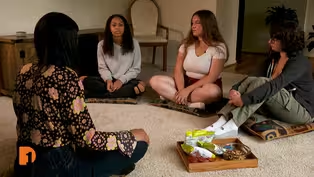
The effects of social media on teens’ mental health
Video has Closed Captions
Clip: S51 Ep41 | 6m 45s | How does social media effect teens' mental health? Zion Williams searches for the answers. (6m 45s)
Providing Support for PBS.org
Learn Moreabout PBS online sponsorship
- News and Public Affairs

Top journalists deliver compelling original analysis of the hour's headlines.

- News and Public Affairs

FRONTLINE is investigative journalism that questions, explains and changes our world.












Support for PBS provided by:
American Black Journal is a local public television program presented by Detroit PBS